NBC caught a lot of flak for its live video streams during the London Olympics, but for Sochi, the network promises to stream every event live. Just like during the London Olympics, NBC’s partner for making these streams possible (and authenticating cable subscribers) is Adobe – and Adobe itself is partnering with Microsoft to power the streams.
Adobe’s Primetime platform will power the video delivery and video ads on the NBC Sports website and the NBC Sports Live Extra App for iOS and Android. All events will be available live and on demand.
In the back-end, Adobe will use Microsoft’s Windows Azure Media Services to power all of the encoding and streaming. This partnership, Helfand said, will continue even after the Olympics. As the broadcasters move from experimentation to going live with their online video streams for big events, he argues, they also need to ensure that the streams live up to their audience’s exceptions.
While the rest of the world is wondering about when we will see 4K broadcasts, NHK in Japan is conducting test transmissions of 8K Super Hi-Vision signals over the air. Its latest test demonstrated a signal with 16 times the resolution of high-definition sent over a single terrestrial television channel.
The standards for Ultra-High-Definition or UHDTV include both 8K and 4K profiles. An 8K Super Hi-Vision image has a resolution of 7680×4320 pixels, or over 33 megapixels, which is four times the resolution of a 4K or 3840×2160 image, or 16 times the resolution of a full-frame high-definition picture.
In its latest test, at the research laboratories of NHK in Hitoyoshi in southern Japan, an 8K signal was transmitted over a standard 6MHz broadcast channel and received 27 kilometres away.
4K streaming, mobile broadcasting for the crowd, generalized delinearization, worldwide video events…
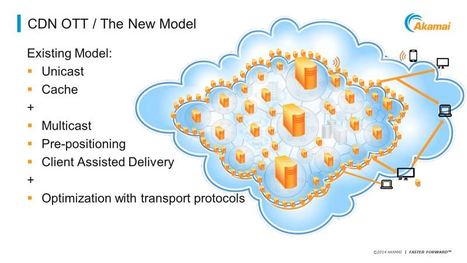
OTT delivery is just multiplying the challenges, as customers’ expectations are raising each day in terms of video fast-start, instant channel switching, lack of buffer and high frame size/rate – on all devices in all network conditions. To answer those challenges, OTT delivery answer today is basically more unicast sessions, more servers, more peering – and less and less guarantee of satisfying end-user experience as long as there is no specific end-to-end paid agreement to guarantee that the path will be provisioned from the origin server up to the video device. Even in this ideal scheme, the device might still suffer from poor wireless conditions which jeopardize the experience. So, how do we deal with all this stack of potential problems: do we stick to the aging receipts, rely blindly on Moore’s law and perpetuate a hopeless CDN weapons race? Or do we try to find smarter ways to make the OTT growth reach a sustainable delivery model ?
A heavyweight panel that included Google, Microsoft Open Technologies, and Digital Primates guided Streaming Media West attendees through the creation of an open source DASH-AVC/264 player. Will Law, chief architect for Akamai, moderated and kicked off the discussion.
"We're trying to cook up something delicious here, and we have three ingredients to do it. We've got MPEG-DASH, we've got MSE/EME, and we've got dash.js," Law began. "You may not know what these are. I'm going to describe very briefly what our core ingredients are, and then we'll see how they're mixed by our panelists."
The EBU has published a new specification for the distribution of subtitles: EBU-TT-D (Tech 3380). The XML based EBU-TT-D format is a low-complexity way to combine subtitle text, styling, timing information, and positioning details to allow implementers to provide users with a subtitle experience at least as good as that on current TVs, regardless of the platform on which they are watching the content.
EBU-TT-D was developed in less than a year, by taking into account expertise from users, distribution parties, hybrid TV organizations and CE manufacturers. The work built on the EBU XML Subtitles group’s knowledge gained when creating the EBU-TT subtitle format for production interchange and archiving (EBU Tech 3350). The specification is derived from the base W3C TTML specification. It strongly constrains the feature set of TTML to make it easier for decoder/renderer implementers to add subtitle overlays to video without the complexity that is present in TTML to support other scenarios.
Akamai has been providing a number of clues about how the company intends to dramatically increase the performance of the Internet for video streaming to support Ultra HD and ultimately match the scale and quality of broadcast TV. One big clue could be found on the Qualcomm stand at International CES 2014 when that company’s subsidiary, Qualcomm Atheros, was demonstrating its IPQ home gateway. Among other things this included a proof-of-concept client software from Akamai that is designed to optimize the delivery and pre-positioning of content like video and software.
The client software is not a product yet but Akamai is certainly talking as if it will be. Kris Alexander, Chief Strategist, Connected Devices & Gaming at Akamai, says, “The demo offers a glimpse into the future of the Akamai platform as we explore ways to move beyond the edge and onto devices of many types – not only gateways but game consoles, set-top-boxes, Blu-ray players, connected TVs and more.”
There is hope on the horizon. MPEG-DASH exists as an open alternative to these closed standards. Two of the three companies with proprietary closed standards have been actively involved in the formation and promotion of DASH. These efforts have been clearly successful, as DASH delivery of content is becoming more and more prevalent – for example, Netflix, Hulu and YouTube have all released versions of their content via DASH delivery. Through the efforts of Browser manufacturers, Media Source Extensions (another open standard), have become available in many browsers allowing delivery of DASH content without any additional plugins required.
Unfortunately, HLS remains the most common delivery format in the US, and Apple (the author/owner of HLS) has shown no interest in supporting MSE in their browser. A tipping point is clearly on the way, which will see a massive growth in DASH delivery. Eventually Apple will be forced to embrace the current open standard, or risk losing content which has made their platform so appealing. The irony of course is that Apple has done so much marketing touting themselves as leaders of the “open web” movement, and they are the long holdout stalling the success of this open standard.
Opus is a state-of-the-art royalty-free lossy audio codec convering more applications than any other single audio codec— from low latency VoIP to high fidelity music storage. After five years of open development, including contributions from Xiph.Org, Skype/Microsoft, Mozilla, Broadcom, and many individual developers, Opus was standardized in 2012 by the IETF in RFC 6716 and has since been deployed to hundreds of millions of computers and devices.
Daala is a new open effort to build a state-of-the-art video codec targeting compression performance beyond HEVC and VP9. Leveraging the experience we had with Opus we are building a new technical framework for video coding the ground up to avoid patent thickets and be royalty free: By breaking from the common design pattern of block based transform codecs we avoid many licensing complications and create an opportunity to better resolve some of the weaknesses of existing formats.
Hulu has already moved ahead on MPEG-DASH, but you'll have to get Google's $35 connected TV dongle if you want to try it. All of Hulu's Chromecast streaming uses DASH, Baptiste Coudurier, principle software development lead at Hulu, told the audience at the recent Streaming Media West conference in Huntington Beach, California.
"We are actually using DASH in production right now on the Google Chromecast device, and we definitely see it as the future of on-demand delivery," Coudurier said. "It's 100 percent of the content, every piece of content that you watch on Google Chromecast is using MPEG-DASH."
John Batter, CEO of M-Go, the transactional VOD content service backed by DreamWorks Animation and Technicolor, had every reason to smile at the International Consumer Electronics Show (CES).
Standing in front of a 4K TV at the sprawling Samsung booth, Batter showed off an upgraded, more user-friendly interface for M-Go, which had just announced a new 4K streaming service exclusively through Samsung.
“We think it’s really visually [unique],” he said of the 4K service, which will offer a combination of native 4K and up-scaled 4K movies, from Fox, Paramount and other studios. “Our plan is to build it up aggressively. We’ve got discussions going on with everyone right now.”
He went on to mention that content that’s merely optimized for 4K — which denotes a video resolution of 3,840 x 2,160 pixels, or four times that of current high-def — would only require a 3 Mbps Internet connection, an easy entryway for early consumers of 4K technology.
However, for native 4K, a 15 Mbps connection would be required for streaming purposes, Batter mentioned. And that portends a major problem for 4K overall, according to Dan Rayburn, principal analyst with consulting firm Frost & Sullivan, and EVP of StreamingMedia.com. Despite all the High Efficiency Video Coding (HEVC) compression solutions for 4K offered by numerous companies, despite the hardware push for 4K two years running now at CES, and despite the numerous 4K services announced at the 2014 CES — from Netflix, Amazon, Comcast and more — the content delivery model doesn’t make fiscal sense, in Rayburn’s estimation.
Poor quality streaming video solutions resulted in an estimated $2.16 Billion of lost revenue in 2012 (according to the2013 Conviva Viewer Experience Report). That’s a LOT of zeros!
Since we at Microsoft Open technologies, Inc. (MS Open Tech) believe this is simply unacceptable, we’d like to share some ways in which developers can leverage open source code to ensure their own delivery of video is of the highest possible standard.
For this tutorial, we have chosen to use the dash.js player to deliver MPEG-DASH video to any browser that supports the W3C Media Source Extensions (MSE).
KALRAY, the designer and exclusive provider of the low power, high performance MPPA MANYCORE processor, today announced plans to demonstrate at CES 2014, the first low power live Ultra HD HEVC (4K) encoder running on the KALRAY MPPA MANYCORE processor. The demonstration is streaming DivX HEVC UltraHD (4K) video to a set top box.
Less than a year after it was first made available to the market, the MPPA-256 , KALRAY’s first MPPA® MANYCORE processor coming with 256 cores on a single chip, will be used for a world première demonstration at CES 2014, being held in Las Vegas (Jan 7-10). The MPPA-256 processor demonstrates a complete Ultra HD HEVC live encoding and decoding flow based on DivX HEVC UltraHD video.
The MainConcept HEVC SDK is used in the demo and is capable of encoding a high-qualityUltra HD HEVC video at 30 fps using four MPPA®-256 processors which consume less than 50 Watts altogether. Decoding and live display on a commercially available Ultra HD TV is being performed by a single MPPA based EMB01 embedded board, which was recently announced by KALRAY.
The age of 4K may have officially begun, but the world still has some catching up to do. Case in point: You can't actually watch this weekend's Super Bowl in 4K (a.k.a. Ultra HD), even if you have a 4K TV, since there isn't yet a broadcast or cable standard for ultra-high-def format. Even the live stream is "just" in 720p.
That doesn't mean 4K won't make a difference at the big game. Fox will have six 4K cameras at MetLife Stadium — two on the sidelines, two on the goal lines and two on the end lines — specifically for the network's "Super Zoom" feature. When the broadcast needs to get in tight on some action, the feed will crop a 720p "window" from the 4K picture captured by those cameras. That way, Fox can get tight, high-res images without needing to zoom in optically.
Transparent caching specialist Qwilt has introduced Qwilt Live Stream Cache, a software solution that enhances the company's QB-Series Video Fabric Controllers. The solution replaces the existing unicast model, where each viewer has a dedicated HTTP session, and replaces it with a shared stream model. Qwilt Live Stream Cache is able to identify popular live streams on its own, then store those streams to the controller's FastCache. This dedicated storage area has been optimized to deliver live streams quickly. Next, the Qwilt Live Stream Cache creates a local live video transmission point for each area, letting a large group of viewers share a single video stream.
The Google Cast SDK is simple to integrate because there’s no need to write a new app. Just incorporate the SDK into your existing mobile and web apps to bring your content to the TV. You are in control of how and when you develop and publish your cast-ready apps through the Google Cast developer console. The SDK is available on Android and iOS as well as on Chrome through the Google Cast browser extension.
For non-media applications, or for more flexibility and design options, you can build your own custom receiver application using standard web technologies. With a custom receiver you can build virtually any application while including support for many streaming protocols, including MPEG-DASH, HLS, and Microsoft Smooth Streaming, all of which are available in the Media Player Library.
Alors que l'on évoquait il y a quelques jours les tests menés par la NHK au Japon sur la diffusion hertzienne de flux vidéo en 8K (et réussis sur une distance de 27 Km), on apprend aujourd'hui que l'équipementier Broadcom est, en partenariat avec l'opérateur scandinave Teracom, parvenu à diffuser un flux vidéo en 2160p (sans doute de l'Ultra HD en 3840 x 2160) via le codec HEVC (ex-H.265) en exploitant la technologie DVB-T2 (une évolution du DVB-T utilisé pour notre TNT).
Norme DVB-T2 qui devrait, logiquement, être choisie pour la future TNT2, tandis que malgré les tentatives de Google d'imposer son codec VP9, l'industrie devrait se tourner massivement vers le HEVC pour la compression des flux vidéo Ultra HD à l'avenir. HEVC qui permet, gross modo, de diviser par deux la bande passante nécessaire pour la diffusion d'un flux vidéo de qualité identique par rapport à l'actuel H.264. Soit un précieux allié pour ne pas voir la taille des fichiers trop exploser lors du passage à l'Ultra HD.
InAiR turns your TV into a Minority Report-like experience, with layers of Web content, inline with the programs you're watching.
InAiR brings you the world's first Augmented TV experience
With InAir plugged in, your TV becomes an Augmented Television. You can turn any ordinary television into a new and wonderful medium, filled with rich and dynamic information from the Web. InAiR uses your TV screen and layers in additional content from the Web and social media.
The text of ISO/IEC 23009-1 2nd edition PDAM1 has been approved which may be referred to as MPEG-DASH v3 (once finalized and integrated into the second edition, possibly with further amendments and corrigenda, if applicable). This first amendment to MPEG-DASH v2 comprises accurate time synchronization between server and client for live services as well as a new profile, i.e., ISOBMFF High Profile which basically combines the ISOBMFF Live and ISOBMFF On-demand profiles and adds the Xlink feature.
Additionally, a second amendment to MPEG-DASH v2 has been started featuring Spatial Relationship Description (SRD) and DASH Client Authentication and Content Access Authorization (DAA).
Other DASH-related aspects include the following:
The common encryption for ISOBMFF has been extended with a simple pattern-based encryption mode, i.e., a new method which should simply content encryption.
The CD has been approved for the carriage of timed metadata metrics of media in ISOBMFF. This allows for the signaling of quality metrics within the segments enabling QoE-aware DASH clients.
Avec le passage au full HD et bientôt à la 4K de a diffusion OTT, le modèle de distribution unicast montre ses limites. La course à l’armement des CDNs dans le déploiement de baies de serveurs et la multiplication des points de peering n’est pas scalable à l’infini, et pourtant le traffic vidéo ne cesse d’augmenter de manière exponentielle, y compris – et surtout – sur les terminaux mobiles. La recherche de modèles de distribution OTT complémentaires avec le multicast est donc une priorité pour continuer d’assurer la qualité de l’expérience utilisateur et optimiser les coûts de diffusion. Les regards se tournent de plus en plus vers le transport multicast qui a fait le succès de l’IPTV, ainsi que le Peer-to-Peer qui, malgré sa réputation sulfureuse, a déjà fait ses preuves pour la diffusion de chaines live OTT à très grande échelle.
Pour tout savoir du multicast et du P2P, et apprendre des retours d’expérience et de recherche des membres de la Squad qui travaillent sur ces systèmes hybrides, OVFSquad organisait le 23 janvier 2014 une soirée spéciale de présentations (aka « Conférensquad ») dont voici le compte-rendu et les présentations.
Ultra HD is not another 3DTV, set to grab the headlines and then fade away, but is the next big consumer-facing development in television and one that will prompt a new arms race in the Pay TV industry and new infrastructure investments. That was the conclusion from a Videonet webcast last week that looked at what we learned from International CES 2014. On a panel featuring experts from Strategy Analytics, MTM London and Genovation Capital, it was argued that the early efforts of OTT service providers like Netflix to get UHD content in front of consumers will not give them any long-term advantage over the Pay TV industry.
Audio and video content forms an integral, important and expanding part of the digital collections in libraries and archives world-wide. While these memory institutions are familiar and well versed in the management of more conventional materials such as books, periodicals, ephemera and images, the handling of audio (e.g., oral history recordings) and video content (e.g., audio-visual recordings, broadcast content) requires additional toolkits. In particular, a robust and comprehensive tool that provides a programmable interface is indispensable when dealing with tens of thousands of hours of audio and video content.
FFmpeg is comprehensive and well-established open source software that is capable of the full range of audio/video processing tasks (such as encode, decode, transcode, mux, demux, stream and filter). It is also capable of handling a wide range of audio and video formats, a unique challenge in memory institutions. It comes with a command line interface, as well as a set of developer libraries that can be incorporated into applications.
A l’occasion du CES 2014, qui s’est tenu début janvier à Las Vegas, la firme allemande Novabase Digital TV Technologies a présenté une clé HDMI de classe opérateur qui fait office de décodeur IPTVune fois insérée dans la prise HDMI d’un écran plat. Une clé-décodeur qui a aussi l’originalité d’être la première de ce type à être compatible avec le standard de télévision connectée HbbTV.
Pour ce faire, le produit embarque le processeur SoC multimédia à cœur Mips SMP8674 deSigma Designs et le logiciel httvLink de l’éditeur français httv. Egalement compatible HTML5, httvLink est un middleware pour décodeurs et récepteurs TV connectés qui améliore la qualité de service en intégrant le support du standard MPEG-Dash et son mécanisme d’ajustement dynamique des flux multimédias aux fluctuations du réseau IP large bande.
In this article, we'll document a viable 4k encoding workflow assembled for in-house testing, and look at some of the inherent challenges, as well as current products and enabling technologies used to make it work.
Ultra HD and HEVC are two of the subjects that have dominated the International CES 2014 news announcements from the broadcast/Pay TV industry vendors. Here is a round-up of what we have not reported on elsewhere.
To get content containing either thought or leadership enter:
To get content containing both thought and leadership enter:
To get content containing the expression thought leadership enter:
You can enter several keywords and you can refine them whenever you want. Our suggestion engine uses more signals but entering a few keywords here will rapidly give you great content to curate.


 Your new post is loading...