 Your new post is loading...

|
Scooped by
Nicolas Weil
March 28, 2014 4:14 AM
|
New major release: - Live HDS muxer - string validation in ffprobe - support for decoding through VDPAU in ffmpeg (the -hwaccel option) - stereoscopic 3d metadata handling - WebP encoding via libwebp - ATRAC3+ decoder - OpenGL device - Support DNx444 - libx265 encoder [...]
|
|
Scooped by
Nicolas Weil
March 25, 2014 6:44 AM
|
Smooth Streaming and MPEG-DASH Client 2.5 SDK enables you to build rich IIS Smooth Streaming experiences for both on-demand and live IIS Smooth Streaming for Silverlight and Windows Phone 8 applications. In addition, MPEG Dynamic Adaptive Streaming over HTTP (DASH) for Silverlight on-demand scenarios using the Live Profile support has been added to the 2.5 release.
MPEG DASH is now a supported feature, so developers that wish to move content libraries to DASH have the option of using DASH in places where Silverlight is supported. The existing SSME object model forms the basis of DASH support in the SSME. DASH concepts like Adaptation Sets and Representations have been mapped to their logical counterpart in the SSME. Adaptation Sets are exposed as Smooth Streams and Representations are exposed as Smooth Tracks. Existing Track selection and restriction APIs can be expected to function identically for Smooth and DASH content. In most other respects, DASH support is transparent to the user and a programmer who has worked with the SSME APIs can expect the same developer experience when working with DASH content.
|
|
Scooped by
Nicolas Weil
March 20, 2014 12:44 PM
|
The demonstration will be streaming DivX HEVC UltraHD (4K) video to a 4K TV set. The MPPA-256 , KALRAY’s first MPPA® MANYCORE processor coming with 256 cores on a single chip, will be used for a demonstration at CCBN 2014, being held in Beijing, China (Mar 20-22). The MPPA-256 processor demonstrates a complete Ultra HD HEVC live encoding based on DivX HEVC UltraHD video.
Kalray’s demnonstrator uses the MainConcept HEVC SDK that is capable of encoding a high-quality Ultra HD HEVC video at 30 fps using four MPPA®-256 processors which consume less than 50 Watts altogether. The decoding and live display will be shown on a commercially available Ultra HD TV.
|
|
Scooped by
Nicolas Weil
March 13, 2014 5:27 PM
|
This solution demonstrates a DASH stream playing in Adobe Flash. The license key is exchanged between DRMtoday's cloud service and the Unified Streaming Platform. Live or on-demand content is encrypted on-the-fly and delivered for protected playback to any device supporting the Adobe Access DRM.
|
|
Scooped by
Nicolas Weil
March 13, 2014 5:24 PM
|
Dash.as runs MPEG-DASH video on any device supporting Adobe Flash. It was designed from the ground-up to be lightweight with performance in mind. Hosted as a GitHub project, it is available as an open-source video player written in Adobe ActionScript. We provide everything you need to get started and invite you to help refine the application.
|
|
Scooped by
Nicolas Weil
March 9, 2014 5:30 AM
|
Converging CAS and DRM", a presentation by David Bouteruche from Nagra.
Online Video French Squad – HangoutSquad #2 February 27th 2014
|
|
Scooped by
Nicolas Weil
March 5, 2014 5:42 PM
|
Presentation by Romain Bouqueau (GPAC Licensing) during @OVFSquad Hangout - March 2014
|
|
Scooped by
Nicolas Weil
February 27, 2014 2:01 PM
|
Today, MulticoreWare is announcing the availability of accelerated VP9 decoding solutions for mobile and embedded devices. VP9 is Google’s Open-Source video codec, available for free as part of the WebM project. VP9 will be used for YouTube and Google Hangouts as well as other web-based video applications. VP9 is supported today in Google’s Chrome browser, with support in v28 of the Mozilla Firefox browser scheduled to be released on March 18th.
|
|
Scooped by
Nicolas Weil
February 25, 2014 4:32 AM
|
As I begin my journey to this year’s Mobile World Congress in Barcelona, I am thinking through the major trends and inflections that will most impact mobile technology and usage models going forward. One of those I wrote about last week was quick charging. What I would like to talk about now is 4K capabilities on mobile devices and how mobile could be the primary driver for 4K. Let me start with explaining what 4K is and how it applies to mobile devices. I also wanted to touch on some interesting things Qualcomm is doing in this arena.
|
|
Scooped by
Nicolas Weil
February 23, 2014 3:09 PM
|
As before, I was very excited when Google released VP9 – for one, because I was one of the people involved in creating it back when I worked for Google (I no longer do). How good is it, and how much better can it be? To evaluate that question, Clément Bœsch and I set out to write a VP9 decoder from scratch for FFmpeg. The goals never changed from the original ffvp8 situation (community-developed, fast, free from the beginning). We also wanted to answer new questions: how does a well-written decoder compare, speed-wise, with a well-written decoder for other codecs?
|
|
Scooped by
Nicolas Weil
February 17, 2014 7:23 PM
|
Expect big changes from the renamed Wowza Media Server, which now offers a GUI. Both first-timers and power users will be happy about it.
Just how much faster does the new graphical user interface (GUI) make setting up Wowza Streaming Engine, the fourth generation of Wowza Media Server?
Very fast, if one wants to do a standard configuration.
|
|
Scooped by
Nicolas Weil
February 14, 2014 1:40 PM
|
Ace Thought Technologies, a leading provider of media processing software, today announced the release of highly optimized, multi-threaded, power efficient and real-time H.265/HEVC software video decoder for ARM Cortex-A series and x86 processors. Ace Thought’s HEVC video decoder software enables rich entertainment experience across smart-phones, tablets, set-top boxes, smart TVs and connected devices.
Ace Thought’s HEVC video decoder for ARM processor provides scalable performance by utilizing ARM NEON SIMD and multi-core processor technologies. The HEVC video decoder is scalable up to 8 cores and enables 60 fps playback of 1080p HD resolution content on quad-core ARM Cortex-A15 processor. Ace Thought’s HEVC video decoder software enables the creation of high-quality player application on existing Android, iOS and Windows Phone 8 based tablets and smart-phones.
|
|
Scooped by
Nicolas Weil
February 5, 2014 5:12 PM
|
Adobe, NBCU, Elemental, Deltatre, LiveU, and more are readying streaming platforms that will deliver coverage to desktops and mobile devices around the globe.
Four years ago according to the IOC there was a defining moment in Olympic broadcasting history. Vancouver was the first Winter Games to be fully embraced on digital media platforms where digital coverage accounted for around half of the overall broadcast output.
Globally, on official rights-holding broadcasters’ internet and mobile platforms, there were more than 265 million video views and in excess of 1.2 billion page views during the games. There were also approximately 6,000 hours of 2010 coverage on mobile phone platforms.
Digital coverage from Sochi will surpass this, with many more broadcasters drawing on the clear consumer demand from London 2012 for any time, any device viewing.
The IOC places such draconian restraints on rights holders and anyone working for them to report involvement in the Olympics, which extends to technology contractors, that it's tricky to unearth details on this story. With that caveat, here are some of the large-scale video streaming activities set to go live from Sochi at the end of this week.
|
|
|
Scooped by
Nicolas Weil
March 25, 2014 6:53 AM
|
For the last two years, I have been working to extend the capabilities to of the Origin Server for Window Azure Media Services. In January of 2013, Windows Azure Media Services (WAMS) became generally available as a Platform as a Service (PaaS) on Windows Azure, Microsoft’s cloud computing platform. Just over a year later, it would stream the largest live sporting event in history – millions of concurrent users and over 10,000 hours of unique content over the 16-day Sochi Winter Olympic Games. This article describes the capabilities of Microsoft’s origin server, as well as the evolution of the product in the last two years to meet today’s demanding streaming media space.
|
|
Scooped by
Nicolas Weil
March 24, 2014 2:16 PM
|
Could Netflix change its video streaming service to use a P2P architecture, in order to save money on content delivery and sidestep peering conflicts with ISPs like Comcast?
That’s a possibility raised by Netflix CEO Reed Hastings in a blog post Thursday, which urged the FCC to make peering part of new net neutrality regulations. ISPs want Netflix to pay for delivering traffic to their customers because the company doesn’t consume as much traffic as it delivers — to which Hastings replied: “Interestingly, there is one special case where no-fee interconnection is embraced by the big ISPs — when they are connecting among themselves. They argue this is because roughly the same amount of data comes and goes between their networks. But when we ask them if we too would qualify for no-fee interconnect if we changed our service to upload as much data as we download (in other words, moving to peer-to-peer content delivery) — thus filling their upstream networks and nearly doubling our total traffic — there is an uncomfortable silence.”
This brings up an interesting question: Could Netflix actually do that?
|
|
Scooped by
Nicolas Weil
March 19, 2014 9:00 PM
|
Since 2012, YouTube has been trying to reduce dramatically the time it takes for a video to start from the moment you press play. Flash Networks (Mobixell at the time) was among the first to detect a new proprietary implementation called sliced bread. The matter might seem trivial, but internal research from Google show that most users find a waiting time exceeding 200ms unacceptable for short videos. YouTube has been developing a proprietary protocol, based on HTTP adaptive streaming DASH to decrease latency and start time for its videos.
|
|
Scooped by
Nicolas Weil
March 16, 2014 7:52 AM
|
Content companies including Viacom and HBO have met with folks from Comcast, Qwilt and others to discuss transparent caching as a way to solve the problem of online video.
|
|
Scooped by
Nicolas Weil
March 13, 2014 5:17 PM
|
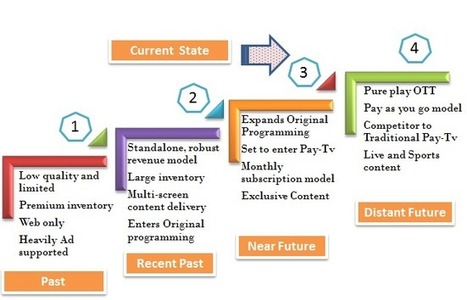
We are amidst most radical times in the history of Television with Pay-TV subscriptions experiencing their greatest 12 month losses on one hand and OTT (Over the top) video witnessing overwhelming rise on other. Television which brought visual entertainment to our homes but kept away “when and what to watch” within its control is challenged by OTT which is reinventing Television with freedom to choose what, when and where all for a reasonable price. Over the top video which became popular as a complementary service to traditional TV has started to stand out as an independent medium and for majority of this growing population it is fast becoming the only medium for entertainment. The service platform which was once questioned for its business model and lack of content is finally coming of Age!
|
|
Scooped by
Nicolas Weil
March 9, 2014 4:59 AM
|
While online video providers will be able to pioneer 4K viewing for the public using bit rates as low as 10Mbps (for movies over broadband), the introduction of true Ultra High Definition (UHD) television on broadcast networks will start at around 15Mbps, while we could see bit rates as high as 30Mbps initially, using the best current available HEVC/H.265 compression.
Although consumer marketing is confusing the two, there is a big difference between 4K television, which delivers four times the pixels of HDTV, and what is being talked about as true UHD, which quadruples the pixel count but also supports at least 50/60 frames per second and at least 10 bit colour depth.
|
|
Scooped by
Nicolas Weil
March 3, 2014 5:04 AM
|
A live demonstration of a unique satellite and terrestrial hybrid 4K transmission system is in the works for the upcoming ABU DBS (Digital Broadcasting Symposium) 2014 Exhibition in Malaysia.
For the demonstration, Village Island and Aviindos developed with MEASAT the idea to empower the live transmission through a DVB-S2 transponder. This follows a request from the DVB group to demonstrate dual 4K services on a single DVB-T2 channel. The demonstration is also in response to generic deployment trends in South-East Asia to deploy digital TV concurrently via satellite and terrestrial means.
|
|
Rescooped by
Nicolas Weil
from CDN Breakthroughs
February 27, 2014 8:26 AM
|
As we reported previously, the Broadpeak solution introduces very lightweight clients into the home router/gateway and these intercept the unicast stream requests made by a tablet or smartphone to an origin server. The client looks for a multicast stream of the linear content instead. The platform operator works with a content owner to make the most popular channels available in multicast, perhaps during peak times or for popular shows or live sports, or even 24/7. The nanoCDN client receives this multicast stream instead, then converts it to unicast ABR (adaptive bit rate) inside the home so it can be watched on the multiscreen devices without any changes to their apps.
By replacing multiple unicast streams with a single multicast stream in the broadband network, nanoCDN reduces the bandwidth demands for linear/live video. nanoCDN is pioneering because of the way it harnesses multicast within a CDN environment and because it makes in-home devices an extension of the CDN.
|
|
Scooped by
Nicolas Weil
February 23, 2014 3:11 PM
|
FFmpeg and its forked Libav have each added an H.265 / HEVC encoder today to their respective code-bases.
Going back to the middle of last year there's been the open-source x265 project for implementing the High Efficiency Video Coding (HEVC) video format that succeds H.264/MPEG-4 AVC. We have also seen open-source HEVC / H.265 support come via libde265 as a decoder for this video format that doubles the data compression ratio of H.264 while at the same video quality level.
|
|
Scooped by
Nicolas Weil
February 20, 2014 6:04 PM
|
NTV Plus pioneered the initiative to broadcast the Sochi 2014 Winter Games in 4K. Following an extensive period of testing during 2013, NTV Plus designed and deployed an end-to-end 4K HEVC workflow that features Sony 4K cameras, Elemental Live video encoders, NTV Plus satellite uplink and signal receiving systems and Broadcom-enabled real-time decoders for playback on Panasonic 4K TVs. A single video stream encoded by Elemental enables NTV Plus to reduce the 100Mb of bandwidth which would otherwise have been required for delivery of 4K HEVC content.
|
|
Scooped by
Nicolas Weil
February 16, 2014 12:15 PM
|
The launch of the Joint Task Force on File Formats and Media Interoperability was announced today by its sponsors, the North American Broadcasters Association (NABA), Advanced Media Workflow Association (AMWA), Society of Motion Picture and Television Engineers (SMPTE), International Association of Broadcast Manufacturers (IABM), American Association of Advertising Agencies (4A’s), and Association of National Advertisers (ANA). The European Broadcasting Union (EBU) is participating as an observer.
Bringing together manufacturers, broadcasters, advertisers, ad agencies, and industry organizations (standards bodies and trade associations) serving the professional media market, the Task Force has an ultimate goal to create greater efficiencies and cost savings for exchange of file-based content. The group’s initial focus will be to gather and analyze requirements for a machine-generated and readable file interchange and delivery specification — including standardized and common structured metadata — for the professional media industry. Use case examples include promo, spot, and program delivery from a provider to a broadcaster.
|
|
Scooped by
Nicolas Weil
February 11, 2014 9:59 AM
|
Live streaming every phase of every sporting event of the Olympics is a big task. This year NBC expanded their targeted devices to include iOS, Android and Windows smartphones, PCs, Macs, and tablets. The combination of the increased number of live feeds and the increased number of targeted devices creates a complex live video workflow requiring coordination between a number of technologies and partners.
|


















FFmpeg is a complete, cross-platform solution to record, convert and stream audio and video. It includes libavcodec - the leading audio/video codec library.
Would be curious to see how the libx265 encoder sports compared to NGcodec