Your new post is loading...

|
Scooped by
Nicolas Weil
January 12, 2012 8:41 PM
|
The Digital Living Network Alliance used CES 2012 to introduce DLNA Premium Video — an extension to existing standards that enables service providers like cable companies to stream protected films and television shows to DLNA certified devices. While this sounds significant given the hundreds of thousands of DLNA certified TVs, tablets, smartphones, Blu-ray Disc players, media streamers, and game consoles already sold, the standard requires at least one DLNA Premium Video certified device in the home.
ON THE SAME DLNA TOPIC : http://bit.ly/xHW7O9
|
|
Scooped by
Nicolas Weil
January 12, 2012 6:09 PM
|
Visitors to CES and the Detroit Auto Show can sample 5.1 surround sound streamed at only 64 kbps bandwidth. That’s because those are the two locations where Fraunhofer is publicly debuting its MPEG Surround audio codec.
Surround sound audio typically takes 160- to 400 kbps for a stream, notes a Fraunhofer representative, but with MPEG Surround the requirement is far less. That gives content providers the ability to stream to new locations, such as cars using a 3G connection.
|
|
Scooped by
Nicolas Weil
January 12, 2012 6:08 PM
|
So why isn't ABR more successful? As we have seen here and here, there are many pros for the technology. It is a simple, efficient means to reduce the load on networks, while optimizing the quality of experience and reducing costs.
Lets review the problems experienced by ABR that hinder its penetration in the market : 1. Interoperability 2. Economics 4. Content owners' knowledge of mobile networks 5. Tablet and smartphone manufacturers knowledge of mobile networks
|
|
Scooped by
Nicolas Weil
January 12, 2012 6:03 PM
|
Mobile devices are an increasingly popular method of viewing media content, and the availability of increasingly powerful devices pushes video playback to the top of the list of most desired features on mobile networks today and well into the future. This rapid growth underscores the need for encoding and transcoding guidelines to ensure that the content is optimized for the greatest compatibility and playback performance. Due to the wide variety of devices in the marketplace, we suggest two approaches to encoding for mobile delivery. One approach targets individual classes of mobile devices, optimizing encoding settings differently for each. The second approach services each of the diverse mobile phone devices through universally applicable encoding settings. Each of these approaches has its advantages and disadvantages.
This white paper focus specifically on Research in Motion (RIM) BlackBerry PlayBook, a QNX powered device. It is an addendum to the white paper, Video encoding cookbook and profile guidelines for the Adobe Flash Platform.
|
|
Scooped by
Nicolas Weil
January 11, 2012 8:58 AM
|
CES 2012 is jam-packed with smart TVs of every size and shape, but you won't find TiVo amongst the fray: the original DVR company is holding quiet meetings in its usual private booth tucked above the show floor. We stopped by a for a visit and were treated to a demonstration of a very interesting external transcoder box that lets you stream anything on your DVR to the TiVo iPad app when you're on your home network, and download shows to watch offline or away from home. The box is just a prototype right now — it might not look like anything like this when it comes out — but TiVo says it'll work on any network fast enough to support the TiVo Premiere's new multiroom streaming feature. In practice, the prototype worked well; we streamed a show from the TiVo across the room without any hiccups.
|
|
Scooped by
Nicolas Weil
January 10, 2012 12:09 PM
|
Adobe AIR provides a very attractive abstraction layer for video playback on mobile devices, but a certain level of knowledge is required to take full advantage. Before we start, it is important to understand the difference between Adobe AIR and Flash Player on mobile devices. Flash Player on mobile runs in the browser, and allows to display Flash web content that otherwise wouldn’t be available. The challenge of this approach is iOS does not have Flash support, meaning for reach, mobile sites are not authored in Flash, but rather HTML. Adobe recognized this, and made appropriate adjustments late last year.
Adobe AIR in contrast is based on the application approach, and can combine Flash, HTML and native functionality – as result, it is possible to take advantage of the advanced video features that are widely deployed with Flash on the desktop, including adaptive streaming, content protection, ad monetization and beyond.
|
|
Scooped by
Nicolas Weil
January 9, 2012 9:10 AM
|
Audible Magic, a pioneer and consistent innovator in automated content recognition (ACR) technologies and services, today introduced the Live TViD service, a capability that enables CE manufacturers, broadcasters and companion screen applications developers to identify live, never-before-seen content as it airs in applications for smart TV, smart phones, tablets, and other devices.
These include the abilities to: - Recognize shows broadcast live on TV in as few as 3 seconds - Recognize content even if viewing is time-shifted - Make accurate identifications even when "talk over" or other ambient noise is present - Identify content from more than 150 channels - Identify commercials viewers are watching - Pinpoint to the exact video frame where a viewer is during a show
|
|
Scooped by
Nicolas Weil
January 8, 2012 1:51 PM
|
With the number of devices supporting IP video continues to expand, content creators are seeking ways to reach consumers on as many screens and as many devices as possible. That’s the impetus behind cable’s TV Everywhere initiative, as well as Hollywood’s new UltraViolet video format. In order to cater to these customers, Akamai is rolling out new capabilities to its HD Network for video distribution that will make it even easier for content owners to securely distribute content to nearly any device.
|
|
Scooped by
Nicolas Weil
January 7, 2012 4:23 AM
|
Interactive TV technology provider Rovi is using the CES show in Las Vegas to unveil an update to its Rovi Entertainment Store, the company’s white-label product for over-the-top storefront creation and management.
This new version will offer software development kits to streamline customer storefront launches, features including DivX Plus Streaming to help enhance the consumer viewing experience, and support for companies that wish to introduce UltraViolet-compatible services.
|
|
Scooped by
Nicolas Weil
January 7, 2012 4:04 AM
|
In this special article, we take a look at how one company supplies a national US broadcaster with half hour shows cut exclusively on Final Cut Pro X. Advantages, disadvantages, the workflow and more. The timing for this article is pretty apt, a perfect response to news that the once Apple poster child of FCP in television, Bunim Murray has decided to switch back to Avid.
This is a question and answer session with Dustin Hoye, the Lead Editor/Developer at Sour Squirrel Studios who kindly spent time with us to give us an insight on how FCPX performs for broadcast. He edits 'The Next Bite' which is aired on Tuesdays and Thursdays on NBC Sports Network (Formerly Versus Network) at 1:00pm Est and 10:00am Est.
|
|
Scooped by
Nicolas Weil
January 7, 2012 3:52 AM
|
|
|
Scooped by
Nicolas Weil
January 7, 2012 3:46 AM
|
Ahead of the CES convention — where the interplay between TVs and second screen devices such as tablets is expected to be a major theme — interactive video solutions provider Related Content Database (RCDb) announces that it is integrating automatic content recognition (ACR) technology from Silicon Valley startup Zeitera into RCDb’s Watchwith Delivery Platform. The platform is capable of delivering frame-by-frame syncing between feature content and complementary app content.
|
|
Scooped by
Nicolas Weil
January 5, 2012 4:08 PM
|
Online video is just plain hot. Marketers from all corners of the business world are combining clips with online venues like YouTube, Hulu and corporate Web sites to get moving pictures into the hands of existing and future customers. In May, Google heated up the online video space even more when it released its new open source, royalty-free video format known as “WebM.” Google’s newest addition is an outgrowth of its acquisition of On2, creator of the open-source format, which will soon be a part of Google’s popular online video service, YouTube.
Corey Lopardi, producer-director with Pardiman Productions in Olympia, Wash., says marketers will benefit from WebM’s release on several fronts. Lower production costs, ease of use, improved video quality and increased control over how videos are downloaded and viewed are just a few of the key benefits that companies could see. “This is definitely something that anyone wishing to market themselves online should be thinking about right now,” says Lopardi.
If you’re still not convinced of WebM’s impact, check out these five ways that the new format will alter the online video space...
|
|
|
Scooped by
Nicolas Weil
January 12, 2012 6:15 PM
|
The H.264 Scalable Video Codec (SVC) reduces network bandwidth, eliminates transcoding, and simplifies storage management. Here's how it works.
|
|
Scooped by
Nicolas Weil
January 3, 2012 5:10 PM
|
MPEG systems technologies Part 7 Final Draft : Common Encryption (CENC) in ISO base media file format files
If you are interested into knowing details of the upcoming Common Encryption (CENC) format that is supposed to be finalized in februray (cf http://bit.ly/rxuijU ), you can take a look at its Final Draft version...
It seems that there is a ballot pending about AES CBC beside AES CTR : http://bit.ly/znGz6M
READ THE SPECIFICATION HERE : http://bit.ly/wzqsOO
|
|
Scooped by
Nicolas Weil
January 12, 2012 6:05 PM
|
Sling Media’s place-shifting technology, which until now has been limited to the company’s retail devices, DISH Network customers and the SlingLoaded pre-integrated platforms offered via parent company EchoStar (e.g. EchoStar Europe), is going to be made available more widely. At CES the company has announced the integration of the Sling Media SDK into Broadcom’s latest set-top box SoC (System on Chip) platforms, notably the Broadcom BCM7425 Dual HD Transcoding MoCA Gateway SoC. The collaboration paves the way for manufacturers of STBs and CE devices to offer place-shifting capabilities so consumers can shift their content to any compatible device via the Internet.
|
|
Scooped by
Nicolas Weil
January 12, 2012 12:38 AM
|
In a decade or so down the line, experts looking back likely will say that 2012 was the year cable operators and the rest of the telecommunications industry pivoted from basic “get it out there” multiscreen platforms to those that work with a far higher level of precision and efficiency.
That’s the plan, at least. What happens remains to be seen. What is clear is that the industry is poised to take several important steps beyond the “one off” catch-as-catch-can approach that has dominated to date. “The year 2011 saw most — if not all — the major service providers world-wide investigating adaptive streaming, ranging from lab investigations to highly publicized deployments,” wrote Yuval Fisher, chief technology officer of RGB Networks in response to emailed questions. “The market has matured quickly, with operators’ expectations quickly rising from the initial ‘help me just see how this works’ to ‘I need high video quality, high-availability equipment.’”
|
|
Scooped by
Nicolas Weil
January 11, 2012 8:33 AM
|
Amazon says it has signed a deal with a major Hollywood studio for UltraViolet rights; Netflix pulls out of DECE.
Amazon has put its weight behind Ultraviolet (UV), the DRM/authentication system that gives users unlimited online access to movies once they've purchased a DVD.
It is the largest retailer to have joined the Digital Entertainment Content Ecosystem (DECE) and gives the initiative a significant boost - just as Netflix has pulled out.
During a CES press conference updating its progress and future roadmap, the DECE consortium revealed it has 750,000 UltraViolet accounts in U.S. households since its launch in October. It predicts that number to dramatically rise during 2012
|
|
Scooped by
Nicolas Weil
January 9, 2012 4:16 PM
|
The current digital cinema standard-bearer is a format called 4K that delivers more than four times the detail of an HDTV image for any given screen size. Today, 4K is making its first push into the consumer video market. Whether its impact at home will rival what it has already done and threatens to do in the film industry remains to be seen. What is clear, however, is that its arrival at our doorsteps is historical and promises a new, even more immersive home theater experience.
READ ALSO : 4K resolution displays bring really high definition
|
|
Scooped by
Nicolas Weil
January 8, 2012 3:10 PM
|
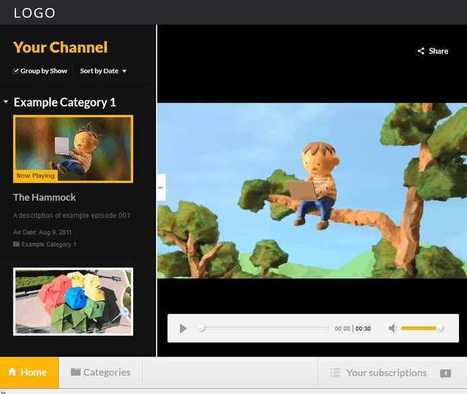
Perhaps Google isn't all bad these days! A new open source HTML5 video player is yours for the download. As well as being a good showcase app it is also practically useful. It is the architectural core of the new 60 Minutes and RedBull.tv apps available in the Chrome Web Store.
As well as being a basic video player, the app allows the user to add their own content, be it a single episode or a playlist. A Category page also allows the user to build up a catalog of things they would like to watch. The user interface is fairly polished and you can try it out at The Video Player Sample.
The key features of the app are (according to the Google Code Blog): - A beautiful video watching experience, including a full screen view - Ability to subscribe to shows, watch episodes, create play lists - Support for multiple video formats depending on what the user’s browser supports (including WebM, Ogg, MP4, and even a Flash fallback) - A Categories page with an overview of the different shows/categories available in the app - Notifications of new episodes (when the app is installed via the Chrome Web Store) - Built in support for sharing to Google+, Twitter and Facebook - To ensure easy customization, all source files, including the Photoshop PSD’s, are included
|
|
Scooped by
Nicolas Weil
January 7, 2012 4:26 AM
|
SyncTV, the leader in delivering television services to the largest set of Internet connected TVs, mobile platforms, and other media-enabled devices, today announced that M6 (RTL Group), one of France’s largest and most popular broadcasting and media organizations, selected SyncTV to develop its first Over-The-Top (OTT) service for the Microsoft Xbox 360 gaming and media console. M6 worked with SyncTV to bring the new branded channel to market which launched on December 21.
|
|
Scooped by
Nicolas Weil
January 7, 2012 4:15 AM
|
On the eve of the Consumer Electronics Show, Google makes a splash with key partnerships that promise a strong year for the battered connected TV platform.
Just a few days ago, you could probably forgive any of Google TV's product managers who might consider cashing in their chips in Las Vegas next week at the Consumer Electronics Show. But what a difference a few days makes.
|
|
Scooped by
Nicolas Weil
January 5, 2012 2:46 PM
|
For a while now I've seen people ask when support for Apple's Pantos HTTP live streaming would make it past Safari and iOS. The answer seems to have been that it wasn't clear that Pantos streaming was the best option and something else would come about eventually that would be more flexible. There have been other options but they involve either Flash or Silverlight and most people want something that works with html5 video. After a long wait it seems like the time is getting close now with the MediaSource API.
The basics of how the Pantos technique works are simple. A video is broken down into chunks and each of those chunks is downloaded, buffered and played. In older drafts this ment splitting a video file into multiple files but in later drafts support was added for range requests allowing the large file to remain intact. With that understanding there are two major parts that need to be addressed: - Segmenting a WebM video – This will require some understanding of the container format for WebM and the result will be something like a playlist for the video. - Javascript to play the video – This will use the playlist created by segmenting the WebM video to drive the MediaSource API.
See also : seeking with MediaSource API http://bit.ly/AyFssO
|
|
Scooped by
Nicolas Weil
January 4, 2012 7:39 PM
|
So I've been evaluating methods of HTTP Adaptive Streaming - namely Adobe HTTP Dynamic Streaming (HDS) and Apple HTTP Live Streaming (HLS).
The implementation of HDS seemed ugly and inefficient to me when I first learnt about it, and I thought it looked like it would not scale well. The main reason for this is that for every request, for every fragment of a movie, the origin must look up an index for that movie, and use information so-gained to open a media file (.f4v) and extract a byte range from it - seems like quite a bit of cpu, memory and io overhead right, especially compared to "just be a stupid web server and serve the file". I guess how often unique content is requested from an edge depends on things like how deep your edge caches are, entire size of your library etc, but it's reasonable to assume that often the exact requested fragment will not be cached on the Edge, which will have to ask the Origin.
So in order to actually test my suspicion (hey, perhaps it actually doesn't matter; perhaps the architecture actually scales OK) - today I've been benchmarking on a dev machine, to get an idea of the overhead and efficiency of the Apache module for HDS.
|
|
Scooped by
Nicolas Weil
January 5, 2012 3:34 PM
|
Shaun the Sheep, An HTML5 Video Experiment
Watch Shaun and his friends' antics in clips from "An Ill Wind", "Snowed In", "The Big Chase", and "Twos Company" through an interactive experiment created with hardware-accelerated HTML5 video, 3D CSS Transforms, and WebM. Use the controls to expand and shrink the video, rotate the scene, bring up a rotating carousel of videos, turn on puddle reflection, and navigate between videos in a snap.
HTML5 and CSS make these advanced functionalities (and more!) a part of the modern web standard, and allow developers and artists to create immersive, imaginative experiences for everyone to enjoy.
Requirements:Windows Vista/Mac OS X 10.6 or above, Google Chrome
|