Your new post is loading...

|
Scooped by
Nicolas Weil
January 30, 2012 6:03 AM
|
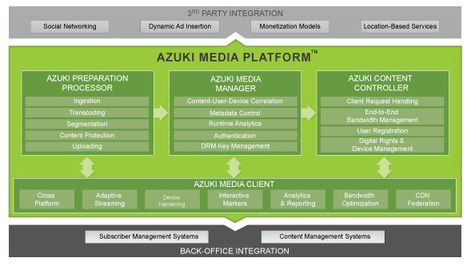
Azuki announced the next generation OTT video delivery solution framework that seamlessly extends service providers’ managed set-top-box services to multi-screens, at home and on-the-go, with equivalent user experience and zero impact to existing DOCSIS and IPTV infrastructure.
With Azuki, service providers can ensure unmanaged networks behave and perform like managed networks, with no disruption to existing video operations, enabling service providers to capitalize on multi-screens and TV Everywhere initiatives, with: - Anywhere, anytime, any device session-shifting - End-to-end entitlement control per subscriber, device and content - Dynamic multi-screen ad insertion - Extended HTML5 compatibility for monetization and security - Detailed consumption analytics and metrics from all device types
Azuki manages OTT video delivery by simplifying and automating the process of normalizing and unifying media preparation, adaptive streaming, digital rights management (DRM), entitlement enforcement, analytics and monetization - including ad-insertion, across all consumer-owned devices.
|
|
Scooped by
Nicolas Weil
January 30, 2012 5:35 AM
|
today announced a partnership with Conviva to integrate Conviva’s video performance monitoring technology with Limelight’s massively provisioned global computing platform. Together, the solutions take a huge step forward in improving online video viewing quality and delivery. Adding Conviva’s analytics to the Limelight suite of products will give Limelight customers access to real-time audience metrics and will provide new data for Limelight operations teams to improve overall network performance.
The new solution, called Embedded Insights, will give Limelight Networks’ customers access to a tailored version of Insights, Conviva’s advanced video analytics offering. Conviva monitors the experience of each online viewer and reports up-to-the-second measurements of video quality and audience engagement. Embedded Insights will help users see problems within the content delivery network while also monitoring audience reach and engagement.
|
|
Scooped by
Nicolas Weil
January 26, 2012 5:35 AM
|
Octoshape and Crunchfish announced today a partnership that integrates Octoshape Infinite HD technologies into Crunchfish mobile application development platforms. The combination of Crunchfish's unique mobile app design and Octoshape's high quality and efficient global content distribution technology sets the stage for rapid monetization of broadcast quality content on all connected devices. The first apps for iPhone, iPad and Android were showcased at CES in Las Vegas this year.
|
|
Scooped by
Nicolas Weil
January 26, 2012 4:24 AM
|
A Streaming Media West panel offered tips on coping with the fractured landscape of handheld hardware. Once, preparing video for the Web meant choosing the format that would reach the greatest number of viewers. Now, the landscape has become much more complex. For one thing, even small businesses that serve video need to think about reaching viewers on tablets and other mobile devices. How to do that was the topic of a panel discussion at the recent Streaming Media West conference in Los Angele
|
|
Scooped by
Nicolas Weil
January 21, 2012 5:00 AM
|
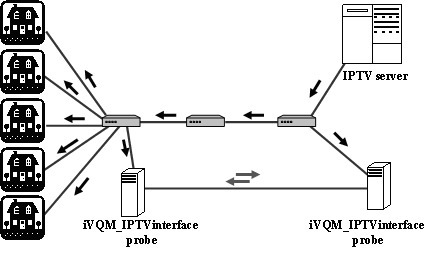
The monitoring of the service quality is crucial to the successful operation of commercial internet services to end customers. Services such as IPTV, which require high available bandwidth, low latency and few transmission errors, are especially sensitive to network congestions.
Video quality measurements methods are often divided into three groups, full reference, reduced reference, and no reference, depending on how much of the reference or the original is available or needed by the method. The standard for video quality (image-only) measurements by the International Telecommunication Union (ITU) covers full reference methods for standard definition TV e.g. (ITU-T, 2004). However, the standard covers four different methods, making it possible to measure with standardised methods and still come to different results.
|
|
Scooped by
Nicolas Weil
December 30, 2011 6:45 PM
|
1st Quarter 2012 Video Breakthroughs Events List
|
|
Scooped by
Nicolas Weil
January 8, 2012 5:33 AM
|
MPEG-DASH [Part 1: Media presentation description and segment formats] ISO document and XSD/manifest samples
The final version of MPEG-DASH ISO standard has been released. It goes with the Common Encryption format ( http://bit.ly/xADRVk ) for a complete standard streaming feature set.
Companion documents include : - XSD Schema that defines the Media Presentation Description for MPEG-DASH - Manifest samples for different profiles and use cases (on-demand multi-audio+timed text, live multi-audio, on-demand multi-audio MP2T, on-demand MVC 3D, on-demand SVC split representation, on-demand fast-forward sub-representations, on-demand DRM protected streams)
GRAB THE DOCUMENT HERE : http://bit.ly/zKljqq
|
|
Scooped by
Nicolas Weil
January 17, 2012 6:51 PM
|
Input media formats: - Smooth (VoD & Live). An adaptive HTTP format specified by Microsoft. Used by Microsoft in Silverlight, but is an open format that third party clients also support. - Apple HLS (VoD & Live). An adaptive HTTP format specified by Apple. Used by Apple in iPhone/iPad, but is – like Smooth – an open format. - MPEG DASH (VoD). A new adaptive format specified by ISO. Wide and promising industry backing. We support both MPEG-2 TS and MP4-based (ISOBFF) profiles.
Input DRM formats:
- Microsoft PlayReady DRM
|
|
Scooped by
Nicolas Weil
January 18, 2012 6:57 PM
|
Service providers, vendors, content owners and others are trying to wring out as much of the confusion as possible with an open standard. In December, the MPEG (the Moving Picture Experts Group) — which is run by the Organization for Standardization (the ISO) and the International Electrotechnical Commission — passed ISO/IEC 23009. The standard is called Dynamic Adaptive Streaming over HTTP or MPEG-DASH.
The next steps are for various industry groups — including CableLabs — to create the profiles that fit best for their industries and for owners of intellectual property to take the necessary steps to create a royalty-free environment.
|
|
Scooped by
Nicolas Weil
January 18, 2012 6:40 AM
|
The EBU has published a new Subtitling Format specification (EBU Tech 3350). The new format is called EBU Timed Text (EBU-TT) and provides an easy-to-use method to interchange and archive subtitles in XML.
EBU-TT is based on the W3C Timed Text Markup Language (TTML) specification. The EBU format can be seen as a constrained version of the W3C spec, aimed at providing a solution more tailored to broadcast operation. This is especially relevant as broadcasters are increasingly moving to file-based HDTV facilities, where subtitles are created, edited, exchanged and archived together with the content.
|
|
Scooped by
Nicolas Weil
January 16, 2012 11:44 AM
|
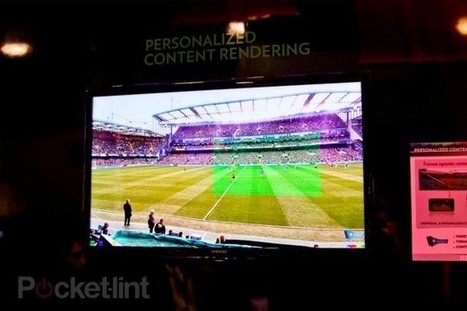
Technicolor has demoed a new technology at this year's CES in Las Vegas that would allow you to watch a football match as if you had actually has a seat in the stadium.
The new tech, dubbed Personalized Content Rendering, which is expected to become a commercial reality in the next couple of years, uses six cameras at the stadium to create the ultimate moving panoramic view.
Where Technicolor comes into the project is through the behind-the-scenes software that merges the six individual video feeds into one before allowing you control over where to look within that picture.
|
|
Rescooped by
Nicolas Weil
from Video ecosystem
January 16, 2012 3:34 AM
|
Slow uptake, technical problems, and poor user reviews bring UltraViolet's future into question. If UltraViolet fails to gain traction, it may jeopardize DASH. On the other hand, looking back two years from now, we may find the only vestiges of UltraViolet left are the common file format and common encryption schemes that DASH has adopted.
Via Olivier NOEL
|
|
Scooped by
Nicolas Weil
January 12, 2012 9:24 PM
|
A panel at this week’s CES show in Las Vegas yielded two pieces of positive news for the DECE/UltraViolet standard, after a launch several months ago with Warner Bros. and its Flixster subsidiary that could charitably be called “premature.” Of the two news items, one is a nice to have, but the other is a game-changer.
|
|
|
Scooped by
Nicolas Weil
January 30, 2012 5:59 AM
|
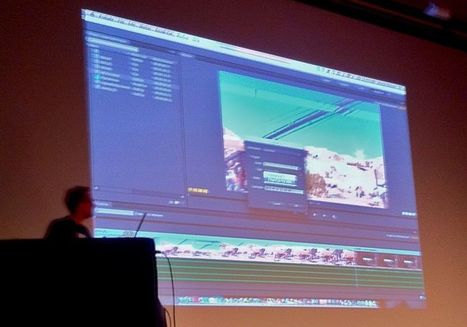
At the San Francisco Supermeet Friday 27th January, Adobe’s Al Mooney revealed a sneak peek at a new application for the Creative Suite called Prelude.
Essentially Prelude is an ingest, logging and rough cut tool. It’s designed to make it easy to add log notes (a.k.a. metadata) quickly and easily, then perform a rough first string out to send to a craft (skilled) editor for the real work.
|
|
Scooped by
Nicolas Weil
January 29, 2012 12:03 PM
|
Whether you love it or hate it, 3D Stereography is here for awhile. And if you’re totally into it like I am, you quickly realize that there are few turnkey workflows out there to capture and process 3D Stereo video that’s easy to setup, shoot and edit Stereo pairs. Sure, there are a lot of high-end (expensive to rent) systems for two cameras to shoot, software to sync/mux the footage and rigs you can build to edit it, but GoPro has brought it together with a fun and easy-to-use system that anyone can use.
|
|
Scooped by
Nicolas Weil
January 26, 2012 5:23 AM
|
At the Streaming Media West conference, attendees got a look at the new Google TV software. "The reality is, the way people are watching television and the number of options they have available to them, has really grown, which causes content fragmentation," said Shanna Prevé, business development lead for Google TV. Prevé was speaking at the recent Streaming Media West conference in Los Angeles, where she demoed version 2.0 of the Google TV platform and explained Google's thinking in revising the platform.
|
|
Scooped by
Nicolas Weil
January 24, 2012 5:17 AM
|
Two of the major challenges for apps developers in 2012 will be to enable second screen synchronisation with the main TV experience and to harness voice and possibly gesture recognition, which are set to become a feature of high-end connected TVs, with Samsung leading the way. During CES, Accedo, one of the leading apps developers for connected TV (covering games through to Pay TV operator TV Everywhere apps) highlighted its work in both these areas and the company expects these developments to have an important impact on the user experience. It looks like the third major focus could be social TV, which is closely tied to companion screen and synchronised experiences anyway, and the continued development of ‘remote control’ type functions for companion devices, which is made possible via an apps download to a tablet or smartphone, for example.
|
|
Scooped by
Nicolas Weil
January 21, 2012 4:37 AM
|
Mozilla is drafting a proposal for a new Web standard called MediaStream Processing that introduces JavaScript APIs for manipulating audio and video streams in real time. The specification is still at an early stage of development, but Mozilla has already started working on an implementation for testing purposes.
Mozilla's Robert O'Callahan, the author of the MediaStream Processing API proposal draft, released experimental Firefox builds that include MediaStream Processing support. He has also published a set of demos (note: you need to run the experimental build to see the demos) that illustrate some of the functionality defined by the specification.
The demos show how the APIs can be used to perform tasks like rendering a visualization of a video's audio track in a Canvas element while the video is playing. It also shows how the APIs can be used for mixing tasks, like implementing a cross-fade between two audio streams, dynamically adjusting the volume of a video, and programmatically generating audio streams.
|
|
Scooped by
Nicolas Weil
January 21, 2012 4:33 AM
|
The online video world got its first look at SnappyTV during the 2011 State of the Union Address. One year later, SnappyTV is using the 2012 Address to test and promote its new Pro Editor, which works with a cloud-based DVR.
The existing SnappyTV, which debuted last year, is a second-screen system where viewers can watch an event on TV and then instantly grab a video clip of it online to share through blogs or social networks. The PGA and Turner Sports partnered with SnappyTV in August to promote the PGA Championship.
The Pro Editor version, which will debut in beta during the State of the Union (Tuesday, January 24 at 9PM ET) is a much more flexible system. It works with a cloud-based DVR, allowing people to view the Address right on their computer, and to view and clip moments from any place within the speech. Videos can then be shared on blogs or social networks.
|
|
Scooped by
Nicolas Weil
January 20, 2012 8:05 AM
|
Vous allez me dire, mais qu’est ce que ce titre signifie en réalité ? C’est assez simple, je vais décomposer : - HDS pour HTTP Dynamic Streaming est un protocole de diffusion des vidéos (créé par Adobe). Le principe est similaire au HTTP Live Streaming utilisé sur les iPhone et iPad (j’avais présenté ce protocole). - Late Binding Audio : comprenez par là la possibilité d’avoir plusieurs pistes audios associé à un flux vidéo - OSMF pour Open Source Media Framework, un framework Flex utilisé pour la gestion des vidéos.
|
|
Scooped by
Nicolas Weil
January 19, 2012 3:45 PM
|
In some ways, video transcoding for mobile delivery has grown a lot simpler of late. Thanks to lightweight video wrappers, we don’t need to create as many primary mobile streams as we once did. We can consolidate the heavy lifting part of the transcoding process, and leave the video wrapping to simple servers distributed around the edge of the delivery network. However, this shift in technology means we also need to re-evaluate our video transcoding tools. Instead of a CPU-based system, silicon increasingly makes more sense for the initial video transcoding process. Silicon is less flexible, but more robust than CPU-based transcoding. It’s also more cost-efficient.
|
|
Scooped by
Nicolas Weil
January 18, 2012 6:48 PM
|
Tying it All Together : A watershed moment in the Media Industry
Viewers have seen several step changes in the evolution of television, analog to digital, standard to high definition, and if you go back far enough, monochrome to color.
There have been similar changes on the production side, but those that have had most impact are the changes from film to videotape and analog to digital processing, the introduction of HD, and now the migration to file-based operations.
The migration from physical media to files processed on computer platforms presents opportunities and a new flexibility, but potentially adds complexity. You need systems that work together, and converting to file-based technology only gets you part of the way there.
Agreed file formats are necessary, but not sufficient to build digital facilities. To simplify file-based operations many media companies are adopting a service-oriented architecture. For the future the ‘cloud’ beckons, abstracting the services from geographical constraints.
The key to reusable services in the cloud lies in agreed standards and specifications that can enable interoperability.
READ THE PAPER HERE : http://www.amwa.tv/downloads/whitepapers/Tying_it_Together-Gilmer.pdf
|
|
Scooped by
Nicolas Weil
January 17, 2012 3:07 PM
|
Last week I read through over 3,000 posts in my RSS feeds covering news from the CES show. I've sorted through all the noise, stripped out all the releases about WiFi washing machines (seriously), and condensed it down to bring you the most important topics pertaining directly to the streaming and online video industry.
|
|
Scooped by
Nicolas Weil
January 16, 2012 6:13 AM
|
At the turn of the month, at the European Broadcast Union (EBU) Production Technology Seminar in Geneva, European broadcasters will be urged to change their approach to production in order to reach a wider variety of platforms and, at the same time, cut energy consumption. The three-day seminar is designed to provide the 70 participants representing European broadcasters with the technical knowledge require to reconcile these conflicting goals and share experiences across all aspects of production. The headline themes of expanding reach and greenness will be covered in two keynotes, starting with Roberto Pomari, head of business development at RSI, the Italian speaking division of the Swiss public broadcaster. Pomari’s theme, how to become “tomorrow’s broadcaster,” will be based on RSI’s experience of moving to full HD production in the first months of this year, and developing a Service Oriented Architecture-based production platform as the next step in its digital evolution.
|
|
Scooped by
Nicolas Weil
January 12, 2012 10:15 PM
|
DVEO, the broadcast division of Computer Modules, Inc. (CMI), is proud to introduce the latest addition to their unique product family of real time adaptive bitrate streaming transcoders.
Now shipping, the MultiStreamer IP/IP (Brutus) is an MPEG-2 to H.264, or H.264 to MPEG-2, transcoder Blade System with simultaneous multiformat inputs and outputs. It is targeted at cable operators, telco TV, IPTV, A/V systems, or university and entertainment systems.
The MultiStreamer IP/IP (Brutus) receives multiple simultaneous IP streams, transcodes them to H.264 or MPEG-2, and/or changes wrappers, and then streams them to any number of IP devices -- including standard IP capable set-top boxes, streaming video, TV's, smart phones, iPads, or software clients such as VLC or Mplayer. With the Brutus, Cable and Telco operators can transcode H.264 video to MPEG-2 and deliver it to customer's home set-top boxes. This blade system can be used in the cloud or in installations where multiple options and extra horsepower are required.
VIEW THE FULL PRODUCT SPECS HERE : http://www.dveo.com/pdf/MultiStreamer-IP-IP-Brutus-Datasheet.pdf
|