


Perry Lethlean explains the concept behind the National Arboretum in Canberra, named World Landscape of the Year 2014 at the World Architecture Festival.

 Your new post is loading...
 Scoop.it! Perry Lethlean explains the concept behind the National Arboretum in Canberra, named World Landscape of the Year 2014 at the World Architecture Festival. 
No comment yet.
Sign up to comment
Scoop.it!

The people behind Frank Gehry’s Fondation Louis Vuitton (FLV) in Paris, which is set to officially open on the 27th October 2014, recently invited a band of architecture critics to take a look around and pen their thoughts. Gehry’s bold approach to architectural form, most evident in buildings like the Guggenheim Museum in Bilbao and the Walt Disney Concert Hall in LA, matches the foundation’s aim to “promote and support contemporary and artistic creation” in France. According to their website, they in particular embody “a passion for artistic freedom.” How, then, has the enormous sailed structure, challenged by local opposition from the outset, settled into its Parisian parkland surroundings? See what The Guardian’s Oliver Wainwright, The Observer’s Rowan Moore, Vanity Fair’sPaul Goldberger, The LA Times’ Christopher Hawthorne, as well as the Architectural Digests’ Mayer Rus, had to say about Gehry’s latest completed building ...

Lola Ripollés's curator insight,
October 30, 2014 3:23 PM
Los mejores críticos de arquitectura nos dan su visión sobre la última obra de Gehry. "Passion for artistic freedom". Independientemente de otras consideraciones, ante esta reflexión, sólo puedo decir que siento envidia sana.
Scoop.it!

Red brick buildings wrap around an elevated piazza at this education centre in Rwanda by German office Dominikus Stark Architekten.
Scoop.it!

The mirrored roof of this children's medical centre by SATA reflects the surrounding treetops and transient reflections of the west Ireland skies.
Scoop.it!

Architects: Wespi de Meuron Romeo architects
Scoop.it!

Esta semana Autodesk lanzó la última versión de AutoCAD para Mac (2015), que ofrece una serie de cambios que buscan aportar nuevas mejorías en la interfase y el software de diseño, sin sacrificar la funcionalidad, clave para la comodidad del trabajo cotidiano de las personas. Según Amy Bunszel, vicepresidenta de AutoCAD, "esta versión tiene algunas características nuevas y enriquecidas, pero en el fondo, se trata de eliminar los callejones sin salida que impiden que las personas sean todo lo eficaces que pueden ser al trabajar juntos en proyectos de diseño". Por ejemplo, los usuarios pueden compartir también su trabajo con colegas que utilizan versiones Windows del software en colaboración ininterrumpida.
Scoop.it!

The President of the People’s Republic of China, Xi Jinping, has reportedly called for a end to the “weird buildings” being built in China, and particularly in the nation’s capital, Beijing. In a two hour speech at a literary symposium in Beijing last week, Mr Xi expressed his views that art should serve the people and be morally inspiring, identifying architectural projects such as OMA’s CCTV Headquarters as the kind of building that should no longer be constructed in Beijing. With China’s construction boom being one of the most talked about features of today’s architecture scene – and many a Western practice relying on their extravagant projects to prop up their studios – the Chinese leader’s comments have the potential to affect the landscape of architectural practice worldwide. But what is behind these sentiments? Read on after the break to find out.
Scoop.it!

Have you ever had the urge to squeeze a lemon on the dome of St. Peters Basilica? Or perhaps, crack a beer with Kohn Pedersen Fox’s “bottle opener”? New York-based designer Nicholas Blechman has put into illustration what we’ve all been thinking, landmark architecture as the food-related items they resemble. Check out Blechman’s “Gastro-Architecture” series here on the New York Times and preview a couple of our favorites, after the break.
Scoop.it!

Architects: Heatherwick Studio
Scoop.it!

Zaha Hadid and Norman Foster have been selected to design high-rise hotels in China for Jumeirah Group.
Scoop.it!

Architects: Gair Williamson Architect, Ankenman Marchand Architects
Scoop.it!

Let’s start with a piece of fiction. The setting is the crowded Mercat de la Boqueira in Barcelona, by reputation one of the best fresh food markets in Europe. Scores of fruit vendors display varieties of apples, pears, peaches, plums, apricots, cherries and oranges in but the few square meters of area that each has available. In competition with each other, they vie for the attention of housewives and tourists who press ahead from stall to stall. One of the merchants has arranged his Valencia oranges... The story of the oranges provides a sense of what Mathematical Excursions to the World’s Great Buildings is all about. Of course, the setting of its narrative is not a fruit market and the subject is not a pyramid of oranges. Rather, it is a carefully selected flow of some of the great buildings of the world and the subject is the analysis of their most prominent features: their beams, arches, vaults and domes. By analogy with the example of the pyramid, the numerical, geometric and analytic information that the mathematics adds is essential to the understanding of the architecture of these structures. It provides insights that verbal descriptions or even sets of images cannot convey. The Mathematical Excursions discusses the pyramids of Egypt, the Parthenon in Athens, the Colosseum and Pantheon in Rome, the Hagia Sophia, historic mosques, great Romanesque, Gothic, and Renaissance cathedrals, some of Palladio’s villas, the US Capitol, and three icons of the 20th century: the Sydney Opera House, Gateway Arch in St. Louis and the Guggenheim Museum in Bilbao.
association concert urbain's insight:
Scoop.it!
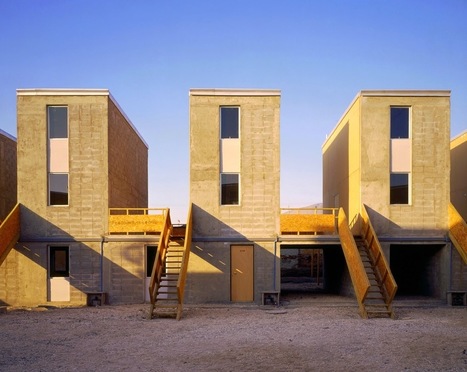
Quand innovation architecturale et innovation sociale sont conjuguées, cela peut aboutir - entre autre - à la passionnante opération d'aménagement de Quinta Monroy
association concert urbain's insight:
via @transitcit
|
Scoop.it!
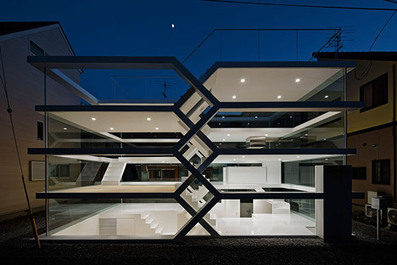
The exposed criss-crossing skeleton of this see-through house in Japan frames a labyrinth of wall-less rooms connected by over a dozen different staircases.
Scoop.it!

Architects: thescape
association concert urbain's insight:
‘Chinese boxes’ is the first built project of ‘thescape’, an architectural design office based in Seoul, South Korea. It is a very small apartment house, 237.34sqm of gross floor area, with four units and one underground studio.
Scoop.it!

John McAslan + Partners has won an international competition to design a new metro line for Dhaka, which will stretch 12 miles across the city.
Scoop.it!
association concert urbain's insight:
Scoop.it!

Scoop.it!

Architects: NL Architects
Scoop.it!

“Let me tell you one thing. In this world we are living in, 98 percent of everything that is built and designed today is pure shit. There’s no sense of design, no respect for humanity or for anything else. They are damn buildings and that’s it. “Once in a while, however, there’s a small group of people who does something special. Very few. But good god, leave us alone! We are dedicated to our work. I don’t ask for work. I don’t have a publicist. I’m not waiting for anyone to call me. I work with clients who respect the art of architecture. Therefore, please don’t ask questions as stupid as that one.”
Scoop.it!

Architect firm: Vo Trong Nghia Architects
Scoop.it!

This architectural magic trick would make David Copperfield proud. Imagine removing what you think is the losing block in a Jenga game, only to have the top of the tower remain hovering in the air. That's the illusion artistAlex Chinneck has accomplished with this London building, whose upper half seems to have broken from its mooring bricks to float away into the sky. The gravity-defying structure, which went up last week in Covent Garden, is the latest architectural oddity from the 30-year-old Chinneck; he's also made anupside-down townhouse and a facade that's sliding onto the street. For the levitating building, titled "Take My Lightning But Don’t Steal My Thunder," the artist's team toiled to re-create the area's 184-year-old stone edifices with lightweight foam blocks. They then spent four days assembling the installation, at one point slipping in a hidden mechanism that achieves the semblance of weightlessness. (See if you can spot it in the below time-lapse video.)
Scoop.it!

Singapore's national sports stadium lays claim to the world's largest free-spanning dome and its roof can be opened or closed to suit the tropical climate.
Scoop.it!

Frank Gehry discusses the inception of his pavilion-like cultural center in Paris’s bois de boulogne, and how his design process influenced the result.
Scoop.it!

These images from artist Xavier Delory show Le Corbusier’s celebrated Villa Sovoye in a shocking state of disrepair. With stones and spray paint, vandals have tragically defaced its pristine walls and windows. Don’t panic: the images shown here are photoshopped. But what if they weren’t? In this article originally published by Metropolis Magazine as “Modernism in Ruins: Artist “Vandalizes” a Le Corbusier Masterpiece,” AJ Artemel explores how our shock and dismay at such images exposes an underlying hypocrisy in our reverence for famous modernist works, and proposes that perhaps Modernism and vandalism are more closely related than we thought.
|





