 Your new post is loading...
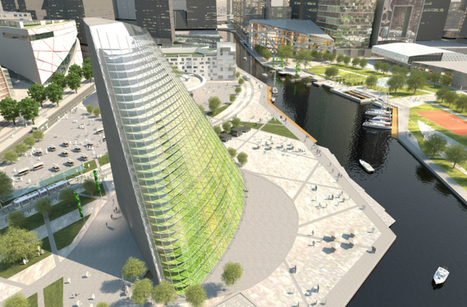
Designed for Linkoping, Sweden, this 177-foot vertical farm features crops grown on spirals that run down the building. Crops move downward over the course of two to three months and are then harvested at the bottom.
Flourishing green skyscrapers are sprouting up, both literally and conceptually, around the world. With the world’s population on target to grow by some 2.5 billion people by 2050, according to the United Nations, 80 percent of those people will reside in cities, which will challenge agriculturalists and designers alike to accommodate the increasing need for vertical epicenters.
We are used to offices and apartments going up, but in the future, we could also see farms. Some of the most innovative developments tout everything from special LED lighting to so-called farmscrapers that simultaneously nurture crops and clean smog.
Via MIPIM & MAPIC World, massimo facchinetti

|
Rescooped by
association concert urbain
from Adaptive Cities
August 5, 2013 7:35 AM
|
New forms of cooperative urbanism are harnessing the internet to achive grand civic goals. A generation of intrepid software developers is creating powerful tools for ordinary people to work together to achieve civic goals. SeeClickFix.com and FixMyStreet.com are US and UK websites where users can report problems in their area directly to the relevant local authority. Collapsed walls, broken signage and faulty streetlighting can be logged by anyone in the community. Reports are mapped online while statistics about how swiftly issues are dealt with are automatically published, encouraging authorities to act quickly. Rather than individual complainants acting in isolation, the sites allow strangers to cooperate in holding their elected officials to account while improving their public spaces. Critics argue the sites foster apathy − encouraging the public to rely on local authorities for relatively minor maintenance jobs rather than taking responsibility as a neighbourhood, but nevertheless, the idea of using decentralised web-based input as a generator for development is gathering momentum.
Via Lauren Moss, Manu Fernandez
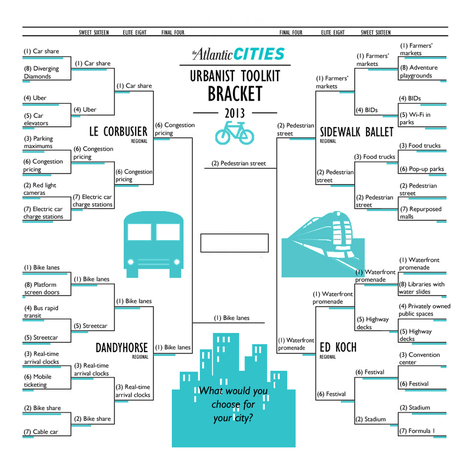
Welcome to the first annual Urbanist Toolkit Bracket Challenge, where the hottest trends in urbanism go head-to-head in a conceptual game that challenges the instincts, tastes, and urban design wisdom of readers. Here's how it works: Thirty-two in-form tools of urbanism have been seeded, according to their popularity and utility, into four regional groups: the Ed Koch, the Sidewalk Ballet, the Le Corbusier, and the Dandyhorse. The four #1 seeds -- car share, bike lanes, farmers' markets, and the waterfront promenade -- are paired off against decidedly more obscure options. It's the nature of an elimination tournament: two urban design features enter, one urban design feature emerges victorious. At the moment we have a choice between Bike Lanes and Pedestrian Street. The Pedestrian Street easily trumped the Waterfront Promenade, 69-31, to advance to the finals. On the left side of the bracket, Bike Lanes sent congestion pricing back to the theoretical realm, 60-40, in a match-up that many people found particularly aggravating, for reasons that commenter Quinn Raymond elucidated at the very start of the bracket challenge: "The final question is basically, 'Would you rather stab yourself in the face or the chest?'" (Confused? Check out the Final Four, the Elite Eight, the Sweet Sixteen, or the initial post for more info on the entries.)
Via Lauren Moss
|
|
Scooped by
association concert urbain
January 15, 2013 1:04 PM
|
|
|
Rescooped by
association concert urbain
from green streets
November 11, 2012 12:37 PM
|
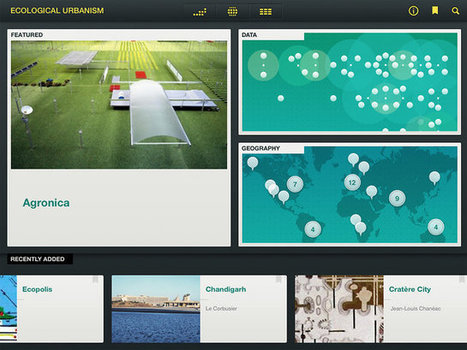
The Harvard Graduate School of Design released its Ecological Urbanism app last month. The interactive app adapts content from the GSD book of the same name, which explores how designers can unite urbanism with environmentalism.
Combining data from around the world, the app “reveals and locates current practices, emerging trends, and opportunities for new initiatives” in regard to the future of cities.
A collaboration between the school and Second Story Interactive Studios,the app stems from the GSD’s Ecological Urbanism conference and dovetails with the duo’s ongoing efforts to explore sustainability in our cities of the future. More than 100 participating architects and designers have provided content for the project, including such heavyweights as OMA, Rem Koolhaas, Kara Oehler, and Stefano Boeri. And the ever-evolving app allows designers and academics to add research and project updates as they happen...
Via Lauren Moss
|
|
Rescooped by
association concert urbain
from green streets
August 28, 2012 3:04 PM
|
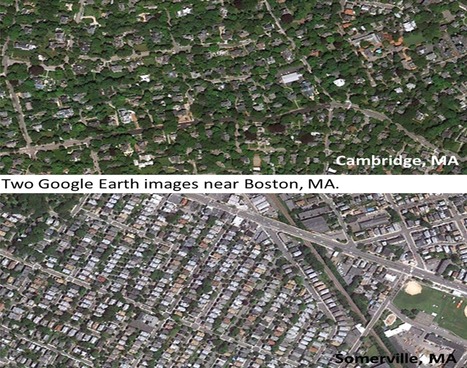
Are suburbanization and urbanism always at odds? Much has been made lately of a supposedly historic shift in American demographics, in which community survey data from the Census Bureau showed many large American cities (mainly in the Sun Belt) grew at a faster rate than their suburbs since last year. But as any drive through the collar counties will make clear, the suburbs still loom large. In absolute numbers, the growth seen downtown is still a fraction of the growth enjoyed by communities more far-flung. We recently looked closely at redevelopment in Ohio’s three largest cities. Movements to revitalize withering urban cores there have progressed to a point where some see a brighter future for Rust Belt cities. A genuine interest in downtown living has coalesced with efforts by private developers and all levels of government to help produce a new template for urban redevelopment...
Via Lauren Moss
Wealthy cities seem to have it all. Expansive, well-manicured parks. Fine dining. Renowned orchestras and theaters. More trees. Wait, trees? I certainly wouldn't argue that trees create economic inequality, but there appears to be a strong correlation in between high income neighborhoods and large mature trees in cities throughout the world (for a scholarly reference from the Journal, Landscape and Urban Planning, see: http://www.sciencedirect.com/science/article/pii/S0169204607002174 ). Why is there such a connection? In terms of landscape analysis, what does this say about those who have created these environments? Why do societies value trees in cities? How does the presence of trees change the sense of place of a particular neighborhood? For more Google images that show the correlation between income and trees (and to share your own), see: http://persquaremile.com/2012/05/24/income-inequality-seen-from-space/
Via Ashesh
|
|
Scooped by
association concert urbain
May 1, 2012 7:57 AM
|
TED Talks Eduardo Paes is the mayor of Rio de Janeiro, a sprawling, complicated, beautiful city of 6.5 million. What should city planners be doing to maintain a vibrant city? The Mayor of Rio de Janeiro explains his vision for cities and city management for the future.
|
Bazar Urbain est un collectif pluridisciplinaire qui intervient sur l’espace urbain construit et social par la réflexion et l’action sur les usages, les ambiances et la conduite de projet. Composé de praticiens, d’enseignants et de chercheurs de différentes disciplines, Bazar Urbain développe, avec un fort ancrage au terrain, des méthodes d’appréhension, d’analyse et de construction...
Via Horizome
|
|
Rescooped by
association concert urbain
from green streets
April 28, 2013 4:38 AM
|
The urban ecology framework of Patch Dynamics has been key in watching how city models such as the megalopolis and the megacity interact and generate urban ecosystem change. Urban Design practices have always been created in response to emerging and overlapping city models and the disciplinary contexts designers find themselves in. The urban ecology framework of Patch Dynamics has been key in allowing me to see how city models such as the megalopolis and the megacity interact and generate urban ecosystem change. One's first thought about a patch may be that of a shape that changes. However, the concept of a patch in this case describes a set of patches or a mosaic that changes over time. This search is not to find or create the best patch mosaics, or those that function in the most resilient ways. Instead, it is a project of creating urban design practices and strategies for a diversity of urban actors to engage their patches and democratize the resilience cycle in their own ways.
Via Lauren Moss
See the big picture of how suburban developments are changing the country's landscape, with aerial photos and ideas for the future
Via Apres
|
|
Rescooped by
association concert urbain
from green streets
December 2, 2012 8:11 AM
|
In 2010, Harvard’s Graduate School of Design published Ecological Urbanism, a book of interdisciplinary essays on sustainable city-building. But the project had one inescapable shortcoming: When you’re dealing with a field that’s evolving so rapidly, a finite, physical book is liable to be outdated by the time it leaves the printer. So upon completing the collection, the school commissioned Portland-based interactive studio Second Story to transform the book into an iPad app, a resource that would draw from the original text but could also be updated with new projects and papers as needed. Now available for free, the app shows how dynamic areas of study can benefit greatly from equally dynamic texts. Features like interactive graphs are innovative ways to access data, as well as useful tools for understanding it. "While working on the app, we found that the data visualizations revealed patterns that told another meta-story that already existed in the book," he says. "Essentially, the patterns illustrated trends in sustainable design, which is attractive for both scholars and the general reader to see." Visit the link to learn more about how this new format has given research and urban issues a stronger, more engaging and current platform with which users to engage...
Via Lauren Moss
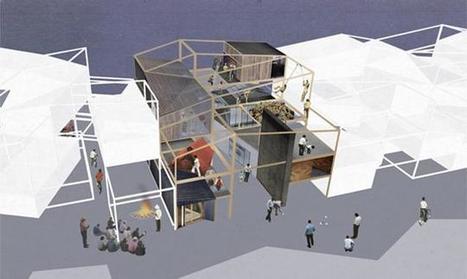
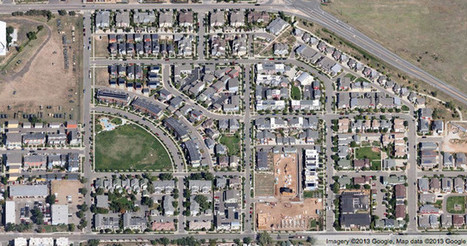
On ne sait pas bien imaginer l’avenir de nos villes, comme s’il n’y avait pas d’alternative à l’extension sans fin de l’habitat pavillonnaire. La seule réponse qu’on lui oppose, l’habitat collectif, est loin de séduire la plupart des gens. Comme nous le confiait Jean Haëntjens, ceux qui vivent en maison individuelle ne rêvent pas forcément d’habitat collectif. Dans le domaine de la ville, on a l’habitude de dire que l’intérêt collectif rejoint rarement l’intérêt personnel. C’est ce qu’exprime l’expression Nimby (Not In My Back Yard qui signifie “pas dans mon arrière-cour”), qui désigne ceux qui veulent bien des projets collectifs… tant qu’ils n’empiètent pas leurs propres intérêts. C’est pourtant une tout autre approche que prône le projet Bimby (Build In My Back Yard, c’est-à-dire : “Construit dans mon arrière-cour”) porté par les architectes Benoit Le Foll du Centre d’études techniques de l’Équipement (CETE) Normandie Centre et David Miet du CETE Île-de-France, comme l’expliquait ce dernier lors de la conférence....
Via F|Mattiuzzo
"This collection of student projects from the AA's Diploma Unit 6 encapsulates a generational shift. After the past decade of deep (and sometimes, it would appear, deeply self-satisfied) explorations into new digital and computational design tools, "Typological Formations" demarcates a return to the city as the overt site, not just for architecture but for architectural thinking. A quick glance through this book will confirm the obvious: sophisticated parametric tools are all over these projects, but they are no longer a topic or focus in and of themselves.Instead, such tools are merely brought to bear on the design agenda: the search for 'renewable' building types that are able to negotiate the rapidly changing circumstances of cities in an era of global capitalism. [...] With this book, the idea of an architectural 'type' seems more supple - that is, more differentiated and therefore more relevant and productive - than ever. "Typological Formations" is nothing less than a manifesto for a return to projects and project-based forms of architectural knowledge today."
Via Ignacio López Busón
|
|
Scooped by
association concert urbain
May 7, 2012 4:44 AM
|
Kennedy Smith is considered one of the nation's leading experts on downtowns, downtown economics, independent business development and the economic impact of urban sprawl, with a long career in downtown revitalization. This video discusses the decline of the American Central Business District, the rise of shopping malls, the importance of the automobile and spatial organization of particular economic sectors. Parts Two http://vimeo.com/37041011 ; and Three http://vimeo.com/37050944 ; continue the discussion with an emphasis on practical urban planning policies for small cities to revitalize the downtown region with some domestic and foreign examples.
|













![progetto Bimby : peut-on lutter contre l'ÉTALEMENT urbain ? [possiamo combattere l'espansione urbana] « InternetActu.net | URBANmedias | Scoop.it](https://img.scoop.it/cjeM94bUYWl83ZDpdAAP6Dl72eJkfbmt4t8yenImKBVvK0kTmF0xjctABnaLJIm9)





