URBANmedias
75.8K views | +0 today
Follow
URBANmedias
le mediation des aménagements urbains
Your new post is loading...
Rescooped by association concert urbain from green streets
October 25, 2012 4:12 AM
Scoop.it!

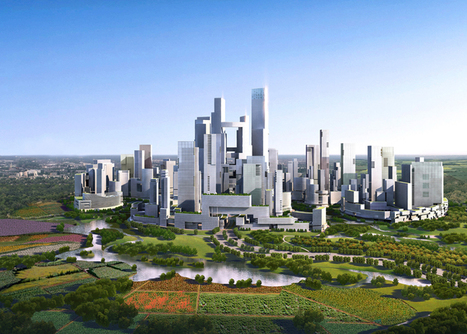
Sustainable Urbanism: a high-density, car-free vertical city in Chengdu, China

Sustainable Urbanism: a high-density, car-free vertical city in Chengdu, China | URBANmedias | Scoop.it
Work is about to start on a high-density, car-free "satellite city" for 80,000 people close to Chengdu in China.


Designed by Chicago firm Adrian Smith + Gordon Gill Architecture, the 1.3 square km 'Great City' will feature a high-rise core surrounded by a buffer landscape of open space (60% of the total area). Residents will be able to walk from the city center to its edge in just 10 minutes.

“The design is attempting to address some of the most pressing urban issues of our time,” said architect Gordon Gill. “We’ve designed this project as a dense vertical city that acknowledges and in fact embraces the surrounding landscape.”

“The sustainability framework for Great City, custom-designed based on the principles of LEED-ND and BREEAM, follows an integrated approach toward meeting the overall objectives of environmental, economic and social sustainability,” notes Peter J. Kindel, AIA, ASLA, AS+GG’s Director of Urban Design. “Great City will incorporate innovative technologies and infrastructure systems to achieve 48% energy savings of a conventional urban development.”


The architects also note that the city will use 48% less energy and 58% less water than conventional developments of this size, producing 89% less landfill waste and generating 60% less carbon dioxide...


Via Lauren Moss
No comment yet.
Rescooped by association concert urbain from Greener World
September 29, 2012 1:04 PM
Scoop.it!

How can cities be designed for sustainable living?

How can cities be designed for sustainable living? | URBANmedias | Scoop.it
How can cities be designed for sustainable living?


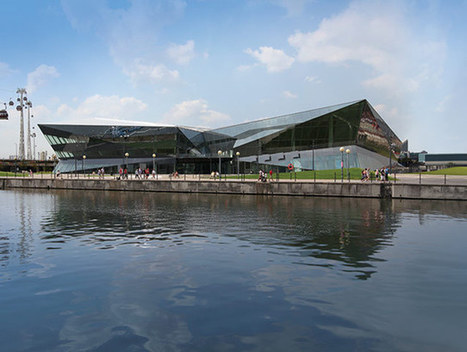
A new interactive exhibition from the Guardian, 'Our Urban Future', explores the importance of cities in making the world a more sustainable place. The exhibition at The Crystal in London's Docklands seeks to challenge and reinvent the way we think about cities and gives visitors the chance to learn how they can make a contribution to sustainable living.

Scroll through the gallery showcasing snippets from the exhibition, and read responses on how cities can be designed for sustainable living and share what you think urban environments will look like in future...


Visit the link for a slideshow of exhibition highlights, including:

The immersive Forces of Change theatre: a global view of the challenges and opportunities that climate change, demographic change and urbanisation raise. The Creating Cities game: exploring issues around city management and urban planning. The Go Electric Zone: the challenges and solutions to balancing energy supply, demand and storage. The Water is Life Zone: harvested rainwater is used to shed light on desalination, purity and resources. The ‘Future Life’ film gallery: how London, New York and Copenhagen look forward to 2050, and envisioning how our cities could develop if sustainable solutions are embraced.


Via Lauren Moss, Gerry B
No comment yet.
Rescooped by association concert urbain from green streets
June 24, 2012 4:37 AM
Scoop.it!

Top 25 greenest cities in the U.S.

Top 25 greenest cities in the U.S. | URBANmedias | Scoop.it
Which region in the U.S. has the largest number of sustainable cities?

Having a green city isn’t just about how many people you can get to carry reusable bags to the grocery store (though that doesn’t hurt). It’s about smart development, land use, and transportation policies. It’s about waste reduction, energy efficiency, and so much more.

Corporate Knights, a publication that promotes “clean capitalism,” checked in on the biggest cities across the US to see if they have policies in place to help them be more sustainable. As Huffington Post points out, the list is not about results but which cities are making the most effort.

They looked specifically at the largest 54 U.S. cities, along with Pittsburgh. Each city was analyzed based on 38 policies and programs in eight categories: smart growth activities; land-use planning programs and policies; transportation planning programs and policies; pollution prevention, reduction and remediation; energy and resource conservation/efficiency, and more...


Via Lauren Moss
No comment yet.
Rescooped by association concert urbain from landscape architecture & sustainability
October 7, 2012 8:41 AM
Scoop.it!

The New Architecture of Smart Cities

The New Architecture of Smart Cities | URBANmedias | Scoop.it

What makes a city a “Smart City” as opposed to a city where some “smart things” happen?


Three obvious criteria for answering that question stand out:

1. Smart Cities are led from the top – they have a strong and visionary leader championing the Smart agenda across the city. 

2. Smart Cities have a stakeholder forum – they have drawn together a community of city stakeholders across the city. Those stakeholders have not only created a compelling vision for a Smart City; they have committed to taking an ongoing role coordinating a programme to deliver it. 

3. Smart Cities invest in technology infrastructure – they are deploying the required information and communication technology (ICT) platforms across the city; and doing so in such a way as to support the integration of information and activity across city systems.


It’s also important, though, to consider what is different about the structure and organisation of city systems in a Smart City. How does a city decide which technology infrastructures are required? Which organizations will make use of them, and how? How can they be designed and delivered so that they effectively serve individuals, communities and businesses in the city? What other structures and processes are required to achieve this progress in a Smart City?


Read on to learn about the design of the infrastructures and systems of Smart Cities and view  them visually represented in an accompanying diagram.


Via Lauren Moss, landscape architecture &sustainability
No comment yet.
Rescooped by association concert urbain from green streets
July 4, 2012 5:16 AM
Scoop.it!

Sustainable cities: considering the city of tomorrow as an ecosystem

Sustainable cities: considering the city of tomorrow as an ecosystem | URBANmedias | Scoop.it

More than 3.5 billion people now live in cities and this figure is continually increasing. When the UN put the subject of sustainable cities on the Rio+20 agenda it confirmed the fundamental importance of redefining the city, given that rapid urbanization is placing great pressure on water resources, their treatment, the environment, biodiversity and public health. The city must not be designed as a goal in itself, but as an ecosystem in which sustainable resource management – whether of water or energy – is a fundamental priority...


Via Lauren Moss
No comment yet.
Rescooped by association concert urbain from green streets
May 31, 2012 1:35 PM
Scoop.it!

Future cities: sustainable and resilient

Future cities: sustainable and resilient | URBANmedias | Scoop.it
How can we make our future cities less resource-hungry, more sustainable, and more resilient to the ever changing global conditions?


This is probably one of the most significant questions we face as the global population is expected to rise to 9.3 billion by 2050, with urban dwellers likely to make up two-thirds of that number.


Of course we want to lift people out of poverty, as the Millennium Development Goals state, but the desire to own and consume is often at odds with the carrying capacity of the planet and the local capacity to deal with the implications is often not present in local government.


We need our urban communities to become more resilient in the context of decreasing resources of all kinds. We need citizens to be empowered to develop their own sustainable solutions. We need new infrastructures that can encourage, enable and empower innovation at every level...


Via Lauren Moss
No comment yet.