 Your new post is loading...

|
Rescooped by
association concert urbain
from green streets
July 17, 2013 1:07 PM
|
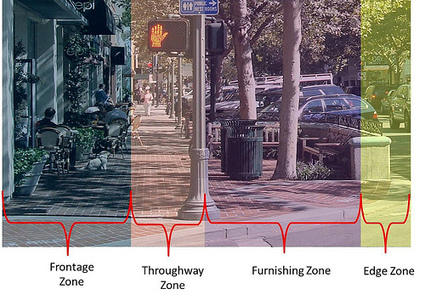
A street shouldn't just be about transportation, but also about civic definition and social and commercial interaction. There is no better place to start using land more efficiently than with our streets, our most plentiful and visible parts of the urban commons. The recent "complete streets" movement has made a terrific contribution to getting our streets right, by insisting that they be designed so as to accommodate all users. Connectivity is hugely important to a sustainable street network to encourage walking and shorten driving trips by making destinations more convenient. The pedestrian experience should be safe and enjoyable, and should be so perceived. Other design elements to help turn streets into worthy places are: Sidewalks with real curbs;On-street parking ;Street trees;Storefronts with elements that shelter pedestrians such as awnings, arcades, and colonnades;Buildings with windows and "other signs of human occupancy such as porches and balconies" for "eyes on the street";Design appropriate to safe motor vehicle speeds.
Via Lauren Moss
|
|
Rescooped by
association concert urbain
from green streets
January 14, 2013 1:38 AM
|
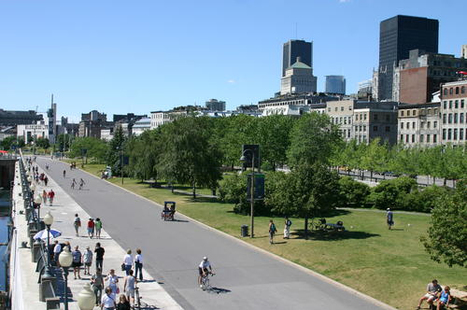
As more cities envision their waterfronts as lively public destinations that keep people coming back, PPS outlines the following principles to make that happen. They are not all hard and fast laws, but rules of thumb drawn from 32 years of experience working to improve urban waterfronts around the world. These ideas can serve as the framework for any waterfront project seeking to create vibrant public spaces, and, by extension, a vibrant city.
Via Lauren Moss
|
|
Rescooped by
association concert urbain
from green streets
November 12, 2012 4:56 AM
|
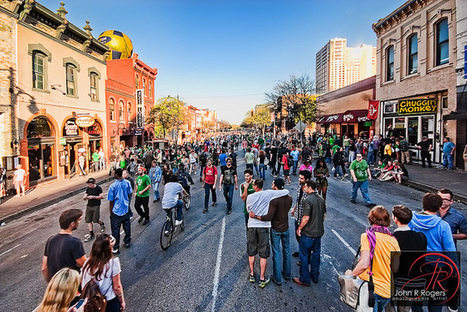
In a recent blog post, entrepreneur-turned-VC Mark Suster wrote about the necessary ingredients for a city trying o develop a successful start-up community. His advice seemed applicable to any community that’s trying to create a strong local sense of place, so we’ve retrofitted his recommendations to speak broadly to people who are working to transform their public spaces into magnetic destinations that are reflective of the diverse communities that surround them. Stop by and read the complete article for details on the elements of great public spaces, including: place capital events access to advocates local press + organizational tools placemakers flagship public space
Via Lauren Moss
|
|
Rescooped by
association concert urbain
from green streets
July 3, 2012 10:39 AM
|
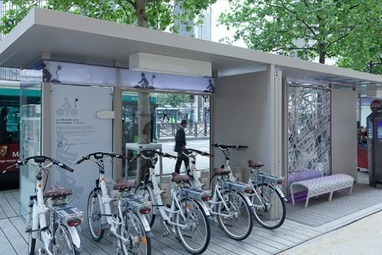
At Design Urbain's bus station on Paris' Boulevard Diderot, you can grab dinner and charge your phone while you wait. If asked to describe the perfect bus station, you probably wouldn’t have much to say. A place to sit, not too dirty, and a bit of overhead cover in case of rain? The truth is, there’s not much to them. At least there hasn't been in the past. At best they they're comfortable and don't feel unsafe. But what if we could re-imagine bus stations, making them so useful and attractive that they would actually draw people to public transportation? It sounds a little bit strange, but that’s exactly what it looks like the French firm Design Urbain is trying to do. The firm has debuted an "experimental station" on Paris' Boulevard Diderot that sounds more like a Starbucks than a place where you wait for the bus. At the Diderot station, you can grab a sandwich, charge your phone, listen to music, rent a bike, borrow a book—or, yes, get a cup of coffee...
Via Lauren Moss
|
|
|
Rescooped by
association concert urbain
from green streets
July 14, 2013 2:44 AM
|
The Communication Hut by Herreros Arquitectos is hung from three poles placed beyond its floating amoeba-like ring, and sits in the trees scattered through one of South Korea’s public squares. At all times of day, the ring emits WiFi signals to encourage occupation of the space, while at night it glows to provide a feeling of safety.
The Communication Hut encourages the public to use the space as an outdoor living room. By providing a relatively unobstructed ground plane, the occupants of the space can see friends from afar and children can play safely. The suspended structure, then, gives the site its boundaries, suggesting an enclosed space where sitting and stopping is welcomed. The Communication Hut is a subtle yet effective intervention in the workings of the city...
Via Lauren Moss
|
|
Rescooped by
association concert urbain
from #territori
November 27, 2012 6:17 AM
|
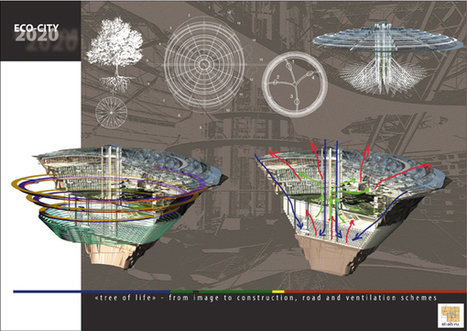
Eco-city 2020 is a proposal for the rehabilitation of the Mirniy industrial zone in Eastern Siberia, Russia designed by the innovative architectural studio AB Elis Ltd. The project would be located inside a giant man-made crater of more than one kilometer in diameter and 550 meters deep that used to be one of the world’s largest quarries. The idea is to create a new garden city shielded from the harsh Siberian environmental conditions and instead, attract tourists and residents to Eastern Siberia, with the ability to accommodate more than 100,000 people. The new city is planned to be divided in 3 main levels with a vertical farm, forests, residences, and recreational areas. One of the most interesting aspects of the proposal is the glass dome that will protect the city and would be covered by photovoltaic cells that will harvest enough solar energy for the new development. A central core houses the majority of the vertical circulations and infrastructure along with a multi-level research center. The housing area is located in the first level with outdoor terraces overlooking a forest in the center of the city, in order to create a new type of highly dense urbanism in harmony with nature. View diagrams & renderings, and learn more about this interesting approach to urban design, sustainability and renewal at the complete article link...
Via Lauren Moss, Territori
|
|
Rescooped by
association concert urbain
from Greener World
September 29, 2012 1:06 PM
|
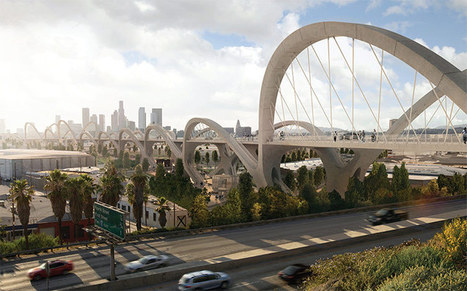
Three finalists present plans for major new bridge in Los Angeles: The groups—headed by HNTB, AECOM, and Parsons Brinckerhoff— have all been shortlisted to create the city’s new Sixth Street Viaduct. Their vivid public presentations were the first glimpse of what will likely be LA’s next major icon. The original 3,500-foot-long structure, a famous rounded Art Deco span designed in 1932, has been deemed unsalvageable due to irreversible decay, and in April the city’s Bureau of Engineering called for a competition to design a new, $400 million, cable stayed structure. Following the city’s lead, all three teams presented plans that not only showcased memorable forms, but embraced people-friendly designs, including pedestrian paths, parks, and connections to the river below. The push reveals Los Angeles’s focus on attracting people and talent through increased livability. Such moves are a welcome, if uphill battle considering that so much of the city has been designed for cars, not people...
Via Lauren Moss, Gerry B
|
|
Rescooped by
association concert urbain
from green streets
June 15, 2012 2:58 PM
|
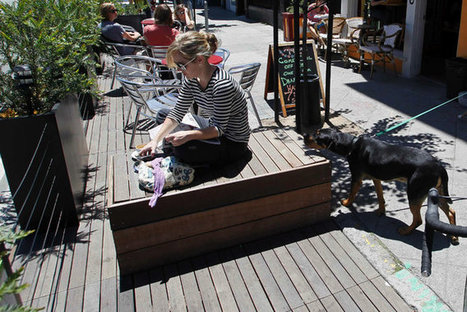
Cities from coast to coast are giving up parking spaces (and the revenue that comes from them) to create green public places for people to sit. It all started in 2005, when a San Francisco design company descended on a downtown parking space, fed the meter and created a pop-up park complete with sod, public benches and leafy trees. They called it Park(ing) Day, which eventually became an annual event. Then in 2009, when New York City began converting some street spaces into pedestrian-only plazas, urban planners started to see the appeal of pint-sized parks. Officials in different places began working with local business owners to convert parking spaces. San Francisco cut the ribbon on its first permanent parklet in March 2010; today the city boasts 27 completed parklets with another 40 in the pipeline. In the past year alone, cities from Philadelphia to Oakland and Long Beach, Calif., have launched parklet programs; others, including Chicago, Los Angeles and Roanoke, Va., are exploring the idea...
Via Lauren Moss
|











Visit the article link for more details and information on the process of creating better public spaces and the elements that make for healthy, safe and vibrant communities.
Nice trend: refitting streets to create connectivity