URBANmedias
76.1K views | +0 today
Follow
URBANmedias
le mediation des aménagements urbains
Your new post is loading...
Rescooped by association concert urbain from green streets
January 11, 2014 4:57 AM
Scoop.it!

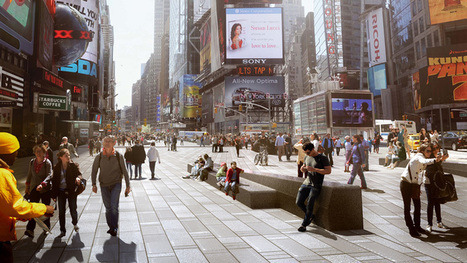
Snøhetta COMPLETES phase one of Times Square transformation

Snøhetta COMPLETES phase one of Times Square transformation | URBANmedias | Scoop.it

Architecture firm Snøhetta has concluded the first phase of a major overhaul of New York's Times Square, continuing the initiative started in 2009 to pedestrianise large sections of the popular tourist destination.

The $55 million reconstruction project is the largest redesign of the square in decades and encompasses the transformation of five public plazas between 42nd and 47th Streets, which will be entirely reconstructed to remove any traces that vehicular traffic once ran through the square along the Broadway...


Via Lauren Moss
ELISA TANGKEARUNG's curator insight, January 11, 2014 9:38 PM

HE said : Don't look at me or your brother & your sister FROM THE "crowd"....TAKE A LOOK them from "THAT CROSS"! where HIS LOVE make EVERYTHING IS DONE!!!..

Rescooped by association concert urbain from green infographics
April 29, 2013 8:13 AM
Scoop.it!

Urbanist Toolkit Bracket Challenge: Championship Round

Urbanist Toolkit Bracket Challenge: Championship Round | URBANmedias | Scoop.it

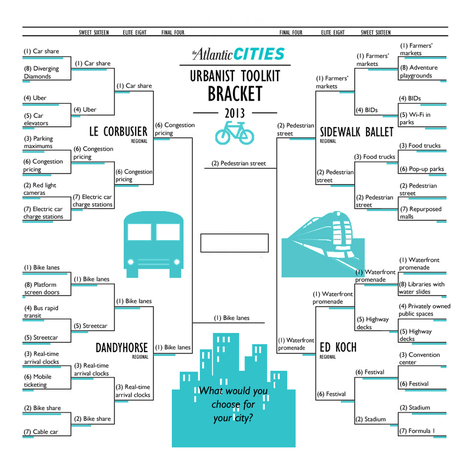
Welcome to the first annual Urbanist Toolkit Bracket Challenge, where the hottest trends in urbanism go head-to-head in a conceptual game that challenges the instincts, tastes, and urban design wisdom of readers.

Here's how it works:

Thirty-two in-form tools of urbanism have been seeded, according to their popularity and utility, into four regional groups: the Ed Koch, the Sidewalk Ballet, the Le Corbusier, and the Dandyhorse. The four #1 seeds -- car share, bike lanes, farmers' markets, and the waterfront promenade -- are paired off against decidedly more obscure options.


It's the nature of an elimination tournament: two urban design features enter, one urban design feature emerges victorious. At the moment we have a choice between Bike Lanes and Pedestrian Street.


The Pedestrian Street easily trumped the Waterfront Promenade, 69-31, to advance to the finals. On the left side of the bracket, Bike Lanes sent congestion pricing back to the theoretical realm, 60-40, in a match-up that many people found particularly aggravating, for reasons that commenter Quinn Raymond elucidated at the very start of the bracket challenge: "The final question is basically, 'Would you rather stab yourself in the face or the chest?'"

(Confused? Check out the Final Four, the Elite Eight, the Sweet Sixteen, or the initial post for more info on the entries.)


Via Lauren Moss
Lauren Moss's curator insight, April 7, 2013 6:30 PM

An interesting concept in the realm of planning and development: a challenge to determine the urban design elements that readers of the Atlantic Cities prioritize as transformative.

For more details, view previous articles on this inaugural, interactive challenge...

Rescooped by association concert urbain from Greener World
September 29, 2012 1:06 PM
Scoop.it!

Visions of Sixth Street - plans for a new, pedestrian-friendly bridge in Los Angeles

Visions of Sixth Street - plans for a new, pedestrian-friendly bridge in Los Angeles | URBANmedias | Scoop.it

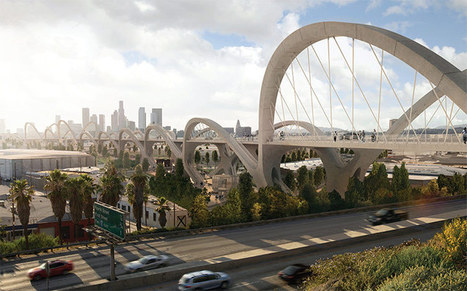
Three finalists present plans for major new bridge in Los Angeles:

The groups—headed by HNTB, AECOM, and Parsons Brinckerhoff— have all been shortlisted to create the city’s new Sixth Street Viaduct. Their vivid public presentations were the first glimpse of what will likely be LA’s next major icon.

The original 3,500-foot-long structure, a famous rounded Art Deco span designed in 1932, has been deemed unsalvageable due to irreversible decay, and in April the city’s Bureau of Engineering called for a competition to design a new, $400 million, cable stayed structure.

Following the city’s lead, all three teams presented plans that not only showcased memorable forms, but embraced people-friendly designs, including pedestrian paths, parks, and connections to the river below. The push reveals Los Angeles’s focus on attracting people and talent through increased livability. Such moves are a welcome, if uphill battle considering that so much of the city has been designed for cars, not people...


Via Lauren Moss, Gerry B
No comment yet.
Rescooped by association concert urbain from green streets
November 23, 2013 3:53 AM
Scoop.it!

Hamburg's ANSWER to Climate Change: An Extensive Pedestrian & Bicycle-Oriented Green Network

Hamburg's ANSWER to Climate Change:  An Extensive Pedestrian & Bicycle-Oriented Green Network | URBANmedias | Scoop.it
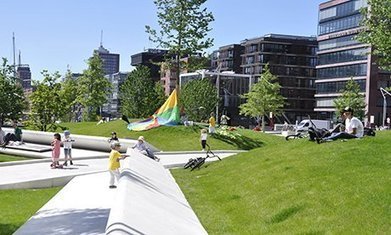
The German city is planning a green network that will cover 40% of the city area, contributing to resilience and allowing biking, swimming and nature watching in the city

The European commercial hub promotes bicycling as the main mode of transportation, and plans to build a network around bikes and pedestrians, linking car-free roads to parks and playgrounds, from the city centre to the suburbs.

Welcome to Hamburg, an environmental pioneer whose planned green network will cover 40% of the city's area. "It will connect parks, recreational areas, playgrounds, gardens and cemeteries through green paths", says Angelika Fritsch, a spokeswoman for the city's department of urban planning and the environment. "Other cities, including London, have green rings, but the green network will be unique in covering an area from the outskirts to the city centre. In 15 to 20 years you'll be able to explore the city exclusively on bike and foot."


Via Lauren Moss
No comment yet.
Rescooped by association concert urbain from green streets
November 27, 2012 3:07 PM
Scoop.it!

What Makes a Great City: A General Theory of Walkability

What Makes a Great City: A General Theory of Walkability | URBANmedias | Scoop.it

City engineers have turned our downtowns into places that are easy to get to but not worth arriving at.


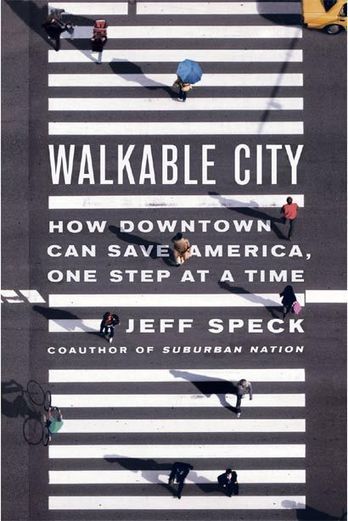
In Walkable City: How Downtown Can Save America, One Step at a Time (public library), city planner Jeff Speck, who spent four years leading the design division of the National Endowment for the Arts working directly with a couple hundred mayors to help solve their greatest city-planning challenges, turns a perceptive eye towards what makes a great city and how we might be able to harness the power of a conceptually simple, practically complex, immeasurably far-reaching solution in improving the fabric and experience of urban life.


Speck outlines a “General Theory of Walkability,” focusing on the four key factors of making a city attractive to pedestrians: 'it must be useful, safe, comfortable, and interesting. Each of these qualities is essential an none alone is sufficient...'


Learn more about urban livability, how to create the conditions that enable pedestrian-oriented development, and the benefits of this approach to urban spaces to the economic, environmental, and cultural health of a city at the article link...


Via Lauren Moss
No comment yet.
Rescooped by association concert urbain from green streets
August 12, 2012 10:18 AM
Scoop.it!

Pedestrian Bridge in Amsterdam: an extension of the public realm

Pedestrian Bridge in Amsterdam: an extension of the public realm | URBANmedias | Scoop.it

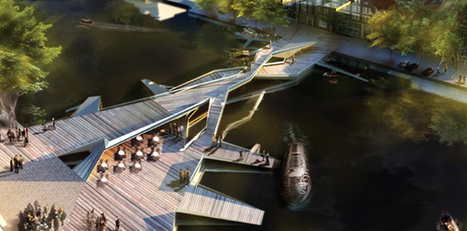
Designed for the [AMSTERDAM] Iconic Pedestrian Bridge Competition, the project offers more than just a possibility of crossing the Amstel river. Branching into several pedestrian trajectories, the bridge prioritizes on being an extension of the public space in front of the Hermitage Museum. In order to prolong the experience of water, the bridge comprises several routes to create a public promenade. The iconic nature of the project is seen by the design team as an emergent feature resulting from both the geometry of the bridge as well as the socially enabled functional potential.

'We see Amsterdam as a city of differences at a small scale which emphasize its local realm. Houseboats represent a specific way of living which could better highlight the local and embed a fruitful cultural echange between the visitors and Amsterdam’s way of living...'


Via Lauren Moss
No comment yet.