URBANmedias
76.1K views | +1 today
Follow
URBANmedias
le mediation des aménagements urbains
Your new post is loading...
Rescooped by association concert urbain from green streets
December 21, 2012 6:22 AM
Scoop.it!

Is China's lakeside city the future of urban planning?

Is China's lakeside city the future of urban planning? | URBANmedias | Scoop.it

China's next new city will be designed by US firm KPF, next to Hunan's regional capital, around a 40-hectare lake.


Adjacent to Changsha, the ancient capital city of Hunan, the design implements the sort of urban innovation that creates a sustainable and truly habitable environment.

"We can introduce integrated urban innovation," von Klemperer says, "we can combine water transport with localised energy production, cluster neighbourhood centres, advanced flood prevention and water management, and urban agriculture. Meixi is an experiment in future city planning and building. It will serve Changsha as a new CBD, but it will also serve as a paradigm for other Chinese city planners. It's a kind of live test case."


The firm seeks to achieve these goals through its dense, mixed-use urban, plan, with integration with surrounding mountains, lakes, parks and canals. Meixi Lake will eventually be home to 180,000 inhabitants, living in "villages" of 10,000 people, clustered around the canals...


Via Lauren Moss
association concert urbain's insight:


via @Territori

Rescooped by association concert urbain from green streets
October 25, 2012 4:12 AM
Scoop.it!

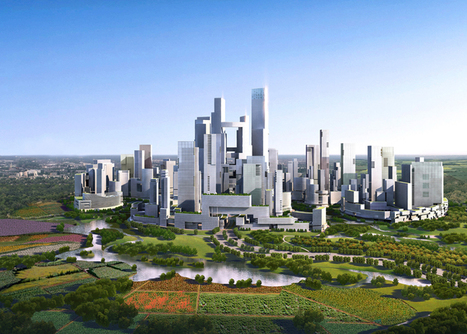
Sustainable Urbanism: a high-density, car-free vertical city in Chengdu, China

Sustainable Urbanism: a high-density, car-free vertical city in Chengdu, China | URBANmedias | Scoop.it
Work is about to start on a high-density, car-free "satellite city" for 80,000 people close to Chengdu in China.


Designed by Chicago firm Adrian Smith + Gordon Gill Architecture, the 1.3 square km 'Great City' will feature a high-rise core surrounded by a buffer landscape of open space (60% of the total area). Residents will be able to walk from the city center to its edge in just 10 minutes.

“The design is attempting to address some of the most pressing urban issues of our time,” said architect Gordon Gill. “We’ve designed this project as a dense vertical city that acknowledges and in fact embraces the surrounding landscape.”

“The sustainability framework for Great City, custom-designed based on the principles of LEED-ND and BREEAM, follows an integrated approach toward meeting the overall objectives of environmental, economic and social sustainability,” notes Peter J. Kindel, AIA, ASLA, AS+GG’s Director of Urban Design. “Great City will incorporate innovative technologies and infrastructure systems to achieve 48% energy savings of a conventional urban development.”


The architects also note that the city will use 48% less energy and 58% less water than conventional developments of this size, producing 89% less landfill waste and generating 60% less carbon dioxide...


Via Lauren Moss
No comment yet.