Your new post is loading...
An executive order signed by President Donald Trump stating English should be the official language of the United States is ignoring the demographic reality of the U.S. and rejecting a long-standing tradition in American government of making key civic information accessible.
Daniel J. Olson
Purdue University/The Conversation
ScreenshotThe White House’s Spanish-language page no longer works.
English should be the official language of the United States, says a new executive order signed by President Donald Trump on March 1, 2025. The move follows the Trump administration’s termination of the Spanish-language version of the White House website and its Spanish-language account on X, formerly Twitter.
Both were abruptly shut down within hours of Trump’s second presidential inauguration. Visitors to whitehouse.gov/espanol were met with “page not found” and a “GO HOME” button that sent the user to the English-language page. This button was later updated to read, “GO TO HOME PAGE.”
In halting its Spanish-language communications, the White House is ignoring the demographic reality of the U.S. and rejecting a long-standing tradition in American government of making key civic information accessible to the public. These changes, while mostly symbolic, signal the Trump administration’s unwelcoming stance toward Spanish specifically and multilingualism in general.
US is a Spanish-speaking country
“This is a country where we speak English, not Spanish.,” Trump said in a 2015 debate during his first presidential run.
But, as a linguist specializing in Spanish and bilingualism, I know that this is simply not true. Historically, the U.S. has had no official language, and Spanish was spoken in the lands that now make up the U.S. well before the country’s founding.
Spain founded its first permanent settlement in what’s now Florida in 1565, nearly 50 years before English settlers established Jamestown and the colony of Virginia. Spanish settlements in the Southwest began in the early 1600s, and large numbers of English speakers did not arrive there until the mid-19th century.
Today, approximately 43 million people in the U.S. speak Spanish as their primary language, representing roughly 14% of the entire population. If those who speak Spanish as their second language are included, then the U.S. is the second-largest Spanish-speaking country in the world after Mexico.
Beyond population size, Spanish speakers help power the U.S. economy, contributing an estimated US$2.3 trillion. That’s more than the gross domestic product of any other Spanish-speaking country in the world. With the help of its Spanish-speaking population, Miami is the financial and commercial capital of Latin America.
An inclusive communications strategy
Responding to this demographic reality, the Spanish-language content was first included on the White House webpage in 2001 by the administration of George W. Bush, a Republican.
In a press release, the Bush White House said that the new WhiteHouse.gov website would now “accomodate Spanish-speaking visitors.” It included both Spanish-language translations of the English materials, as well as feature stories relevant to the Hispanic community.
The Bush White House’s website was inclusive in other ways, too, with enhanced content for people who are hard of hearing or visually impaired and special content for kids.
The Obama administration maintained WhiteHouse.gov/espanol from 2009 to 2017.
Under the first Trump administration, however, the page was quickly removed. At the time, the White House said that the site would be restored shortly.
That didn’t happen. The page did not reappear until the Biden administration in 2021.
Following the latest removal of whitehouse.gov/espanol, a White House spokesperson has again said that the administration is “committed to bringing back” the website, although no timeline was given.
US has multilingual history
The Trump administration’s effort to limit White House communication in languages other than English breaks with not just the recent past but also with the earliest traditions of the republic. Since the inception of the country, there has been a concerted effort to provide information to the public in relevant languages.
For example, the U.S. Constitution was translated into German and Dutch in 1787 and 1788, languages that were widely spoken at the time, especially in New York, Pennsylvania and Maryland. These translations helped inform the public of the country’s foundational values and allowed for public engagement and participation during the ratification process.
The 1848 Treaty of Guadalupe Hidalgo, which ended the Mexican–American War and redrew the southern boundaries of the U.S., was written in both Spanish and English, ensuring that Spanish speakers in the territories newly claimed by the U.S. were informed about their citizenship and rights.
Translators who spoke everything from Italian to Turkish to Albanian were stationed at Ellis Island in the early 20th century to help register and assist immigrants arriving to New York from across the globe. A few decades later, the U.S. government produced World War I propaganda posters in various languages, hoping to convince a culturally and linguistically diverse American public to support the war effort, buy war bonds and enlist in the military.
In 1964, the Civil Rights Act, which outlawed discrimination based on race, color, religion and sex, also laid the legal foundation for multilingual services in federal assistance programs. In government programs such as Medicaid, people who speak a language other than English are entitled to treatment equal to that of English speakers.
The U.S. has never embraced multilingualism. History is rife with campaigns to suppress “foreign” and Indigenous languages. But as these examples show, the U.S. has often taken a policy approach that acknowledges the linguistic needs of the U.S public.
Spanish on the campaign trail, not in the White House
Even Trump, who has made anti-immigrant and especially anti-Latino rhetoric a centerpiece of all his candidacies, released multiple Spanish-language advertisements during his 2024 presidential campaign, in hopes of improving his standing with Latino voters.
His campaign released several ads targeting swing states with large Spanish-speaking populations, such as Arizona and Nevada, and in October 2024 Trump even participated in a town hall meeting on the Spanish-language channel Univision, where audience members asked questions in Spanish.
These voters helped put Trump into office: Exit polling data shows that Trump won 42% of the Latino vote in the 2024 race, the highest percentage for a GOP candidate in at least 40 years.
The federal government continues to host Spanish-language information on a variety of agency websites and offers multilingual support for key civic processes, such as filing taxes and requesting passports. The shuttering of the Spanish-language White House website seems largely symbolic.
His executive order making English the official language of the U.S. may end up being largely symbolic as well. It allows federal agencies to continue providing information in other languages, effectively separating Trump’s public stance from its practical implementation.
But for a president with a staunch anti-immigrant attitude, symbolism is politically advantageous.
Trump, it seems, is willing to use Spanish on the campaign trail when it benefits him while reinforcing a public narrative of rejecting Spanish and Spanish speakers.
This story originally appeared on The Conversation.
Professor of Linguistics and Spanish, Purdue University
https://www.tucsonsentinel.com/opinion/report/030325_official_english_op/making-english-official-us-language-cant-erase-fact-that-us-has-millions-spanish-speakers/
#metaglossia_mundus
"What Trump’s order making English the official language in the US could mean
Posted Mar 03, 2025 8:00 PM
BY FERNANDA FIGUEROA
President Donald Trump signed an executive order Saturday designating English as the official language of the United States. Activists and advocacy groups are alarmed by what it will mean for non-English speakers when it comes to immigration, voter access and other issues.
The order will allow government agencies and organizations that receive federal funding to choose whether to continue to offer documents and services in languages other than English, according to a fact sheet. The move rescinds a mandate from former President Bill Clinton that required the government and organizations that received federal funding to provide language assistance to non-English speakers.
Designating English as the national language “promotes unity, establishes efficiency in government operations, and creates a pathway for civic engagement,” according to the White House. But some activists and organizations think the move is just another way for the president to stoke division and fear.
“This isn’t just an offensive gesture that sticks a thumb in the eye of millions of U.S. citizens who speak other languages, but also will directly harm those who have previously relied on language assistance for vital information,” Vanessa Cárdenas, executive director of America’s Voice, an advocacy group for immigration reform, said in an email.
What does it mean to have an official language?
According to the International Institute for Democracy and Electoral Assistance, an official language is what is used by the government to conduct official, day-to-day business. Having one or more official languages can help define a nation’s character and the cultural identity of those who live in it.
Prioritizing one language may place certain people in position of power and exclude others whose language is not recognized, according to the institute.
U.S. English, a group that advocates for making English the official language in the United States, believes having an official language provides a common means of communication, encourages immigrants to learn English to use government services and “defines a much-needed common sense language policy.”
Currently there are more than 350 languages spoken in the United States, according to U.S. Census Bureau data. The most widely spoken languages other than English are Spanish, Chinese, Tagalog, Vietnamese and Arabic.
People in the U.S. also speak Native North American languages such as Navajo, Yupik, Dakota, Apache, Keres and Cherokee, among others.
Potential impact on citizenship and voting
Anabel Mendoza, the communications director for United We Dream, a nonprofit immigrant advocacy organization, said limiting the language of federal communication will make it harder for people to become citizens if they are denied the ability to speak their native tongue throughout the process. Currently, people of certain age and residency requirements can qualify for a waiver to do the citizenship test and interview in their native language.
“Trump is trying to send the message that if you’re not white, rich and speak English you don’t belong here,” Mendoza said. “Let me be clear: Immigrants are here to stay. No matter how hard Trump tries, he can’t erase us.”
The Congressional Hispanic Caucus announced Friday that New York Rep. Adriano Espaillat, caucus chair, will deliver, on behalf of Democrats, the official Spanish-language response to Trump’s upcoming joint address to Congress.
George Carrillo, co-founder & CEO of the Hispanic Construction Council, said it seems like a step backwards in a country that has championed its diversity. He is also concerned how limiting governmental communication might affect U.S. territories such as Puerto Rico where the predominant language is Spanish.
“This executive order, while framed as promoting unity, risks dismantling critical supports like ESL programs and multilingual resources that help immigrants adapt and contribute,” Carrillo said. “Imagine families navigating healthcare or legal systems without materials in a language they understand, it’s a barrier, not a bridge.”
APIAVote, a nonpartisan nonprofit focused on registering Asian American and Pacific Islander voters, also expressed worry this could mean barriers for millions of voters such as naturalized citizens or elderly residents who aren’t English-proficient.
“It will make it harder for them to participate civically and vote, as well as access critical healthcare, economic and education resources,” the group said in a statement.
Furthermore, the organization says this action could make anyone who speaks another language a target.
“The exclusionary nature of this policy will only fuel xenophobia and discrimination at a time when anti-Asian hate and hate against other minority and immigrant groups are rising.”
States that have English as the official language
More than 30 states, from California to New Hampshire, as well as the U.S. Virgin Islands have already passed laws designating English as their official language, according to U.S. English. Hawaii is the only state to declare two official languages, English and Hawaiian.
For decades, lawmakers in Congress have introduced legislation to designate English as the official language, but those efforts failed. The most recent effort was in 2023, when Sens. Kevin Cramer, R-N.D., and JD Vance, R-Ohio, introduced the English Language Unity Act. Vance is now vice president.
How many countries have official languages?
It is estimated that over 170 countries have an official language, with some having more than one language.
Mexico does not have an official language. In Canada the official languages are English and French. According to Canada’s Official Languages Act of 1969, the purpose of designating two languages ensures “the equality of status” and protecting linguistic minorities “while taking into account the fact that they have different needs.”"
https://hayspost.com/posts/205e9831-3b9d-4481-aab3-dd05268d57b3
#metaglossia_mundus
"President Donald Trump signed on Saturday an executive order designating English as the official language of the United States.
The order allows government agencies and organizations that receive federal funding to choose whether to continue to offer documents and services in a language other than English.
It rescinds a mandate from former President Bill Clinton that required the government and organizations that received federal funding to provide language assistance to non-English speakers.
"Establishing English as the official language will not only streamline communication but also reinforce shared national values, and create a more cohesive and efficient society," according to the order.
"In welcoming new Americans, a policy of encouraging the learning and adoption of our national language will make the United States a shared home and empower new citizens to achieve the American dream," the order also states. "Speaking English not only opens doors economically, but it helps newcomers engage in their communities, participate in national traditions, and give back to our society."
More than 30 states have already passed laws designating English as their official language, according to U.S. English, a group that advocates for making English the official language in the United States.
For decades, lawmakers in Congress have introduced legislation to designate English as the official language of the U.S., but those efforts have not succeeded.
Within hours of Trump's inauguration last month, the new administration took down the Spanish language version of the official White House website."
"...The White House document, which was obtained Friday, states that President Donald Trump plans to designate English as the official language of the United States to promote “cohesion” in a nation that has historically been defined by immigration from around the globe.
The document, which was provided by an official on the condition of anonymity, stated that “English is long overdue to be recognised as the official language of the United States.”
Additionally, Trump’s executive order “affirms that a common language fosters national cohesion.”"
BY ABISOYE ADEYIGA
https://newscentral.africa/trump-to-order-english-as-official-language-in-us/
#metaglossia_mundus

"As more English words enter the Korean language, linguists are fighting back – but finding alternatives to ‘asap’ and ‘deepfake’ isn’t easy
Published: 7:15am, 26 Feb 2025
Kim Hyeong-bae, a South Korean linguist, had a problem: how to translate the word “deepfake” into Korean.
A senior researcher at the National Institute of Korean Language, a government regulator, Kim works in the public language department.
His job is to sift through the many foreign words that clutter everyday speech and bring them to the committee – called the “new language group” – to be translated into Korean.
Deepfake, which is pronounced “dihp-PAY-kuh” and has been appearing in newspaper headlines with increasing frequency, was a textbook candidate.
We can’t rework borrowed words as soon as they appear – we have to observe for a bit until it’s clear that it’s being used widely, after which we can step in
Kim Hyeong-bae, a South Korean linguist
A word-for-word translation would sound like nonsense, so Kim and 14 other language experts in a video conference in autumn 2024 began with two essential questions. How could the word’s negative connotations be accurately expressed in Korean? And was it necessary to use qualifiers like “counterfeit” or “artificial intelligence”?
One participant suggested “intelligent modification”, only for another to object, saying: “That makes it sound like a good thing.”
READ FULL ARTICLE>>>
https://www.scmp.com/lifestyle/arts/article/3300069/koreas-fight-against-english-word-usage-and-challenge-translating-borrowed-words?module=hp_section_lifestyle&pgtype=homepage

Speaking of Words: Can Poetry be Translated?
Speaking of Words
By MICHAEL FERBER
Almost everyone who cares about poetry will say that poetry, or at least good poetry, cannot be translated into another language. They may quote Robert Frost, who knew a thing or two about it, as saying, “Poetry is what gets lost in translation.” They may point to nuances and subtleties of meaning and sound that cannot be carried over into another tongue; they may refer to an inner “spirit” of a language that differs in essence from the spirits of all other languages. They may say there are no true cross-linguistic synonyms. And so on.
And yet quite a few great poets have translated poetry—Chaucer, Milton, Dryden, Pope, Wordsworth, Shelley, Longfellow, Yeats, Millay, Heaney, and New Hampshire’s own Charles Simic, to name a few who worked in English. Why did they do it, if it cannot be done?
Indepth Your InboxGet unbiased nonprofit watchdog news sent directly to your inbox.
You could argue that what they really wrote were not translations but poems in English inspired by poems in foreign tongues, something like what the French call imitations. That may be true of some works supposedly in translation, such as Pope’s Iliad, which is brilliant but not very much like Homer’s Iliad, yet many translators have worked very hard to come as close as they can to conveying everything important in a foreign poem. They wouldn’t have called it a translation if they didn’t think it was.
In any case, what are we to do? We can’t learn more than a few second languages, and those who say poetry is untranslatable usually also say that only native speakers can appreciate it. So only those lucky enough to be bilingual or trilingual from childhood can fully take in poetry in two or three languages. But most of us aren’t so lucky, and there must be hundreds of languages that have some fine poetry, and maybe several thousand languages, since song and rhythmical music and verbal play are found in every society on earth.
Frost did not actually say “Poetry is what gets lost in translation,” but something a little less quotable. He said, in a conversation, “I like to say, guardedly, that I could define poetry this way: it is that which is lost out of both prose and verse in translation.” Poetry, then, is a certain something that may be found in prose as well as verse, but only in the original language. This something seems to be what John Denham in 1656 referred to: “Poesie is of so subtile a spirit, that of pouring out of one Language into another, it will all evaporate.” Poetry is a spirit, or a gas, it seems, that evaporates from its vehicle, a liquid, when it is poured from one container to another.
It’s certainly true that many subtleties of sense and sound cannot be poured from one language into another. Rhyme and other sound-effects, for example, are rarely transferable. Here is a good example.
One of the most beloved poems in German is Goethe’s “Wanderer’s Night Song”:
Über allen Gipfeln
Ist Ruh,
In allen Wipfeln
Spürest du
Kaum einen Hauch;
Die Vögelein schweigen im Walde.
Warte nur, balde
Ruhest du auch.
Here is a clunky word-for-word version in English: Over all summits / Is rest; / In all treetops / Feelest thou / Scarcely a breath; / The little birds are silent in the woods. / Wait only, soon / Restest thou too. Even this awkward rendition will convey the stillness of the scene and the suggestion of oncoming evening, with all that evening might imply..
But it has a tight rhyme scheme: ababcddc. If you want to capture it, you have a large problem. Hauch must be translated as “breath,” and it needs to come at the end of its short line, but it rhymes with auch (“too” or “also”). You can’t use “too” or “also” or “as well” or anything of the sort as a rhyme. In fact there is only one rhyme for “breath” in English, besides proper names and the short form of “methamphetamine.” That word is “death,” the perfect rhyme-mate for “breath.” Shakespeare rhymes them three times in the same scene in Richard II. But do you want “death” at the end of this delicate little poem? It seems too much, too blunt, for the little suggestion that our “rest” tonight is like our final rest in some night to come. What to do?
I think Longfellow did as well as one can by using a half-rhyme or off-rhyme, that is, “rest” itself:
O’er all the hill-tops
Is quiet now,
In all the tree-tops
Hearest thou
Hardly a breath;
The birds are asleep in the trees:
Wait, soon like these
Thou, too, shalt rest.
He keeps “breath,” and experienced readers will expect “death,” so it will hover silently, as it should, over “rest.” Rita Dove, in a recent translation of this poem, though it differs from Longfellow’s at many points, resorts to the same half-rhyme. There is probably no better answer.
So, if many subtle aspects of poetry are lost, what can be translated? Well, metaphor usually comes across. Akhilleus leon esti is the same metaphor as “Achilles is a lion,” though perhaps to an ancient Greek leon had slightly different connotations, since European lions were somewhat different from the African lions we normally think of. Metaphors are essential to a lot of poetry. Structure and form, too, can usually be preserved; the Petrarchan sonnet, for instance, has been a favorite form for poets in dozens of languages for hundreds of years. The argument or plot of a poem can also survive the pouring. These are not trivial aspects.
So keep reading translations, if you like poetry, and don’t worry too much about what you are missing. You’re not missing everything, and if some things get lost other things get found.
I am happy to hear from readers with comments or questions: mferber@unh.edu.
Michael Ferber moved to New Hampshire in 1987 to join the English Department at UNH, from which he is now retired. Before that he earned his BA in Ancient Greek at Swarthmore College and his doctorate in English at Harvard, taught at Yale, and served on the staff of the Coalition for a New Foreign Policy in Washington, DC. In 1968 he stood trial in Federal Court in Boston for conspiracy to violate the draft law, with the pediatrician Benjamin Spock and three other men. He has published many books and articles on literature, and has a deep interest in linguistics. He is married to Susan Arnold; they have a daughter in San Francisco.

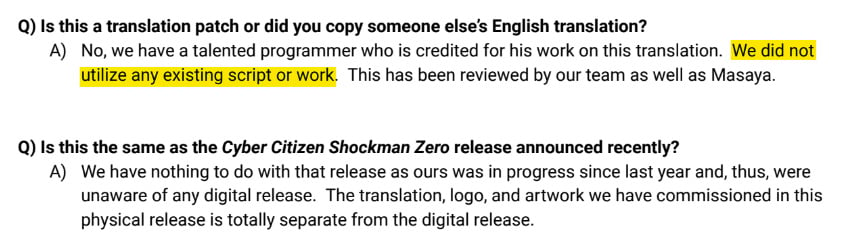
"Retro-Bit has given us the following statement:
We (Retro-Bit) have had success working with a number of translators and programmers to deliver each release. Unfortunately, due to schedule conflicts, we are not always able to work with them on every title. The translator who worked on these titles has a portfolio of translating entire text-heavy games, so we believed he was capable of our translation request since they were games that contained less text. We reached out to the translator for their explanation regarding these claims. After our discussion internally we as Retro-Bit concluded that the final work submitted contained, to a lesser or higher degree, uncredited work. We’ve always had a successful understanding of our shared responsibilities with our collaborators and unfortunately in this instance, we let our guard down.
This was an irresponsible oversight on our end and we take full accountability for this outcome and not verifying the submitted translation. To amend this situation, we will set out to reach those whose work was not recognized to offer a means of resolution.
Although we have upcoming titles that we are excited to release that have never been localized, we will be delaying them to refine our translation and programming procedures to ensure this does not happen again. One of the most rewarding parts of doing these re-releases is collaborating with many talented members of the retro gaming community while being able to support the original developers. Our intent was never to take advantage of that relationship and we apologize for disappointing our fans.
We deeply value the retro gaming community and appreciate your ongoing support and patience as we improve our processes.
Original Story: Retro-Bit, a company which has a long history of re-releasing old-school titles in physical form, has been accused of plagiarising fan-translations—despite its insistence that its localisation efforts are totally bespoke.
Translator Krokodyl has amassed a staggering amount of evidence to back up this claim and has cited four titles which prove it: Shubibinman Zero / Shockman Zero, Assault Suits Valken, Gley Lancer and Majyūō: King of Demons.
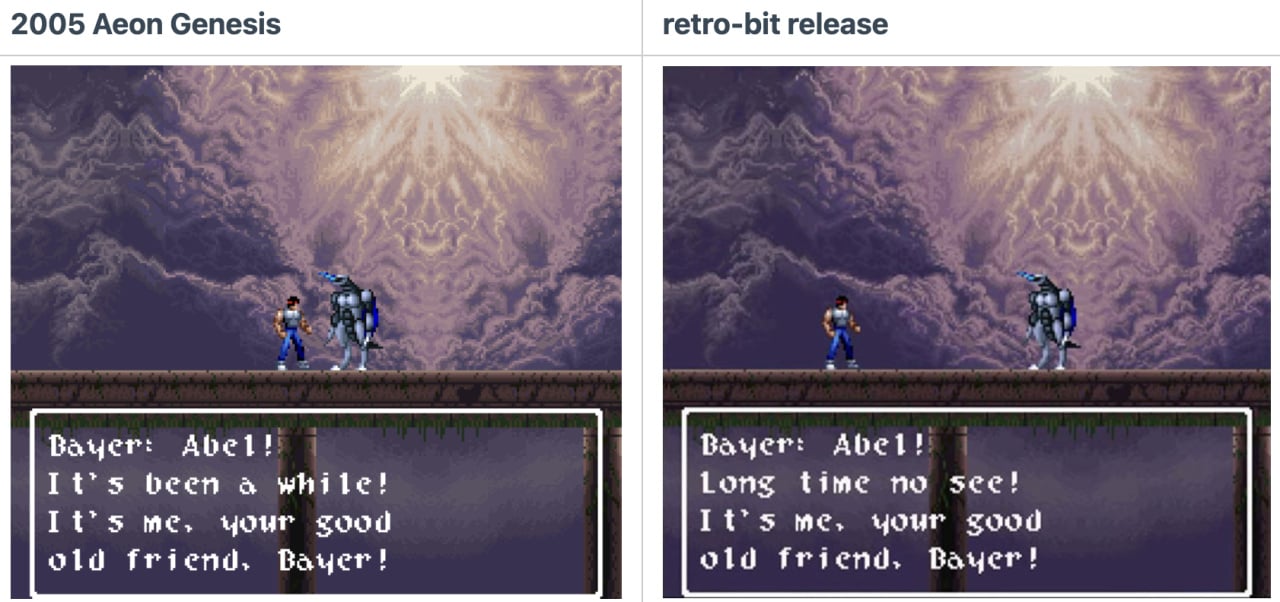
The post is worth viewing, as it's quite lengthy and includes an overwhelming amount of information and evidence. To summarise, Krokodyl highlights elements such as copied fonts, near-identical translated text and errors which appear both in the plagiarised translation and Retro-Bit's releases. Krokodyl also uses special tools to analyse and compare hex data to see how closely the two match. It's pretty damning stuff, and it would be amazing if all of this were merely a coincidence.
In Shubibinman Zero, The line よくおぼえておくわ means “I’ll remember this well”. Svambo translated this as “I’ll put you on my list!” and this line is used in the Retro-Bit version, too — Image: Krokodyl
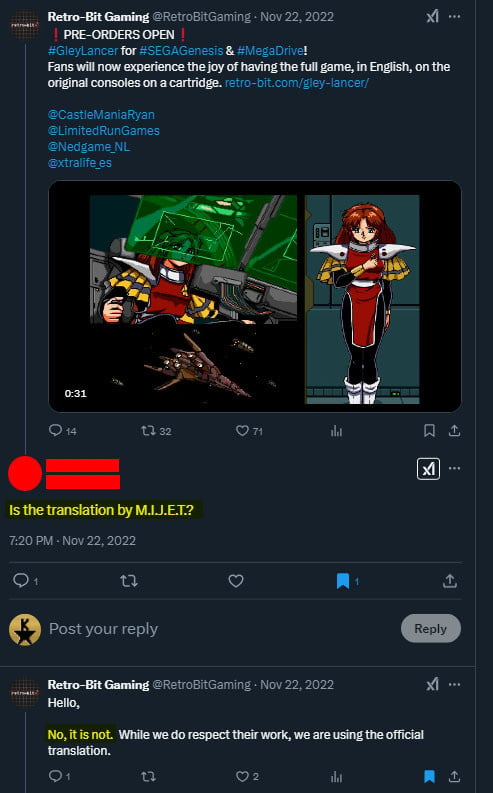
One of the most compelling pieces of evidence relates to Gley Lancer, which, Krokodyl alleges, is based on MIJET's translation from 2006. The game includes both an English and Japanese script (something Retro-Bit itself fails to note), and MIJET's name appears in the Japanese version of the game's "good" ending—which Retro-Bit's translator clearly didn't read properly.
It's important to note that with all four of these games, Retro-Bit has publicly stated that it has not used any existing translation for its versions. The credits on Retro-Bit's games all list the same person as the translator.
Image: Retro-Bit / Krokodyl
Image: Retro-Bit / Krokodyl
Image: Retro-Bit / Krokodyl
Image: Krokodyl
"I suspect that several of retro-bit’s releases presented as new and original translations of old SNES and Genesis games are, in fact, plagiarism of existing fan translations or, in at least one instance, other official translations," concludes Krokodyl. "By plagiarism, I mean that they’ve used graphics, code and/or texts from pre-existing translations while claiming otherwise."
Krokodyl notes that Aeon Genesis—the translator behind Assault Suits Valken and Majyūō: King of Demons' previous fan translations—has worked with Retro-Bit in the past and has always been credited. However, Aeon Genesis was not involved with any of these releases, nor were MIJET (Gley Lancer) or Svambo (Shockman Zero), as Krokodyl has reached out to all three and asked.
While Krokodyl admits that some of the evidence could be circumstantial, "having translated about a dozen games from Japanese to English over the last few years as an amateur translator and a professional developer, I am utterly convinced that these four translations by retro-bit use previous fan translations extensively in terms of graphics, game code and scripts. I am convinced that they are not original Japanese to English translations, and can only exist because of previous translations."
Retro-Bit's version of Majyūō: King of Demons uses the same font as Aeon Genesis's translation — Image: Krokodyl
Krokodyl also points out that, even if these translations had been acquired legally, "the claim of not using existing work would be false advertisement. You can’t have it both ways. I believe that the FAQ that claims that 'a talented programmer' is working on the translations from scratch is a blatant lie. They’re not working from scratch and they are not talented. My understanding is that the translations are commissioned and not done in-house."
Long-standing readers of Time Extension will note that we've covered Retro-Bit's releases in detail in the past. The company has always been kind enough to supply us with pre-release copies of its titles and has helped organise giveaway competitions via social media. In light of these accusations, we will be reviewing this relationship moving forward.
We have also reached out to Retro-Bit over the weekend for a statement and will update this piece when we hear back."

Prof. Dr. S. Goksel Turkozu, the translator of the Nobel Prize-winning book ''The Vegetarian'' by Han Kang into Turkish, received a scholarship from the Korean government and earned his master’s degree in Korean Language Education at Seoul National University in 1996, followed by a Ph.D. in 2004.
How did you grow interested in Korean?
My interest began with the 1988 Seoul Summer Olympics. Growing up, I'd often heard about the Korean War, so I assumed Korea was a poor country. When I watched the Olympics on television, I was amazed to see how modern and developed the country had become. The combination of the Korean War stories I'd heard while growing up and the impression the Seoul Olympics left on me ultimately inspired me to study Korean.
How did you learn the language?
When I first visited Korea, I began reading literary works to improve my Korean. As I read, I noticed many cultural similarities between Turkiye and Korea, which sparked my desire to translate Korean literature into Turkish. After returning home, I began working on this.
Why did you choose to translate Han Kang's works starting with "The Vegetarian?"
The novel was my first encounter with her writing, and it left a profound impact on me. When April Publishing House approached me in 2015 to translate the novel, I hadn't read her work though I was aware of her name. After reading it, I was deeply moved and knew Turkish readers could relate to it on many levels. Translating the book opened the door to discovering more of Han's works, and each deepened my admiration for her ability to tackle societal structures and resist violence in the world.
S. Goksel Turkozu in 2017 meets "The Vegetarian" author Han Kang at a cafe in Seoul.
You met Han in Seoul in 2017. What did both of you discuss?
After translating "The Vegetarian," we met in Seoul. She is a respectful and gentle woman and was invited to Turkiye several times, but couldn’t come due to her busy schedule.
After the book came out, many readers questioned why it wasn't titled "The Vegan." I asked her this and her response was the term wasn't commonly used in Korea while she wrote the book, and Korean had no equivalent for it. At the time, vegan even in Turkiye wasn't widely known or used.
How was translating "The Vegetarian?"
Translating Han's works was a unique experience due to her clear yet profound writing style. Even her simplest sentences carry deep meaning, so capturing that depth wasn't easy. To preserve Han's perspective and emotional tone, I immersed myself in the characters' experiences and tried to see things through their eyes. Sometimes, it took hours or even days just to find the right word or phrase.
What do you find unique about Han's works?
The striking power of her language. Her writing is sometimes intense and even overwhelming for the reader, as she doesn't shy away from discomforting or challenging emotions. She pushes readers to think deeply and empathize with her characters, making the translation process demanding. It wasn't just about finding the right words but also maintaining the emotional weight and authenticity of her characters' journeys.
In literary talks you've attended, what do strikes readers the most about this book?
In the many literary discussions I attended, I was once asked if I liked the main character Yeong-hye, which was such a thought-provoking question. My answer was a definite yes.
Based on my experience, Turkish readers deeply appreciate Han's language. Korean literature was relatively unknown in Turkiye, but it's become significantly more recognized thanks to her. Those who read Han's works have grown curious about other Korean authors. But Korean literature is still not as well known as its Western, Latin or Japanese counterparts. For Korean literature to gain further recognition, more quality translations are needed.
What advice do you have for those interested in translation of Korean literature?
To be a good translator, my humble advice is to read a variety of literary works from different genres and translations from different languages. You also need a solid command of your own language. Finally, a translation is always incomplete if the translator lacks deep and extensive understanding of the target language's culture, history and people.
https://www.korea.net/NewsFocus/HonoraryReporters/view?articleId=265934
"...The challenges of translations
This novel — titled Uma Jornada de Amor e Aprendizagem in Portuguese or Un Voyage d’Amour et Apprentissage in French— narrates the everyday life of a Black family, exploring themes of interrelationships, well-being, and positive parenting. Through this work of translation, I’ve seen translation not just as a linguistic task but as an act of cultural preservation — one that ensures narratives remain authentic while becoming accessible to a wider audience.
In an interview with The Varsity, Da Silva explains her book and its main objectives in French, stating that, “Mon objectif était d’aider les parents à mieux comprendre les besoins émotionnels de leurs enfants et à cultiver des relations plus harmonieuses et intentionnelles” (My goal was to help parents better understand their children’s emotional needs and foster more harmonious and intentional relationships).
The translation process for the novel involved more than just converting words from one language to another. It required a degree of cultural understanding to ensure that the message retained its original meaning and emotional impact. Some phrases — particularly those related to conscious parenting — had no direct equivalent in some target languages. In these cases, the translation had to be adapted rather than translated literally to preserve the essence of the text’s original meaning.
Additionally, certain cultural perspectives on discipline and parental authority must be carefully balanced to remain faithful to the original intent while making sense to a different audience. Beyond the important devotion to linguistic accuracy, the translation process also required translators to convey the emotions, values, and deeper messages of the novel.
Da Silva went on to say that, “Par exemple, certaines expressions autour de l’éducation bienveillante n’ont pas d’équivalent exact dans toutes les langues. Il a fallu reformuler certaines phrases pour qu’elles gardent leur essence sans perdre leur signification pour les lecteurs d’une autre culture” (For example, some expressions related to gentle parenting do not have an exact equivalent in all languages. It was necessary to rephrase certain sentences so that they retained their essence without losing their meaning for readers from another culture).
Translating any text — whether an article or a novel — requires cultural sensitivity and careful navigation of nuanced concepts. In this way, the process for Da Silva’s book ensured an accurate rendering of ideas like conscious parenting and discipline, making the book accessible to a wider audience. Beyond broadening its reach, the translation also fosters meaningful discussions about conscious parenting within Black communities, amplifying their experiences within the global conversation.
Translation and representation
As translators, it is important to stay updated with any terms added in the languages we work in. This way we can guide readers into an up-to-date translation while maintaining the original meaning of the message being delivered.
A prime example of this is Úrsula, a novel written by Maria Firmina dos Reis, who broke new ground in Brazil’s literary scene and revolutionized history — particularly within the Afro-Brazilian diaspora. Set in the nineteenth century, the novel explores themes of slavery, oppression, and resilience through the story of its titular character, Úrsula, and the enslaved people around her.
Translation, in this sense, is an act of cultural preservation and empowerment.
William U. Ferreira Da Silva, Varsity Contributor
Úrsula gave a new voice to the Afro-Brazilian experience, critiquing the brutal realities of slavery to not only mark a milestone in Brazilian literature, but also become a powerful testament to the strength and agency of the Afro-Brazilian diaspora.
In Úrsula, the resistance portrayed is not just against the institution of slavery, but against the systems that sought to strip people of their humanity. The novel gives voice to characters of African descent who resist the dehumanizing forces of slavery in various ways. From subtle acts of defiance to outright rebellion, these characters fight to maintain their dignity and assert their right to freedom. Their resistance bore a testament to the strength of those who lived under oppression but never accepted it, and the novel played a crucial role in shaping nineteenth century abolitionist discourse.
Racial identity in Úrsula links itself to this resistance. The novel highlights the complexity of Afro-Brazilian identity, showing that even within the brutal confines of slavery, characters strived to preserve their sense of self and their cultural heritage. Through their experiences, the novel critiques the rigid racial hierarchies of nineteenth-century Brazil, challenging the dehumanizing stereotypes of Afro-descendants. The novel makes it clear that slavery not only oppressed bodies but also sought to erase cultural identities.
Yet, through acts of resistance and self-preservation, Úrsula ultimately affirms the humanity, worth, and identity of Afro-Brazilian people — pushing for a broader understanding of racial equality. It also gave a stepping-stool for the native speakers to reclaim their history in their own linguistic and cultural framework, strengthening the African diaspora. From Úrsula’s lessons, the work of translation exemplifies how a simple text can not only inform, but also empower marginalized communities by reinforcing their cultural and linguistic heritage.
Just as actress Lupita Nyong’o speaks of the power of seeing someone who looks like you achieve the impossible, I’ve come to understand the profound impact translation can have in making stories from underrepresented communities more visible and accessible. In translating Uma Jornada de Amor e Aprendizagem, I realized that the work went beyond converting words between languages — it meant breaking down barriers and fostering understanding.
As I carefully navigated the nuances of language, I felt myself helping to preserve and amplify the voices of Black families whose stories deserve to be heard on a global scale.
Translation, in this sense, is an act of cultural preservation and empowerment, allowing important narratives from Black history and culture to reach broader audiences and inspire change. Let it remind us that when we share these stories, we do not just translate words — we make history more inclusive and shape a more informed future."
https://thevarsity.ca/2025/02/23/breaking-language-barriers-the-power-of-translation-in-cultural-preservation/

EqualyzAI, a pioneering African-centric AI start-up, has developed an AI app that supports native tongues.
"...Founded by award-winning experts, Dr. Olubayo Adekanmbi and Dr. Ife Adebara, EqualyzAI is committed to ensuring African languages, cultures, and contexts remain central to the global AI evolution.
Adekanmbi, at the unveiling event, over the weekend, in Lagos, to commemorate International Mother Language Day, said the company’s mission is to ensure that AI speaks Nigerian local languages, understands contexts in text, speech, images, and videos, and solves Nigerians’ unique challenges.
“Our mission is to ensure that AI speaks our languages, understands our contexts in text, speeches, images and videos, and solves our unique challenges. This is not just about technology; it’s about empowerment and inclusion. At EqualyzAI, we are bridging this gap by creating AI solutions trained on African realities, ensuring that no one is left behind,” Adekanmbi averred.
Adebara further emphasised the importance of localized AI solutions, stating: “Language is a gateway to knowledge, opportunity, and identity. By building AI that understands and speaks African languages, we are preserving our cultural heritage and creating tools that can transform lives. Africa is home to over 2,000 languages, yet most AI models struggle to understand even a fraction of them. Our goal is to change this by developing AI that speaks and understands Africa’s languages, unlocking new opportunities for education, business, and social impact.”
At the event, EqualyzAI demonstrated its cutting-edge AI solutions designed to address critical challenges in Africa while promoting linguistic diversity. Key innovations include: DataCollect, a platform designed to collect hyperlocal datasets needed to build AI solutions that speak many African languages, ensuring inclusivity and representation; AfroSLM 1.0, a Small Language Model (SLM) optimised to improve financial literacy in Yoruba and Hausa, empowering users with accessible financial education in their native languages and uLearn, an LLM-powered tool for teachers to generate lesson plans, notes, and quizzes in English and local languages, revolutionising education delivery across Africa.
Additionally, EqualyzAI shared its recent white paper, titled “How Small Language Models (SLMs) Are Revolutionizing Localized AI Innovations for Social Good in Africa.” The paper explores the transformative potential of SLMs in addressing Africa’s unique challenges and advancing AI accessibility.
EqualyzAI is not just building AI models—it is fostering a movement to democratize AI and make its possibilities accessible to all Africans. By investing in hyperlocal AI innovations, the company aims to create solutions that empower communities, drive economic growth, and preserve Africa’s linguistic heritage.
https://leadership.ng/nigerian-startup-develops-ai-app-to-support-native-tongues/
#metaglossia_mundus

Digital communication is reducing vocabulary among youth, impacting cognitive abilities. Experts warn of the risk to critical thinking and cultural heritage.
https://www.turkiyetoday.com/lifestyle/are-young-people-losing-their-linguistic-skills-experts-warn-of-alarming-trend-122872/
The rise of digital communication is leading to a sharp decline in vocabulary among young people, which in turn is negatively impacting their cognitive abilities, experts warn.
Professor Deniz Melanlioglu, a faculty member at Istanbul University’s (IU) Department of Linguistics, emphasized the alarming trend: “Young people today use a very limited number of words. They often shorten words when expressing themselves. If we lack a rich vocabulary, we also lack sufficient capacity for critical and creative thinking.”
A language shaped by geography and history
Speaking to Anadolu Agency on the occasion of International Mother Language Day, Professor Melanlioglu highlighted the fundamental role of geography and history in shaping a language.
“Geographical conditions influence human physiology and the development of vocal organs. Some sounds that exist in Turkish, such as ‘ü, ö, i,’ do not appear in other languages. Likewise, the guttural ‘h’ sound is challenging for Turkish speakers due to anatomical factors. Over centuries, language is shaped by how people interpret and define their environment,” she explained.
Melanlioglu also noted the socio-cultural factors that influence language evolution. “For instance, in early Turkic societies, horses were central to daily life, so the language had many words related to horses. However, as modern life has changed, the vocabulary related to horses has significantly diminished,” she added.
Professor Deniz Melanlioglu from Istanbul University is giving a statement to an AA reporter. (AA Photo)
Is Turkish language at risk?
Despite global threats to linguistic diversity, Melanlioglu believes that Turkish remains protected. She emphasized that strong educational policies are key to preserving a nation’s language and identity.
“Being a nation starts with having a collective identity, and language is the primary unifying factor. Without a shared language, individuals remain isolated as ‘I’ rather than forming a ‘we.’ If a society loses its language, it risks losing its national identity as well,” she warned.
She pointed to positive steps in Türkiye’s education system, such as requiring students to repeat a grade if their Turkish language skills fall below a certain level. Additionally, Türkiye’s Ministry of Education has developed programs to help Turkish children abroad maintain their native language.
Thousands of languages face extinction
According to UNESCO, more than 7,000 languages are spoken worldwide, but many are at risk of extinction. “This is not just an issue for small indigenous languages. Even in Europe, many languages are struggling to survive. Institutions such as the European Council are actively working to prevent linguistic extinction,” Melanlioglu noted.
While Turkish remains one of the widely spoken languages across Asia, Africa, and the Balkans, it does not have the same global influence as English, Chinese, or French. “The widespread use of these languages is largely due to colonial history and population size rather than linguistic superiority,” she remarked.
A beginner Turkish language learner writing ‘Hello=Merhaba’ for homework, captured in a close-up shot of a notebook. (Adobe Stock Photo)
Should foreign words in Turkish be a concern?
Language evolution is inevitable, and borrowing words from other languages is a natural process, Melanlioglu argued.
“Throughout history, Turkish has absorbed words from Arabic, Persian, and French. Take the word ‘merdiven’ (staircase) for example—it originated from Persian but has been adapted to fit Turkish phonetics. If a word conforms to our language’s sound rules, it becomes part of our vocabulary,” she explained.
Impact of social media on language
Digitalization has had a profound effect on language use, particularly among young people. Social media has introduced a more condensed form of communication, reducing the variety of words people use in daily interactions.
Melanlioglu warned that this trend could have significant cognitive consequences: “Language is the foundation of thought. If we do not possess a rich vocabulary, we cannot fully develop our ability to analyze, criticize, and create. To preserve our native language and pass it on to future generations, we must actively expand our vocabulary.”
She stressed the importance of initiatives aimed at enriching linguistic skills, highlighting that efforts to enhance vocabulary are crucial for maintaining both cultural heritage and intellectual development.

Claudia Quevedo-Webb, César Hoyos Álvarez, María Jesús Barros García and Spencer Striker have been named the 2025 recipients of the Alumnae of Northwestern University’s Award for Curriculum Innovation.
"...Although study abroad experiences are recognized for developing critical intercultural communicative competence (ICC) in language learners, not all students can study abroad, and if they do, they may not have the opportunity to take part in cultural practices.
The team's curricular innovation utilizes VR to immerse students in various scenarios and real-life situations. Paired with classroom discussions, cultural comparisons, and self-reflection, this approach helps students develop cultural competence and a deeper appreciation for different cultures.
María Jesús Barros García
Quevedo-Webb’s research focuses on using new technologies in the language classroom and diversity and inclusion practices. She joined Northwestern in 2022.
Hoyos Álvarez joined Northwestern in 2022. His research centers around the application of critical pedagogies and addresses the need for more inclusive learning environments that cater to the linguistic and socio-affective needs of emergent bilinguals.
Barros García joined Northwestern in 2018. Her research focuses on intercultural pragmatics, politeness theory and second language acquisition.
The future of digital media design
Spencer Striker is an associate professor of digital media design at Northwestern Qatar.
His curricular innovation is to integrate creative production curriculum with NU-Q’s AIM Lab research to advance human centered AI innovation in media, creative production and digital communication..."
https://news.northwestern.edu/stories/2025/02/award-for-curriculum-innovation/
#metaglossia_mundus

La littérature bretonne dans le sillage de Gwalarn
Cette année 2025 est celle du centenaire de la création de la revue Gwalarn (165 numéros publiés de1925 à 1944) par Roparz Hemon (1900-1978), centenaire qui va être commémoré tout au long de l’année. Cette revue en langue bretonne fut la revue phare de l’école Gwalarn, mouvement littéraire d’une langue bretonne modernisée, normalisée et ouverte sur le monde comme en témoignent les nombreuses traductions en breton d’oeuvres littéraires majeures de France et du monde.
Lire, traduire et produire des oeuvres prestigieuses en breton
Combien de Brezhonegerien (Bretonnants ou néo-bretonnants instruits, c’est-à-dire capables et désireux de lire du breton) achètent à l’heure actuelle au moins un livre en breton par an ? Faire connaître les traductions en breton d’oeuvres prestigieuses d’écrivains étrangers ne serait-il pas l’un des moyens de motiver les adultes comme les adolescents à lire du breton ?
- Le Conseil régional de Bretagne subventionne les traductions et la publication en breton d’une liste de romans classiques ou modernes célèbres en français ou en langues étrangères. Cette liste est téléchargeable sur le site de l’OPAB (Office Public de la Langue Bretonne).
- À l’ICB-SUAV (Institut Culturel de Bretagne), dont la médiathèque comprend 20% de livres en breton, 200 livres d’écrivains étrangers traduits en breton ont été répertoriés.
Oeuvres de William Shakespeare traduites en breton
Pour les oeuvres de W. Shakespeare, l’CB peut citer cinq traductions : d’une part les trois livres publiés par Al Lanv en 2007 puis 2011 Makbez ( Macbeth) ; Ar Geben Doñvaet (La mégère apprivoisée), traduction de Y.L. Emili, Romeo ha Julieta, et Otello, les deux traductions de Marsel Klerg. D’autre part en 2014, chez Skol Vreizh : Komedienn mil luiet (The Comedy of errors), traduction de Marie-Hélène Morvan et S. Botrel. Et en 1999 (N° spécial 213 de la revue Brud nevez) Buhez ha maro ar Roue Yann (Vie et mort du Roi Jean), traduction de J.C. Miossec.
Quelle autre œuvre de Shakespeare, pouvant notamment intéresser les troupes de théâtre en breton, retiendra l’attention des traducteurs ? Pourquoi pas Hamlet ? Ou Richard III, pièce qui donne l’occasion d’évoquer l’implication de la Bretagne de François II dans la guerre-des-deux-Roses ? Ou une pièce plus courte qui retient encore l’attention de notre monde telle que The Tempest ? Ne serait-ce pas un bon objectif pour le centenaire de Gwalarn ?
Littérature fantastique pour adolescents
Les adolescents qui sont fascinés par les mangas ou privilégient le monde de la littérature fantastique, peuvent déjà lire en breton: Harry Potter ha Maen ar furien ou Harry Potter ha kambr ar sekredou
Citons aussi la traduction en breton de The Hobbit de JRR Tolkien An Hobbit par Alan Dipode et Joshua Tyra publié par Evertype en 2020. A noter que la trilogie Le seigneur des anneaux est sur la liste des oeuvres à traduire que propose l’OPAB , ainsi que l’oeuvre de Salman Rushdie Haroun and the sea of stories.
Une proposition de traduction à l’attention des adolescents
Qui s’engagerait à traduire par exemple l’œuvre de l’écrivain anglais Philip Pullman né en 1946, dont le premier tome de la trilogie À la croisée des mondes est paru en 1995, marquant profondément l’imaginaire collectif ? Traduite en 40 langues et totalisant près de 20 millions d’exemplaires vendus, l’oeuvre a été jouée au National Théâtre de Londres avant d’être transposée au cinéma, dans un film au casting prestigieux. Lauréat de la médaille Memorial Astrid Lindgren, l’équivalent jeunesse du prix Nobel, l’auteur a aussi reçu en Grande-Bretagne deux prix majeurs de littérature générale, jamais décernés auparavant à un livre pour enfants : Philip Pullman est lauréat du British Book Awards 2018 et du Prix J.M. Barrie en 2019.

Policymakers must balance the need to preserve mother tongues while educating young people in a lingua franca such as Portuguese.
"As the world marked International Mother Language Day on 21 February, two former Portuguese colonies with diverse linguistic traditions faced distinctly different challenges in balancing the preservation of culture with the need to exist in an increasingly connected world.
The majority of the 16 mother languages of Timor-Leste are quickly disappearing amid the proliferation of official languages (Portuguese and the largest native language, Tetum) and lingua francas (Indonesian and English). Besides Tetum, which is used within the Catholic Church, only two other languages have a strong base of native speakers in the country: Makasae (spoken mainly in the eastern Baucau municipality) and Mambae (spoken across several west-central municipalities, such as Ermera, Aileu and Ainaro).
The other 13 languages identified by Davi Albuquerque in his 2003 paper As línguas de Timor Leste: perspectivas are rapidly disappearing or even extinct, as is the case with Makuva, now used solely in rituals conducted by elders in Lautém, the country’s eastern-most municipality.
“All Timorese must defend their mother tongue because it represents their culture and identity,” remarked Rosa Tilman, director of the National Institute of Linguistics at the National University of Timor-Leste, to the Portuguese news agency Lusa. With so many of the languages having no written component, she pointed out, increasing the number of speakers is vital.
Another lusophone nation, Mozambique finds itself facing the opposite problem. The southern African country boasts more than 40 mother tongues, and the majority of the population speaks one or more as their first language. Portuguese, the official language of Mozambique, is far less widespread, with around 90 percent of Mozambican children beginning school without knowing it.
Mozambican authorities introduced bilingual education in primary schools in 2015 to address this problem, and by 2024, a total of 2,894 schools used the bilingual model, benefiting a total of 886,998 students, according to government data. Yet the model has fallen far short of its goals, according to Armindo Ngunga, a linguistics professor at Eduardo Mondlane University (UEM) and former deputy minister of education, who worked on the rollout a decade ago.
Ngunga lamented the lack of emphasis on bilingual education in the country, telling Lusa that teachers often end up passing children who don’t know the material “because if they were to fail them, they would fail everyone.” He called for more training, so teachers are equipped with the tools they need to provide a bilingual education, and to extend the curriculum to secondary schools.
Ngunga believes these changes and a clear political will are necessary to reach the goal set by the government in 2019 of over 5 million students studying in both Portuguese and a native language by 2029."
https://macaonews.org/news/lusofonia/native-languages-present-unique-challenges-across-the-portuguese-speaking-world/
"...Les motifs sont nombreux dans cette œuvre méticuleuse, furieusement engagée dans son sujet jusqu’à la fin. Les métaphores se tissent, mais sans surplomber l’œuvre d’un regard politique ou critique. Les jeunes actrices décrivent Une langue universelle comme un film sur l’amitié et sur le croisement entre deux cultures très éloignées, la canadienne et l’iranienne, qui en viennent pourtant à se ressembler. « Il n’y a pas de temps ni de lieu. Il n’y a pas d’horloge. Je n’ai jamais vu un film comme celui-là, qui croise de cette manière deux cultures », remarque Rojina..."
https://www.ledevoir.com/culture/cinema/836920/langue-universelle-comme-soeurs
#metaglossia_mundus

A lightly satirical and surrealist comedy imagines the snowy Canadian city in the style of the Iranian New Wave.
"...“Universal Language” is likely to most please the viewer who has dwelt, so to speak, on one side or the other of the imagined Winnipeg (or both). But when all smushed together into one plot and laced with humor about Canada, they take on a dreamy quality, augmented by sequences (like one with a skater in a sparkly costume) that seem dislocated entirely from time and space. Instead of positing a world where one culture has assimilated into the other, “Universal Language” imagines a world where the two have merged, and now a new cultural identity peacefully exists, a culture in its own right..."
https://www.nytimes.com/2025/02/13/movies/universal-language-review.html
#metaglossia_mundus

El nuevo libro del argentino Andrés Neuman recrea la historia de esa lingüista excepcional, autora del diccionario más completo y divertido del español.
"...Hija de un médico de a bordo que enfiló hacia la Argentina, espaciando los contactos hasta esfumarse, y de una de las pocas mujeres de su época que sabía leer y escribir, María Moliner fue una self made woman que Neuman recrea con elocuencia, desde una infancia en la que se conjugan “una madre enferma, un padre fantasma y ningún capital”, con la ambición de soñar un diccionario y la hazaña solitaria de concretarlo como puntos culminantes.
Últimas noticias
Durante su investigación, el autor de Bariloche se sentó a leer ambos tomos de cabo a rabo y afirma que sus páginas cifran una autobiografía secreta de la filóloga y una contestación tan documentada como elegante al diccionario de la Real Academia Española de 1956 con el cual debatía.
En el verbo “bloquear”, por caso, María agregó a las acepciones oficiales una ausente: “detener o interceptar algo para que no llegue al sitio donde va dirigido; por ejemplo, una pelota o una emisión de radio”. Junto al modelo deportivo contrabandeó el otro, especialmente significativo en dictadura.
A medida que el diccionario fue invadiendo cada rincón del departamento (las entradas abordan definiciones, sinónimos, expresiones, frases hechas y familias de palabras; dos fichas por hoja, un vocablo por ficha, que ocupaban incluso el baño), María temió no terminarlo jamás. No lo apuró, sin embargo; lo cocinó a su modo, incluyendo “una gramática de andar por casa”..."
https://www.clarin.com/opinion/maria-moliner-mujer-sono-diccionario-ahora-novela_0_QyaElgWwXD.html
#metaglossia_mundus

Body odors offer a unique window into the physiological and psychological profile of the emitter. This information, broadcast in nonverbal communication, significantly shapes social interactions. However, effectively digitizing body odors requires a precise framework for perceptual operationalization. Previous research has used a very limited number of verbal terms, such as pleasant, intense, or attractive, which fails to adequately capture qualitative differences. To address this gap, we elicited body odor descriptions from 2,607 participants across 17 countries and 13 languages. All these descriptions are presented here in one dataset, together with a condensed list of 25 body odor words (BOW). Those terms reliably differentiated between body states, and were validated in a separate study with a different group of 155 perceivers. The dataset, available as a web application, provides a novel operationalization of body odor impressions, which is a precondition for studying olfaction in human nonverbal communication, for perception-based digitization of body odors and for comparative studies.
https://www.nature.com/articles/s41597-025-04630-8
#metaglossia_mundus
"...The Bangladesh High Commission in Nigeria has emphasised the importance of preserving indigenous languages as a reflection of history, culture, and shared human connection.
Mr Masudur Rahman, the High Commissioner of Bangladesh to Nigeria, made this known on Friday during the “Martyrs’ Day” and “International Mother Language Day” ceremony in Abuja.
He extended his deepest gratitude to the language martyrs of 1952 who made the ultimate sacrifice in the battle to protect the sanctity and identity of the mother tongue.
The High commissioner underscored the importance of International Mother Language Day in demonstrating respect for and preserving the diversity of languages globally.
He emphasised that mother tongue plays a vital role in fostering peace, mutual understanding and building an inclusive society.
He reiterated the Chief Adviser of the Interim Government of the People’s Republic of Bangladesh and the Foreign Adviser of the Ministry of Foreign Affairs, Bangladesh commitment to the significance of ‘Amar Ekushe February’ (Immortal 21) in Bangladesh’s national history.
“This historic movement aimed at securing the right to the mother tongue and safeguarding the nation’s self-identity and cultural heritage against external threats.”
He also acknowledged the silver jubilee of International Mother Language Day, which was officially recognised by the UNESCO General Assembly in 1999.
He lauded individuals from all linguistic backgrounds, especially Bengali speakers, and recognised the contributions of the Bangladeshi diaspora in preserving and promoting the language and culture.
Prof. Chinwe Anunobi, the CEO of the National Library of Nigeria, emphasised the need for Nigeria to draw inspiration from Bangladesh’s commitment to language preservation to prevent the extinction of indigenous languages.
See also IFRC plans to help vaccinate 500m people against COVID-19
She highlighted the alarming rate at which many Nigerian indigenous languages, particularly in regions like Taraba, are facing the threat of disappearance.
“We have produced a map of Nigerian indigenous languages.
“Taraba has 61 languages and out of the 61, many of them are endangered.
“So, we went to Taraba with the support of regional UNESCO, UN House, to begin to see how we are going to address those at least three that are endangered,” Anunobi said.
Prof. Patricia Lar, the Acting Vice Chancellor of Yakubu Gowon University, Abuja also stressed the importance of incorporating original languages into educational curricula to enhance effective communication and knowledge dissemination.
She outlined plans to develop policies that promote the use of indigenous languages in educational content delivery to bridge the communication gap and foster community development..."
Edited by Ismail Abdulaziz
https://nannews.ng/2025/02/23/martyrs-day-bangladeshi-envoy-advocates-language-preservation/

Researchers are increasingly using language measures to study emotion, yet less is known about whether language relates to other measures often used to study emotion. Building on previous work which focuses on associations between language and self-report, we test associations between language and a broader range of measures (self-report, observer report, facial cues, vocal cues). Furthermore, we examine associations across different dictionaries (LIWC-22, NRC, Lexical Suite, ANEW, VADER) used to estimate valence (i.e., positive versus negative emotion) or discrete emotions (i.e., anger, fear, sadness) in language. Associations were tested in three large, multimodal datasets (Ns = 193–1856; average word count = 316.7–2782.8). Language consistently related to observer report and consistently related to self-report in two of the three datasets. Statistically significant associations between language and facial cues emerged for language measures of valence but not for language measures of discrete emotions. Language did not consistently show significant associations with vocal cues. Results did not tend to significantly vary across dictionaries. The current research suggests that language measures (in particular, language measures of valence) are correlated with a range of other measures used to study emotion. Therefore, researchers may wish to use language to study emotion when other measures are unavailable or impractical for their research question. Language measures tended to relate to observer report, self-report, and in some cases, facial cues of emotion across three multimodal datasets. Similar results emerged for five dictionaries used to estimate valence or discrete emotions in language.

"Journalist Fréderike Geerdink criticises International Mother Language Day as a token gesture by the UN, arguing that true linguistic protection requires recognising forced assimilation as genocide. Drawing parallels between Kurdish and Palestinian struggles, she highlights how the denial of self-determination suppresses languages and cultures, framing it as a systematic process of erasure...."
https://medyanews.net/mother-tongue-day-as-an-act-to-obscure-genocide/
#metaglossia_mundus: Your take? Would linguicide be a form of genocide? Cf. the so-called 'language gene'?
"This study explores the impact of artificial intelligence (AI) in specialized translation processes, using ChatGPT as the primary tool. The research, with an empirical-exploratory and mixed-method approach, focuses on two objectives: first, to analyze the translation skills and strategies used by students employing ChatGPT to translate texts in legal, medical, and scientific fields; second, to describe the post-editing process, evaluating the techniques used to improve the accuracy and cultural adaptation of the final text. The central research question guiding the study is how ChatGPT influences the development of translation skills and what post-editing strategies students apply to enhance their translations. The methodology involves translation practices with a group of 15 advanced students from the Bachelor’s Degree in Translation at UABC, who translated and post-edited three specialized texts with ChatGPT. These exercises, conducted in three-hour sessions, also included the creation of specific terminological glossaries. A specialized rubric was used to measure translation quality, and Translog-II software recorded the time spent on each activity, assessing the efficiency and accuracy of the process. Preliminary results indicate improved efficiency in the translation process and the final product quality through AI tools and post-editing. In the final survey, students also reported a positive perception of ChatGPT, highlighting its utility in developing specific translation competencies..."
https://www.researchgate.net/publication/389252901_Integrating_ChatGPT_and_Generative_IA_apps_in_Specialized_Text_Translation_and_Post-Editing_An_Exploratory_Study

Descubre las más de 4.000 actualizaciones del diccionario de la RAE, con nuevas palabras, anglicismos y términos rechazados
"La RAE incluye más de 4.000 cambios en el diccionario
La Real Academia Española (RAE) continúa actualizando el Diccionario de la Lengua Española (DLE) para reflejar los cambios en el idioma. En la última actualización, se han agregado 4,079 nuevas palabras, se han modificado definiciones y ajustadas etimologías. Entre las incorporaciones destacan anglicismos y extranjerismos, así como términos de uso cotidiano.
Nuevas palabras y anglicismos en el diccionario
Entre las novedades más destacadas se encuentran anglicismos como spoiler , esnórquel , groupie , indie , funk y script . También se han sumado extranjerismos como umami , wasabi , barista , tabulé y sérum . Además, se han incluido palabras de uso común como micelar y chiringuito . Un término que ha generado mucha discusión es DANA , sigla de Depresión Aislada en Niveles Altos, un fenómeno meteorológico cada vez más frecuente.
En el ámbito musical, se incorporan palabras como blusero y rapear , además de anglicismos utilizados en el cine, como funk , groupie e indie . En deportes, se han añadido términos como bicicross , capoeira , curling , drive , fitness y full contact .
Palabras rechazadas por la RAE
A pesar de su uso común, la RAE ha rechazado términos como inaportante , moción , rensionante , comaprendo , líbido y sanduche , ya que no cumplen con las normas del idioma. Sin embargo, ha aceptado palabras compuestas como friegasuelos , arboricidio , turismofobia , elevamuebles , heptacampeón y socioambiental .
Recomendaciones sobre el uso de extranjerismos
La RAE recomienda evitar extranjerismos innecesarios cuando ya existen equivalentes en español. Por ejemplo, sugiere usar resumen o extracto en lugar de abstract . Además, los términos que no han sido adaptados a la ortografía española deben escribirse en cursiva o entre comillas, como gigoló , gentleman , Wellington , Mompou y Düsseldorf .
Consulta las redes sociales de la RAE
La RAE responde rápidamente a consultas sobre el significado o uso de palabras a través de sus redes sociales. Dado que el idioma evoluciona con las tendencias y cambios culturales, es importante mantenerse actualizado sobre las nuevas incorporaciones y recomendaciones.
Con más de 4,000 cambios, esta actualización ha sacudido el idioma español. No te pierdas las últimas novedades lingüísticas y mantente informado sobre las nuevas palabras y anglicismos que están marcando la evolución de nuestra lengua."
https://notigram.com/mexico/tendencias/la-rae-incluye-mas-de-4-000-cambios-en-el-diccionario-20250220-1434065
"Con la finalidad de socializar la lengua de señas de Bolivia, se busca que los educadores puedan acceder a este material para la inclusión de los estudiantes con discapacidad.
El subdirector de educación regular y alternativa, Sady Omar Fernández presentó el II Diccionario de lenguaje de señas destinado a impulsar una educación inclusiva.
Señaló que se espera promover la interculturalidad y que las personas puedan conocer el lenguaje y los maestros estén capacitados para la enseñanza a estudiantes con discapacidad.
Más allá de los centros de educación especial, se espera que se pueda conocer el lenguaje por parte de los educadores de diferentes áreas, ya sea de nivel inicial, primaria y secundaria.
..........
Señor Lector, este es solo un reporte. La información completa está en la edición impresa de El Potosí."
https://elpotosi.net/local/20250220_presentan-el-ii-diccionario-de-lenguaje-de-senas.html
#metaglossia_mundus

"Translator Hwang Seok-hee shares grueling work life during tight deadlines
By OSEN Published 2025.02.23. 00:00 Translator Hwang Seok-hee of 'The World of the Married' has revealed her daily life for the first time. In the MBC entertainment program 'The World of the Married' (hereinafter referred to as 'The Married'), which aired on the 22nd, the real daily life of translator Hwang Seok-hee, who made her mark in the translation industry, was revealed for the first time. On that day, when asked, "Aren't there many fans?" Hwang Seok-hee humbly replied, "I think they like it because it's a flavor they haven't tasted before." In response, Song Eun-yi praised, "Hwang Seok-hee's translations are said to be transcendent translations from another world." Hwang Seok-hee has translated numerous films, but among them, the most impressive translations were for 'Deadpool' and 'Spider-Man: No Way Home.' She gained attention for breaking the mold in her translations, interpreting swear words vividly, matching rhymes, or using emojis. Eventually, Hwang Seok-hee's daily life was revealed for the first time. In the workspace set up in a corner of her home, guitars and her daughter's drawings were prominently displayed. In particular, equipment for translation was also set up. There were two monitors, and three keyboards with different key pressures. When asked if she used three keyboards, Hwang Seok-hee said, "The key pressure, feel, and sound are all different. My fingers hurt a lot, so on some days, I use the one with lighter key pressure." She used a vertical mouse to prevent carpal tunnel syndrome. The manager who later appeared introduced himself by saying, "I started in 2003, and I have 23 years of translation experience," and stated that he is a friend of Hwang Seok-hee and the representative of a translation company. He revealed, "When deadlines are tight, there have been many times she didn't go out at all for 3 or 4 days. When she showered and changed clothes, her legs looked emaciated," which surprised everyone. When the panelists asked, "Doesn't your wife get surprised?" Hwang Seok-hee responded, "My wife is also in the translation field. When I was active in Hanchang, she came to my blog and left a message. It turned out that my wife is a specialist in dubbing translation while I am in subtitling. If you’ve seen Disney animations or live-action adaptations, there’s a good chance you've seen her work." /mint1023/@osen.co.kr ※ This article has been translated using the OpenAI translation tool.
|


 Scoop.it!