 Your new post is loading...

|
Scooped by
Charles Tiayon
August 29, 11:27 PM
|
"2026 World Translators Congress Highlights Shift From Trends to Literary Value By Hwang Ji-yoon Published 2026.08.29. 00:35 Updated 2026.08.29. 06:22 “As the presence of Korean literature on the global stage grows, Korean authors have begun to receive recognition in international literary awards. I would like to celebrate the current situation where works by Korean authors are gaining attention worldwide.” Anders Karlsson, a Swedish translator and professor in the Korean Studies Department at the School of Oriental and African Studies (SOAS) under the University of London, emphasized. His keynote speech opened the ‘2026 World Translators Congress.’ Professor Karlsson has introduced Korean literature to Sweden since the 1990s, collaborating with co-translator Park Ok-kyung. He played a significant role in Han Kang’s Nobel Prize in Literature by translating her full-length novel *We Do Not Part* into Swedish. The Literature Translation Institute of Korea (Director Jeon Yoong-sung), which celebrated its 30th anniversary this year, held the 2026 World Translators Congress and Translation Academy Graduates Homecoming Day at the Grand Mercure Imperial Palace in Seoul on August 28–29. Approximately 150 people related to Korean literature, including renowned translators, researchers, publishers, and cultural industry experts, visited the venue from the first day. Speakers included Professor Jeong Eun-gwi of Hankuk University of Foreign Studies, English subtitle translator Darcy Parker, and novelist Mun Ji-hyeok. Professor Karlsson stated on this day, “Thirty years ago, when I entered a large bookstore in London and asked if there were any books about Korea, I would receive a somewhat bewildering response directing me to the Southeast Asian section. However, today, numerous Korean books are prominently displayed in London bookstores,” adding, “I feel the change in the status of Korean literature.” However, he expressed concern about the phenomenon of translating works by merely following the latest publishing trends. He said, “Now that Korean literature has established its position on the global stage, when deciding which works to translate, we should focus on qualitative aspects,” adding, “We must consider what qualitative elements give a work enough value to be translated into other languages and introduced to readers around the world.” What works should be translated? How to discover valuable works? It was concluded that these are questions translators must fervently ask. Cristina Baon Arnaiz, a Spanish translator and associate professor at the Autonomous University of Madrid, said, “Translation is not merely a task of changing languages but recreating the literary experience itself within another language.” French translator Jeong Irene defined a ‘translator’ as “someone who devises strategies, transforms texts, and continuously makes aesthetic judgments.” This article has been translated by Upstage Solar AI." https://www.chosun.com/english/travel-food-en/2026/08/29/FSJ25T3KAFD5THURBW3AYYB3OI/ #metaglossia #metaglossia_mundus

"Charles Tiayon, cartographer of the translation world
Charles Tiayon is a translator, lecturer and consultant whose Scoop.it activity reflects the professional universe named in his bio: translation, terminology, lexicography and intercultural issues. Through METAGLOSSIA, his public selection tracks language as a field of work, a field of rights, and a field being altered by AI.
A systems view of language
Tiayon looks at translation as a living system. His selections connect interpreters, translators, dictionary makers, universities, publishers, language activists and software companies, rather than treating them as separate worlds.
Technology with memory
AI is a recurring concern, but it is not treated as the whole story. Real-time speech translation, OCR and voice AI appear alongside older and slower forms of linguistic work: dictionaries, terminology, literary translation and language education.
A multilingual compass
The geographic spread is notably international, with attention to French, Spanish, Chinese, Arabic, Maltese, Breton, Ukrainian, Filipino, Indigenous languages in Canada and Indian language politics. No single country dominates the map.
What defines this selection
Archive-scale attention
With 99,235 posts analysed in a single topic, this is a long-running, high-volume observatory of the translation world. The account dates back to 2011, giving the selection the feel of an archive as much as a live feed.
A broad professional lens
The material moves easily between AI translation tools, national dictionaries, literary translation, terminology work, market news and language policy. That range reflects a professional view of language work as both craft and infrastructure.
Mixed-source reliability
The sources span institutions, universities, technology companies, mainstream media and regional outlets. UNESCO, university sites, DeepL, Mistral, CBC, Ouest-France and other sources create a mixed diet of policy, research, product news and local reporting.
Specialist reach, public scale
The audience numbers are substantial, with more than 567,000 views and over 424,000 unique visitors across all topics. The reach suggests sustained interest beyond a narrow specialist circle.
Topics
◍
Metaglossia: The Translation World
This flagship topic covers translation, interpreting, intercultural communication, terminology and lexicography as they unfold in public life. It is especially strong on AI language tools, institutional language policy, minority languages, literary translation and dictionaries.
99.2K posts
en
Deep dives
Where language becomes infrastructure
Charles Tiayon’s main topic reads like a newsroom for the language professions, but with a wider lens than trade news alone. Translation, interpreting, terminology and lexicography appear beside minority-language rights, literary circulation, dictionaries, competitions, and the fast-moving world of AI speech and OCR tools.
Metaglossia: The Translation World
The strongest thread is the collision between language as culture and language as system. A new Maltese digital dictionary, a Doha historical dictionary with text-to-speech, UNESCO and Unicode cooperation, and First Nations language translation all sit in the same frame as DeepL, Mistral OCR, and real-time speech models.
Metaglossia: The Translation World
His editorial voice is not silent aggregation. The analysis points to regular INSIGHT notes, often substantial and quote-based, with an explanatory tone and occasional sharper framing when language politics or AI consequences are at stake. The result is a practical map of a field being reshaped by institutions, software, markets and communities at once."
Courtesy
Scoop.it
06.07.2026
#metaglossia_mundus
#metaglossia

In the AI era, a country’s translation capabilities have become a core measure of its cultural soft power and ability to participate in global governance
Professor Li Yan says human expertise is vital to retaining context in AI translations of Beijing’s policy ideas for overseas audiences
"China is being urged to use human translators to refine AI renderings of its political messaging, amid concerns that literal translations could make Beijing’s language sound more threatening abroad.
An article in a state-affiliated academic newspaper said the country should strengthen its translation capacity and guard against AI-generated distortions to improve how its policies and intentions were understood overseas.
As artificial intelligence (AI) takes on more translation work, human translators should work alongside the technology, according to Li Yan, a professor at Xian Fanyi University.
“The value of translation goes far beyond language itself,” Li wrote in an article published on Wednesday in Chinese Social Sciences Today, a newspaper run by the Beijing-based Chinese Academy of Social Sciences.
“In the AI era, a country’s translation capabilities have become a core measure of its cultural soft power and ability to participate in global governance.”
China must guard against cultural misreadings, lapses in logic and value-laden bias when AI translates its political terminology, according to Xian Fanyi University professor Li Yan. Photo: Reuters
Li called on Chinese translators to strengthen their ability to refine AI translations according to context, audience and purpose..."
Orange Wang
Published: 2:00pm, 29 Aug 2026Updated: 5:04pm, 29 Aug 2026
https://www.scmp.com/news/china/diplomacy/article/3365635/ai-can-make-chinas-political-language-sound-more-threatening-scholar-warns?module=perpetual_scroll_0&pgtype=article
#metaglossia
#metaglossia_mundus

"When people apologise, they do more than acknowledge a mistake. They also reveal how they understand responsibility, ethics, social and moral norms, and their relationship with others. These things all differ widely between cultural contexts.
Speaking in a foreign language may directly influence the emotions – such as guilt and shame – that we feel when we apologise. However, apologies are an especially complex type of communication, and are shaped by much more than just the words we use.
Even within a particular culture, people apologise in different ways in different situations. For example, a student apologising to a professor for missing a deadline must do more than simply say “sorry”; they need to acknowledge the missed deadline, take responsibility for the mistake, and communicate respectfully in the context of the professor-student relationship.
Every apology – be it to a spouse, a friend, a colleague, a stranger – has its own set of unspoken rules and expectations.
And although apologies are influenced by a huge range of factors, social power, distance and the seriousness of the offence are especially important. These are often what determine each culture’s approach to apologising, and go far deeper than simply uttering the words “I’m sorry”.
Guilt and shame are not the same
Guilt and shame are often used interchangeably, but they work differently. Guilt says: I did something wrong. Shame says: There is something wrong with me.
That difference matters. Guilt often pushes people to repair the damage by apologising, taking responsibility or making amends. Shame can have the opposite effect, leading people to withdraw, avoid the situation, or stay silent.
Culture also plays a role. Guilt tends to be more strongly emphasised in individualistic cultural contexts (for example, in some Western societies such as Europe and the US). In more collective cultural contexts (for example, in East Asian societies), group harmony and social evaluation are especially important, meaning shame can carry greater social weight.
Both guilt and shame can arise when we feel we have crossed a social line, which makes them central to the act of apologising.
Korean vs Spanish apologies
In a recent study, we investigated how people apologise in their first and second languages. To do this, we focused on native Korean speakers learning Spanish and native Spanish speakers learning Korean.
The study involved 115 participants, all with at least an intermediate level in their second language. Many had also lived abroad in Spain or Korea.
Participants completed an online questionnaire with twelve university-related situations that required an apology, such as missing a tutoring session, losing a borrowed book, or interrupting another student.
The scenarios varied according to social power and social distance. For example, some involved apologising to a close classmate, while others involved apologising to a professor or someone in a higher position of authority.
Participants completed the task either entirely in their first language or entirely in their second language. After each apology, they rated how much guilt and shame they would feel using 10-point scales, and were asked to respond as they would in a real-life situation.
We then identified and analysed different apology strategies. These included direct apologies (“I’m sorry”), self-blame (“it was my fault”), explanations (“I misunderstood the deadline”), and offers of repair (“I’ll replace the book”). In total, we analysed nearly 3,000 apology strategies across the dataset.
Two ways of taking responsibility
Korean and Spanish speakers did not apologise in the same way.
Korean speakers often took responsibility directly, using expressions like “it was my fault” and, at times, strongly self-critical language. Spanish speakers were more likely to soften responsibility. They often explained what happened, stressed that the offence was unintentional, or used impersonal phrases such as “se me olvidó” (which roughly translates as “it slipped my mind”).
This does not imply that one group was more sincere or more apologetic than the other – it shows that cultures repair social relationships differently. In Spanish, this happens through explanation and negotiation, while in Korean, it is often done through a clearer acknowledgement of fault, especially when social power is involved.
Do we feel less in a foreign language?
Speaking a second language can sometimes create emotional distance. Words learned later in life, often in classrooms rather than at home, may feel less emotionally charged than those learned in childhood.
Our findings complicate that idea. Participants did not generally feel less guilt or shame in their second language. They were able to experience strong moral emotions in both languages.
The difference appeared when social power entered the picture. When apologising to someone of higher status, such as a professor, participants expressed guilt and shame more strongly in their first language. This suggests that the emotional weight of authority, responsibility, and social norms may be more deeply rooted in the language we grew up with.
Language learning
Learning a language is not just about grammar and vocabulary. It is also about knowing how to manage emotions, acknowledge responsibility, and maintain positive social relationships.
A learner may know how to say “I’m sorry”, but may not know how that apology will come across in another culture, whether it sounds too distant, too formal, or not sincere enough. Language teaching should therefore include intercultural pragmatics: not only what to say, but how to say it, when to say it, and how much emotional weight it should carry.
In international workplaces, universities and online spaces, people often need to apologise. However, what sounds sincere and responsible in their first language may sound cold, exaggerated, or evasive in a different language. Understanding how emotions like guilt and shame are expressed across cultures can help reduce misunderstandings in intercultural communication, especially in contexts influenced by authority and social expectations."
Psychology
Language
Cultural norms
Apology
The Conversation Europe
Irini Mavrou, Universidad Nebrija, UCL, Lucía Martín Pérez, Universidad Nebrija
https://theconversation.com/why-its-so-hard-to-apologise-sincerely-in-a-foreign-language-289918
#metaglossia
#metaglossia_mundus
"'Language is a dialect with an army and a navy:' Chinese speakers reflect on diversity in Richmond
“Chinese is not just Mandarin or Cantonese; we have a lot of dialects,” says a KPU undergraduate.
Zachary Zheng
Imagine you speak Mandarin, but another Chinese person in Richmond asks you for directions in their own dialect, and you feel lost because what they are saying sounds like a foreign language to you.
For many Chinese people living in Richmond, this could be part of their daily experience.
“Chinese is not just Mandarin or Cantonese; we have a lot of dialects,” said Jojo Dong, a Kwantlen Polytechnic University student who grew up in Richmond.
Dong’s grandparents immigrated to Canada from Taishan county, Guangdong province, which is across the water from Hong Kong.
Growing up with her grandparents, Taishanese was the first Chinese dialect she learned.
She later learned Cantonese from her mother, who grew up in Guangzhou. Dong then began studying Mandarin at language schools in Richmond and Vancouver from the age of three until she was 17.
She has heard many Chinese dialects in Richmond, including Hakka and Shanghainese.
Although Hakka is also spoken in her family's home province of Guangdong, Dong said it's “very different” from Taishanese.
“As a Taishanese person, I can only understand the tiniest bits,” she said. And, if someone speaks to her in pure Hakka, she can't understand anything.
What does “Chinese” mean?
Dr. Zoe Lam, a lecturer in Cantonese language and culture at the University of British Columbia, said the term “Chinese” can have both broad and narrow meanings.
In the linguistic sense, Chinese is an “umbrella term” for all Sinitic languages, including Mandarin, Cantonese and Shanghainese, and they are considered different languages because of their significant differences in sentence structure, vocabulary and pronunciation, Lam said.
According to Ethnologue, China has a population of about 1.4 billion and more than 280 living languages, including Mandarin, Wu, Min, Yue (Cantonese), Gan, Hakka, Jin and Hui.
While Mandarin is the most widely spoken language in China, with more than 1.1 billion speakers — about 80 per cent of the country’s population — Chinese speakers in Richmond are fairly evenly split between Cantonese and Mandarin.
According to the 2021 census, 92,930 of Richmond’s roughly 209,000 residents speak Chinese languages.
The most common is Yue, that is, Cantonese, with 44,985 speakers, followed closely by 44,060 Richmond residents who speak Mandarin.
Many dialects, which linguistically are not considered languages, weren't counted in the census.
But the 2021 census noted Hakka, Min Dong, Wu, also known as Shanghainese, and Min Nan, which includes Chaochow, Teochow, Fukien and Taiwanese, are spoken in Richmond.
Lam cited a common saying, “Language is a dialect with an army and a navy,” suggesting political and social power can impact whether a variation is recognized as a language or a dialect.
Even how a language is called can have political overtones, for example, “Mandarin” is called “Guoyu” in Taiwan, but it is referred to as “Putonghua” in mainland China to be “politically correct,” said Lam.
And the word “Chinese” can also be interpreted differently by different communities, she added.
“When Taiwanese people ask, ‘Do you speak Chinese?’ they are asking whether you speak Mandarin,” Lam said. “But in Hong Kong, if someone asks you, ‘Do you speak Chinese?’ they are basically asking if you speak Cantonese.”
Richmond as a multi-dialect Chinese community
Ronald Zhang, a Cantonese speaker who was born in Guangdong province and has lived in Richmond for 13 years, said he has encountered a wide variety of Chinese dialects in the community, including Beijing dialect, Shanghainese and Chaochow.
Zhang has noticed many older immigrants in Richmond speak Taishanese.
Gavin Lu, who has lived in Richmond for 32 years, said his dialect, Shanghainese, is particularly expressive when describing things such as size, direction, colour and emotions.
He said Shanghai is an immigrant city, historically attracting people from other parts of China and from overseas; therefore, some terms in Shanghainese are derived from English. For example, “Chadeu” in Shanghainese comes from the word “charter,” and means “taxi.”
Dong describes Shanghainese as a “beautiful” and “interesting” dialect, particularly when she hears it in Chinese movies.
Dong said she enjoys hearing different Chinese dialects in Richmond, and she wants people to understand that Chinese languages and dialects are as diverse as the ethnic groups, regions and food in China.
Chinese languages carry culture, tradition and memory
Dong’s great-grandfather, Tom Dong, came to Canada as part of the early waves of immigrants from China.
He ran a food stall and sold food to Chinese workers who were building the Canadian Pacific Railway in the 1880s. This allowed the workers to “taste a bit of home” and feel less homesick, Dong said.
In high school, Dong learned many of these immigrants came from Guangdong province, including Taishan, which explains why Taishanese was once widely spoken in some North American Chinatowns, including in Vancouver and Los Angeles.
“It is interesting because I remember my dad telling me, ‘There was a time when you went to these Chinatowns, you’d hear our dialect,’” Dong said.
Dong’s grandparents spoke only their “very specific” dialect, Taishanese, and could not speak standard Cantonese, while her parents primarily spoke standard Cantonese and were less familiar with Taishanese.
She believes many kids born in Canada can relate to the experience of their grandparents who may speak little English. As a result, a family dialect can become almost the only way for grandparents and grandchildren to communicate, Dong said.
Learning Taishanese at an early age allowed her to keep a connection to her grandparents, something that makes her feels “very blessed.”
But she is also concerned about what will happen when younger generations lose the ability to practice their family dialects after their grandparents and parents pass away.
She said it is a “beautiful thing” that she can stay connected to her ancestors by sharing the same “knowledge, language and phrases.”
“Like how our forefathers did, our grandparents taught our parents and passed down a language, like idioms,” Dong said.
She noted Chinese languages can put so much meaning into just a few characters.
For example, the sentence “If you know the enemy and know yourself, you need not fear the result of a hundred battles” originally came from an eight-word idiom in The Art of War by Sun Tzu, “zhi ji zhi bi, bai zhan bu dai (知己知彼,百战不殆),” meaning “understanding both sides wins battles.”
Speaking “standard Mandarin” is not the goal
For some people, like Zhang, differentiating Chinese dialects feels like “second nature.”
“In fact, I don’t have to understand; it is all about feeling,” he said — it's like recognizing a friend as soon as you hear their footsteps.
According to Zhang, people from Beijing tend to think how they speak is “standard” Mandarin, perhaps because of the political power and status of the capital city.
However, to him, people who speak Beijing dialect sound like “they have a candy in their mouth.”
In contrast, he believes the most standard Mandarin is on China Central Television (CCTV), where reporters speak very “nice, pleasant and comfortable” Mandarin.
Zhang believes people from different regions of China should be more tolerant of others when they’re not speaking Mandarin in a “standard” way.
“Although someone’s Mandarin is not that standard, as long as we can communicate with each other, that is all that matters,” he said.
Is Cantonese a language or a dialect?
Whether Cantonese should be considered a language or a dialect is a subjective debate among the Chinese community, according to Dong.
“If you go to Hong Kong, of course, they’ll say it’s a very different language,” she said.
While Guangzhou was previously a Cantonese-speaking area, younger generations are learning Mandarin in school and are becoming more accustomed to using it, although they may still understand Cantonese, Dong explained.
“Here in Richmond and Vancouver, there’s a lot of Cantonese-speaking individuals and seniors, and they’re very proud of their Cantonese dialect,” she added.
Dong considers Cantonese a distinct language because its pronunciation and sounds are significantly different from Mandarin, and learning it also requires a different process.
Lam said Cantonese and Mandarin should be considered different languages from a linguistic perspective, comparable to the difference between German and Swedish.
People who speak only Mandarin or only Cantonese can be mutually unintelligible, Lam said.
According to some scholars, Cantonese retains some features of ancient Chinese that have disappeared in today’s Mandarin, including vocabulary and a different tonal system.
History might have played a role in this.
More than 2,200 years ago, a series of military campaigns known as the "Qin campaign against the Baiyue" pushed people from the Central Plains of the Yellow River basin southward into present-day Guangdong province, bringing with them “Yayan,” also known as Old Chinese.
Mandarin and Cantonese differ in writing
Zhang also considers Cantonese an independent language especially with its own writing system.
Mandarin is written in simplified Chinese characters, while Cantonese is written in traditional Chinese characters.
Dong remembers learning to write traditional Chinese with its more intricate strokes and her hand cramping as she mastered the characters.
“I would be really frustrated having to write so many strokes,” she said.
Her parents wanted her to be able to read traditional Chinese characters, but she later learned simplified Chinese because it was more practical for work.
“There are many words that we cannot express in simplified scripts. It has to be written in traditional,” she said.
Despite the difficulty, Dong said she is grateful she learned traditional Chinese writing.
“It really does show a lot of history in each character, each word,” she said.
She pointed to the word “爱” in simplified Chinese and “愛” in traditional Chinese, both meaning “love.”
“In traditional, it has the word ‘heart’ (心) in it,” she said. “But in simplified, they have to remove it to save space.”
How Chinese dialects change in Richmond
Chinese dialects, like many other languages, are not static but change as communities move and interact.
Lu recalled hearing the Beijing dialect in Beijing in the early 1980s and said the version he hears in Richmond today sounds different.
He described the Beijing dialect he remembers as having “undulating heights,” while the version he hears in Richmond is “a little bit plain.”
He attributed the change partly to adaptation.
“When in Rome, do as the Romans do,” Lu said, suggesting perhaps Mandarin speakers adjust their speech to accommodate people from different Chinese-speaking backgrounds in Richmond.
Dong has observed a similar shift.
Many Chinese Canadians may learn a family dialect at home but later switch to standard Cantonese or Mandarin when they enter the workforce, she said.
“When we grow up and work, we have to learn standard Cantonese, because at work, they don’t expect us to speak the dialect (Taishanese) anymore,” she said.
Passing on Chinese dialects is key
For Dong, one of the biggest challenges to preserving less commonly spoken Chinese dialects is the lack of accessible learning resources.
“If I Google how to learn Mandarin, YouTube will have a bunch of lessons for me,” she said.
She continues to learn Taishanese from her parents, even though they don't remember as much of it as her grandparents did.
She hopes more online resources will become available to help people learn less commonly spoken Chinese dialects and help to stay connected to their roots.
“Even though we move so far away, we go to study in the U.K., or U.S. or Canada, I feel like us Chinese people, we never forget our roots, and that’s something to cherish,” she said.
“I spend time with my family and learn these traditions, because traditions can only be passed down if one of us puts in the effort and doesn’t forget it,” she said.
For Lu, preserving Chinese languages and dialects in Richmond is not only important for immigrants from mainland China, but also for people from Hong Kong, Macao and Southeast Asia.
With shared languages and cultural traditions, he said, Chinese communities around the world can “support and warm each other.”"
https://www.richmond-news.com/local-news/language-is-a-dialect-with-an-army-and-a-navy-chinese-speakers-reflect-on-diversity-in-richmond-12707271
#metaglossia
#metaglossia_mundus

Explore solutions capable of supporting multiple languages, language variants and dialects, potentially making public services more accessible to citizens across different linguistic communities
"The discussions took place on August 24, 2026, in Rabat, where Amal El Fallah Seghrouchni, Morocco’s Minister Delegate to the Head of Government in charge of Digital Transition and Administration Reform, met with Jitin Prasada, India’s Minister of State for Trade and Industry and Electronics and Information Technology.
The meeting focused on opportunities to deepen bilateral collaboration across emerging digital technologies and public-sector digitalisation. Both sides agreed to establish a joint commission, with an initial focus on language technologies and their potential to improve interactions between citizens and government administrations.
The proposed cooperation would explore solutions capable of supporting multiple languages, language variants and dialects, potentially making public services more accessible to citizens across different linguistic communities.
The officials also discussed opportunities for collaboration around the JAZARI Institutes and their work in artificial intelligence. The discussions build on an earlier meeting between the two officials in New Delhi in February 2026, held on the sidelines of the AI Impact Summit.
The latest engagement underscores Morocco and India’s intention to translate their digital cooperation into concrete partnerships, particularly in AI, digital public infrastructure, language technologies and digital talent development.
The TechAfrica News Podcast"
August 28, 2026
Author: Jennifer Onyeagoro
https://techafricanews.com/2026/08/28/morocco-and-india-to-establish-joint-commission-on-ai-and-language-technologies/
#metaglossia
#metaglossia_mundus

"...Google AI Releases Gemini 3.5 Transcribe: A Speech-to-Text Model Reporting 2.6% Average WER Across 85+ Languages
Google has released Gemini 3.5 Transcribe, a speech-to-text model for real-time voice interfaces and recorded audio. It ships as two endpoints, not one. gemini-3.5-transcribe handles pre-recorded files through the Interactions API. gemini-3.5-transcribe-live handles bidirectional streaming through the Live API. Google reports average word error rates of 4.0% streaming and 2.6% non-streaming, as measured by Artificial Analysis. Time to final transcription improves 70% over Chirp 3, the previous model. Automatic detection covers more than 85 languages, including mid-sentence code-switching. The split between the two endpoints is the part worth planning around. They do not share the same feature set, limits, or price.
Is it deployable?
Yes, but API-only. There are no open weights and no self-hosted path. This is a managed-service decision, not an infrastructure one.
Company level: Any. Solo developers and startups can start on the Gemini API free tier via Google AI Studio. Mid-market teams move to the paid tier for higher rate limits. The paid tier also guarantees content is not used to improve Google’s products. Regulated enterprises route through the Gemini Enterprise Agent Platform, which adds provisioned throughput, compliance controls, and volume discounts. Both developer and enterprise tracks are in public preview, so treat production commitments accordingly.
Industries: Contact centers and CX platforms, clinical documentation, media captioning and localization, legal and insurance intake, meeting tooling, and voice-driven developer tools.
Applications: Real-time voice agents, live captioning, post-call analytics pipelines, meeting transcription with speaker attribution, dictation, and voice-controlled interfaces.
Two API surfaces, two different products
The Live API delivers sub-second, continuous transcription. It emits interim_input_transcription for speculative partials while someone is still talking, then input_transcription when the turn finalizes. Audio goes in as raw 16-bit PCM at 16kHz mono, in 100ms chunks. It supports automatic, hybrid, and manual voice-activity detection. Ephemeral tokens let mobile and web clients stream without holding an API key.
The constraints are real. Live sessions cap at 10 minutes of continuous streaming. Speaker diarization is not supported. Word-level timestamps are not supported.
The Interactions API covers what streaming cannot. It offers speaker diarization, word-level start and end offsets, and custom vocabulary biasing. The vocabulary list takes up to 1,000 terms, with best results below 100. Standard requests accept up to one hour of audio. That drops to 30 minutes once diarization or word timestamps are enabled.
Verbatim and smart are the real design decision
Both endpoints expose two modes. verbatim is the default and returns everything, including fillers, repetitions, and false starts. smart removes disfluencies, resolves spoken self-corrections inline, and applies structured formatting.
Google’s own documented example: “Um, so for the meeting, I think we should, uh, invite Alice and, wait no, Bob and Carol.” Verbatim keeps all of it. Smart returns “For the meeting, I think we should invite Bob and Carol.”
Smart mode cannot be combined with word timestamps or diarization. That is the tradeoff to plan around. A readable summary and an auditable transcript are now two different API calls.
Performance
As measured by Artificial Analysis, Google reports an average word error rate of 4.0% for streaming and 2.6% for non-streaming. On the multilingual FLEURS benchmark, across a set of top languages and locales, the model reports 5.50% streaming and 5.04% non-streaming.
Against Chirp 3, Google’s previous transcription model, time to final transcription improves by 70%. Language coverage spans over 85 locales with automatic detection and code-switching handled without configuration.
Ecosystem
The Live API is already wired into LiveKit, Pipecat, Agora, Fishjam, Vercel, and Vision Agents. On the consumer side, the model powers Rambler on Android, the Gemini app on macOS, and Google Antigravity. Chrome is listed as coming soon.
Key Takeaways
Two endpoints, not one: streaming trades diarization and word timestamps for sub-second latency.
Reported WER is 4.0% streaming and 2.6% non-streaming, per Artificial Analysis.
Smart mode cannot be combined with timestamps or diarization — pick one per call.
Blended cost runs about $0.005/min batch and $0.009/min live; no open weights.
Hard limits: 10-minute live sessions, 1-hour files, 30 minutes with diarization on.
Check out the Technical details here. Also, feel free to follow us on Twitter and don’t forget to join our 150k+ML SubReddit and Subscribe to our Newsletter. Wait! are you on telegram? now you can join us on telegram as well.
Need to partner with us for promoting your GitHub Repo OR Hugging Face Page OR Product Release OR Webinar etc.? Connect with us
Asif Razzaq
Website | + posts
Asif Razzaq is the CEO of Marktechpost Media Inc
https://www.marktechpost.com/2026/08/27/google-ai-releases-gemini-3-5-transcribe-a-speech-to-text-model-reporting-2-6-average-wer-across-85-languages/
#metaglossia
#metaglossia_mundus
Live Voice translation is the AI Americans want most, ahead of email drafting and meeting notes, new DeepL research finds
Live Voice translation is the AI Americans want most, ahead of email drafting and meeting notes, new DeepL research finds
PR Newswire
New DeepL research finds real-time conversation translation is the #1 AI tool Americans say would be most personally useful, chosen by 42% – more than 4x the share who picked AI meeting summaries (10%).
59% of business leaders say the conversations that matter most happen outside scheduled meetings, where transcripts and summaries can't follow
NEW YORK, Aug. 25, 2026 /PRNewswire/ -- New research from DeepL, a leading global Language AI company, finds that real-time conversation translation tops the list of AI tools Americans say would be most useful to them. Forty-two percent chose AI that translates live conversations in real time, more than 4x those who chose meeting summaries (10%), followed by document search (9%), writing emails (9%) and creating presentations or content (8%). Business leaders see the same opportunity, with 43% saying live speech translation would create more business value than AI that summarizes meetings afterward (30%). These findings come from two new surveys commissioned by DeepL and conducted by Censuswide from June 23-30 2026 among 2,000 business decision makers at US-based global companies and 2,000 US general consumers.
Many US companies already work across languages every day, but most aren't equipped to do this live. Nearly all business leaders surveyed (96%) say real-time multilingual communication is important or critical to their company's growth, with 65% operating across four or more languages. But just 21% say their company can effectively support it in live conversations. That matters, because 59% say their most important conversations often happen outside formal, scheduled meetings, where transcripts and summaries are of little help.
This gap has real consequences. Sixty-one percent of Americans say they have nodded along, smiled or pretended to understand during a conversation because of a language barrier, and 42% have agreed to something they did not fully understand. Twenty-two percent of business leaders say people simply pretend to understand when language gaps arise, while 32% acknowledge that their organizations "assume people understood more often than we verify."
"Language runs through everything we do, including how we work with each other, with customers and with partners. When people can't communicate with one another, it comes with costs we don't always notice immediately but that can have detrimental impact on the way work gets done - whether that's valuable ideas going unshared and people holding back, or critical context being missed," said Jarek Kutylowski, CEO and Founder, DeepL. "Our latest research shows that this is an everyday reality even for US companies, with 65% working across four or more languages and just 21% equipped to actually support multilingual communication in real time. Voice AI translation can close this gap so that employees, customers and partners can communicate naturally, in their first language without losing any meaning or connection."
The AI Americans want is a live translator for real-time conversations
Real-time conversation translation was the top choice of AI tool among Americans, at 42% – more than four times the share who chose AI meeting summaries (10%).
43% of business decision makers say live speech translation would create more business value than AI that summarizes meetings afterward (30%).
59% of leaders say important business conversations always or often happen outside formal, scheduled meetings, where transcripts, captions and AI summaries can't follow.
Existing translation tools aren't earning trust: 51% of Americans who have used a translation app, chatbot, earbuds or captions in a live conversation have had them fail, most often through lag (29%) or mistranslating something important (27%). 25% say it made the interaction more awkward, and 22% stopped using the tool.
67% agree that typing into a translation app can kill the emotion, humor or human connection of a conversation. 45% say speaking normally while hearing translated speech in real time would feel most natural, double the share who chose a human interpreter (22%) and more than three times typing into an app (13%).
People are working around the problem, not solving it
61% of Americans have nodded along, smiled, or pretended to understand during a live conversation because of a language barrier.
42% have agreed to something they didn't fully understand. Of those, 36% agreed to a work task, 26% to a purchase or service agreement, 18% to a legal, financial or insurance matter, and 15% to a medical instruction or treatment detail.
54% have changed what they wanted to say because translating felt too hard. Of those, 42% held back a question, 30% an important detail, 28% a work idea or professional opinion, and 20% humor or a joke.
Companies handle it the same way. Asked how they actually manage language gaps, 27% of leaders rely on assuming people understood enough, 23% assume understanding unless something goes wrong, and 22% say people simply pretend.
This is now a workplace problem as much as a travel one. Asked where they feel most stuck, Americans named work and travel equally, at 29% each.
Most companies are multilingual on paper and English-only in practice
96% of business leaders say real-time multilingual communication is critical or important to their company's growth, but only 21% say their company can support it in live conversation.
65% operate across four or more languages. 13% translate documents only, and 7% have no approach at all.
67% say their company defaults to English always or often, even when not everyone is strongest in it, rising to 83% of the C-suite.
The cost is measurable: 32% have lost or delayed a customer support resolution because of a language misunderstanding, 28% a customer relationship, and 15% an actual deal.
Leaders rate safety instructions and frontline operations as the most dangerous setting for a live misunderstanding (27%), ahead of legal, executive and M&A conversations (20–23%).
Fluency often gets mistaken for ability
71% of Americans say people are judged as less capable because they are less fluent, less polished, or have an accent when speaking English.
67% of business decision makers say companies mistake English fluency for confidence, authority or leadership ability. 79% agree the best English speaker usually has the most influence in global business conversations, rising to 86% of the C-suite.
56% of Americans have watched someone's idea get overlooked, then taken seriously when someone with stronger English repeated it. Of those, 38% saw it happen in a work meeting.
Methodology
The research was conducted by Censuswide between June 23-30, 2026 across two sample groups: 2,000 business decision makers (aged 29+) at US-based global companies with over 500 employees that trade with non-English-speaking countries; and 2,000 US general consumers (aged 18+).Censuswide abides by and employs members of the Market Research Society and follows the MRS code of conduct and ESOMAR principles.
About DeepL
DeepL is a global AI company building the language infrastructure that powers global business"
PR Newswire
Aug 25, 2026
https://www.morningstar.com/news/pr-newswire/20260825ne32557/live-voice-translation-is-the-ai-americans-want-most-ahead-of-email-drafting-and-meeting-notes-new-deepl-research-finds
#metaglossia
#metaglossia_mundus

"El español predominó en todo el territorio nacional, a pesar de que las lenguas indígenas han resistido durante siglos: Francisco Segovia
agosto 27, 2026
Boletines Institución Luis Fernando Lara Noticias Prensa
FacebookXWhatsAppEmailCopy Link
El poeta y traductor participó en el ciclo La educación y las culturas de la lengua, que coordina el lingüista Luis Fernando Lara, miembro de El Colegio Nacional.
En el Aula Mayor de la institución, Segovia dijo que los primeros intérpretes que sirvieron a los conquistadores fueron indios esclavos que verían el trabajo como condición de despojo.
Expuso que, como la labor del poeta, el acto de traducir es un acto de amor que busca compartir lo otro.
Si bien la interpretación de una lengua a otra jugó un papel importante durante la Conquista, los primeros intérpretes aprendieron desde la esclavitud. “Julianillo, Melchorejo, Aguilar y Malintzin aprendieron la segunda lengua, y hasta la tercera, como esclavos. En este caso el bilingüismo no representa una virtud de gente acomodada y culta, sino una condición de la derrota y el despojo”, sostuvo el poeta y traductor Francisco Segovia.
También lexicógrafo, Segovia dictó la conferencia “Las tradiciones de la escritura I. La traducción: escritura en dos lenguas” como parte del ciclo La educación y las culturas de la lengua, que coordina el lingüista Luis Fernando Lara, miembro de El Colegio Nacional.
En el Aula Mayor de la institución, el poeta expuso que traducir de una lengua a otra supone un conocimiento profundo de ambas lenguas y de ambas culturas a las que pertenecen, por lo que resulta necesario comprender en qué consiste ese encuentro de culturas y lenguas, y el valor que tiene para la educación.
En la época de Conquista, explicó, el bilingüismo se dio principalmente entre los pueblos indios. “Hubo unos cuantos españoles, en especial sacerdotes y frailes, que aprendieron alguna lengua americana, pero sigue siendo cierto que la mayoría de los nahuas aprendieron el castellano sin que una mínima parte de los españoles aprendiera el náhuatl, cosa que acaso prefigura el estado actual de la cuestión”.
Segovia recordó el episodio de los marineros españoles Gonzalo Guerrero y Jerónimo de Aguilar, quienes naufragaron en las costas mayas junto con un puñado de otros españoles en 1511. Cuando Cortés atracó en Cozumel, ocho años después, “ambos habían tenido tiempo suficiente para aprender bien la lengua maya, que hasta ese momento sólo había sido traducida al español al balbuciente de dos indios llamados Julianillo y Melchorejo, que habían sido capturados en Cabo Catoche en 1517 y que tras vivir un tiempo en Cuba ahora viajaban con Cortés”.
“Guerrero eligió quedarse al lado de su familia (después de casarse con una princesa maya). En cambio, Aguilar volvió a la compañía de sus antiguos compatriotas y sirvió como intérprete en los primeros años de la conquista, hasta que aprendió el castellano Malintzin, también llamada Malinche, Malinalli o doña Marina. Antes de eso, ella hablaba su lengua materna, el náhuatl, además de la maya que aprendió como esclava de Tabscoob, cacique de Tabasco”.
De esta manera, Cortés se comunicaba con los nahuas mediante dos intérpretes: “Él hablaba en castellano, Guillermo de Aguilar lo traducía al maya y Malintzin del maya al náhuatl, o al revés, si el que hablaba era un nahua. Cuando ella aprendió castellano, los servicios de Aguilar resultaron redundantes y fue despedido como intérprete, aunque no como soldado”.
Además de que la interpretación de una lengua a otra inició en América entre indígenas esclavos, agregó, “el papel de los intérpretes indios era justamente ese: el de intérpretes, más que el de traductores. Aunque queda claro que ambos oficios caben en la gran categoría de la interpretación, aquí se entiende interpretar como traducir de viva voz lo que alguien dice en el momento en que lo dice, en presencia tanto del que habla como del que escucha”.
Traducir, expuso, “significa normalmente trasladar de una lengua a otra un escrito, cosa que puede hacerse en cualquier momento y en ausencia tanto del autor como del lector. En resumen, la traducción se hace a solas y por escrito, mientras que la interpretación se hace en vivo y oralmente. Por eso parece tan apropiado que los españoles llamaran lenguas a sus intérpretes, no sólo porque supieran dos o más lenguas, sino porque la lengua de su boca era su instrumento principal”.
Así, frente al dominio del conquistador, el español también acabó predominando en todo el territorio nacional sobre las lenguas indígenas y, “a pesar de que han resistido durante siglos, no han dejado de menguar”.
Abrazar la tradición propia
Luego de exponer casos donde la traducción resulta falsa, peligrosa o errónea, Francisco Segovia se refirió a la noción que plantea el lingüista Luis Fernando Lara, miembro de El Colegio Nacional, respecto a la sustitución de la noción de norma por la de tradición lingüística, para deducir que, ante todo, “una traducción es una costumbre socialmente valorada”.
De esta manera, “cuando los mexicanos decimos banqueta en vez de acera como los españoles, o vereda como los argentinos, no estamos aplicando una regla que nos obligue a hacerlo, estamos eligiendo abrazar la tradición de nuestro país, donde está mejor decir banqueta que acera”.
Para Segovia, “quien no reflexiona sobre su propia lengua no puede ser un buen traductor, ni un buen corrector de estilo, ni un buen maestro de español. Que la lengua cambie a menudo perpetuando errores no significa que mientras aún se consideren tales puedan permitírselos los escritores, los traductores, correctores, periodistas, publicistas, etcétera”.
Pero advirtió que “no es fácil el oficio de traductor y es poco agradecido. En general, los lectores recuerdan a los autores de los libros que leen, pero no a sus traductores”, a pesar de que existen casos en los que el traductor supera al autor.
“¿Alguien se acuerda de los nombres de quienes tradujeron los primeros libros que leyó? No muchos, ¿verdad? Pero si ya es bastante difícil que los lectores reconozcan la labor de los traductores, resulta casi inaudito que un autor alabe la traducción de una obra suya, aunque se han dado casos”.
Es el caso de El cementerio marino (1920), traducido por Jorge Guillén, de cuya versión Paul Dalery dijo: “me adoro en español”. Un caso similar es el de Marcel Bataillon, quien señaló, a propósito de la traducción de su Erasmo y España (1966): “a quien más debe la segunda edición de este libro es al traductor Antonio Alatorre, quien fue miembro de El Colegio Nacional”.
Según Bataillon, Alatorre no se contentó “con contribuir valiosamente al acopio de datos destinados a poner las notas al día, con mejorar esta obra. Alatorre ha superado al propio autor en conocimiento de su libro”.
En suma, agregó el poeta, “traducir es humano, quizá lo más humano que hay: cruzar la frontera entre una lengua y otra, y entre una cultura y otra. Pero ojo, cruzar la frontera, no quedarse en ella, en esa especie de limbo donde las aguas entran en contacto como el flujo y el reflujo del mar sobre la arena de una playa”.
El traductor, además, “no es sólo un lector cuidadoso, es también un lector interesado, apasionado, deseante” y, como el poeta, también teje una red para atrapar palabras y sentidos: “También el traductor debe tejer su red, pero él sabe de antemano qué tan apretada debe hacerla, pues tiene ante los ojos un original y sabe de qué tamaño habrá de ser su pesca”.
“En cualquier caso, lo sorprendente es que, mirando la pesca que el escritor entrega a los suyos allá, del otro lado de su lengua, a él le parezca que esos peces hacen falta acá, de este lado, y quisiera que los suyos, y quiera que también los suyos también los tengan. Si no literalmente los mismos que el autor pescó en su mar, al menos otros equivalentes a aquellos, pero pescados en este mar de acá, que es su propia lengua”.
Así, para Segovia, traducir es un acto de amor: “El traductor quiere llenar el hueco que la obra de su autor abre como una herida en su propia lengua, en su cultura. En su caso, se ve a las claras que el deseo de llenar el hueco es deseo de palabras, deseo de sentido, pero también deseo del otro, de lo otro, cosa que creo no sentirán jamás las pobres y sensibles computadoras. Pues como decía Platón, ‘sólo el amor llena el hueco’”.
La conferencia “Las tradiciones de la escritura I. La traducción: escritura en dos lenguas” como parte del ciclo “La educación y las culturas, se encuentra disponible
en las plataformas digitales de El Colegio Nacional:
YouTube: elcolegionacionalmx
Facebook: ColegioNacional.mx
Twitter: @ColegioNal_mx
Correo de contacto: prensa@colnal.mx"
https://colnal.mx/noticias/el-espanol-predomino-en-todo-el-territorio-nacional-a-pesar-de-que-las-lenguas-indigenas-han-resistido-durante-siglos-francisco-segovia/
#metaglossia
#metaglossia_mundus

"Transius Symposium
"Facilitating Legal and Administrative Communication in Multilingual Settings"
2nd Workshop on Artificial Intelligence and Easy and Plain Language in Institutional Contexts
9 October 2026, University of Geneva
Funded by the Swiss National Science Foundation
The demand for accessible communication has grown significantly in recent years, driven by legal mandates, such as Directives (EU) 2019/882 and 2016/2102 in the context of the European Union, and by a broader commitment to inclusivity across public and private sectors worldwide. This has generated, among other needs, an increased demand for texts in Plain Language and Easy Language to serve diverse lay audiences and those with special communication needs. Recent advances in generative artificial intelligence offer promising opportunities to scale up the production of accessible institutional content but also introduce risks — both of which are currently the subject of an increasingly sustained debate.
Building on the “1st Workshop on Artificial Intelligence and Easy and Plain Language in Institutional Contexts” (2025), co-located with the 20th Machine Translation Summit held in Geneva, this Symposium aims to continue and deepen this debate, placing a stronger focus on legal and institutional communication. The programme will cover a range of topics related to AI-assisted Plain Language and Easy Language text production, including tool evaluation, prompting strategies, text assessments, implications for the tasks and workflows of drafters and translators, evolving professional competences, and empirical studies on reader reception across diverse cohorts.
This one-day hybrid event brings together research- and practice-based contributions, with the aim of fostering exchange of experience and best practices. It is open to all interested participants, including scholars, practitioners, and students in Translation Studies, Linguistics, Communication and Law.
Local organising committee:
Paolo Canavese, Fernando Prieto Ramos, Annarita Felici
Advisory committee:
Patrick Cadwell, Silvia Hansen-Schirra, Martin Kappus, Chris Maaß, Anna Matamala, Will Noonan, María Isabel Rivas Ginel
Programme
8.45-9.15: Registration
9.15-9.30: Opening
9.30-10.00: Helen Xanthaki (University College London): "Let linguists teach the drafters: easification in legislative practice"
10.00-10.30: Horacio Saggion (Universitat Pompeu Fabra): "Automatic text simplification to facilitate democratic participation of people with language barriers: lessons learned from the iDEM project"
10.30-11.00: Coffee break
11.00-11.30: Valeria Qualatrucci (Centre of Expertise on Easy Language, Swiss Federal Department of Home Affairs): "Producing easy language in the Swiss federal administration: workflows, challenges and AI support"
11.30-12.00: Paolo Canavese, Annarita Felici, Eugenia Portioli & Fernando Prieto Ramos (Transius Centre, University of Geneva): Interactive session
12.00-13.30: Lunch break
13.30-14.00: Giulia Venturi (Institue of Computational Linguistics Pisa, Italy): "Putting the right text into the right reader's hands: opportunities and challenges of controllable text simplification"
14.00-14.30: Silke Gutermuth & Fabian Merkel (Johannes Guthenberg Universität Mainz): "Between lab and AI in user-centered easy language research: looking at a methodological landscape"
14.30-14.45: Short break
14.45-15.15: Jeroen Aspeslagh (European Commission’s Directorate General for Translation): "Making clarity count… when AI is around: editing and clear language at the European Commission"
15.15-15.45: Michael Filhol (Centre national de la recherche scientifique (CNRS), France): "Sign Languages, a distinctive case for language generation, recognition and translation"
15.45-16.00: Closing remarks and outlook
Each presentation: 20 min. + 10 min. discussion
Registration
Standard participants Practitioners, students and academics from IAMLADP - UCG network organisations and universities (incl. UNIGE)
On-site*
CHF 30.00
Free
Online
CHF 20.00
*The registration fee includes participation in all sessions of the symposium and the coffee break, but not lunch or accommodation.
Registration will be open from 31 August to 4 October 2026.
Practical information
Venue
The symposium will take place at the Uni Mail building (40, Boulevard du Pont d'Arve. 1205 - Geneva)..."
https://transius.unige.ch/en/conferences-and-seminars/transius-symposia/legal-administrative-communication
#metaglossia
#metaglossia_mundus

Not Imitation, But Translation: Beyond the Surface of Rebekah Marangon's Antithetical Metaphor
"In legal education, the school activity cannot simply be copied and pasted into a law seminar. Transferred unchanged, even a valuable activity may feel patronising, artificial, or disconnected from the discipline. That is a legitimate concern, but it is an argument for thoughtful adaptation rather than for dismissing the approach altogether. The answer is not imitation, but translation.
Translation begins by asking three questions: what intellectual process sits beneath the activity, where does that process arise in legal learning, and how can the activity be redesigned for the students, subject, and level of study in front of us? The marketplace might, for example, become a client-interview carousel or a legal networking fair. Different groups could examine judgments, statutory provisions, or competing perspectives on a contested issue before deciding what others genuinely need to understand. Students moving between groups might be required not simply to collect information, but to identify tensions between authorities, record points of uncertainty, and return to their original group to construct a reasoned position or advise a client.
The translated activity would retain the research, synthesis, peer explanation, and shared responsibility of the original, while introducing the ambiguity, authority, and contestability that characterise legal reasoning. It might look very different from the school activity that inspired it, but that is not a weakness. What has been transferred is not the activity itself, but its underlying purpose.
The best dining-room-table conversations in my family are rarely about copying exactly what somebody else has done. They are about understanding what made an idea work, identifying what it enabled learners to do, and wondering what it might look like in another classroom. School teaching does not provide ready-made activities that can simply be imported into legal education. It offers something more valuable: an invitation to reconsider what intellectually rigorous teaching can look like."
Rebekah Marangon
August 28th 2026
PS: Not for legal education only
https://blog.oup.com/2026/08/translation-not-imitation-what-legal-educators-can-learn-from-schools/
#metaglossia
#metaglossia_mundus

AI can translate words, but doesn't bear responsibility, experts say
International Translators' Summit participants stress preserving human ethical judgment while giving translators control over AI tool key
Translators must defend their role not by competing with artificial intelligence (AI) on speed, but by taking responsibility for the cultural and ethical choices embedded in their work, experts said Friday at a conference on literary translation organized by the Literature Translation Institute (LTI) Korea.
The International Translators' Summit brought together Lee Sang-bin, a professor of English interpretation and translation at Hankuk University of Foreign Studies; Korean American literary translator and poet Stine An; and novelist-translator Moon Ji-hyuk.
The discussion wasn't about whether AI can produce fluent translation. Instead, the panelists focused on who should bear responsibility for a translation, how translators should use AI and what kind of work must remain human-led.
Lee argued that translation is not simply the transfer of meaning from one language to another.
“I want to say that translation is not the work of copying meaning, but an act of responding to the words of the other,” the professor said, adding that a translator can never completely know an author or source text. However, he said, the translator must still answer the call through choice of words, tone, rhythm and cultural framing, which distinguishes human translation from AI-generated output.
“AI does not feel uncomfortable after reading a source text. It does not feel guilty about choosing a particular word, nor can it step forward and take responsibility for the result,” he said.
Lee said human translators’ apparent inefficiency should be understood as a necessary ethical interval rather than a weakness. “This time of hesitation is the time in which responsibility takes concrete form,” he said.
He proposed a future in which technological translation, oriented toward efficiency, automation and scale, coexists with ethical translation, which centers on response, responsibility and a relationship with the author or text.
An offered a more pragmatic account of how AI can support translators without taking over their creative work. She stressed that literary translators do much more than produce a finished text: They organize readings, communicate with publishers and institutions, apply for grants, promote writers and build communities across languages.
She described AI as a useful tool for such work — including drafting emails, preparing event materials and summarizing recordings — particularly as a translator manages multiple projects and professional commitments. AI, in that sense, can function as an assistant that frees up time for the more demanding work of translating literature and creating human connections, she said.
However, An cautioned against machine-translation post-editing models that make translators responsible for correcting text they did not create. Instead, she called for a human-centered approach in which translators retain control over the goals, tools and final decisions of a project.
Moon framed the speakers’ ideas as two paths toward the same decision: AI is disruptive not only because it is faster and cheaper, but because it exposes how narrowly translation has been defined.
“Human translation’s value is not in perfection, but in being able to explain why one translated something in a way and bear the consequences of that choice,” Moon said. “A good translation is not about producing the correct answer. It is closer to choosing one responsible failure among countless impossible choices.”
He said translators should retain three key roles in an AI-assisted future: final authority over major interpretive and ethical decisions, responsibility for relationship among authors, readers, publishers and communities, and awareness of translation’s inevitable limits.
The summit runs through Saturday and was organized to mark LTI Korea’s 30th anniversary."
Lee Hae-rin
Aug 28, 2026
https://www.koreatimes.co.kr/amp/lifestyle/books/20260828/ai-can-translate-words-but-doesnt-bear-responsibility-experts-say
#metaglossia
#metaglossia_mundus

"“It's a complete retranslation. It's not a revision of the old version,” Wilson told The Associated Press during a recent Zoom interview from her home in Philadelphia, where she is a professor of classical studies at the University of Pennsylvania. “I'm about halfway through.”
Regarded as the first major English-language translation of Homer’s epic by a woman, her book was already a bestseller and a culture-wars flashpoint before the release of Christopher Nolan’s blockbuster adaptation. But she says her translation methods have become more sophisticated and that enough time has passed for her to see some flaws in her work — as an example, she overused the word “slave” when ancient Greek had different terms for different categories of enslaved people. The new edition will be longer, she says, and will better reflect the differing social worlds of Homer’s poem.
Fiction writers and poets, from Henry James to Walt Whitman, have revised and reissued early works. But translators rarely start over on a full-length text — especially not within a decade of the original work's completion, and not when the translation has had the success of Wilson's “Odyssey.”
“I can’t really come up with a previous example of this situation,” says Kate Deimling, who oversees the literary division of the American Translators Association. “It’s not unheard of for translators to go back and make some corrections or edits in subsequent editions, but that’s not the same as a retranslation.”
Asked how her publisher responded, Wilson says her decision was “very controversial.” She says she’s “very much aware” that having two recent editions by the same translator would be a challenge for teachers, and hopes they won’t “curse” her name. Her editor at Liveright Publishing, Peter Simon, said in a statement that since she “has poured so much of her life and scholarship into ‘The Odyssey’ ... her new approach is bound to be thrilling.”
Fame was of prime importance to the ancient Greeks, and Wilson is the rare classical scholar who has firsthand knowledge of a public life. Wilson's 2017 translation was praised by many critics for making “The Odyssey” feel more modern and accessible, but also faced criticism online for making the story “woke.” Her “Odyssey” has now sold more than a million copies, and Wilson has again become a reason to argue.
Nolan had cited her translation and its opening sentence, “Tell me about a complicated man,” as inspiration for his epic film. Wilson, who says she will “probably” leave the line unchanged in the next edition, did not return his admiration. In interviews with the AP and other media outlets, and in an assessment for the London Review of Books, she called the movie grandiose and superficial, and at times incoherent.
Her reaction to the film has been extensively — even obsessively — defended and denounced, including by Joyce Carol Oates, who faulted her “haughty superiority.” Nolan has yet to respond directly, although, while being interviewed by podcaster Zhong Shu, he did speak out against “amateur criticism” for lacking the cinematic background essential for understanding the language of movies.
Wilson's current prominence aligns with the release of her new collection of essays, conceived well before Nolan's movie came out: “Crossing the Wine-Dark Sea,” a book that arrives Tuesday with blurbs from Salman Rushdie and “Song of Achilles” novelist Madeline Miller. It features a long section on translating “The Odyssey,” with tough assessments of modern editions by Daniel Mendelsohn and the late Robert Fagles. Other chapters take on the “slut-shaming” of Helen of Troy, offer tribute to the Roman poet Catullus and point to how some of the most famous words ever spoken by Robert F. Kennedy — his quoting Aeschylus in the aftermath of the Rev. Martin Luther King's assassination — echoed author Edith Hamilton's mistranslation.
During her interview, Wilson also discussed her feelings about celebrity, her disdain for Rick Riordan's “Percy Jackson” books (Riordan, through a spokesperson at Penguin Random House, declined to comment) and her renewed appreciation for Stoic philosophy."
https://abcnews.com/Entertainment/wireStory/emily-wilsons-odyssey-cultural-flashpoint-now-shes-retranslating-136024176
#metaglossia
#metaglossia_mundus

"August 27, 2026
The Vatican's Dicastery for Divine Worship and the Discipline of the Sacraments finalized Aug. 4 English and Spanish translations of the Mass "for the care of creation," a new set of prayers and texts the Vatican added to the Roman Missal in June 2025.
The completion of the translations proved providential for the Seattle Archdiocese, which plans to use the new texts (known as a formulary) at a Mass Sept. 2 celebrated by Archbishop Paul Etienne at St. James Cathedral to open its celebration of the Season of Creation. The monthlong period of prayer and actions for God's creation runs from Sept. 1, the World Day of Prayer for the Care of Creation, to Oct. 4, the feast day of St. Francis of Assisi.
Related: What is the Season of Creation?
"The timing is ideal to be able to celebrate it when it's new and fresh and just start a new tradition, I guess, to do this each year," said Corinna Laughlin, the cathedral's pastoral assistant for liturgy and consultant for the archdiocese's liturgy office.
The Mass for creation joins 17 other "civil needs" formularies in the Roman Missal, among others for particular needs and other circumstances. Several touch on environment-related themes, such as times of harvest and famine along with prayers for good weather.
Vatican officials said its development was in response to requests for a liturgical means to celebrate the messages of Pope Francis' 2015 encyclical, "Laudato Si', on Care for Our Common Home." In that papal teaching document, Francis bemoaned the numerous ecological threats facing the planet, including climate change and biodiversity loss, and called on Christians to act.
Tim Hansen carries a statue of an angel retrieved from the debris as his wife, Shelly, and Nancy Fuller survey their destroyed home in Spokane, Wash., Aug. 3, 2026, after a wildfire swept through the neighborhood. (OSV News/Reuters/David Ryder)
"At this time it is evident that the work of creation is seriously threatened because of the irresponsible use and abuse of the goods God has endowed to our care," Cardinal Arthur Roche, prefect of the divine worship dicastery, wrote in the decree issuing the new formulary.
The first iteration of the Mass for creation was celebrated in July 2025 by Leo at the Borgo Laudato Si' ecology project in Castel Gandolfo outside Rome. He is set to do so again on Sept. 1. But before it could be used in most churches in the U.S., it first needed to be translated from Latin.
Along with the exemplar originale Latin text, the Vatican released working translations to assist national bishops' conferences in preparing them for use in their native languages. The English translation was led by the International Commission on English in the Liturgy, which includes the U.S. Conference of Catholic Bishops. In June, the U.S. bishops' unanimously approved the translation, which were then sent back to Rome for final confirmation.
A similar process unfolded for the Spanish translation, which was undertaken through a collaboration by the U.S. bishops' conference and the Mexican Episcopal Conference.
Fr. Dustin Dought, executive director of the U.S. bishops' Secretariat of Divine Worship, said the procedure for approving adaptations of liturgical texts was outlined in Francis' 2017 motu proprio ("on his own initiative") Magnum Principium. That document gave bishop conferences responsibility for translating into local languages.
"His insight there was that the conference of bishops is closest to the culture and language that it serves," Dought said.
The new formulary will be included in future editions of the Catholic Lectionary for Mass. In the meantime, the U.S. bishops' conference has posted translations for both the English and Spanish versions of the Mass for the care of creation on its website, as well as bulletin inserts.
Along with creation-themed prayers, the formulary suggests readings for the Liturgy of the Word, including passages from Matthew's Gospel where Jesus calms the sea and where he instructs his disciples to learn from the birds in the air and flowers in the field to trust in God's providence.
Before the Mass for creation was issued, some Catholic churches prepared ecological liturgies at various times, even at the occasion of the first Earth Day in 1970. The practice has grown in the past decade, including with "Green Masses," following Francis' invitation for Catholics to join fellow Christians in marking the Season of Creation.
Having a Mass for the care of creation formally added to the Roman Missal is a major step, said Jesuit Fr. James Hug, who for years has developed liturgical resources for the Season of Creation.
"It's official, and that makes it legitimate to use," he said, calling the prayers "lovely" and affirming the Christian mission to care for the world God has created.
That stamp of approval from the Vatican is important, Hug added, for many priests who may have been hesitant to use other creation-centered liturgical resources in the past, whether ones he prepared or from groups like the Catholic Climate Covenant or Laudato Si' Movement.
"It says that this is the concern of the whole church," Laughlin said. "This isn't just a thing we pray about but a really important universal concern."
At Seattle's St. James Cathedral, the new formulary will be used at the Mass with the archbishop as well as a weekend Mass later in the month. Other parishes have also expressed an interest in planning their own liturgies for creation.
Related: The new Mass 'for the care of creation' is a mixed bag
Dought said his office has received many inquiries about when the Mass for the care of creation would be available.
Preparations are already in the works in at least a half-dozen dioceses to celebrate the Mass for the care of creation. That includes the St. Paul-Minneapolis Archdiocese, where Archbishop Bernard Hebda will be the lead celebrant Sept. 6 at St. Francis of Assisi Catholic Church in Lake St Croix Beach, situated along the St. Croix River in Minnesota.
School Sister of Notre Dame Kathleen Storms, who too for decades has developed creation prayer services, is eagerly anticipating the first use of the new formulary in the Twin Cities region.
Sr. Kathleen Storms shows tomatoes grown in a raised garden bed made by her brother with recycled cedar planks at her apartment in West St. Paul, Minn., Aug. 17, 2022. (CNS/The Catholic Spirit/Dave Hrbacek)
"Even with everything we've seen just this summer — with the fires and the floods and the huge hurricanes and all of the rest — sometimes there is no connection between what's going on there and what the church teaches about care for creation," she said.
Storms hopes the new Mass for creation will lead more priests to uplift Catholic social teaching on creation and to preach on environmental concerns. How and when a formulary is used is mostly left to the discretion of the pastor, who weighs it against other feast days and holy dates on the liturgical calendar.
Catholics who have been eagerly anticipating the new formulary see in it the potential to expand awareness of Laudato Si' and other church teachings on creation, as well as cultivate the ecological conversion both Leo and Francis have said is essential to spur the level of collective action needed to address crises like climate change and deforestation.
"The liturgy does something that a lecture can't do. The liturgy does something that a catechism can't do," Dought said.
Laughlin, the liturgical consultant in the Seattle Archdiocese, turned to the church adage "Lex orandi, lex credendi" — how we pray expresses what we believe.
"What we lift up at Mass really shapes our understanding of what church teaching is, even without going to other documents. ... It tells us this is part of what we believe. This is significant enough and substantial enough that this is part of the Mass, which is source and summit.
"So I think planting the seeds there will make a difference, because obviously we need to be praying about this.""
https://www.ncronline.org/news/mass-care-creation-ready-us-churches-after-vatican-finalizes-translations
#metaglossia
#metaglossia_mundus

As AI does more of our thinking, how much of ourselves do we surrender along the way?
"
Cognitive Selfhood and the Last Human Right
As AI takes on more thinking, what happens to the self doing the thinking?
Updated August 26, 2026
Reviewed by Davia Sills
Key points
AI is changing how we think and how we experience ourselves.
Cognitive selfhood means remaining meaningfully present in our own thinking.
Every human right begins with a self that is there to hold it.
Over 100 years ago, Auguste Deter sat across from the physician Alois Alzheimer, struggling to answer simple questions about her life. Her memory was failing, along with other elements of cognition that most of us take for granted. At one point, she offered a remarkable description of what was happening to her: “I have, so to speak, lost myself.”
Her words are powerful and resonant. She didn’t simply say that she had lost her memory or couldn’t remember. She said she had lost herself. Alzheimer’s disease is much more complicated than memory loss, but her words point toward something we almost intuitively understand. Cognition isn’t simply something the self possesses; it’s part of how the self is constructed and experienced.
We tend to think of cognition in functional and rather practical terms. We remember, reason, judge, imagine, and decide. When these capacities begin to fail in dementia, something deeper may change along with them. People with dementia can certainly retain important aspects of identity and agency even with significant cognitive decline. But Deter’s observation raises a fundamental question.
How much of who we are is connected to the thinking we do?
Artificial intelligence approaches that question from a very different direction. With Alzheimer’s disease, cognition can be involuntarily diminished. With AI, cognition can be expanded while portions of the cognitive work are voluntarily handed somewhere else. The machine becomes a cognitive alternative that remembers, writes, analyzes, and participates in decisions that were once the domain of our human brains.
AI’s output can be extraordinary, yet our own participation in producing that output becomes smaller.
This is the emerging issue of cognitive surrender. The concern isn’t that AI makes us less intelligent or somehow diminishes our humanity. AI can be an extraordinary cognitive partner, and many use it that way every day.
But its growing role in our thinking raises another question about what I would call cognitive selfhood.
Cognitive selfhood is our meaningful participation in the thinking through which we experience and become ourselves. It doesn’t require that every thought originate independently inside our heads—that was never true. Teachers, books, conversations, and culture have always shaped our thinking. But I believe that AI introduces something different in degree and perhaps eventually in kind. It can enter the production of an idea before that idea has fully formed within us. It can complete the argument, suggest the judgment, and sometimes provide the thought itself.
This creates a curious inversion. In dementia, cognitive capacity can decline, and the experience of self can become disrupted along with it. With AI, our cognitive capacity can increase dramatically even as our participation in that cognition decreases. We may know more and reason more effectively while becoming less certain about where our own cognition ends and another intelligence begins.
This is where the idea of a human right becomes relevant, although perhaps in a more fundamental sense than we typically use the term. And to be clear, I’m not arguing for another item in a legal or political catalog of rights. I’m thinking about something that comes before the catalog itself. As AI becomes increasingly capable of participating in our thinking, there may be something fundamental worth preserving.
We must preserve our participation in the cognitive processes that help constitute who we are.
Auguste Deter’s words came from the tragedy of a disease that was taking something from her. AI presents almost the opposite circumstance. We are gaining extraordinary cognitive capability, often willingly and enthusiastically. Yet her words offer a strangely relevant and important warning. If cognition is deeply connected to selfhood, the question isn’t simply how much thinking a machine can do for us. It’s how much of our own thinking we need to retain to remain meaningfully ourselves.
Why 'Relational Foreclosure' Matters in the Age of AI
After all, every other human right assumes there is a self there to hold it. And that makes cognitive selfhood something more fundamental than another right on the list. It may be the last human right because, without it, the others begin to lose their meaning."
https://www.psychologytoday.com/us/blog/the-digital-self/202608/cognitive-selfhood-the-last-human-right
#metaglossia
#metaglossia_mundus
"Intron Voice AI a déployé Sahara v2.5, une plateforme d’intelligence artificielle vocale capable de prendre en charge 63 langues africaines. Le système intègre le tout premier modèle de reconnaissance automatique de la parole (ASR) trilingue du continent, traitant simultanément le kinyarwanda, l’anglais et le français. Cette mise à jour logicielle majeure permet de gérer de manière fluide le « code-switching » (mélange de langues) sur 12 paires de langues différentes, ouvrant la voie à des applications de synthèse vocale parfaitement adaptées aux usages locaux..."
https://afriqueitnews.com/intelligence-artificielle-ia/ia-vocale-intron-brise-la-barriere-de-la-langue-avec-sahara-v2-5/
#metaglossia
#metaglossia_mundus

"The Ministry of Culture is launching a call for proposals under the 2027 Programme for the Translation and Publication of National Literature Abroad, funded from the state budget. Foreign publishers interested in participating may submit their applications until 26 October 2026.
Under the Programme, translation and publishing projects featuring works by authors who are citizens of the Republic of Moldova may receive funding. Works written in Romanian are eligible, while, in the case of national minorities in the Republic of Moldova, works written in their respective languages may also be considered.
Priority will be given to contemporary literature and to works by authors who have received the European Union Prize for Literature, the National Prize of the Republic of Moldova, the Ministry of Culture Prize, awards granted by the Writers’ Union of Romania and the Writers’ Union of Moldova, as well as awards presented by cultural journals in Romania and the Republic of Moldova.
Foreign publishers may select works by Moldovan authors both from the Indicative List of Works by Moldovan Authors Recommended for Translation Abroad, published in the electronic catalogue of the Ministry of Culture, and from books published in Romanian, at their own discretion.
The following book categories are eligible for funding: fiction, including prose, poetry and drama; non-fiction, including reportage, memoirs, diaries, biographies and autobiographies, and essays; history books, particularly those addressing the history of Bessarabia; albums; books for children and young adults; graphic novels and comics; as well as anthologies of poetry, prose and drama.
Both printed books and e-books are eligible for funding. The maximum amount of funding available for a translation project is MDL 300,000. An eligible publisher may receive funding only once during a budgetary year, and a project may include no more than five book titles.
The funding application must include:
the funding application/standard application form, in accordance with the Regulation;
a copy of the letter of intent concluded with the copyright holder;
a copy of the letter of intent concluded with the translator;
the translator’s CV;
a copy of the certificate of registration or other documents confirming the applicant’s legal status;
a report on the applicant’s publications over the past two years;
the applicant’s editorial plan for the following year;
the project’s financial calculation sheet/budget;
a declaration on the applicant’s own financial contribution, amounting to at least 30% of the project’s total budget;
a strategy for the translation, publication, distribution and promotion of the translated and published works abroad.
Applications may be submitted in hard copy to the Ministry of Culture, 21 Nicolae Iorga Street, MD-2012, Chișinău, or electronically to cancelaria@mc.gov.md .
The application must be prepared in Times New Roman, size 12, in PDF format, and all documents must be included in a single archive file.
Projects that do not meet the participation requirements will not be considered.
The Regulation on the mechanism for financing the translation and publication of national literature abroad from the state budget is available here.
For further information regarding the submission of applications and the participation requirements, please contact the responsible representative by telephone at 022 823 825 or by email at olga.zimbriean@mc.gov.md ."
https://mc.gov.md/ro/content/ministry-culture-launches-call-proposals-2027-programme-translation-and-publication-national
#metaglossia
#metaglossia_mundus

The program has more than 50 languages in its database and will allow officers to interact with the public in the language of their choice.
"Winnipeg police adding AI translation tool to body-worn cameras
Program has dozens of languages in database, officers hope it will improve communication with public
Karen Pauls · CBC News · Posted: Aug 26, 2026 6:00 AM EDT | Last Updated: August 26
Winnipeg police are adding an artificial intelligence translation tool to the body-worn cameras officers are currently testing.
The program has more than 50 languages in its database and will allow officers to interact with the public in the language of their choice.
"If an officer should come across somebody and not even recognize the language that they're speaking, they simply have to push one small button, and the device will hear and recognize that language and then translate it to English," said George Labossière, deputy chief of operations with the Winnipeg Police Service.
"The officer can then answer back in English — or French, if they're French-speaking. And it'll translate into the language of that individual they're dealing with."
The police service has not yet activated the translation feature. About 40 officers are currently using the cameras as a pilot project, and they're being trained on the new translation program. The service hopes to launch it by Friday.
Labossière hopes the tool will help improve communication with the public.
"I think it will provide many people … the opportunity to express themselves in their home native language," he said. "And the reason I think that's important is because when you're dealing with [an] emergency situation, the emotions are high. It might be difficult to articulate what you want to say. To let them say it in their native tongue is so much easier."
A Toronto Police Service officer demonstrates body-worn cameras made by Axon Enterprise, Inc. They have become mandatory for police services across Canada, and some are now incorporating AI translation programs. (Evan Mitsui/CBC)
Michael Weinrath, professor emeritus at the University of Winnipeg's criminal justice department, said the technology could help police with de-escalation.
"There's some potential to eliminate serious incidents and perhaps even deaths in some situations," he said.
Weinrath said AI translation could also assist police investigations, as long as the information is carefully verified.
40 police officers in Winnipeg to start wearing body cams
Calgary police body cams to translate dozens of languages using AI
That could be particularly important in the moments immediately after an incident, when someone's recollection of events is more accurate, he said.
Testing so far has produced translation accuracy rates in the low-to-mid 90 per cent range, but Labossière said officers will still be expected to verify important information. The Calgary Police Service also launched the program earlier this year.
"Winnipeg, Canada [have] become increasingly diverse," Weinrath said. "It seems like a slam dunk that you would be able to improve your communication with citizens through the use of this technology."
Critics of the use of AI by police say the public has a right to know when technology such as this is being used.
"We're moving into an era where technology and surveillance is occurring in ways that legislators, courts and others never contemplated," said Shakir Rahim, director of the criminal justice program for the Canadian Civil Liberties Association.
"When these new technologies are being deployed, it's critically important that they're evaluated for Charter compliance, and also that the public knows what is going on, and so can provide input into their rollout."
Shakir Rahim, a lawyer working with the Canadian Civil Liberties Association, worries there's not enough oversight and accountability over the use of artificial intelligence by police. (Sarah MacMillan/CBC)
The Winnipeg Police Service has set up an AI committee with experts from the University of Manitoba who are providing advice and oversight, Labossière said.
"When it comes to serving the needs of the public, I think it's important that we do use these tools, but not in a way to infringe on people's rights and privacies," he said.
For example, the service is taking steps to protect the video captured by the cameras. It's using AI to automatically redact sensitive information captured on screens.
"If I happen to be talking to you and your cellphone's out, and my camera picks it up, it won't have that information on your phone for others to see," Labossière said.
The same technology can cover information displayed on computers and tablets — something Labossière says is particularly important when officers are working in hospitals, workplaces or other settings where sensitive information might be visible.
Video recordings are stored securely on cloud technology, and access is restricted, although they can be provided to the Crown through disclosure.
The service's body-camera pilot is scheduled to run until late December. Winnipeggers will have a chance to weigh in on the cameras next month, when the police service opens a survey.
"It gives the public an opportunity to voice any concerns they might have or give us any feedback … that they may want to share with police about privacy and their rights," Labossière said."
https://www.cbc.ca/news/canada/manitoba/artificial-intelligence-translation-police-cameras-9.7320248
#metaglossia
#metaglossia_mundus

Romm’s book translates fragments from ancient Greek literature and sorts them into themes about life lessons on love, politics, and more. Romm’s translation is the first time they have been translated into English
"Romm’s book, which was reviewed earlier this year in the Wall Street Journal, translates fragments from ancient Greek literature and sorts them into themes about life lessons on love, politics, and more. These fragments come from the writings of Stobaeus, a fifth-century man who compiled lines from Classical writing to instruct his son; Romm’s translation is the first time they have been translated into English. “There is hardly anything more powerful or more beautiful than a great line,” writes Dustin Bass for the Epoch Times. “Romm’s new book gifts the reader these textual forms in all their beauty and wisdom.”
Romm, whose previous books have been reviewed in the Washington Post and the Wall Street Journal, also recently reviewed Alexander: God, King, Man by Edmund Richardson for the Times Literary Supplement. He teaches in Bard’s Classical Studies Program, which seeks to understand the languages, literatures, histories, and visual and material cultures of the premodern Mediterranean world. The program approaches these ancient societies from a variety of disciplinary perspectives, including linguistics, art history, archaeology, anthropology, and philosophy, while also considering the long and complex legacies of ancient Greece and Rome in art, language, politics, and culture from antiquity to the present day.
Post Date: 08-26-2026
https://www.bard.edu/news/professor-james-romms-translation-of-greek-fragments-reviewed-in-the-epoch-times-2026-08-26
#metaglossia #metaglossia_mundus

Provide financial assistance to professional publishers that want to translate eligible works originally published in German-speaking countries into another language
"Deadline: 15-Sep-2026
The Goethe-Institut Translation Funding Programme supports professional publishers worldwide in translating contemporary German-language literature and selected non-fiction into other languages. Grants typically cover 40–60% of eligible translation costs, up to €8,000 per book, helping German-language authors reach international readers...
The programme provides financial assistance to professional publishers that want to translate eligible works originally published in German-speaking countries into another language.
The initiative is particularly interested in contemporary German-language authors and works from regions or languages where German literature has previously received limited translation exposure..."
https://www2.fundsforngos.org/individuals/request-for-applications-translation-funding-programme/
#metaglossia
#metaglossia_mundus
"La Corée du Sud a approuvé un prêt concessionnel de 170 millions de dollars pour financer la création en Tanzanie d’un institut consacré à l’intelligence artificielle et aux technologies numériques. L’établissement doit proposer des formations en IA, robotique, analyse de données et Internet des objets, avec un campus, des laboratoires et des infrastructures numériques dédiés.
Le financement provient de l’EDCF, le fonds sud-coréen de coopération économique avec les pays en développement. Le projet s’inscrit dans la stratégie sud-coréenne K-AI Package, dévoilée en juillet, qui associe développement des compétences, infrastructures numériques, centres de données et solutions d’intelligence artificielle dans les pays partenaires.
Pour la Tanzanie, l’intérêt est de disposer d’une infrastructure de formation spécialisée alors que les compétences constituent l’un des principaux freins au développement des usages avancés de l’IA sur le continent. L’institut doit également contribuer à structurer un écosystème local autour de technologies encore peu maîtrisées à grande échelle, notamment la robotique et l’analyse de données.
L’opération révèle aussi une évolution de la coopération technologique entre la Corée du Sud et l’Afrique. Séoul ne cherche plus seulement à exporter des équipements ou des services : avec le K-AI Package, il propose un modèle combinant financement, infrastructures, formation et technologies sud-coréennes. La Tanzanie constitue ainsi l’un des premiers terrains d’application de cette stratégie africaine."
https://afriqueitnews.com/intelligence-artificielle-ia/seoul-investit-170-millions-dans-formation-lia-tanzanie/
#metaglossia
#metaglossia_mundus
Bien loin l’époque où on pouvait lire, jusque sur les murs des écoles, cette directive académique : « Il est interdit de parler flamand » !
Formation au flamand occidental accessible à tous : étudiants, salariés et amateurs de cette langue...
"À partir du 28 septembre, le Centre de langues de l’Université de Lille proposera une formation au flamand occidental. Elle est accessible à tous : étudiants, salariés et amateurs de cette langue...
Elle semble bien loin l’époque où on pouvait lire, jusque sur les murs des écoles, cette directive académique : « Il est interdit de parler flamand »..."
Par Ghislain Duhot (Correspondant Local de Presse)
Publié: 20 Août 2026
https://www.lavoixdunord.fr/1730367/article/2026-08-20/partir-de-septembre-le-flamand-sera-enseigne-l-universite-de-lille
#metaglossia #metaglossia_mundus

Google is reportedly testing a new ‘Listening area’ mode for Google Live Translate on Android XR, something that sounds like a headlining feature for the company’s upcoming fleet of smart glasses.
Google has always said it’s bringing real-time translations to its Android XR, so no surprise there, as the company promises its slate of smart glasses will serve up both translated audio matching the tone and pitch of the speaker’s voice as well as the ability to translate text from things like menus and signs.
Now, digging into the 10.32.66 version of the Google Translate app, Android Authority has discovered Google Live Translate is reportedly being developed to offer two distinct listening modes: ‘Front only’, which translates speech directly in front of the wearer for one-on-one conversations, and ‘Surrounding area’, which translates speech throughout the nearby area, potentially using the glasses’ full microphone array.
Granted, the feature was found in apk code, which means there’s no guarantee it will ship. It does however seem to fit into Google’s broader effort to expand Android XR ahead of upcoming smart glasses, which thus far include a variety of frames shipping this fall from Gentle Monster and Warby Parker. Additionally, frames from Gucci parent company Kering are also reportedly in development.
Considering Google’s strength in live translation, it’s a good bet the company will be looking to pack in every bit of functionality as it seeks to compete with Meta’s fleet of smart glasses, which also feature a live translation feature.
Notably, live translation on Meta’s smart glasses is more akin to the ‘Front only’ one-on-one interactions described above, which work by serving up translated speech to the user through the glasses’ open-ear speakers as the other participant can see translated transcript on a user’s smartphone."
Google Reportedly Working on New Live Translation Feature for Android XR | Road to VR
Scott Hayden
August 26, 2026 https://roadtovr.com/google-live-translation-android-xr-feature/
#metaglossia
#metaglossia_mundus

ENCO to Feature Captioning, Translation, AI Tools at IBC2026
The company will also demo its automation and virtual production offerings
"ENCO will demonstrate five areas at IBC 2026 in Amsterdam: captioning, translation, AI production tools, automation and virtual production.
At the forthcoming IBC Show in Amsterdam, ENCO will unveil its latest products that it said help media organizations achieve more with fewer resources.
The company is highlighting five areas: captioning, translation, AI production tools, automation and virtual production.
September’s show will mark the European debut of ENCO’s enSpeak real-time voice solution. It will also showcase new AI tools for TV and radio, while its Qimera Virtual Production offering will make its IBC debut.
“Together, ENCO’s IBC showcase reflects an expanding technology ecosystem designed to make sophisticated broadcast workflows easier to deploy, operate and scale,” a release said.
For captioning, ENCO will demonstrate its enCaption suite, with an emphasis on its enCaption Sierra platform.
Sierra offers on-premises and cloud deployment with improvements in language support and accuracy, the company said. ENCO will also demonstrate its Raptor cloud captioning encoder, which the company said is designed for IP and cloud-based broadcast setups.
ENCO will also feature its enTranslate, which takes live captions and turns them into multilingual text translations. Its enSpeak, meanwhile, offers low-latency voice translation that the company describes as natural sounding.
The company will also preview an AI-based video solution that identifies and extracts segments from long-form programming for repurposing across digital and social media platforms. It will also feature SPECai, its AI-based radio advertising platform for producing commercials, designed to assist in meetings with potential advertising buyers.
It will also demonstrate aiTrack, its cloud-based platform for generating, localizing and scheduling AI-based audio content for radio.
ENCO will also return to IBC with its DAD radio automation system, along with its VDESK system for visual radio and video production applications."
By Nick Langan ⋅
August 25, 2026
https://www.radioworld.com/tech-and-gear/products/enco-to-feature-captioning-translation-ai-tools-at-ibc2026
#metaglossia
#metaglossia_mundus

Inside Cal Poly Humboldt’s Center for Translation & Interpretation
When families... hear their first language spoken clearly and confidently, the impact is immediate. What might otherwise feel inaccessible becomes welcoming and personal
...
"Launched in 2019, the Center operates at the intersection of experiential learning for students, community service, and institutional transformation. Its work includes live interpretation at major University events like fall and spring commencement, translation of essential materials, and hands-on student learning embedded in real-world contexts.
Partnership is central to the Center’s approach. It collaborates closely with Cal Poly Humboldt’s Office of Diversity, Equity & Inclusion (ODEI), as well as community organizations and events like El Centro del Pueblo and the Latino Film Festival. These collaborations highlight the Center’s purpose to serve students and families in meaningful, culturally responsive ways and elevate Cal Poly Humboldt's commitments as a Hispanic Serving Institution (HSI). Latinx students make up approximately 30% of the student body.
The Center has recently finished an ambitious new project translating fact sheets into Spanish for all 87 of the University’s academic programs. These materials, often a first point of contact for prospective students and their families, play a crucial role in college access. By making them available in Spanish, the Center is helping more families engage with academic offerings, understand pathways, and support their students’ decisions.
“Language isn’t something students should feel they have to leave behind when they come to University,” says Center Director Agustín Amaro. “Maintaining and developing their first language is a strength that connects them to their communities, families, and futures. Our goal is to create spaces where that knowledge is valued and cultivated.”
That philosophy shapes the Center’s role in teaching and learning. Housed within the Department of Applied Humanities, the Center is closely integrated into the curriculum. Students engage with foundational principles of translation and interpretation like accuracy, ethics, and cultural nuance, and then apply those skills in real-world settings.
This experiential approach will expand further with the launch of a new minor in Spanish Healthcare Interpretation - the first of its kind in the CSU system. The Center will play a key role in that program, helping prepare students to work in medical and clinical settings where clear, accurate communication can directly impact care and outcomes. As demand grows for trained interpreters in healthcare, the program positions students for meaningful careers while addressing a critical statewide need.
The Center’s influence extends well beyond campus. It regularly provides pro bono translation and interpretation services to local organizations, including the Humboldt County Office of Education, the City of Arcata, and the City of Eureka. These partnerships reinforce the University’s role as a regional resource, supporting communication and access in public institutions that serve diverse communities."
Aug 25, 2026
CAHSS
https://now.humboldt.edu/news/bridging-languages-expanding-access-inside-cal-poly-humboldts-center-translation
#metaglossia
#metaglossia_mundus
|


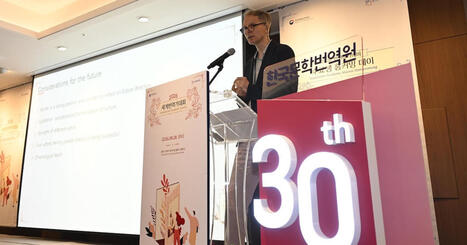







"2026 World Translators Congress Highlights Shift From Trends to Literary Value
By Hwang Ji-yoon
Published 2026.08.29. 00:35
Updated 2026.08.29. 06:22
“As the presence of Korean literature on the global stage grows, Korean authors have begun to receive recognition in international literary awards. I would like to celebrate the current situation where works by Korean authors are gaining attention worldwide.”
Anders Karlsson, a Swedish translator and professor in the Korean Studies Department at the School of Oriental and African Studies (SOAS) under the University of London, emphasized. His keynote speech opened the ‘2026 World Translators Congress.’ Professor Karlsson has introduced Korean literature to Sweden since the 1990s, collaborating with co-translator Park Ok-kyung. He played a significant role in Han Kang’s Nobel Prize in Literature by translating her full-length novel *We Do Not Part* into Swedish.
The Literature Translation Institute of Korea (Director Jeon Yoong-sung), which celebrated its 30th anniversary this year, held the 2026 World Translators Congress and Translation Academy Graduates Homecoming Day at the Grand Mercure Imperial Palace in Seoul on August 28–29. Approximately 150 people related to Korean literature, including renowned translators, researchers, publishers, and cultural industry experts, visited the venue from the first day. Speakers included Professor Jeong Eun-gwi of Hankuk University of Foreign Studies, English subtitle translator Darcy Parker, and novelist Mun Ji-hyeok.
Professor Karlsson stated on this day, “Thirty years ago, when I entered a large bookstore in London and asked if there were any books about Korea, I would receive a somewhat bewildering response directing me to the Southeast Asian section. However, today, numerous Korean books are prominently displayed in London bookstores,” adding, “I feel the change in the status of Korean literature.”
However, he expressed concern about the phenomenon of translating works by merely following the latest publishing trends. He said, “Now that Korean literature has established its position on the global stage, when deciding which works to translate, we should focus on qualitative aspects,” adding, “We must consider what qualitative elements give a work enough value to be translated into other languages and introduced to readers around the world.”
What works should be translated? How to discover valuable works? It was concluded that these are questions translators must fervently ask. Cristina Baon Arnaiz, a Spanish translator and associate professor at the Autonomous University of Madrid, said, “Translation is not merely a task of changing languages but recreating the literary experience itself within another language.” French translator Jeong Irene defined a ‘translator’ as “someone who devises strategies, transforms texts, and continuously makes aesthetic judgments.”
This article has been translated by Upstage Solar AI."
https://www.chosun.com/english/travel-food-en/2026/08/29/FSJ25T3KAFD5THURBW3AYYB3OI/
#metaglossia #metaglossia_mundus