Your new post is loading...

|
Scooped by
Charles Tiayon
August 29, 2021 5:24 AM
|
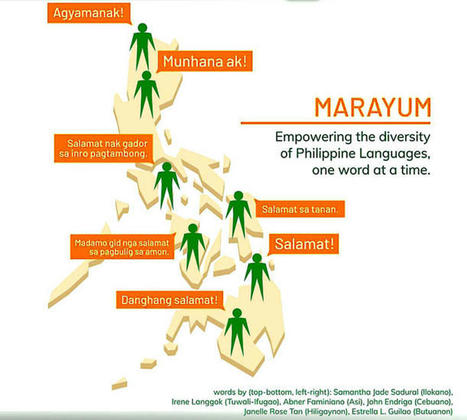
What is “thank you” in Asi, Cebuano, Hiligaynon, Kinaray-a or other Filipino languages? You may get the answer and learn more Filipino words from the web-based dictionary platform that was developed by a team of computer scientists and linguists who are motivated by a mission to preserve and save endangered Filipino languages. Project Marayum was led by Assistant Professor Mario Carreon of the Department of Computer Science at the University of the Philippines Diliman, the DOST-PCIEERD said in a news release. The project sought to produce an online language dictionary which can be modified by registered members of a specific community who mainly uses the language. During its initial development, the first uploaded was the Asi-English language dictionary. Asi is a Visayan language spoken in the province of Romblon. Revisions to the dictionary are allowed only to registered Asi language speakers with entries reviewed by a group of assigned language experts. Project Marayum was built through a collaborative effort of different communities. The Marayum website is currently available online at https://marayum.ph. It has an initial layout of four dictionaries: Asi-English, Cebuano-English, Hiligaynon-English, and Kinaray-a-English. Other dictionaries are currently being collated using Marayum which include Bikol-Buhi’non, Bikol-Central, Bikol-Rinconada, Masbatenyo, Kapampangan, Chavacano, Gaddang, Inakyeanon, Waray, and Ilocano with corresponding English translations. All the dictionaries are being managed by their communities and assigned linguists. As an online dictionary platform for Philippine languages, it aims to empower native language speakers to create and curate an online dictionary of their language without needing to have technical expertise in website design, implementation, and maintenance. The project is funded by the Department of Science and Technology and monitored by the Philippine Council for Industry, Energy, and Emerging Technology Research and Development (DOST-PCIEERD). DOST-PCIEERD Executive Director Dr. Enrico Paringit expressed support to the project which paved the way for further communication through innovative solutions. He underscored the project’s importance in celebration of Buwan ng Wika. “The national language is as symbolic as the country’s own freedom, giving it its unique identity as a sovereign nation. This Buwan ng Wika, we can also celebrate other local languages in the country through this project,” Paringit said.

"...Translated novels
On the Calculation of Volume III by Solvej Balle, translated by Sophia Hersi Smith and Jennifer Russell
The Unworthy by Agustina Bazterrica, translated by Sarah Moses
The Midnight Shift by Cheon Seon-Ran, translated by Gene Png
Red Sword by Bora Chung, translated by Anton Hur
The Midnight Timetable by Bora Chung, translated by Anton Hur
Ice by Jacek Dukaj, translated by Ursula Phillips
Blood for the Undying Throne by Sung-il Kim, translated by Anton Hur
Vanishing World by Sayaka Murata, translated by Ginny Tapley Takemori
Dengue Boy by Michel Nieva, translated by Rahul Bery
The Wax Child by Olga Ravn, translated by Martin Aitken ..."
https://www.andrewliptak.com/locus-award-winners-2026-harrow-okorafor-jones/
#metaglossia
#metaglossia_mundus
"Headsome Communication and the Association of Romanian Publishers are launching the project “The Romanian Shelf in Sofia” – a call for book donations intended for the University Library of Sofia, an initiative supporting the study of Romanian language and literature in Bulgaria.
The call is addressed to publishers participating in this year’s Bookfest edition, as well as authors, who are invited to accompany their donated volumes with autographs.
Organized in the context of Bulgaria’s participation as Guest of Honour Country at the International Book Fair Bookfest 2026, the project aims to foster cultural dialogue and academic exchange between the two spaces. Romanian language studies in Bulgaria contribute to the formation of a community of translators, researchers, and cultural mediators who facilitate the circulation of ideas and literature between the two countries. The development of these skills depends directly on access to a diverse and up-to-date book collection.
Within the initiative, the following may be donated:
● volumes of contemporary and classic Romanian literature;
● poetry, essays, and memoirs;
● children’s and young adult books;
● art albums and illustrated volumes;
● literary criticism, linguistics, and humanities works.
Donations may be deposited at the Bulgaria stand, Guest of Honour country at Bookfest 2026, throughout the entire duration of the book fair (June 3–7, 2026).
The initiators of the call are convinced that the donated volumes will contribute to the development of academic resources available to students and professors and will facilitate access to the diversity and dynamics of contemporary Romanian literature.
The visual identity of the initiative is signed by Zelmirka (Szabó Zelmira).
About the organizations
The Association of Romanian Publishers (AER) was founded in 1991 and is the main professional association of Romanian book publishers, bringing together publishers from all fields of cultural interest. Under the aegis of the Federation of Romanian Publishers, AER organizes the Bookfest International Book Fair, the most important book fair in Romania and the only publishing industry event that has achieved a significant international dimension, as well as local Bookfest editions.
Headsome Communication is a creative and strategic boutique with 13 years of experience in developing and implementing cultural projects and PR campaigns for institutions in Romania and international institutions based in Romania. This year, it coordinates Bulgaria’s participation as Guest of Honour Country at Bookfest, being the tenth Guest of Honour in its portfolio, after German-speaking countries (Germany, Austria, Switzerland – 2013), Czech Republic (2015), Israel (2016), Sweden (2017), United States (2018), United Kingdom (2019), Japan (2022), Republic of Moldova (2024), and Portugal (2025)..."
By Romania Journal Last updated Jun 3, 2026
https://www.romaniajournal.ro/spare-time/romanian-book-shelf-in-sofia-promotes-translation-studies/
#metaglossia
#metaglossia_mundus

"Deadline: 27-Jun-2026
The United Nations High Commissioner for Refugees (UNHCR) is inviting applications to support protection activities through the provision of professional interpretation and translation services for refugees and asylum seekers in Egypt. The initiative aims to ensure equitable, timely, and high-quality communication support that enables refugees to access protection services, legal procedures, registration processes, and essential information in languages they understand.
By reducing language barriers and strengthening communication, the project seeks to improve protection outcomes, enhance accountability, and ensure that refugees can effectively participate in decisions affecting their lives.
About the Project
UNHCR Egypt currently supports more than 1 million registered refugees and asylum seekers originating from over 35 countries.
Given the diversity of languages spoken by refugee communities, professional interpretation and translation services are essential to ensure that individuals can access protection services, understand their rights, and communicate effectively with UNHCR and its partners.
The project focuses on delivering reliable, culturally sensitive, and confidential language services that support protection activities across multiple operational areas.
Project Objectives
The initiative aims to:
Ensure equitable access to interpretation and translation services
Reduce language barriers faced by refugees and asylum seekers
Improve communication during protection and legal procedures
Support timely access to essential services and information
Strengthen protection case management
Promote accountability and transparency in service delivery
Ensure confidentiality and ethical interpretation practices
Enhance participation of refugees in decision-making processes
Maintain consistent quality standards across language services
The project plays a critical role in ensuring that language differences do not prevent refugees from accessing protection and assistance.
Key Focus Areas
The project focuses on:
Interpretation services for refugees and asylum seekers
Translation of protection-related documents
Registration support
Refugee status determination procedures
Resettlement processes
Legal assistance and legal procedures
Protection case management
Community services and outreach
Access to basic services
Confidential and culturally sensitive communication
These services help ensure effective communication across all stages of refugee protection.
Why Interpretation Services Matter
Language barriers can significantly affect a refugee’s ability to access services, understand procedures, and exercise their rights.
Professional interpretation and translation services help:
Improve access to protection services
Ensure informed decision-making
Facilitate accurate information sharing
Strengthen legal and administrative processes
Reduce misunderstandings and communication gaps
Promote inclusion and participation
Protect the rights of refugees and asylum seekers
Effective communication is a fundamental component of quality refugee protection.
Services to Be Provided
Selected partners will support a broad range of interpretation and translation activities.
Services may include:
Oral interpretation during interviews
Translation of official documents
Support during counseling sessions
Interpretation during legal procedures
Assistance during refugee status determination interviews
Resettlement-related interpretation
Community outreach interpretation
Telephone interpretation services
Training and workshop interpretation
Translation of protection information materials
All services must meet high standards of accuracy, professionalism, and confidentiality.
Translation Support
Translation services may cover documents related to:
Registration procedures
Refugee status determination
Resettlement applications
Protection case files
Community services
Legal documentation
Information materials
Training resources
Official correspondence
Accurate document translation is essential to ensure fair and effective protection processes.
Interpretation Support Activities
Interpreters may assist during:
Individual interviews
Case management sessions
Counseling meetings
Protection briefings
Information sessions
Legal consultations
Community engagement activities
Telephone inquiries
Capacity-building workshops
Training programmes
These services help refugees understand available support and communicate their needs effectively.
Expected Outcomes
The project aims to achieve several important outcomes, including:
Improved access to information and services
Enhanced protection outcomes
Better case management processes
Greater participation of refugees in decision-making
Stronger accountability within protection systems
Consistent and reliable language services
Reduced communication barriers
Improved trust between refugees and service providers
These outcomes contribute directly to more effective refugee protection and assistance.
Quality and Ethical Standards
All interpretation and translation services are expected to comply with UNHCR protection standards.
Key principles include:
Confidentiality
Neutrality
Accuracy
Professionalism
Cultural sensitivity
Impartiality
Respect for refugee rights
Protection of sensitive information
Maintaining these standards is essential for safeguarding the integrity of protection services.
Benefits for Refugees and Asylum Seekers
Through this initiative, refugees and asylum seekers will benefit from:
Language-appropriate communication
Clear understanding of procedures and rights
Improved access to services
Better support during legal and protection processes
Greater confidence in interacting with institutions
Increased participation in community activities
Reduced risk of misunderstandings
The project helps ensure that all individuals can access protection services regardless of the language they speak.
Who Should Apply?
The opportunity is intended for organizations capable of providing professional interpretation and translation services that meet UNHCR standards.
Applicants should demonstrate:
Experience in interpretation and translation services
Capacity to work across multiple languages
Understanding of refugee protection contexts
Strong quality assurance mechanisms
Ability to maintain confidentiality and ethical standards
Capacity to deliver timely and reliable services
Organizations with expertise in humanitarian, refugee, migration, or protection-related language services may be particularly well positioned to contribute.
Why This Initiative Matters
Communication is central to effective refugee protection. Without appropriate language support, refugees may struggle to access legal assistance, protection services, education, healthcare, and other essential support systems.
This initiative strengthens:
Refugee protection systems
Access to justice
Service delivery effectiveness
Community participation
Accountability and transparency
Inclusion and equality
Human rights protection
By ensuring high-quality interpretation and translation services, UNHCR helps create a more accessible and responsive protection environment for refugees and asylum seekers in Egypt.
Frequently Asked Questions
What is the purpose of this UNHCR initiative?
The project aims to provide professional interpretation and translation services that support communication between refugees, asylum seekers, and protection service providers.
Where will the project be implemented?
The initiative supports UNHCR operations in Egypt.
Who benefits from the project?
Refugees and asylum seekers registered with or supported by UNHCR Egypt.
What types of services will be provided?
Interpretation for interviews, counseling, legal procedures, training sessions, and translation of protection-related documents and materials.
Why are interpretation services important in refugee protection?
They help refugees understand their rights, access services, participate in procedures, and communicate effectively with service providers.
What standards must interpreters and translators follow?
Services must adhere to principles of confidentiality, neutrality, accuracy, professionalism, and cultural sensitivity.
What outcomes does UNHCR expect from the project?
Improved communication, stronger protection outcomes, better access to services, enhanced accountability, and reduced language barriers.
Conclusion
The UNHCR interpretation and translation services initiative in Egypt seeks to strengthen refugee protection by ensuring that language barriers do not prevent refugees and asylum seekers from accessing essential services and exercising their rights. Through professional, confidential, and culturally sensitive language support, the project will improve communication, strengthen case management, and enhance the overall effectiveness of protection services for more than one million refugees and asylum seekers living in Egypt.
For more information, visit UN Partner Portal."
https://www2.fundsforngos.org/refugee-asylum-seekers-2/call-for-interpretation-and-translation-services-for-refugee-protection-egypt/amp/
#metaglossia
#metaglossia_mundus

"Not lost in translation: training AI to speak African languages
Frustrated by the neglect of African languages by AI platforms, researchers at the University of Cape Town have developed their own tool.
The African continent is home to more than 2,000 languages, yet a 2025 study of large language models – advanced artificial intelligence systems designed to understand, generate and interact with human language – published in the Proceedings of Machine Learning Research found only limited support for African tongues.
The paper, which comparatively analysed African language coverage across six large language models, eight small language models and six specialised small language models (SSLMs), found support for 41 African languages and 23 available public data sets. But it found “a big gap” with only four languages – Amharic, Swahili, Afrikaans and Malagasy – always handled, while over 98% of African languages went unsupported.
With so many African languages neglected, there are fears that entire groups of speakers could be cut out of the AI revolution. So one team of computer scientists from the University of Cape Town is looking to close the gap that has left millions underserved by mainstream AI tools.
Earlier this year, researchers Anri Lombard, Jan Buys, Francois Meyer and their team unveiled MzansiLM, a language model specifically built to include data from all 11 of South Africa’s official written languages. Alongside it, they released MzansiText, the curated multilingual dataset on which MzansiLM was trained.
Compared to the behemoth large language models (LLMs) developed by global tech companies, MzansiLM is a small player. Yet the team’s stringent testing showed it has outperformed larger, well-funded global LLMs in terms of accuracy. When writing in isiXhosa, it bettered the results of systems more than ten times its size in terms of accuracy and fluency.
“MzansiLM was meant to provide a small decoder-only baseline that future work can compare against and build on,” Lombard explains. “It is not a chatbot. It is a foundation; something developers and researchers can adapt for specific purposes, such as summarising documents or annotating data in a language most global AI cannot handle at all.”
Digital footprints
The inability of AI to handle most African languages comes down to the gap between the number of real-world speakers and a language’s digital footprint. IsiZulu is spoken by over 12m South Africans, and Hausa by more than 70m people across West Africa, yet both are considered “low-resource” languages in AI terms, because they leave a small “digital footprint” on websites and in books, so there is little data for AI developers to “scrape”.
“In language modelling, languages are considered low-resource primarily because there are much fewer and smaller textual datasets available in these languages for training language models,” says Buys, a senior lecturer in the University of Cape Town (UCT) department of computer science. “The internet has always skewed heavily towards English.”
“The data pipelines that feed large language models skew even more heavily. The result is a compounding inequality: the languages that already dominate online spaces get better AI tools, which makes them more useful digitally, which generates more data, which makes the AI even better. Everyone else falls further behind.”
Nine of South Africa’s 11 official written languages fall into this low-resource category. Languages such as isiZulu and isiXhosa have attracted some research attention, but others, including isiNdebele and Sepedi, have been largely overlooked even within African language AI. The UCT team is on a mission to change that.
Post-colonial data neglect
In a 2025 policy brief, AI and Language Data Flaring in Africa: Addressing the Low-Resource Challenge for the Centre for International Governance Innovation, Ife Adebara describes this phenomenon as “language data flaring” – which he likens to the gas flaring, common in oil extraction, in which a valuable resource is wasted through neglect.
Adebara argues that a multitude of factors – including under-investment in local languages and foreign language-dominant colonial and post-colonial policies – have meant that African language data goes under-collected, is poorly stored and remains largely unused in AI development.
“If AI continues to evolve without African linguistic inclusion, the continent will not only be a consumer of foreign technologies but will also have little say in shaping its development,” Mpho Primus, co-director of the Institute for Intelligent Systems at the University of Johannesburg, wrote in a February 2025 opinion piece for Independent Online (IOL).
“The digital divide will become a cultural and intellectual divide.”
This is more than just a mere inconvenience. If AI cannot understand or process a language, the consequences reach well beyond the odd mistranslation. Language accessibility effectively decides which countries and cultures get to participate in the digital economy, and which do not.
Many public services in South Africa are now piloting and adopting AI, from healthcare to banking and education.
Help me, but only in English
In 2025, for example, South Africa’s National Department of Health endorsed “Self-Cav”, a digital health chatbot piloted to talk via WhatsApp to young South Africans about sensitive topics such as HIV prevention medication, sex and mental health in a judgement-free way.
It is available only in English – and for life-saving tools like this to reach their full potential creators need to “hyperlocalise” them, training them in languages such as isiZulu and Sepedi and in slang. Without this, they will not be able to reach the people who need them most.
Bridging that language gap is what drove Lombard, Buys and Meyer to build MzansiLM, laying the groundwork for reclaiming digital sovereignty – and they are part of a rapidly growing movement to do so across the African continent.
In late 2025, a team backed by a $2.2m Gates Foundation grant released African Next Voices, described by the BBC as “the largest AI-ready speech dataset for African languages ever assembled,” covering 9,000 hours across 18 languages including Kikuyu, Dholuo, Hausa and Yoruba.
In February 2026 Google launched WAXAL, an open dataset spanning 21 African languages. The Masakhane research community, a pan-African natural language processing (NLP) network whose name means “we build together” in isiZulu, has published translation tools for over 48 African languages.
Outside of the continent, Cohere, a Canadian AI company, has partnered with HausaNLP to bring African language data into its Aya multilingual model.
These collaborative efforts are all steps in the right direction, but they are just the tip of the iceberg. Africa is home to over a billion people and more than 2,000 languages, yet global AI systems require a staggering mountain of data to learn how to speak a language fluently.
The UCT team is confident about where their own work sits in the scale of the solution.
Open research
“A lot of the progress we were able to make depends on earlier open research from the African Natural Language Processing research community, so continuing that openness is essential,” Lombard told UCT News.
“We still need better and broader data sources, stronger benchmarks and the kind of shared datasets, models, code and results that make it possible for others to reproduce and extend the work.”
Meyer agrees: “The research community plays an important role here by working openly, sharing datasets, models and findings so others can build on them.
“That kind of openness is often what leads to progress, especially compared to proprietary systems where much of the data and methodology isn’t accessible.”
MzansiLM is small compared to the behemoths of Silicon Valley, but its accuracy proves the potential of localised research compared solely to corporate funding.
The mountain of data left to build is still staggering, but the momentum has already begun."
Emily Allen
Wed 3rd June 2026
https://african.business/2026/06/arts-culture/not-lost-in-translation-training-ai-to-speak-african-languages
#metaglossia
#metaglossia_mundus

"20 Robert Munsch titles are being translated into Indigenous languages
For generations of Canadian kids, Robert Munsch stories have been a bedtime staple. Now, some of those beloved books are getting a Yukon twist. The Yukon Native Language Centre is translating 20 Munsch titles into Indigenous languages — including several stories with Yukon connections..."
June 3
https://www.cbc.ca/player/play/video/9.7222867
#metaglossia
#metaglossia_mundus

"How One Media Company Is Fighting Manga’s Major Piracy Problem
The manga industry has a big problem and it’s not lack of demand, but a lack of authorized supply.
“There is a global demand for manga worldwide, and there’s far more demands than any content that’s officially translated right now, and that’s a very big issue,” Shoko Ugaki, the CEO of manga translation company Orange Inc., told Variety in an interview via translator last month.
Based on Orange’s recent survey, there are approximately 30,000 manga titles that have been translated into English versus the number of pirated English-translation mangas, which come out to “about five times more than officially translated manga,” per Ugaki.
Orange’s mission is to release licensed manga, with its most notable project to date being “The Gene of AI,” which was originally released in Japan in 2016 to critical acclaimed and received an anime adaptation that launched globally on Crunchyroll in 2023. But despite that success, the original “The Gene of AI” manga never had an official English release until this May, when Orange partnered with publisher Akita Shoten to release the edition through Orange’s emaqi platform.
“Most of the manga the fans read, they’re reading the pirated version, so that is the bottleneck,” Ugaki said. “Officially translated manga is about several thousand titles, which is 20,000 books or comics right now. I own 30,000 comic books privately. So officially translated manga is less than what I own privately. A lot of pirated versions — five to 10 times more than officially translated versions — are translated by volunteers. So the manga fans, if you like manga more, then you read more pirated versions. The issue is that there is no returns for the creators of these [pirated] mangas, that’s the bottleneck.”
Ugaki says there was a financial loss of “close to 6 trillion Japanese yen last year alone” due to manga piracy.
“There’s no appropriate compensation for creators of manga, and at the same time, all the publishers, they don’t receive income or revenue because of the piracy issues,” Ugaki said. “Then they cannot allocate enough budget to create the next works or next line of work, so this influences the entire ecosystem of this manga industry.”
That’s where Orange aims to make real change with its digital cross-publisher manga app emaqi, scaling official translations of never-before-available titles in a creator-friendly way.
“If we can establish the system and produce more official translations, then that will be beneficial for not only creators, but all the publishers that participate in our system, so that within that system we can create a more beneficial cycle for everyone to produce more and produce better works in the future,” Ugaki said. “I believe that we are going to have to put everything we have into this industry itself to raise more official translation and official services, so less people will use or depend on pirated versions.”
Ugaki attributes the growing appetite for official manga translations to the rising popularity of anime in the U.S., and adaptations like Netflix’s “One Piece.”
“I think anime started this manga appetite globally; however, I think that we’re still at the very early phase; that global populations or audiences are starting to notice or become aware of the sort of appeal that manga and anime has, so we have a lot more to offer,” Ugaki said. “However, we have so much to do in order to convey the appeal of manga compared to anime. We need to do more, so that global audiences will be more aware of appeal and attractiveness of manga. In Japan, it’s common sense, where everyone knows that all these anime came from manga, or the manga was the original, and then that was made into anime. But this kind of flow is not really understood overseas, so that is another aspect that we need to work on.”"
Jennifer Maas
Jun 3, 2026
https://variety.com/2026/tv/news/manga-piracy-problem-orange-emaqi-1236764978/
#metaglossia
#metaglossia_mundus
"AI goes medieval on translating
Modern AI technology has found its way into the Byzantine Empire, unlocking the ability to decipher medieval Greek. This language bridged the transition between ancient Greek and modern Greek, spanning the era from 600 to 1500 A.D. This new ability to understand these ancient texts can help us to better understand historical facts and culture, offering new insights into that age. Since medieval Greek is difficult to read, an AI optical character recognition (OCR) engine was used to decipher the language. Finally, we can read a firsthand account of the Siege of Thessalonica (good for Ottoman Empire enthusiasts).
Just like deciphering your doctor’s handwriting can feel like it requires some sort of cryptex, trying to read medieval Greek has been a head-scratching puzzle. The appearance of medieval Greek can vary depending on the period and writer, not only in terms of penmanship but also in format. In some cases, the script can be fragmented, and the spelling is inconsistent. Sometimes there are spaces between words and other times not, making it impossible to understand without a 600-year-old scholar helping you to study the language.
Without a time machine to bring back those ancient scholars, the 5000 medieval Greek manuscripts in the Vatican Library are left to collect dust. That was before TOPPAN, a Japanese printing company, used 50 annotated items from the Vatican Library to transcribe the text into training data. To verify its findings, TOPPAN presented its transcriptions to two experts in medieval Greek philology, who reviewed the data set.
Image courtesy of iStock.com/TopVectors.
The researchers used a deep-learning handwritten text recognition (HTR) system based on TOPPAN’s Fuminoha OCR technology. The system uses a cursive script data set, an AI cursive script recognition program, and a viewer — like a literary Swiss Army knife (or Greek makhaira). It enables the identification of character coordinates even for the most difficult-to-read characters. The system allows users to discard characters with low confidence levels and perform more accurate single-character recognition instead. Fuminoha, a classical Japanese reading service, proved to be well suited for this project, with medieval Greek manuscripts having various ligatures and an unconventional layout of letters. For this kind of complex character layout, the hybrid system is more effective than a solely line-based system; establishing a foothold in translation is a bit like the Ottoman Turks establishing a foothold in northern Greece.
Culture is meant to be preserved, not forgotten. This research is part of TOPPAN’s 30-year collaboration with the Vatican Library to conserve culture for future generations. The collaboration has made more than 2 million items from the Vatican Library’s collection available to the public for research and educational purposes as International Image Interoperability Framework (IIIF) high-resolution images. During the past 30 years, TOPPAN and the Vatican Library have created a high-resolution digital archive of the Gutenberg 42-line Bible and developed a project that deciphers and reconstructs ancient, reused parchment manuscripts.
Beyond medieval Greek, TOPPAN has worked on deciphering cursive-style classical Japanese texts — another form of writing that is difficult for modern people to read. This project used historical materials from across Japan. In 2021, TOPPAN launched Fuminoha and the Komonjo Camera, a mobile application that allows anyone to read classical Japanese easily.
This is not just a fun opportunity for researchers to scream “níke” (victory); it is a monumental contribution to the field of Greek language research. The release of the high-resolution images and documents has made cultural documents accessible to people worldwide — and has solved a puzzle that was hundreds of years old.
Published: June 2026"
https://www.photonics.com/Articles/AI-goes-medieval-on-translating/p5/a72275
#metaglossia
#metaglossia_mundus

About 6.2 billion people have the entire Bible translated in their native tongue, announced Wycliffe Bible Translators UK.
"Wycliffe Bible Translators UK announced that the Bible has been translated into its 800th language, meaning 6.2 billion people have the entire Bible translated in their native tongue. The achievement comes amid what the organization calls a “tremendous acceleration” in Bible translation efforts within recent years.
James Poole, Wycliffe UK’s executive director, says reaching the 800-languages mark is notable, but more important, it means wider global access to the Bible in the heart language or dialect of millions of people.
“Celebrating the 800th completed Bible translation is very exciting, of course,” Poole said. “But more significant than the number itself is what it represents. Millions more people are now able to engage with the whole Bible in the language that speaks to them best, often for the first time.”
In 1998, Bible translation reached its 400th language. But that number has doubled since then in a surge that is only increasing. In 2020, Bible translation reached its 700th language. And since then, 500 million more people have the whole Bible in their language. The acceleration of Bible translation in recent years is remarkable considering that it took over 1,900 years for the first 400 languages to be translated.
Poole says that now “is an extraordinary time for world mission.”
“Over recent decades we have seen remarkable progress, with translation work accelerating in many parts of the world. Communities are receiving the Bible far sooner than would have seemed possible only a generation ago,” Poole said. ‘That matters because it means people are gaining access to God’s Word in languages they understand deeply and naturally. As churches engage with the Scriptures in their own languages, they are better equipped for evangelism, discipleship and ministry.”
Among the most recently translated Bibles is a translation for the Podoko people who live in north Cameroon. They are receiving the Bible through a smartphone app rather than a printed Bible.
Languages currently being translated include Weh and Mokpe, tongues spoken in Cameroon, as well as Ifè which is spoken in Togo and Benin. A language in Ghana known as Koma and a language known as Shor in Siberia are also in the works.
“We are witnessing God at work: this is a historic opportunity, and it is a privilege to play a part in what He is doing,” Poole said.
Despite this milestone, about 1.5 billion people do not have the Bible translated in their native language.
“As we join in the celebrations for the 800th Bible, at the same time we remember the 1 in 5 people worldwide who do not yet have access to the Bible in the language that serves them best,” Poole said. “So, alongside our gratitude for what has been achieved, there remains a sense of urgency. Every language represents people whom God loves. That is why we continue to work with Christians and churches around the world as they seek to make God’s Word accessible to their communities.”
Wycliffe Bible Translators UK attributes the sharp increase in Bible translations in part to technological advancements such as generators that allow computers to operate in places with unpredictable electricity as well as access to computers that are empowering language teams to effectively complete translations. Additionally, new translation software is allowing the quality and speed of translations to improve. The increased ability for people to connect overseas to work together on such projects has also accelerated Bible translations.
Mark Woodward, a Wycliffe UK staff member who is helping develop AI technology to aid in translation-accuracy checking procedures, is seeing AI’s effectiveness in producing accurate translations.
“We think AI can be a tool that can make things better and more efficient for Bible translators,” Woodward explains. “It could be a similar revolution within the work of Bible translation to when translation teams started to use computers.”"
Written by:
Hannah Davis
https://billygraham.org/decision-magazine/articles/bible-translation-hits-landmark-800th-language-mark
#metaglossia
#metaglossia_mundus

⁸Conférences, le 15 juin 2026, à Marseille (Bouches du Rhône) - horaires, tarifs, renseignements. La traduction littéraire est un espace où s'opèrent des réflexions linguistiques et culturelles sur des univers d'expérience spécifiques.
"Traduction des expériences? La littérature comme lieu d’émancipation
La traduction littéraire est un espace où s'opèrent des réflexions linguistiques et culturelles sur des univers d'expérience spécifiques. Les pratiques de traduction et de publication peuvent ainsi ouvrir la voie à de nouveaux publics – ou au contraire la fermer. Jeffrey Trehudic et Marie Herrmann examinent cette question sous un angle féministe, queer, intersectionnel et plurilingue. Ils posent les questions suivantes : comment s'opère le transfert d'expériences spécifiques entre l'Allemagne et la France, et au-delà ? Et la traduction peut-elle être un espace propice à la compréhension et à la solidarité ?
Après des études de médiation culturelle et de traduction à Paris et en Allemagne, Jeffrey Trehudic s'installe à Berlin où il commence à travailler dans le milieu culturel franco-allemand, puis littéraire, avant de participer au programme Georges-Arthur Goldschmidt en 2022. Depuis 2022, il est traducteur littéraire de l'allemand et responsable éditorial de la revue Litterall, et il travaille également comme libraire.
Marie Hermann est éditrice, traductrice et interprète. Elle a fondé les éditions Hors d’atteinte en 2018, domiciliées à Marseille, et a notamment publié des ouvrages de Sara Ahmed, Jacques Bouveresse, Mehdi Charef, Mariame Kaba et Tassadit Imache, ainsi qu'une réactualisation des classiques Notre corps, nous-mêmes et Nos enfants, nous-mêmes. Elle a traduit des textes de Rosa Luxemburg, de Trevor Noah ou de Clara Zetkin.
...
Cet événement est organisé avec le soutien du Fonds citoyen franco-allemand. Il est organisé en partenariat avec le FIDMarseille, le Goethe-Institut de Marseille, la Maison allemande de Marseille, Litterallea et l'AMU.
Cet événement a été renseigné par un organisme institutionnel (Office Métropolitain de tourisme et des congrès de Marseille). Date de dernière mise à jour le 03/06/2026"
Le 15/06/2026
FIDMarseille, 14 allée Léon Gambetta | Marseille
Ouverture des portes à 18 h 45.
L'événement se déroulera en français.
Après la rencontre, un verre de l'amitié sera offert.
NC
https://www.jds.fr/marseille/manifestations/conferences/traduction-des-experiences-la-litterature-comme-lieu-d-emancipation-1569769_A

"Décisions d’avant 1969 de la Cour suprême: pas d’obligation de traduction
MONTRÉAL — L’organisme Droits collectifs Québec (DCQ), qui souhaite forcer la Cour suprême à traduire en français ses décisions antérieures à 1969, a été débouté en Cour fédérale.
Dans une décision rendue mardi, la juge Denise A. LeBlanc a conclu que les décisions historiques du plus haut tribunal du Canada ne constituent ni des «services» ni des «communications au public» assujetties à l’obligation de traduction prévue à la Loi sur les langues officielles (LLO).
DCQ accueille avec déception, mais sans grande surprise, la décision de la Cour fédérale, a réagi son directeur général, Étienne-Alexis Boucher, qui a porté la cause devant le tribunal.
«Il faut quand même réaliser qu’on demandait à la Cour de renverser et d’aller à contre-courant d’un système qui était bien établi depuis plusieurs décennies», a commenté M. Boucher en entrevue. Il indique que l’organisme étudiera la possibilité de porter en appel la décision.
DCQ avait intenté des procédures en Cour fédérale contre le Bureau de la registraire de la Cour suprême en vertu d’un article de la LLO, après avoir eu gain de cause auprès du commissaire aux langues officielles.
L’organisme reprochait l’absence d’une version française pour des décisions rendues entre 1877 et 1969 et mises en ligne sur le site du plus haut tribunal du pays.
Avant l’entrée en vigueur de la LLO en septembre 1969, la Cour suprême n’était pas tenue de publier ses décisions dans les deux langues officielles. On compte environ 6000 décisions unilingues, qui avaient été rendues généralement dans la langue de l’audience ou celle choisie par le juge.
Pas une «retranscription modifiée»
DCQ soutenait que la transcription et la mise en ligne ultérieure de ces jugements constituent un acte de communication ou de prestation de services au public visé par l’obligation de les diffuser en anglais et en français en vertu de la loi.
Pour sa part, le Bureau soutenait plutôt que l’obligation de traduction ne vise que l’interface bilingue du site web de la Cour suprême, et non le texte des décisions historiques elles-mêmes.
La Cour fédérale s’est rangée derrière les arguments du Bureau et a tranché que les décisions des tribunaux fédéraux relèvent exclusivement de la partie de la LLO portant sur l’«administration de la justice».
Cette section prévoit que les décisions des tribunaux fédéraux doivent être «simultanément mises à la disposition du public dans les deux langues officielles» ou «dans les meilleurs délais».
Rien dans la loi ne prévoit que cette disposition s’appliquerait de manière rétroactive aux décisions historiques, mentionne la juge LeBlanc. Elle soulève également que les termes «simultanément» et «dans les meilleurs délais» pouvaient difficilement s’appliquer aux décisions antérieures à 1969, ne pouvant «manifestement pas être mises à la disposition du public ‘‘simultanément’’ ou ‘‘dans les meilleurs délais’’.
DCQ affirmait toutefois que «le texte affiché en ligne, bien qu’identique au contenu papier, constitue un support différent et une nouvelle mise à la disposition du public», peut-on lire dans la décision. Il s’agit alors, selon l’organisme, d’une «retranscription» qui a été produite dans une seule langue officielle, violant ainsi la LLO.
La Cour fédérale a conclu que «tant que le contenu du document n’est pas modifié, un document peut être conservé sous forme électronique, ce qui permet aux jugements de la (Cour suprême) d’exister sous cette forme».
«Il apparaît donc que le transfert sur support technologique pour mise à disposition du public ne constitue ni une ‘‘reproduction’’, ni une ‘‘republication’’ ni une ‘‘retranscription’’ modifiée: le document électronique demeure identique au document original avant sa numérisation», a écrit la juge.
Un problème d’égalité
Bien que le tribunal donne raison au Bureau de la registraire «au niveau de la technique», M. Boucher note un enjeu d’égalité entre les citoyens canadiens.
«Je ne vois pas en quoi cette décision-là permet de respecter l’esprit de la loi sur les langues officielles, c’est-à-dire que le français et l’anglais soient traités sur un pied d’égalité», évoque-t-il à La Presse Canadienne.
«Des jugements, ce sont des documents sérieux sur lesquels travaillent, par exemple, des juristes pour défendre des causes citoyennes ou organisationnelles. Que ces jugements-là soient traduits dans les deux langues, pour nous, ça va de soi», ajoute M. Boucher.
Le directeur général de DCQ se réjouit tout de même des retombées positives de ses démarches judiciaires.
Après le dépôt de la requête de l’organisme, en 2024, la Cour suprême a annoncé le retrait des quelque 6000 jugements unilingues de son site. L’année suivante, elle a annoncé la traduction de 24 d’entre eux, soit «certaines des décisions les plus importantes rendues par la Cour». L’initiative était présentée comme s’inscrivant dans le cadre du 150e anniversaire du tribunal.
«La seule existence de ces procédures-là a convaincu, pour ne pas dire forcé, la Cour suprême à agir. (…) Oui, on a perdu au niveau juridique aujourd’hui, mais on avait déjà fait des gains réels et concrets pour les francophones du Canada», a souligné M. Boucher.
Au moment d’écrire ces lignes, le Bureau de la registraire n’avait pas encore réagi à la décision de la Cour fédérale.
La cause a été entendue en janvier dernier à Montréal. DCQ a ciblé le Bureau de la registraire, car la Cour suprême elle-même, comme tous les tribunaux, est protégée contre ce genre de recours en vertu du principe de l’indépendance des tribunaux."
Par Frédéric Lacroix-Couture, La Presse Canadienne
2 juin 2026, 20 h
https://www.coupdoeil.info/nouvelles-nationales/decisions-davant-1969-de-la-cour-supreme-pas-dobligation-de-traduction/
#metaglossia
#metaglossia_mundus

"Bouygues Telecom ajoute un usage bien plus concret à la puce d’intelligence artificielle intégrée à son nouveau décodeur b.tv disponible avec la Bbox Ultym. Après avoir surtout servi à améliorer l’image, ce composant permet désormais la traduction locale des sous-titres de certaines chaînes TV en direct, le tout grâce à l’intelligence artificielle.
De l’IA pour la traduction de sous-titres
La fonction de traduction en direct permet de suivre un programme télévisé quand le français n’est pas parfaitement maîtrisé ou utiliser la télévision comme appui pour apprendre une autre langue.
Pour l’instant, Bouygues Telecom reste dans une phase d’expérimentation menée auprès d’un nombre limité de clients. Le dispositif ne s’applique qu’aux flux en direct qui disposent déjà de sous-titres pour sourds et malentendants, ce qui ancre la fonction dans une base technique déjà existante plutôt que dans une génération complète de sous-titres par l’opérateur.
L’accès à l’option passe par l’interface de la chaîne en cours de visionnage, via la section « Langue et sous-titres ». L’utilisateur peut ensuite choisir une langue de traduction parmi cinq possibilités, selon la disponibilité des sous-titres d’origine. On retrouve l’anglais, l’espagnol, le portugais, l’arabe et le mandarin.
Cette première liste reste provisoire. Bouygues Telecom précise qu’elle peut évoluer pendant la phase de test qui doit se poursuivre jusqu’en septembre. L’opérateur se laisse donc une marge pour ajuster l’offre avant une éventuelle généralisation.
L’intérêt potentiel de la fonction est assez large. Elle peut aider des personnes peu à l’aise avec le français, servir à des foyers multiculturels ou accompagner des utilisateurs qui veulent progresser dans une langue étrangère.
Il reste toutefois plusieurs points importants à éclaircir. La liste des chaînes réellement compatibles n’est pas encore détaillée et le modèle d’intelligence artificielle n’est pas précisé. Surtout, la valeur réelle du service dépendra de la qualité de traduction sur des programmes en direct, où la vitesse compte autant que la précision."
Jean-Baptiste A.
3 Juin. 2026 • 18:34
https://kulturegeek.fr/news-353148/bouygues-telecom-ajoute-traduction-ia-titres-chaines-tv
#metaglossia
#metaglossia_mundus

Kuala Lumpur, 31 mai 2026, SPA -- Le pavillon du Royaume, invité d'honneur de la Foire internationale du livre de Kuala Lumpur 2026, a inauguré son cycle de séminaires culturels par une table ronde intitulée « La traduction du contenu islamique : transmission du sens et fidélité du message », sur la scène des foires internationales du livre.
Modéré par Ahmed Al-Alkami, le séminaire a accueilli Dr. Waleed Al-Omari, spécialiste de la traduction. Ce dernier a souligné l'importance d'une traduction rigoureuse du contenu islamique pour transmettre une image juste de l'Islam. Il a précisé que la traduction des concepts islamiques exigeait une compréhension profonde des contextes culturels et des nuances juridiques, afin de préserver l'authenticité du sens et l'exactitude du message.
Dr. Al-Omari a abordé les principaux défis liés à la traduction de la terminologie islamique, mettant en garde contre l'usage de concepts susceptibles de transposer le terme originel vers des référentiels culturels différents, ce qui pourrait altérer sa compréhension réelle par le récepteur.
Il a par ailleurs expliqué que les technologies de l'intelligence artificielle constituaient un outil de soutien pour développer et accélérer les travaux de traduction, mais qu'elles ne remplaçaient en aucun cas la révision humaine spécialisée. Il a ainsi insisté sur la nécessité d'une révision visuelle et éditoriale pour garantir la justesse de la traduction et la fidélité de la transmission.
En conclusion de son intervention, il a évoqué le rôle de la formation de compétences spécialisées dans la traduction du contenu islamique, ainsi que l'importance de soutenir les initiatives dédiées à la traduction des connaissances et des sciences islamiques vers les différentes langues.
Ce séminaire s'inscrit dans le cadre d'une série d'événements culturels et intellectuels organisés par le pavillon du Royaume à la Foire internationale du livre de Kuala Lumpur. Ces activités visent à mettre en valeur le dynamisme culturel saoudien, à renforcer les échanges intellectuels avec les diverses cultures, et à enrichir le dialogue autour des enjeux de l'édition et de la traduction.
-- SPA
10:53 Heure locale 07:53 GMT
0011

"In English, words are rarely deleted from dictionaries. So why in 2021 did a Japanese dictionary publisher give 1,100 words the boot?
...It’s not uncommon in Japanese for dictionary editors to decide that a word has outlived its usefulness and should be chucked out the window.
This happened en masse in 2021, when Sankoku, under editor Iima Hiroaki, added 3,500 new words – and ejected 1,100. It was the largest deletion in the dictionary’s history.
Iima later took to X to defend the cuts, which he says were based on contemporary usage frequency and search patterns. For example, “MD” (MiniDisc) was removed because the MiniDisc is dead tech, with Sony discontinuing manufacture in 2013. By contrast, カセットテープ (cassette tape) wasn’t cut because nostalgia keeps it alive.
In other words, words don’t “age out.” They get cut when the general populace stops using them.
“Words are fated to be born and die”
Fortunately, these dead words aren’t lost to time. In 2023, Sanseidō published what amounts to a memorial album: the 三省堂国語辞典から消えたことば辞典, or Dictionary of Words That Disappeared from the National Language Dictionary. As a sign of the times, they even released a “dead words” sticker pack on messaging app LINE. (Yes, you can still buy it!)
...
Sanseidō isn’t the only one cataloging dead words. Yonekawa Akihiko, a professor emeritus at Baika Women’s University, is the author of the 2016 俗語発掘記 消えたことば辞典 (The Dead Words Dictionary: A Forensic Journal of Slang). The words cut between the two dictionaries are revealing, as they show how language vacillates alongside the trends of the day.
Some of the clusters of words eliminated include:
Bubble-era (late Showa) vocabulary. Language from before the economic bubble of the 1980s and 90s popped. Terms like hana-kin (花金) – “Flower Friday,” the Japan Showa equivalent of “TGIF,” reflect the insane work culture of the time. itameshi (イタメシ), “Italian food,” reflects how Italian restaurants were seen as high-end dining and a status symbol. And then there’s スッチー (sutchī) for “stewardess” – a pre-equality relic that got chucked as Japan crawled its way into the Heisei era.
Mid-90s kogal words. With the gyaru era officially over, words like チョベリバ (cho-beriba, “very bad”), 写メ (sha-me, flip phone photo mail), and, yes, even コギャル (ko-gyaru) found themselves on the chopping block.
The boyfriend words. Yonekawa documents a set of words that reflected the extravagant spending of the late bubble period. For example, women used to talk about having three boyfriends: the アッシー君 (asshī-kun) who drives you home; the メッシー君 (messhī-kun) who pays for dinner; and the ミツグ君 (mitsugu-kun) who buys you presents. These days, it seems, women are more intent on avoiding the Three Cs than on finding the Three Ks.
Those aren’t the only relationship words to die. As I discussed in my last write-up about dead Japanese language, for decades leading up to World War II, アベック (abekku), from the French “with,” was used to refer to a couple. This usage petered out sometime in the 1970s.
Press accounts talk about “Showa dead words” or “Heisei dead words.” But some linguists argue that the dead word phase is much tighter – about five to 10 years – and isn’t clearly bounded by imperial eras, which often last decades.
Maybe some of these words, like Heisei retro loose socks, will come back into fashion at some point. Or maybe they’ll stay dead as new trendy words, like kaiwai, take their place.
After all, “words,” as Yonekawa likes to say, “are fated to be born and die.”"
https://unseen-japan.com/japanese-slang-words-dictionary-killed/
#metaglossia
#metaglossia_mundus
"Opinion: Latin is more than a dead language, deserves a larger place in UCLA’s curriculum
Dodd Hall is pictured above. Columnist Catherine Price argues Latin should fulfill General Education requirements because of its many academic benefits. (Amelia Chief/Daily Bruin senior staff)
By Catherine Price
May 31, 2026 2:37 p.m.
Latin is a dead language.
Or at least that’s what I’d heard growing up. As a kid, the only time I was confronted with the language was in church, singing hymns I couldn’t hope to translate.
But as a classics student, Latin or Greek is required for the major.
So, I signed up for Latin 1: Elementary Latin in the fall. At first, I viewed the class as a box to check, one more step to completing my degree. However, after a full year of Latin, I can admit that it’s more than a dead language used during Mass.
Latin is a central foundation for subjects like medicine and law. Learning the language teaches valuable skills that all students should have.
As a subject that lays the groundwork for career success, UCLA should promote Latin to a broader range of students – including by allowing Latin courses to fulfill certain General Education requirements.
Students are required to complete GE courses before graduating, including a Philosophical and Linguistic Analysis course for the Foundations of the Arts and Humanities subcategory. These classes teach students how to examine the world around them and their place in it, according to the UCLA Registrar’s Office.
What could help you understand the world around you more than a Latin class?
I first noticed this quality of Latin in a non-academic setting. It was just after midterms, and I was lounging in my dorm, finishing off a season of Supernatural.
The CW show is not necessarily peak television. But it’s entertaining: two flannel-clad brothers driving across the country in their old car, fighting ghosts. The brothers investigate deaths in a tiny town, and if it’s the work of the supernatural, they kill the monster.
In this episode, it was a demon. So, as one does with demons, they started performing a Latin exorcism.
To my surprise, I understood what they were saying.
It wasn’t difficult stuff. “Glory to God,” that sort of thing. But I was intrigued by what I knew.
I then began to notice Latin in more academic settings.
In a political theory class, my professor asked what the word benevolent actually meant – not just the standard definition, but what the word means when broken down.
Well, “bene” was on my vocabulary list, and I knew it meant “well” or “rightly.” I recognized “volent” as a form of “velle,” the verb “to wish.”
My professor confirmed my line of thinking. The word means “to wish to do good.”
I don’t remember why that was important to the lecture, but I do remember the feeling of satisfaction I had that Latin was a skill I could use in real life.
My peers have the same line of thinking. Many of my classmates are pre-med or pre-law students, hoping to use Latin on graduate school entrance exams.
Students who major or double major in classics have higher medical school acceptance rates than those who only focus on science, according to The Princeton Review. Classics students tend to score the highest on the Graduate Record Examination, according to the same article. A 2014 analysis of law school admissions data found that classics students scored highest on the Law School Admissions Test as well, according to The National Jurist.
Those scores make sense. Jargon like “habeas corpus” is easier to break down if students know the Latin translation – in this case, “you should have the body.” If you forget the definition, you can think through the meaning. Latin teaches students to think critically and analytically.
Nearly half of UCLA undergraduates go on to pursue higher degrees, according to data released by the University of California. Students would benefit from learning Latin in preparation for these endeavors. Fitting Latin courses into GE requirements would make them more accessible to students outside of the classics department who otherwise may not be able to fit such classes into their schedules.
While Latin can go toward fulfilling UCLA’s language requirement, students may overlook the option as it is no longer used conversationally. Latin’s value instead lies in its ability to provide context and teach students logical reasoning. These benefits are why the university should create more opportunities for Latin to fulfill more course requirements.
Now that I’ve taken Latin, when I’m approached by a concept I don’t know, my first instinct is to see if I can glean something from the words themselves.
Once students understand that Latin is more than a dead language, they can gain the critical thinking and analytical skills it provides.
Or, more importantly, they can translate exorcisms while watching television."
https://dailybruin.com/2026/05/31/opinion-latin-is-more-than-a-dead-language-deserves-a-larger-place-in-uclas-curriculum
#metaglossia
#metaglossia_mundus
Afghan interpreters
"Sara De Jong publishes new blog on Afghan interpreters
Overseas military and humanitarian missions are often heavily reliant on the support of locally employed civilians or Local Staff, who place their personal safety at great risk. However, Local Staff have significantly fewer rights and protections than international staff. In a blog post for the Immigration Law Practitioners' Association, following their recent report, ‘Falling Between the Cracks of the Law: Legal Protection and Advocacy for Local Staff’, which documents more than 60 legal challenges brought on behalf of Local Staff across nine countries, Sara de Jong, Professor in Politics at the University of York, and Betsy Fisher, US Immigration Attorney and Advocate and Lecturer at the University of Michigan Law School propose guidelines to establish the status, rights, and avenues for the protection of Local Staff."
Posted on Thursday 28 May 2026
https://www.york.ac.uk/politics/about/news/2026/afghan-interpreters-blog/
#metaglossia
#metaglossia_mundus

"Gaps in interpreter use for Asian patients during surgical consent
29 May 2026
Health and medicine, Faculty of Medical and Health Sciences
University of Auckland study finds that even when Asian patients had clear English language limitations, many were not provided with an interpreter ahead of surgery.
The study also found that patients with limited English proficiency were typically older, with an average age of 65 years. (Stock image: Getty)
A new University of Auckland study conducted by medical student Samantha Turnwald has identified significant gaps in the use of professional interpreters during surgical consent processes for Asian patients with limited English proficiency.
The results raise concerns about patient safety, informed consent and equity in healthcare.
The research, supervised by psychiatrists David Menkes and Pablo Richly and published on 29 May in the New Zealand Medical Journal, analysed clinical data from 540 Asian patients who underwent surgery at Waikato Hospital in 2022 and 2023. Nearly one in three patients was found to have definite evidence of limited English proficiency, yet more than one in five of these patients did not receive a professional interpreter during consent discussions.
Menkes, Associate Professor of Psychiatry at the University of Auckland’s Waikato Clinical Campus, says the findings highlight a critical gap in surgical practice.
“Effective communication is fundamental to informed consent,” says Menkes. “If patients do not fully understand the risks, benefits and alternatives of surgery, we cannot be confident that consent is truly informed.”
Associate Professor David Menkes
If patients do not fully understand the risks, benefits and alternatives of surgery, we cannot be confident that consent is truly informed.
Associate Professor David Menkes, study supervisor
Waipapa Taumata Rau, University of Auckland
The study found that 173/540 patients were classified as having definite limited English proficiency. Of these, 21.4 percent did not receive interpreter support during surgical consent. Also striking was the finding that none of the patients identified as having suspected language difficulties were provided with interpreters.
“This suggests that patients whose language needs are less obvious may be slipping through the cracks,” says Menkes. “If clinicians rely on subjective judgement alone, some patients who need support may not receive it.”
The research also uncovered disparities between ethnic groups. Among patients with limited English proficiency, Indian patients were significantly less likely to receive interpreter services compared with other groups. Interpreter use among Indian patients was around 57 percent, compared with higher rates for Chinese, Korean and Filipino patients.
“These differences raise important questions about equity,” says Menkes. “Healthcare services should be delivered according to need, but our findings suggest this not always happening in practice.”
The study also found that patients with limited English proficiency were typically older, with an average age of 65 years compared with 47 for English-proficient patients. This highlights a potentially vulnerable group who may already face additional barriers to understanding complex medical information.
Professional interpreters are recommended under New Zealand healthcare guidelines, and patients have a legal right to competent interpretation when needed. However, the study found that some patients relied on family members or friends to interpret, which can be problematic and introduce risks.
“Family members may unintentionally filter or misinterpret information,” says Menkes. “This can compromise patient autonomy and lead to misunderstandings that affect surgical consent and possibly other clinical decisions.”
The authors note that inconsistent documentation and a lack of standardised processes for identifying language needs may contribute to the problem. They suggest that more systematic approaches are needed, including better training for clinicians and clearer protocols for identifying when interpreters should be used.
“One practical step would be to require clinicians to formally assess and record language proficiency as part of the consent process,” says Menkes. “This would help ensure that interpreter needs are recognised early and consistently.”
The study also recommends that interpreter services be offered not only to patients with clearly identified language barriers, but also to those with suspected difficulties, to reduce the risk of miscommunication.
“Improving access to professional interpreters is not just a procedural issue, it is about patient safety and equity,” Menkes says.
The study points to the need to address the gaps, to support better outcomes and ensure all patients can participate meaningfully in decisions about their care."
https://www.auckland.ac.nz/en/news/2026/05/29/gaps-interpreters-for-asian-patients-study-finds.html
#metaglossia
#metaglossia_mundus
"The Union of Professional Sworn Translators and Interpreters (UPTIJ) has expressed concern over offers for asylum-related interpretation work in Brussels that it claims are incompatible with a sustainable independent profession.
The offers, published by various intermediaries, require full-time, on-site presence, fixed working hours, and long-term commitments for a gross hourly rate of approximately €16 with limited allowances.
UPTIJ stressed that these interpreters work as independent professionals who bear costs such as social contributions, taxes, operational expenses, and non-billable periods.
"In these conditions, a gross hourly rate of €16 does not cover the actual costs of practising independently. This is not only a low rate, but one that makes independent professional work unfeasible," the union stated.
Further, Uptij pointed out that the structured work requirements, including fixed hours and prolonged on-site presence, contradict the principles of independent status, particularly the absence of subordination and freedom in work organisation.
It warned that the combination of rigid conditions and insufficient pay raises concerns about the legal consistency of these offers and could compromise the quality of services provided in this sensitive context.
UPTIJ fears this trend reflects a broader deterioration in sector standards, risking a downward pressure on conditions and undermining the profession’s long-term sustainability."
https://www.brusselstimes.com/2160767/unfeasible-interpreters-denounce-pay-rates-for-asylum-related-assignments-in-brussels
'Unfeasible': Interpreters denounce pay rates for asylum-related assignments in Brussels
#metaglossia
#metaglossia_mundus

The law requires the decision-making office or board in a contested case to hire an interpreter or translator when a witness or party needs it.
"Proceeding is on hold during lawsuit alleging insufficient support for Lakota interpretation
By: Meghan O'Brien
- May 29, 202
A new state law requiring language translation services for some government proceedings — like a contentious recent hearing for a permit application to drill for uranium in the Black Hills — has had its first test drive, even though it doesn’t take effect until later this summer.
The law requires the decision-making office or board in an administrative contested case to hire an interpreter or translator when a witness or party needs it.
“Any proceeding that’s open to the public would receive or have those translation services available at no cost to the participants, so it would be covered by the state of South Dakota,” said Rep. Erik Muckey, D-Sioux Falls, the law’s sponsor.
The law was adopted in March, and it takes effect July 1.
Meanwhile, a decision on a permit application for a company to explore underground for uranium in the southern Black Hills near Edgemont has been pending since 2024.
Dozens of people have signed on as official project opponents, making the matter a contested case. Some have expressed concerns about potential water contamination they said could result from underground drilling, while others have said the proposed drilling site is too close to Craven Canyon — which is lined with ancient Native American petroglyphs and is used for prayer and ceremonies.
Some of those people speak Lakota, the language of tribes in western South Dakota. Elizabeth Lone Eagle, a project opponent, submitted a request for Lakota interpretation services last August and listed five interested parties in the case as Lakota first-language speakers.
Despite not being legally required to provide a translator since the new law hasn’t taken effect yet, Board Chairman Glenn Blumhardt referenced the new law during a March meeting, when the board was voting to overturn an earlier decision by Hearing Chairman Bob Morris, who had denied interpretation services.
“Is this bill currently in effect? The answer is no,” Blumhardt said. “The point is whether or not this is applicable at this time.”
The board voted to provide translation services as outlined in the law.
What the law says
Muckey introduced the legislation known as Helen’s Law, for Helen Red Feather, one of five Lakota first-language speakers who requested Lakota interpretation services.
“This isn’t just about this particular case and trying to tip the odds of this particular instance, but to make it a fair process for this case and virtually every case going forward,” Muckey said. “I’m just grateful that the department saw that need and was willing to change course to follow the spirit of a new law that was soundly supported.”
The state will pay for interpretation services needed during a proceeding. People involved in a contested case can pay for translation services for processes like discovery and document translation. If they’re successful in the case, they can recover those costs.
Oral interpretation slowed the pace of the uranium drilling permit hearing.
“But I don’t know that I was necessarily concerned about that when we were drafting the law,” Muckey said. “The concern was, are we leaving people out of the law? And the answer to that was yes. And so we had to find a way to correct that.”
Though the bill was inspired by Red Feather’s need for translation throughout the case’s proceedings, it’s not just for Lakota speakers, Muckey said.
“We’re also talking about folks who are hard of hearing. They might be blind, and they might need those types of interpretive or translation services, and you have a litany of other languages that are spoken in South Dakota,” he said. “We can’t turn people away from due process of law.”
State officials offered to pay $61.88 per hour for interpreters during the uranium drilling contested case hearing. The Department of Agriculture and Natural Resources said the rate would be split between the two interpreters who were hired, “so only one interpreter is being paid at a time.”
“I was insulted,” by the rate, said Alex White Plume, an Oglala Sioux tribal member, and one of the two interpreters hired.
“I did it anyway,” he said. “I did it because there was a need and it was important for the ones to hear exactly what it’s like in their own language so they can have a clearer understanding.”
Lakota has experienced a decline in speakers as an effect of colonization, and because of forced attendance at boarding schools that required Native American students to speak English in the 1800s and much of the next century. But White Plume said most of the people in his area still speak their own language.
“I grew up speaking Lakota, and English is my second language,” he said. “The vast majority of the members of my community will still speak Lakota, and it’s funny to hear somebody come speak white-man language amongst us, cause it sounds funny.”
Translating for Lakota speakers in the audience was an honor, White Plume said.
“That was really important for the Lakota speakers to really hear their language and get a clear understanding about what the legal jargon was that the lawyers were speaking,” he said.
Hearing started without interpretation
The uranium drilling permit hearing started May 18 in Hot Springs and was scheduled for five days. On the first day, state officials began the hearing without a Lakota interpreter, despite agreeing to provide one.
A state Department of Agriculture and Natural Resources staff member said potential interpreters had conflicts of interest or scheduling conflicts that prevented them from accepting the role.
After project opponents complained about the lack of an interpreter, the state entered into a contract with White Plume and Leola One Feather to interpret the second and following days of the hearing.
When some portions of the hearing’s second day proceeded without Lakota interpretation, project opponents objected.
“This is institutionalized racism, and you are promoting it,” Elizabeth Lone Eagle said, standing from her seat in the audience.
She said the board was “forbidding” the translator, One Feather, “from doing her job, because you want your white colonizer sanitized way of doing things.” The audience cheered, and the board did not respond.
On the third day, the hearing was adjourned indefinitely after Lone Eagle filed a federal lawsuit against the board, the state’s Department of Agriculture and Natural Resources, Clean Nuclear Energy and state employees involved in evaluating the permit application, alleging violations of due process. Lone Eagle filed the lawsuit herself, without representation by an attorney.
Lone Eagle, along with six other people, including five described as Lakota first-language speakers, are listed as plaintiffs. The suit alleges “systematic, ongoing, and deliberate denial of meaningful participation to Lakota first-language speaking” project opponents.
A spokesman for the Department of Agriculture and Natural Resources told South Dakota Searchlight “the Board has postponed the hearing pending resolution of the federal case. Because the Department is a party to the litigation, we are not able to comment on the lawsuit.”
Last week, a federal judge denied Lone Eagle’s request for a temporary restraining order that would have stopped the permit hearing’s proceedings, but the lawsuit remains active."
By: Meghan O'Brien
- May 29, 2026
https://southdakotasearchlight.com/2026/05/29/tense-hearing-on-uranium-drilling-tests-new-language-translation-law-before-its-effective-date/
#metaglossia
#metaglossia_mundus
"Upcoming Translation Events (Virtual & In-Person): June 2026
Wednesday, June 3:
Antonio Romani presents The Patient Wait of the Stones, in conversation with Martha Cooley | Join Antonio Romani at Community Bookstore for a discussion of his new book The Patient Wait of the Stones, with co-translator Martha Cooley. In-person. Hosted by Community Bookstore. More info here. 7:00 p.m. - 8:00 p.m. (ET)
Thursday, June 4:
Tatiana Țîbuleac and Monica Cure Book Launch at Rizzoli Bookstore | Join us at Rizzoli Bookstore for the NYC launch of The Summer My Mother Had Green Eyes. Tatiana Țîbuleac will be in conversation with Monica Cure with book signings to follow. In-person. Hosted by Rizzoli Bookstore. More info here and here. 6:00 p.m. - 7:45 p.m. (ET)
Book Talk: Night Train, Translated by Jeremy Tiang | Jeremy Tiang presents his translation of Night Train by Xu Zechen, in conversation with YZ Chin. In-person. Hosted by Yu & Me Books. More info here. 7:00 p.m. - 8:00 p.m. (ET)
Wednesday, June 10:
Helen & Kurt Wolff Translator’s Prize + Gutekunst Prize of the Friends of Goethe | Join us for our annual translation award doubleheader and help us celebrate both established and emerging translators from German into English. The jury for the Helen & Kurt Wolff Translator’s Prize is pleased to award the prize for 2026 to Max Lawton for his translation of Schattenfroh, by Michael Lentz, published by Deep Vellum. Sylvia Cunningham will be awarded the annual Gutekunst Prize of the Friends of Goethe New York for her translation of an excerpt from Maren Wurster’s Hier bleiben können wir auch nicht (Berlin Verlag, 2025). In-person. Hosted by Goethe-Institut New York. More info here. 6:30 p.m. - 8:30 p.m. (ET)
Saturday, June 13:
Rene Karabash and Izidora Angel with Kristin T. Lee | Join the Transnational Literature Series at Brookline Booksmith for a virtual event with author Rene Karabash and translator Izidora Angel to discuss and honor the release of She Who Remains. They will be in conversation with writer Kristin T. Lee. Virtual. Hosted by Brookline Booksmith. More info here. Starts at 12:00 p.m. (ET)
If you have an upcoming literary translation event and you'd like us to feature it on our website, please fill out this form.
Columbia University School of the Arts2960 Broadway · New York, NY 10027 Lenfest Center for the Arts615 W 129th St · New York, NY 10027
https://arts.columbia.edu/content/upcoming-translation-events-virtual-person-june-2026
#metaglossia
#metaglossia_mundus

"International Booker-nominated authors and translators on their favourite books from childhood
Authors and translators shortlisted for the International Booker Prize in 2025 and 2026 tell us about the books they loved when they were young
With submissions for the first-ever Children’s Booker Prize now open – and our UK-wide competition to find three child judges underway – we asked authors and translators shortlisted for the International Booker in 2025 and 2026 to tell us about the books that ignited their love of reading when they were children. Here’s what they said.
Publication date and time:Published May 28, 2026
Rene Karabash, author of She Who Remains
The first novel I read in my childhood was The Sea-Hawk from Rafael Sabatini, an adventurous saga which revealed to me the infinitely powerful world of imagination. Reading it as a child, it dawned on me that books were a way to experience ‘visions’ – to see people and places that didn’t exist, but took me on a journey nonetheless.
That book became a parallel world for me. A world I could visit whenever I wanted, where I could be whoever I wanted. Holding the book in my hands, even without opening it and reading it, I had the feeling of peacefulness.
I feel the same now too. I keep a pile of books on my bedside table, and every night, even when I am too tired to read, the feeling of having them there fills me with peace, like I can fall asleep because my book-guardians will watch over me.
Izidora Angel, translator of She Who Remains
When I think of the books of my childhood, I think of Charlie Chaplin’s My Autobiography, in Vesselin Izmirliev’s Bulgarian translation. I think of Elin Pelin’s Ian Bibian in the original Bulgarian and Erich Kästner’s Das doppelte Lottchen and Astrid Lindgren’s Pippi Longstocking, in Vera Gancheva’s beautiful Bulgarian translation from Swedish.
But I also remember my parents’ books, many of which had also travelled: the red leather–bound Dumas volumes in our bookcase, not in French or Bulgarian, but in Russian. Solzhenitsyn’s Gulag Archipelago – smuggled in from Russia by a neighbour. Yesenin in Russian. Wodehouse in Bulgarian. Chudomir in the original Bulgarian. We couldn’t really leave Bulgaria in the 1980s but the whole world was right there in our living room.
Yáng Shuāng-zǐ, author of Taiwan Travelogue
Dragon Ball by Akira Toriyama. Its serialisation began in 1984, the year I was born, and concluded when I was 11 – a total of 42 collected volumes. It’s a work that showed me how to read and how to create stories. It was the starting point for me in my resolve to become a creative.
Lin King, translator of Taiwan Travelogue
I wasn’t fluent in English until I was about 11 years old, and one of the first English chapter books that I managed to read on my own was Matilda by Roald Dahl. As a child who only had books to compensate for my little flimsy limbs that inevitably failed me in gym class, Matilda’s adventures were both gratifying and encouraging. And funny!
Ana Paula Maia, author of On Earth As It Is Beneath
The first book I remember reading as a child that had a huge impact on me was a short story about a girl who lived in a small village with her grandfather. It hadn’t rained for a long time and everyone was suffering because of it. Until one day, the rain finally came. The girl danced happily in the rain, but then death took her grandfather. I was utterly devastated. It was such a sad tale. I don’t remember the name of that story. But it was a beautifully illustrated hardcover book. Strangely, I started to enjoy the act of reading after the experience that this book gave me.
Padma Viswanathan, translator of On Earth As It Is Beneath
The crucial three for me were Harriet the Spy, From the Mixed-up Files of Mrs. Basil E. Frankweiler and Anne of Green Gables. Although very different in style and substance, they were all books in which a girl is possessed of a curiosity that exceeds all boundaries, making her behave badly but also ultimately saving her. I grew up in a Canadian suburb that I thought colourless, and so when I encountered any eccentric or unusual or passionate personality or incident, it quenched a thirst in me. Within that world, these books were some of my dearest friends and certainly my beacons.
From the Mixed Up Files of Mrs Basil E. Frankweiler by E.L. Konignsburg, Anne of Green Gables by Lucy Maud Montgomery, The Sea Hawk by Rafael Sabatini, My Autobiography by Charles Chaplin, Ian Bibian by Elin Pelin, Das Doppelte Lottchen by Erich Kästner
Daniel Kehlmann, author of The Director
Michael Ende’s The Neverending Story opened the door. It wasn’t just escapism; it was the first time I felt a book thinking about itself – about storytelling as a place you can enter, and get lost in, and come back from changed. Soon after came Tolkien’s The Lord of the Rings, which I have probably re-read more than any other book. What was special about both, for me, was their seriousness about the invented world: the sense that imagination is not the opposite of reality, but one of its instruments.
Ross Benjamin, translator of The Director
Isaac Asimov’s Foundation trilogy. What I loved was that the excitement is mostly verbal: stratagems, persuasion, people trying to talk their way through problems that are bigger than any one of them. A scene – and, given the stakes of the stories, the future of the Galactic Empire – can turn on a line of dialogue, on someone reframing the situation, on a piece of reasoning that suddenly makes everything else fall into place. And the books don’t hold your hand; they trust you to keep up and reward you when you do. That feeling of having my intelligence and attentiveness taken seriously as a reader was electrifying.
Shida Bazyar, author of The Nights are Quiet in Tehran
When I was a child, at the start of every Christmas holiday I would borrow Little Women by Louisa May Alcott from the small public library in our town. It was only as an adult that I realised I could see myself in the novel, although you wouldn’t think it given the different historical and cultural backgrounds.
But I too grew up with sisters, in a household overshadowed by the absence of family members. Our circumstances were precarious, but despite it all we made things as nice as we could for ourselves. And like the March sisters, that was thanks to our own creativity, and to art. I didn’t consider that as a child, of course. I simply felt at home in that novel.
Ruth Martin, translator of The Nights are Quiet in Tehran
Two narrative poems by Richard Adams: ‘The Tyger Voyage’, illustrated by Nicola Bayley, and ‘The Ship’s Cat’, illustrated by Allan Aldridge. I bought this one again recently for the pictures, which are compositionally very striking and filled with fantastic detail, but it was the rhythm of the language and the clever rhymes that captured my imagination as a child. In ‘The Tyger Voyage’, no one seems bothered by the fact that the narrator’s neighbours are tigers; they just worry about them going to sea in a flimsy boat, and I like the acceptance of difference implicit there.
Jordan Stump, translator of The Witch
James Thurber’s The Thirteen Clocks. Wonderful language, images that immediately imprinted themselves on my mind – the bad guy with a monocle in one eye and a patch over the other, the tears that turn to diamonds and then back to tears after two weeks, and above all the terrifying monster known as the Todal: ‘It’s made of lip. It feels as if it has been dead at least a dozen days, but it moves about like monkeys and like shadows.’ That sentence still makes me shiver with delight.
Pippi Longstocking by Astrid Lindgren, Dragon Ball by Akira Toriyama, Matilda by Roald Dahl, The Neverending Story by Michael Ende, Little Women by Louisa May Alcott, Foundation by Isaac Asimov, The 13 Clocks by James Thurber
Anne Serre, author of A Leopard-Skin Hat
It wasn’t one book but a series: The Famous Five, in the French translations by Claude Voilier. Reading them was one of the great joys of my childhood. Naturally, I identified with Claude-Claudine (the French version of George-Georgina) who behaved like a boy and wanted to be given a boy’s name so that she would be treated like a boy. At 13, I wrote my ‘first novel’, The Clan of Eight, which was obviously a childish pastiche of The Famous Five. I even sent it to the publisher of the French series, who took the trouble to reply, very kindly telling me that it wasn’t good enough to publish, but encouraging me to continue writing.
Mark Hutchinson, translator of A Leopard-Skin Hat
The first book I can remember reading was The Cat in the Hat Comes Back. The first to make a powerful impression upon me was Peter Rabbit, followed by The Wind in the Willows and the adventures of Tintin; then, a little later, The Pilgrim’s Progress and Treasure Island.
Vincenzo Latronico, author of Perfection
Edgar Allan Poe’s Tales of Mystery and Imagination. I read it over the course of a single day at 15 because it was referenced in a comic book – my only reading at the time. I remember feeling my pulse increasing while finishing ‘The Cask of Amontillado’ and thinking that if literature could do this – this spooky action at a distance in time and space, this guiding of dreams – I wanted it to be the centre of my life.
Sophie Hughes, translator of Perfection
Reading as a child was all pleasure. I loved Spike Milligan’s Silly Verse for Kids, and I have a strong memory of a now out-of-print picture book called Mr. Bill and the Runaway Sausages that made me laugh and laugh. In the copy I now read to my children, my sister and I have written and crossed out ‘This book belongs to…’ several times.
I remember being delighted when books included characters called Sophie: The Tiger Who Came to Tea, The BFG, Dick King-Smith’s series Sophie Hits Six etc. Now I can see that this was an early expression of what, as a teenager, turned me on to the power of literature: reading poetry that seemed to have been written for me, that might not feature a Sophie, but absolutely spoke to my first intense experiences of falling in love, being dumped, travelling alone, being a Londoner etc. There was a lot of poetry in the house thanks to my mum, and now there is a lot in mine.
The Famous Five by Enid Blyton, Cat in the Hat Comes Back by Dr. Seuss, The Wind in the Willows by Kenneth Grahame, Tales of Mystery and Imagination by Edgar Allan Poe, Silly Verse for Kids by Spike Milligan, The Chronicles of Narnia by C.S. Lewis
Hiromi Kawakami, author of Under the Eye of the Big Bird
Greek myths, Norse myths, Arabian Nights, Journey to the West, Japanese myths – that’s what I would read over and over again. The Chronicles of Narnia and The Lord of the Rings, too. It’s from these books that I learned that stories can have infinite depth.
Asa Yoneda, translator of Under the Eye of the Big Bird
When I was eight, I accidentally read part of Upton Sinclair’s The Jungle. Boy did it scare me into learning more about the world.
Helen Stevenson, translator of Small Boat
My favourite book as a child was When Marnie Was There by Joan G. Robinson, about loneliness and friendship. A girl goes to stay in East Anglia to recover from an illness. Alone under a huge sky, over the long weeks of summer, she is befriended by a ghost girl. I loved the way I could experience and recognise both loneliness and its remedy through the process of reading and make-believe.
Solvej Balle, author of On the Calculation of Volume I
A Danish children’s book called The Blue-Eyed Pussy in English, which I first encountered in kindergarten. It is about a cat with blue eyes who is constantly told by the yellow-eyed cats that it is not a real cat, but in the end they have to admit that it is. A moral tale in seven chapters with a lot of repetition. I still know it by heart. It said ‘novel’ on the front – I remember asking my mother what a novel was, but I don’t remember her answer.
Barbara J. Haveland, translator of On the Calculation of Volume I
The first books that I clearly remember reading are The Hobbit and Tom Sawyer and Huckleberry Finn. I was seven at the time. I still have these books (my original copies) on my bookshelf and have returned to them again and again over the years. My dad fed me books – he realised that Penguin’s wonderful Puffin and Peacock lists were a guarantee of quality fiction for children and teenagers and would bring me bundles of them home from the bookshop. For me there was nothing better than a pile of new paperbacks."
https://thebookerprizes.com/the-booker-library/features/international-booker-nominated-authors-and-translators-on-their-favourite-books-from-childhood
#metaglossia #metaglossia_mundus

"The Academy of Interpretation and De La Mora Institute of Interpretation Announce Partnership to Expand Interpreter Training Opportunities
The Academy of Interpretation (AOI) is proud to announce a new partnership with De La Mora Institute of Interpretation aimed at expanding access to high-quality interpreter education and strengthening collaboration within the interpreter training industry.
Through this partnership, both organizations will host and promote each other’s courses on their respective platforms, allowing students from both communities to access a broader range of interpreter training programs. This collaboration reflects a shared commitment to improving interpreter education and supporting the continued professional development of interpreters across the country.
The interpreter training industry has seen rapid growth in recent years as demand for qualified interpreters increases across healthcare, legal, educational, and government sectors. Partnerships like this help ensure that interpreters have access to diverse training opportunities, specialized expertise, and flexible learning pathways that support their professional advancement.
“Collaboration is essential to strengthening the interpreter profession,” said Maria Teresa, Assistant Director of Education at the Academy of Interpretation. “By partnering with the De La Mora Institute of Interpretation, we are expanding the reach of both organizations’ educational offerings and helping interpreters access the tools and knowledge they need to succeed in a variety of interpreting environments.”
Through this agreement, AOI students will gain access to courses developed by the De La Mora Institute, while De La Mora students will have the opportunity to enroll in AOI’s interpreter training programs through their platform. The partnership is designed to create a more interconnected learning ecosystem that benefits interpreters, educators, and the broader language services industry.
“We are excited to work alongside the Academy of Interpretation to broaden opportunities for interpreters seeking professional training,” said Claudia Eslava, Director of Operations at De La Mora Institute of Interpretation. “By sharing our course offerings and expertise, we can better serve interpreters and support the growing need for skilled professionals in the field.”
To start, the Academy of Interpretation will feature five courses from De La Mora with plans to add more trainings throughout the year. These five courses include:
State Certification Written Exam Prep
Ethics: The Interpreter’s Conundrum
40 Hours Court Interpretation Training
Texas Court Interpreter Orientation
Community Interpreter Training
De La Mora will feature the AOI’s entire training catalog.
This partnership highlights a growing trend within the interpreter education community: organizations working together to elevate training standards, increase accessibility, and strengthen the professional pipeline for future interpreters.
Both training institutions look forward to continuing to develop new collaborative initiatives that support interpreters at every stage of their careers.
For more information about the Academy of Interpretation and available courses, visit https://www.academyofinterpretation.com/
May 28, 2026 11:48 ET | Source: Academy of Interpretation
VIENNA, Va., May 28, 2026 (GLOBE NEWSWIRE) --
https://www.globenewswire.com/news-release/2026/05/28/3303083/0/en/the-academy-of-interpretation-and-de-la-mora-institute-of-interpretation-announce-partnership-to-expand-interpreter-training-opportunities.html
#metaglossia
#metaglossia_mundus

"Translation is resistance. UNWLA united translators & advocates working to put Ukrainian literature on global shelves — one book, one library at a time.
May 27, 2026 /EINPresswire.com/ — The Ukrainian National Women’s League of America (UNWLA) hosted “Translation as Resistance,” a panel discussion bringing together translators, editors, and cultural advocates to examine how Ukrainian literature moves from the page into the hands of a global readership – and what it costs to get it there. The event was co-organized with Craft Magazine, Chapter Ukraine, and Academic Studies Press.
The panel is part of UNWLA’s annual Ukraine Decolonization Month, established in May 2025 and growing in scope each year. The initiative is rooted in a conviction that Ukraine’s authentic literary and cultural tradition must be disentangled from the distorted lens of russian imperialism and made visible to the world on its own terms. A cornerstone of that effort is the UNWLA Book Club, which focuses on Ukrainian literature available in English translation. Opening these works to non-Ukrainian readers is not a secondary goal – it is the point. Every reader who discovers Ukrainian poetry, fiction, or nonfiction through these pages encounters a culture that is ancient, distinct, and alive, not a simplified version imposed by its colonizer.
The panel was grounded in two recent books that exemplify what is at stake.
“Ukrainian Sunrise” – stories from the Donetsk and Luhansk Regions from the Early 2000s” by Dr. Kateryna Zarembo dismantles the myth of a russian-speaking, russia-aligned Donbas. Drawing on four years of field research conducted up to February 2022, Zarembo documents the Ukrainian civil society that existed in Donetsk and Luhansk – activists, artists, pastors, students – a world the war has since occupied or destroyed.
“War from the Rear” by Andriy Lyubka follows the author and his volunteer team as they raised $1.5 million and delivered over 4,000 vehicles to soldiers on the front lines. It is, deliberately, a Ukrainian book with a happy ending – something nearly unheard of in wartime literature. Both authors are now serving in the Armed Forces of Ukraine, and their books speak to the roots of Ukraine’s resilience in the face of a much larger aggressor.
Getting Ukrainian literature translated into English is only the first obstacle. Translator Tatiana Sachchinska, who translated “Ukrainian Sunrise,” faced over a dozen rejections from publishers despite the book’s rigorous scholarship. Publishers worried about market timing and whether Anglophone audiences would sustain interest – the window that opened briefly after February 2022 was already closing.
“Ukraine is a treasure trove of stories,” Sachchinska said. “It is our responsibility as translators and agents of translation to get these stories across — even when there are obstacles on the road.”...
Anna Bereznyak
Ukrainian National Women’s League of America
+1 212-533-4646"
https://www.dispatch.com/press-release/story/191854/unwla-hosts-translation-as-resistance-panel-to-advance-ukrainian-literature-on-the-global-stage/
#metaglossia
#metaglossia_mundus
The Role of Working Memory, Transcription Skills, and Oral Language Skills in Writing Proficiency Among Taiwanese Children
Author: Wei-Lun Chung
"Little research has examined different dimensions of Chinese writing through multiple evaluative approaches, including writing quality, writing productivity, and curriculum-based measurement (CBM) writing accuracy. The study used cross-sectional and longitudinal designs to examine whether working memory, transcription, and oral language skills could predict various dimensions of Chinese writing proficiency.
Method:
Eighty-four second graders and 100 fourth graders were recruited from Taipei, Taiwan. They undertook the following tasks: working memory, Chinese character dictation, writing fluency, sentence structure, conjunctions (except for the second graders), and picture-prompted writing. The fourth graders received additional text-prompted writing tasks (i.e., a narrative essay and an expository essay) in Grade 5.
Results:
Hierarchical regression analyses revealed that (a) oral language skills were more important to Grade 2 writing quality than transcription skills, whereas the reverse was found in Grade 4 writing quality; (b) transcription skills were more important to Grade 2 CBM writing accuracy than oral language skills, whereas the reverse was found in Grade 4 CBM writing accuracy; and (c) fourth graders' working memory and transcription skills were more important to their Grade 5 narrative CBM writing accuracy than oral language skills, whereas the reverse was found in their Grade 5 expository CBM writing accuracy.
Conclusions:
The findings partially support the developmental writing model in which children's writing proficiency relies on their transcription skills more than on oral language skills at an early phase, whereas the reverse is found at a later phase. Working memory might emerge as a predictor of Grade 5 writing, and the contributions of transcription and oral language skills to Grade 5 writing proficiency differed across genres."
https://pubs.asha.org/doi/10.1044/2026_JSLHR-25-00511?utm_source=researchgate.net&utm_medium=article
#metaglossia
#metaglossia_mundus

"Le projet de formation doctorale – doctorats conjoints (Doctoral Network Joint Doctorates) des Actions Marie Skłodowska-Curie du programme Horizon Europe, Multilingual Language Awareness in the European Digital Society (MultiLAwa) a été sélectionné par la Commission européenne (Call 2025) et démarrera au 1er septembre 2026 !
Une formation doctorale européenne unique autour du multilinguisme et de l’intelligence artificielle
14 doctorantes et doctorants, financés sur fonds européen durant 36 mois, pourront profiter d’une formation unique en allemand et en anglais, alliant innovation, interdisciplinarité et internationalisation, autour du concept de « Language Awareness » appliqué non seulement au domaine de la didactique des langues à l’ère de l’Intelligence Artificielle mais aussi incluant les champs de la politique des langues, de la communication numérique multilingue, de la lexicographie et de la terminologie.
Les candidatures pour pourvoir les 14 contrats doctoraux (format : cotutelle de thèse) sont à présent ouvertes.
La procédure complète et les offres de thèse sont accessibles à partir du site du projet aux liens suivants :
General information
Application process
Selection and evaluation process
Open PhD positions
Date limite de candidature : 8 juillet 2026
Session d’information en ligne : 16 juin 2026 à 14 heures
Les doctorantes et doctorants recruté.e.s séjourneront dans les deux universités partenaires de la cotutelle et profiteront d’une période de détachement (intégralement financée) auprès d’un partenaire associé du projet (cf. ‘secondment’).
Intéréssé.es ?
Contact: helene.vinckel-roisin[at]univ-lorraine.fr (coordinatrice MultiLAwa)
Liste des 14 sujets de thèse MultiLAwa
1: Discourses on Language Awareness and Pluri-/Multilingualism in Digital Society: A Meta-pragmatic Analysis
Joint Doctorate: University of Zurich (UZH) and University of Warsaw (UW)
Academic co-supervisors: Prof. Noah Bubenhofer, Prof. Ewa Żebrowska
Secondment: Leibniz Institute for the German Language (IDS)
2: Language Ideologies in Industry, Science and Politics
Joint Doctorate: University of Zurich (UZH) and University of Mannheim (UMA)
Academic co-supervisors: Prof. Noah Bubenhofer, Prof. Florence Oloff
Planned Secondment: Center for Rhetorical Science Communication Research on Artificial Intelligence (RHET-AI)
3: Multilingual digital practices and digital literacy: Designing and using digital applications in the workplace and higher education
Joint Doctorate: University of Mannheim (UMA) and University of Milan (UNIMI)
Academic co-supervisors: Prof. Florence Oloff, Prof. Carolina Flinz
Planned Secondments: Univerbal (UVB), University of Copenhagen (UCPH)
4: Stereotyped language related to gender, race and ethnicity in digital dictionaries and thesauri
Joint Doctorate: Université de Lorraine (UL) and University of Copenhagen (UCPH)
Academic co-supervisors: Prof. Hélène Vinckel-Roisin, Ass. Prof. Mirjam Schmuck
Planned Secondments: Berlin-Brandenburg Academy of Sciences and Humanities (BBAW), Ordbogen (ORBG)
5: Multilingual gender fairness in AI-generated texts
Joint Doctorate: University of Copenhagen (UCPH) and Université de Lorraine (UL)
Academic co-supervisors: Ass. Prof. Mirjam Schmuck, Prof. Hélène Vinckel-Roisin
Planned Secondments: Center for Rhetorical Science Communication Research on Artificial Intelligence (RHET-AI), Leibniz Institute for the German Language (IDS)
6: Language policy on the European level: Language Awareness and digitality from a discourse analytical approach
Joint Doctorate: Friedrich-Alexander Universität Erlangen-Nürnberg (FAU) and University of Vienna (UNIVIE)
Academic co-supervisors: Prof. Ludwig Fesenmeier, Prof. Eva Vetter
Planned Secondment: Charles University (CU)
7: Language policies in France, Germany and Luxembourg: A Multidimensional Comparative Analysis of Institutional Actors and Critical Multilingual Language Awareness
Joint Doctorate: Université de Lorraine (UL) and University of Mannheim (UMA)
Academic co-supervisors: Prof. Hélène Vinckel-Roisin, Prof. Henning Lobin
Planned Secondments: Leibniz Institute for the German Language (IDS), Zenter fir d’Lëtzebuerger Sprooch (ZLS)
8: Promoting culture and identity-building in digital contexts: Focus on indigenous regional and minority languages
Joint Doctorate: University of Warsaw (UW) and Friedrich-Alexander Universität Erlangen-Nürnberg (FAU)
Academic co-supervisors: Prof. Ewa Žebrowska, Prof. Ludwig Fesenmeier
Planned Secondments: Ministère de la Culture (MC / DGLFLF), UNESCO
9: Conception of a specialised multilingual multimedia lexicographic information system for tourism language
Joint Doctorate: University of Innsbruck (UIBK) and University of Milan (UNIMI)
Academic co-supervisors: Prof. Laura Giacomini, Prof. Carolina Flinz
Planned Secondments: Berlin-Brandenburg Academy of Sciences and Humanities (BBAW – Germany), Interhome Group (IHG)
10: Dataset and technical design of specialised multilingual lexicographic information systems for circular economy
Joint Doctorate: Nova University Lisbon (NOVA) and University of Milan (UNIMI)
Academic co-supervisors: Prof. Rute Costa, Prof. Carolina Flinz
Planned Secondment: Dudenverlag (DUD)
11: Enhancing Language Awareness in Fintech: Terminology Translation and Harmonisation towards Cross-Cultural Communication
Joint Doctorate: University of Milan (UNIMI) and Nova University Lisbon (NOVA)
Academic co-supervisors: Prof. Fabio Mollica, Prof. Rute Costa
Planned Secondment: Swiss National Bank (SNB)
12: Students’ language learning motivation from a Critical Language Awareness perspective
Joint Doctorate: University of Mannheim (UMA) and University of Copenhagen (UCPH)
Academic co-supervisors: Prof. Johannes Müller-Lancé, Ass. Prof. Petra Daryai-Hansen
Planned Secondments: UNESCO, Observatoire Européen du Plurilinguisme (OEP)
13: Migration languages in foreign language education in the era of GenAI
Joint Doctorate: University of Copenhagen (UCPH) and University of Mannheim (UMA)
Academic co-supervisors: Ass. Prof. Petra Daryai-Hansen, Prof. Johannes Müller-Lancé
Planned Secondment: Ernst Klett Verlag (EKV)
14: Language Awareness and communicative ability through exposure: data-driven approaches with corpora and GenAI
Joint Doctorate: University of Vienna (UNIVIE) and Université de Lorraine (UL)
Academic co-supervisors: Prof. Eva Vetter, Prof. Alex Boulton
Planned Secondment: Lexical Computing (LC)
Contrat et financement
Les doctorantes et doctorants seront recruté.e.s sur la base d’un seul contrat doctoral de 36 mois.
Le salaire comprend une indemnité mensuelle (4 010 EUR – montant brut – auquel s’applique le coefficient correcteur du pays), une indemnité mensuelle de mobilité (710 EUR) et, le cas échéant, une indemnité familiale mensuelle (660 EUR). Informations détaillées dans le programme de travail des actions Marie Skłodowska-Curie 2023-2025 (page 118).
Critères d’eligibilité
1. Ne pas être titulaire d’un doctorat à la date du recrutement.
2. Être titulaire d’un ‘Master of Arts’, d’un ‘Master of Translation’, d’un ‘Master of Education’ ou d’un ‘Master of Science’ (MSc) ou d’un diplôme équivalent en linguistique ou dans des disciplines similaires, qui confère aux candidats et candidates les connaissances de base requises pour le projet MultiLAwa, et avoir obtenu une note élevée dans le programme de master.
3. Respecter la règle de mobilité des actions Marie Skłodowska-Curie – Réseaux doctoraux.
4. Compétences linguistiques : un niveau B2 (ou équivalent) en allemand et en anglais est requis. La maîtrise d’autres langues (étrangères) constitue un atout, comme indiqué dans les offres de doctorat.
Partenaires
Coordonné par l’Université de Lorraine (Nancy), le consortium comprend 9 autres universités partenaires :
Autriche: Université de Vienne, Université d’Innsbruck
Allemagne: Université de Mannheim, Friedrich-Alexander Universität Erlangen-Nürnberg
Danemark: Université de Copenhague
Italie: Université de Milan
Pologne: Université de Varsovie
Portugal: Université Nouvelle de Lisbonne
Suisse: Université de Zurich
et 16 partenaires associés :
Allemagne: Leibniz-Institut für Deutsche Sprache, Berlin-Branderburgische Akademie der Wissenschaften, Center for Rhetorical Science Communication Research on Artificial Intelligence, Cornelsen Verlag GmbH, Ernst Klett Verlag GmbH,
Danemark: Ordbogen A/S,
Espagne: WeDo – Project Intelligence Made Easy
France: Ministère de la Culture, Observatoire européen du plurilinguisme, UNESCO
Italie: Interhome Group
Luxembourg: Zenter fir d’Lëtzebuerger Sprooch
République Tchèque: Université Charles de Prague, Lexical Computing
Suisse: Univerbal, Banque Nationale Suisse
Franco-allemand
Stratégie Europe
ATILF
Capucine François
Publié le : 28 mai 2026"
https://factuel.univ-lorraine.fr/article/multilinguisme-ia-et-europe-candidatez-aux-14-contrats-doctoraux-du-projet-multilawa/
#metaglossia
#metaglossia_mundus

"Eight Indigenous language speakers have begun learning how to interpret sessions at the NWT Legislative Assembly as part of a new training program, the legislature said on Wednesday.
“The launch of this pilot program supports a space in the Legislative Assembly where Indigenous languages are spoken, learned and celebrated,” said speaker Shane Thompson.
“When Indigenous language is represented in sessional proceedings, we build an institution that reflects the people it serves.”
The Legislative Assembly said it received 22 applications for the Interpreter Career Pathway Program.
One interpreter has been selected for each of eight of the territory’s nine Indigenous official languages:
Dene Kǝdǝ́;
Dëne Sųłıné;
Dene Zhatıé ;
Dinjii Zhuʼ Ginjik;
Inuinnaqtun;
Inuktitut;
Inuvialuktun; and
Tłı̨chǫ.
Because the legislature does not currently have a nēhiyawēwin (Cree) interpreter, it said the language is not part of the training program.
“The Legislative Assembly recognizes this gap, as well as its responsibilities under the Official Languages Act, and is actively working to identify and recruit qualified nēhiyawēwin interpreters who are interested in this specialized field of work,” Wednesday’s news release said.
The pilot program began with a two-day orientation at the Yellowknife Ski Club and NWT Legislative Assembly.
Interpreters and their trainees will participate in 18 days of in-person training, virtual mentorship and skill development, the legislature said.
Relentless Indigenous Woman Co is developing the curriculum with help from the current Legislative Assembly interpreters. The legislature said trainees in the program will learn theoretical knowledge, terminology development and their role as language carriers, while also shadowing interpreters during Legislative Assembly sessional proceedings.
Caitlin Cleveland, the minister of education, culture and employment, said the program supports capacity building and language revitalization.
“When Indigenous languages are spoken in public and political spaces like the Legislative Assembly, they take their rightful place in government and society,” she stated.
“Our interpreters are central to this work. Their participation and mentorship make this new program possible and show residents and the world the value of Indigenous languages.”
The program runs until March 2027."
Alice Twa
Thursday May 28, 2026 at 11:23am MT
https://cabinradio.ca/292847/news/education/nwt-legislature-interpreter-training-program-begins/
#metaglossia
#metaglossia_mundus
|