Your new post is loading...

|
Scooped by
Prentiss & Carlisle
August 15, 2012 12:55 PM
|
The American Forest Resource Council (AFRC) and a broad group of national and regional interests filed suit today in Washington, D.C. to overturn the new Forest Service Planning Rule adopted last April. According to the Complaint, the new Rule violates the statutory requirements Congress has given the agency to prepare forest plans to provide for multiple uses of outdoor recreation, range, timber, watershed, and wildlife and fish. The Rule instead elevates the vague concepts of “ecological sustainability” and “ecosystem services” such as carbon storage and spiritual values above all else which will lead to years of lawsuits over new forest plans and forest management projects.
|
|
Scooped by
Prentiss & Carlisle
August 10, 2012 9:17 AM
|
State officials say logging companies harvested a record amount of timber on Idaho's endowment lands in the past year.
According to the Idaho Department of Lands, 330 million board feet of timber worth about $50 million was harvested during the fiscal year that ended June 30. The agency said Wednesday the harvest from state lands represented more than a third of the total timber cut in Idaho.
|
|
Scooped by
Prentiss & Carlisle
July 29, 2012 9:36 PM
|
The maps of Oregon’s state forests will look different in the not-too-distant future. Whether that means they’ll be managed differently, is another question.
The Board of Forestry approved clearly labeling parts of five state forests as what are called “high value conservation areas.”
Rob Manning reports that environmentalists and timber advocates are already wondering whether new labels on maps will mean bigger changes on the ground.
|
|
Scooped by
Prentiss & Carlisle
July 25, 2012 12:20 PM
|
When Wilderness Isn’t Wilderness: When the US Forest Service wants to act fast to protect natural resources, it can. But, when it needs to act fast to prevent catastrophic timber loss to pests or fire, it predictably fails to act. June’s double standard example is within the still-burning 297,000 acre Whitewater-Baldy Fire in New Mexico’s Gila Wilderness, Gila National Forest. As the fire burned, biologists used electro-shockers to capture rare Gila trout from streams, then the trout were netted and lifted-out of the Wilderness via helicopter. No Environmental Impact Statement; no appeal period; and no public input for mechanized machinery or fish-snatching in a designated Wilderness. Go figure.
Exploding trees — Forest Service Believe It or Not: US Forest Service workers in Montana’s Helena National Forest are using high explosives to fall beetle-killed pine trees that pose danger to scenic highways and recreation sites. An engineering program leader at the USFS Missoula Technology Development Center said the danger of cutting down rotted trees in tough locations is a reason to use explosives. “We just don’t have a whole lot of really good sawyers. The days of going out and doing that activity are long gone in the Forest Service.” Sometimes, fact is stranger than fiction.
|
|
Scooped by
Prentiss & Carlisle
July 16, 2012 2:39 PM
|
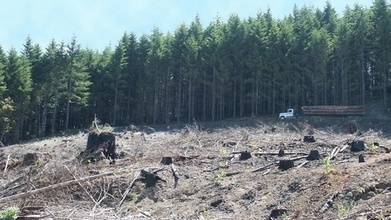
Does the export of raw logs to China hurt or help British Columbia’s economy?
NDP leader Adrian Dix is rallying for export tariffs on logs, which would put a hard stop on the export of raw logs from B.C. that are being shipped and processed in China instead of here. The concern is that log exports result in a loss of jobs for B.C. residents and dampen overall efforts for sustainable forest management. Last year, about one-third of B.C.’s softwood lumber, worth nearly $1.1 billion, was exported to China.
Such protectionist strategies only result in inefficient markets. By trying to force the creation of a few jobs in value-added forestry products, thousands of existing efficient and sustainable jobs in the log exporting sector will be sacrificed.
|
|
Scooped by
Prentiss & Carlisle
July 5, 2012 8:09 AM
|
England's publicly owned forests and woodlands will not be sold off, the environment secretary, Caroline Spelman, said on Wednesday, after the independent panel she appointed recommended it remain in public ownership.
The panel said the sell-off had "greatly undervalued" the benefits that woodlands provide for people, nature and the economy and that investment would repay itself many times over in terms of public benefit. It called for the forests to be held in trust for the nation and for public investment to manage and expand the woods.
|
|
Scooped by
Prentiss & Carlisle
July 5, 2012 7:51 AM
|
The Northwest Forest Plan (NWFP) was adopted in 1994 to “protect” the Sacred Owl. Nobody actually knew how many Sacred Owls existed at the time; nor did they know how many had existed in any previous period. Nobody had ever counted them. Instead, they created a model based on nesting habitat. Since Sacred Owls nest in “old growth,” and “old growth” was being reduced by logging, the model inferred that the Sacred Owl population must be declining also.
Based on this model, the powers that be concluded the Sacred Owl must be endangered. Since the Sacred Owl also requires younger stands and clearings for forage, the critical habitat designation was broadened to include most of the public forest lands in the Pacific Northwest. This opened the door for the environmental movement to litigate virtually any timber sale on public lands under the auspices of the Endangered Species Act.
Today, the environmentalists claim the Sacred Owl population is still declining at an alarming rate. So we must set aside even more land as “critical habitat,” sacrificing even more production, jobs, and communities. But, if the Sacred Owl population really is declining so rapidly, eighteen years after the NWFP was put into effect, then clearly the plan is not successful and should be scrapped. Why double down on a failed plan?
|
|
Scooped by
Prentiss & Carlisle
June 26, 2012 9:33 PM
|
The U.S. Supreme Court will hear an appeal in a case that examines whether sediment running off logging roads is industrial pollution and should be more tightly regulated.
The case could affect thousands of miles of roads. It’s being closely watched by the timber industry, clean water advocates, and politicians in the Northwest.
|
|
Scooped by
Prentiss & Carlisle
June 15, 2012 10:19 AM
|
The cost of fighting a roughly 33-square-mile fire in Michigan's Upper Peninsula is expected to rise to at least $3.5 million. ... The DNR reported Wednesday that crews fully contained the fire, about three weeks after a lightning strike started it. The wildfire destroyed 136 structures, including homes, outbuildings and campers. It temporarily closed Tahquamenon Falls State Park. No injuries were reported.
|
|
Scooped by
Prentiss & Carlisle
June 8, 2012 9:21 AM
|
Four years ago, as the economy was entering a devastating recession, swaths of rural Pennsylvania were booming. ... In the spring of 2008, a gas company offered Josh Fox’s family almost $100,000 to drill on its Wayne County property, inspiring Fox, a filmmaker, to make the anti-fracking documentary Gasland. The Oscar-nominated film, which shows water from a faucet catching fire, was shown on HBO and helped foment broader opposition to fracking. ... While many residents blame Fox for their troubles, he says they were naive to think drilling would ever be allowed in such an environmentally critical area. He faults the gas companies for dangling money in front of farmers without warning them of the potential problems. “It was all sweetness and light,” he says. “‘You’ll make so much money.’ That’s exploitation, not prosperity. This was a bubble.”
|
|
Scooped by
Prentiss & Carlisle
June 4, 2012 10:15 AM
|
Three environmental groups filed a lawsuit Thursday, alleging state timber harvests violate federal law by killing and harassing marbled murrelets, a bird protected by the Endangered Species Act.
The lawsuit comes as Oregon land managers are implementing a plan to increase logging on the 93,000-acre Elliott State Forest between Reedsport and Coos Bay.
|
|
Scooped by
Prentiss & Carlisle
May 25, 2012 1:07 PM
|
Gov. Jerry Brown tucked provisions into his budget that would limit payouts in wildfire liability cases, potentially saving timber companies and other major California landowners hundreds of millions of dollars as federal prosecutors pursue record-high damages in court.
The Democratic governor also asked lawmakers to impose a 1 percent lumber tax to fund forestry oversight while reducing industry costs. And he wants to reduce the frequency with which California reviews tree-cutting plans for environmental impacts. ... But the plan has drawn strong opposition from the Sacramento-based U.S. attorney's office, which is aggressively pursuing wildfire negligence cases, as well as some environmentalists who contend Brown is giving the industry too much.
|
|
Scooped by
Prentiss & Carlisle
May 23, 2012 7:41 AM
|
The government plans to allocate RM3 billion for expansion of forest plantations in the country to achieve an area covering 375,000 hectares by 2020, Deputy Prime Minister Tan Sri Muhyiddin Yassin said today.
|
|
|
Scooped by
Prentiss & Carlisle
August 13, 2012 9:53 AM
|
Malaysian companies exporting timber to the United Kingdom and European Union (EU) countries must produce documentation tracking shipments through their supply chain back to source from March 3 next year, or be subject to legal sanctions for non-compliance.
In a statement today, the Malaysia External Trade Development Corp (Matrade) said the new law prohibits the placing of illegal timber and products derived from such timber on the EU market with operators needing to exercise "due diligence" when selling timber products there.
"For Malaysian exporters, these measures may include additional information requests on the products' details, origin, and legality and so on and certification requests for systems that allow for some legality verification, such as the Forest Stewardship Council and the Programme for the Endorsement of Forest Certification or equivalent verification scheme as certified timber products represent lower risk for EU operators and buyers.
|
|
Scooped by
Prentiss & Carlisle
August 6, 2012 5:02 PM
|
The state of New York is acquiring the biggest chunk of land in the Adirondacks in more than a century, Gov. Andrew Cuomo announced Sunday.
Cuomo said the $49.8 million acquisition of 69,000 acres of land would preserve a significant portion of the Upper Hudson River watershed.
“Today’s agreement will make the Adirondack Park one of the most sought after destinations for paddlers, hikers, hunters, sportspeople and snowmobilers,” he said in a release. “Opening these lands to public use and enjoyment for the first time in 150 years will provide extraordinary new outdoor recreational opportunities, increase the number of visitors to the North Country and generate additional tourism revenue.”
|
|
Scooped by
Prentiss & Carlisle
July 29, 2012 9:32 PM
|
The woodlands of central Maine, long dominated by logging and papermaking, are in the midst of a painful shift. Timber firms are abandoning the state, selling off vast tracts of pine and spruce. The disruption raises the question of what should come next: a transition to a tourism-based economy, or an all-out effort to bring in new industries.
|
|
Scooped by
Prentiss & Carlisle
July 19, 2012 1:28 PM
|
The U.S. Lumber Coalition is disappointed by today's London Court of International Arbitration (LCIA) ruling that British Columbia's (BC) timber pricing practices do not circumvent the U.S.-Canada Softwood Lumber Agreement (SLA).
By selling large volumes of timber for a lower price than should have been charged under the BC Interior timber pricing system grandfathered in the SLA, BC moved Crown timber prices even further from market value - giving back to lumber producers with one hand the export taxes it had collected with the other.
In the arbitration, the United States provided a compelling demonstration that the effects of the mountain pine beetle on the suitability of logs for producing lumber could not begin to justify the increase of timber graded and priced as mostly unsuitable for producing lumber in BC. The LCIA did not take issue with this conclusion as a factual matter, but concluded it could not rule against Canada on this basis alone. Rather, the LCIA tribunal found that the United States also had to demonstrate that a particular amount of misgrading could be attributed to each specific BC government action.
|
|
Scooped by
Prentiss & Carlisle
July 9, 2012 2:09 PM
|
A federal judge has granted a request by several logging industry firms to join Gov. John Kitzhaber and other state officials in defending Oregon’s plan to allow more logging in Coast Range forests.
The lawsuit filed by three environmental groups — Cascadia Wildlands, the Center for Biological Diversity and the Audubon Society of Portland — claims the state’s logging goals in the coastal Elliott, Tillamook and Clatsop state forests illegally harm the habitat of the threatened marbled murrelet, which is protected under the Endangered Species Act. The seabird lays its eggs on the large, mossy branches of mature and old-growth trees.
State officials have said they have a forest management plan to protect the seabird. However, they have voluntarily suspended logging on 10 timber sales until District Judge Ann Aiken rules on the environmentalists’ motion for an injunction.
|
|
Scooped by
Prentiss & Carlisle
July 5, 2012 7:59 AM
|
California timber companies and other major landowners would pay significantly less money when found liable for wildfire damage under draft legislation that resurfaced Monday in the Capitol.
|
|
Scooped by
Prentiss & Carlisle
July 3, 2012 11:11 AM
|
The Minnesota Court of Appeals decided Monday that a lower court erred when it ruled in favor of timber companies who claimed the state broke promises by capping payments under a forest management program.
The decision essentially dismisses a lawsuit filed last year by three large timber companies who argued the $100,000 annual cap put in place as lawmakers were trying to balance the budget was a breach of contract. ... Sarah Crippen, an attorney for Blandin Paper Co., Potlatch Corp., and Meriwether Land and Timber, said her clients were disappointed with the decision and were reviewing their options.
The case centers on the 2001 Sustainable Forest Incentive Act, which allows owners of forest land to receive annual payments for following certain requirements, such as following a forest management plan or avoiding residential or agricultural use. Enrolled land is required to be in the program for eight years, and there are penalties for early withdrawal or noncompliance.
|
|
Scooped by
Prentiss & Carlisle
June 19, 2012 11:23 AM
|
Question: how did an African politician, on an official salary of roughly $6,000 a month, manage to acquire the lifestyle of a Hollywood billionaire, partying at the Playboy mansion, travelling in private jets, and living at a $30m Malibu mansion... ... Answer: simple. First, that politician was lucky enough to be Teodoro Nguema Obiang, heir apparent to the autocratic dictator of Equatorial Guinea, a tiny country in West Africa... ... That, at least, is the claim made in an extraordinary 118-page lawsuit filed this week by the US Department of Justice (DOJ), which is attempting to persuade a judge to confiscate some of Obiang’s most treasured possessions... ... The document sheds unprecedented detail on the alleged schemes by which Obiang used his role as Forestry Minister in his father’s government for personal enrichment. And it unpicks the dubious steps his lawyers then took to, in the words of the DOJ, “defraud” a string of US banks into providing a safe haven for that illegally-acquired wealth. ... The legal complaint tells how Obiang’s father appointed him to his cabinet in 1998. He swiftly began forcing large timber companies – including ABM, Agroforestal and Isoroy - wishing to exploit the country’s publicly-owned forests, to pay millions of dollars in bribes and kickbacks, it claims. They were allegedly told to stump up fees to access forestry, fees to operate there, and fees to export their product. He personally received roughly ten percent of the value of wood harvested.
At one point, Obiang announced an overnight export “tax” of $27 per log, to be applied on every timber shipment out of the country. The money was paid directly into a private commercial bank account in Equatorial Guinea, which he had personal control over, the lawsuit alleges.
|
|
Scooped by
Prentiss & Carlisle
June 11, 2012 11:46 AM
|
The U.S. Forest Service has chosen Pagosa Land Co. to remove woody biomass from national forestland in Pagosa County. Through the Pagosa Area Biomass Long-Term Stewardship Contract, a project developed to restore the region’s forest while reducing fire risk through a 10-year contract, J.R. Ford, president of Pagosa Land Co., and his team will have access to the national forest to harvest woody biomass. ... The contract work will include the removal of saw timber products other than logs, as well as limbs and tops of trees found in ponderosa pine, mixed conifer or aspen stands, according to the USFS. The contract will also allow Ford and his team to perform road maintenance and other associated activities. Roughly 1,000 to 2,000 acres of forest will be treated each year.
|
|
Scooped by
Prentiss & Carlisle
June 6, 2012 8:54 AM
|
The dreams of wood pellets plants in the U.S. shipping millions of tons of biomass to Europe's power plants may be on life support now. Although the EU will not abandon its renewable energy goals, government support for subsidies of biomass is slipping. Without these subsidies, the biomass industry has little reason to undertake the intensive capital investments to use biomass as a fuel source. In return, ports and shippers in the US and Europe will need to take a serious look at what kind of volumes to expect for biomass in the next 5 - 10 years.
|
|
Scooped by
Prentiss & Carlisle
May 29, 2012 1:49 PM
|
The Northwest Forest Plan enacted by President Clinton in 1994 may have had good intentions, but it has failed catastrophically.
According to Forest Service records, the volume of timber harvested on Forest Service lands declined from a peak in 1987 of 12.7 billion board feet to 4.8 billion board feet in 1994. That harvest further declined to 2.4 billion board feet in 2011. When the Northwest Forest Plan was adopted in 1994, harvest levels already had dropped by nearly two-thirds — and today are merely 19 percent of the peak harvest level of 1987. ...
The resulting build-up of biomass in Northwest forests has led to catastrophic fires burning millions of acres. Spotted owl populations have crashed by 60 percent or more. The Northwest Forest Plan has failed to save owls and instead has caused the incineration of their habitat.
The Pacific Northwest is the premier timber-growing region in the world. Yet today, America is importing 40 percent of its softwoods from Canada.
|
|
Scooped by
Prentiss & Carlisle
May 24, 2012 4:26 PM
|
The U.S. Environmental Protection Agency filed notice Wednesday in the Federal Register proposing to revise stormwater regulations to say hundreds of thousands of miles of logging roads on private and public lands nationwide don't need the same kinds of permits that factories must get. Some of the roads are paved, but most are graveled, and some are bare dirt.
Instead, they would be regulated under a less stringent system known as "Best Management Practices," where authorities set up guidelines for the design and maintenance of logging roads to minimize erosion that sends mud into rivers. EPA is reviewing how states and tribes handle the issue, and plans to issue the new rules by Sept. 30, when an exemption for the timber industry enacted by Congress expires.
|





![Raw log exports have Canadians at loggerheads [opinion] | Timberland Investment | Scoop.it](https://img.scoop.it/SZw1ObmNS0-LhWeeUCgiAjl72eJkfbmt4t8yenImKBVvK0kTmF0xjctABnaLJIm9)