 Your new post is loading...

|
Scooped by
Prentiss & Carlisle
August 25, 2014 4:40 PM
|
In order to balance timber supply and demand and guarantee national timber security China plans to establish, by 2020, strategic commercial timber reserves over 14 million hectares in 25 provinces including Guangxi, Guangdong, Hu’nan, Sichuan, Guizhou, Yunnan, Inner Mongolia Autonomous Region, Liaoning, Jilin and Heilongjiang, ITTO reported.
Of the 14 million hectares, 4.5 million will be new plantations, 5 million will be improvement of existing mature forests and a further 4.5 million hectares will require intensive management of young and maturing forest. The aim is to create a base yielding an annual average volume of around 142 million cubic metres.
According to the China National Timber Strategic Reserve Production Base Plan (2013-2020), 1.87 million hectares will be established in Guangxi Province to yield 13% of the target production.
|
|
Scooped by
Prentiss & Carlisle
June 30, 2014 12:18 PM
|
The Department of Natural Resources got the green light to begin selling 10,000 acres of state land. The Natural Resources Board on Wednesday approved the land sales, to take place by June 30, 2017. *** The 10,000 acres available for sale represent less than 1 percent of the DNR’s more than 1.8 million acres, including easements. Proceeds from the land sold will be used to repay outstanding debt related to the Knowles-Nelson Stewardship program.
“The Knowles-Nelson Stewardship Program has done wonders for our state’s natural resources — this next step will ensure that it continues to create new recreational opportunities throughout the state,” DNR Secretary Cathy Stepp said in a statement. *** The program has added more than 600,000 acres for public recreation. Parcels with legal access from a public road will be offered for sale to local or tribal governments first and later to the general public through a competitive bidding process.
|
|
Scooped by
Prentiss & Carlisle
June 23, 2014 12:42 PM
|
It is easy to harp on government and their inadequacies, but let’s face it, the biomass industry exists in the capacity that is does because of supportive government policies. The industrial pellet sector in the southeastern U.S. exists because of Europe’s climate change policies, which incentivize replacing coal with wood pellets. Yet, despite its importance, policy is not the only factor that enables and boosts growth in the biomass industry. Available feedstock and energy infrastructure, along with policy, form the backbone for growth and innovation in the biomass industry. This week’s DataPoints briefly looks at what I’m calling the “triple crown of biomass” and its regional implications. Without any one of the three components (policy, feedstock, and infrastructure), a biomass project will never be successful.
In the southeastern U.S., the swift rise of the industrial pellet export industry is due to the convergence of policy in Europe, numerous years of deferred harvest in southeastern forests, and an existing port infrastructure along the Gulf of Mexico and Atlantic. *** The southeastern U.S. forest industry has had a number of pulp and paper plants close in recent decades, which has led to a decline in demand and lower stumpage fees across southeastern forests compared to other regions in the U.S. While stumpage fees for pulp wood in Mississippi were around $9 a ton in the 4th quarter of 2013, an equivalent amount of pulp wood in Maine sold for roughly double during the same time period. The higher stumpage fee in the Northeast discourages bioenergy development on the scale needed for industrial pellet export development. Instead, the biomass industry in the Northeast primarily utilizes mill residue for local biomass power generation and premium pellet production. *** Despite the Northeast and the Southeast both having a strong port infrastructure, the cost of feedstock in the Northeast along with regionally supportive policy encourages local consumption of biomass rather than exporting it to a different region.
|
|
Scooped by
Prentiss & Carlisle
May 8, 2014 12:03 PM
|
Marbled murrelets are the latest proxies in the long struggle between industrial forestry and conservationists. Like northern spotted owls, if murrelets are convincingly shown to make use of a segment of forest, logging becomes far more problematic.
Sales of standing timber in both Oregon and Washington are in legal jeopardy due in part to objections based on this seabird’s pattern of nesting in the branches of mature coastal forests.
In Oregon, the latest development in the conflict is an April 21 lawsuit to block logging in part of Elliott State Forest by Seneca Jones Timber Co., which was willing to pay about $1.83 million for the timber. Although this particular lawsuit is premised on a different legal theory, the possible presence of murrelets severely impacts the marketability of 2,700 acres of Elliott forest. An appraiser said the land is worth $4 million with murrelets, compared to $22 million if they were not a factor.
Valuing forests based on what their trees sell for is a fundamental problem for preservationists, who argue for a much broader understanding of how intact old forests have a wide array of nonmonetary merit — from mitigating climate change to making our lives more meaningful.
But society also has a legitimate interest in providing necessary public income for government functions including schools, along with jobs and economic opportunities in rural areas of the Pacific Northwest. For many Oregon counties, trees are the primary natural resource. Without timber harvests, these communities are at risk of deteriorating into little but Social Security retirement villages.
|
|
Scooped by
Prentiss & Carlisle
April 24, 2014 2:17 PM
|
Wisconsin and three other Great Lakes states have asked federal authorities to delay plans to protect an imperiled bat species because the proposed restrictions could have a "crippling effect" on the forest industry and harm owners of private and public land.
Environmental agencies in Wisconsin, Minnesota, Michigan and Indiana told the U.S. Fish and Wildlife Service in an April 17 letter that the states favor protections for the northern long-eared bat, but argue the draft rules go too far.
Wisconsin listed four cave-dwelling bats in 2011, including the northern long-eared, as threatened species because of the imminent arrival of fungal disease that has killed millions of bats in the eastern United States and Canada.
The Department of Natural Resources confirmed April 10 that white-nose syndrome had been detected for the first time in little brown and northern long-eared bats in Grant County, in southwestern Wisconsin. Despite concerns about the spread of the disease, directors of natural resources agencies in the four states wrote that a plan by the Fish and Wildlife Service to minimize the public's contact with bat habitat is "overly restrictive and too broad."
***
Meanwhile, one key restriction calls for avoiding cutting of bat habitat during the summer maternity season, from April 1 to Sept. 30. "That's pretty much the whole state," said Erin Crain, director of the Department of Natural Resources' Bureau of Natural Heritage Conservation. "That's pretty much the summer logging season."
***
An industry expert on the topic, T. Bently Wigley, will discuss northern long-eared bats at a regional meeting in Wausau next month of the National Council of Air and Stream Improvement. Wigley has argued that studies have shown that the bat has been well-documented in areas that have been subject to intensive logging.
***
Rather than avoiding entire forests, the solution might lie in maintaining large den trees and snags that "are good homes for a lot of critters," Crain said.
|
|
Scooped by
Prentiss & Carlisle
April 2, 2014 1:41 PM
|
A new report released shows that if the Oregon State Land Board sold or leased the 93,000-acre Elliott State Forest, public school funding would increase by at least $40 million annually.
Roughly 85,000 acres of the Elliott State Forest are managed for the primary purpose of raising funds for public schools. These lands are known as “Common School Trust Lands,” and the Oregon State Land Board is required by law to manage them for the trust beneficiaries: public school students. Net receipts from timber harvest activities on the Elliott are transferred to the Common School Fund (CSF), where assets are invested by the Oregon Investment Council in various financial instruments. Twice each year, public school districts receive cash payments based on the investment returns of CSF assets.
Due to environmental litigation, the State Land Board lost $3 million managing the Elliott State Forest in 2013. As a result, the Land Board has recently decided to sell 2,700 acres of the Elliott. An independent analysis conducted for Cascade Policy Institute by economist Eric Fruits shows that selling or leasing the entire forest would dramatically increase the semi-annual returns to public schools, and would do so in perpetuity.
According to Cascade president John A. Charles, Jr., “The Land Board has a fiduciary duty to manage the state trust lands for the benefit of the public schools. Losing $3 million on a timberland asset worth at least $600 million is likely a breach of that duty. The Land Board is doing the right thing by taking bids to sell parcels of the Elliott, and should continue to pursue a path of selling or leasing larger portions of the forest. There is no plausible scenario of Land Board timber management that would bring superior returns to public schools than simply disposing of these lands and placing the funds under the management of the Oregon Investment Council.
|
|
Scooped by
Prentiss & Carlisle
March 13, 2014 6:31 PM
|
The New Brunswick government is increasing the amount of softwood the forestry sector can take from Crown land by 20 per cent under the province's new forestry strategy.
It's expected to result in the harvesting of an additional 660,000 cubic metres, said Premier David Alward and Natural Resources Minister PaulRobichaud, who unveiled the long-awaited strategy at a news conference in Fredericton on Wednesday. *** The industry is also expected to invest about $600 million, the government said.
J.D. Irving Ltd. plans to announce three "major capital investments" at its forest product operations later this week, according to a news release issued shortly after the forestry plan was unveiled. *** Private wood lot owners will also be positively impacted by the plan, said Robichaud.
The anticipated investment by industry will result in an increased need for wood from private wood lot — about 250,000 cubic metres, he said.
The overall timber objective is now about 3.9 million cubic metres of spruce and fir from Crown lands.
|
|
Scooped by
Prentiss & Carlisle
January 9, 2014 6:47 PM
|
U.S. Sen. Tammy Baldwin saw enough on her visit to Forest County in August to be convinced that Wisconsin’s 1.5 million-acre national forest is being under-harvested and change is needed.
The first-term Democratic senator now says supporting the state’s timber industry is among her top priorities and she pledged to work for reform of the forest management system. Her efforts include calling for increased funding to support additional logging and clarifying regulations to promote environmentally sound harvesting.
***
Records showed that the U.S. Forest Service could have cut 1.3 billion board feet of wood in the past decade under its forest management plan, representing $110 million in revenue. Instead, just 755 million board feet was cut in the forest that spans 11 Wisconsin counties.
National forest officials say a lack of federal money has limited their ability to harvest more timber in the Northwoods. Foreign competition, mechanization and volatile markets have also led to decreases in jobs tied to forest products across Wisconsin.
In December, Gov. Scott Walker said the national forest was being “underutilized” and launched a new $49,000 initiative from the Wisconsin Economic Development Corp. to begin studying stewardship programs. Baldwin sits on the Senate Energy and Natural Resources Committee, allowing her to play a key role in forest policy change.
In December, she called on the Obama Administration to build a new budget plan into the 2015 budget to break the “diversion cycle.”
***
“In six of the last ten years, Forest Service funds available to Wisconsin forests have been diverted through the practice of fire borrowing and reallocated to fight fires,” Baldwin wrote. “As a result, Wisconsin forest management has suffered, and an industry already stretched thin must deal with further delays to complete contracts.”
***
Baldwin also asked Farm Bill conferees to provide clarity about a clean water standard relating to forest roads and to extend support for forest stewardship contracts. The stewardship contracts push proceeds from timber sales back into local projects like road maintenance and other targeted management.
The Farm Bill, long-mired in political bickering over food stamps and divides between rural and urban representatives, could provide certainty for loggers in Wisconsin’s Northwoods by clarifying the water run-off rules and investing in stewardship and conservation programs, Baldwin said.
|
|
Scooped by
Prentiss & Carlisle
December 11, 2013 9:22 AM
|
Top state officials on Tuesday agreed to move forward with the sale of scattered tracts of the Elliott State Forest, despite objections from conservation groups that they include nesting trees for a protected bird. Gov. John Kitzhaber, Secretary of State Kate Brown and State Treasurer Ted Wheeler — who make up the State Land Board — unanimously backed the plan.
They said they're not trying to privatize the forest but need to balance conservation concerns against a constitutional requirement that the land generate money for public schools. *** The Land Board is responsible for managing the Elliott, on the southern coast near Coos Bay, and other state forests to generate money for the Common School Fund, which supports public schools. Officials say the fund lost money in fiscal-year 2013 because litigation over habitat for the marbled murrelet, a threatened seabird, has all but halted timber sales. *** "If you sold it to the timber industry at a cut-rate price, Oregonians would lose the remarkable, rare wildlife habitat, recreational opportunities that can only persist on public lands," said Francis Eatherington, conservation director for Cascadia Wildlands.
Kitzhaber responded that the sale would help establish a fair market value for the land, which would open up more options for divesting land in the future. Without knowing the value of the land, he said, the state can't negotiate exclusively with conservation-focused buyers because it wouldn't be able to prove it earned the maximum return for the land. *** An appraiser hired by the state concluded the presence of marbled murrelets, discovered over the summer, would significantly decrease the value of the land up for sale, from an estimated $22.1 million to $3.6 million. Stands occupied by murrelets can't be logged, but the appraiser suggested a timber company might do so anyway, risking penalties to earn a high return.
|
|
Scooped by
Prentiss & Carlisle
November 25, 2013 2:28 PM
|
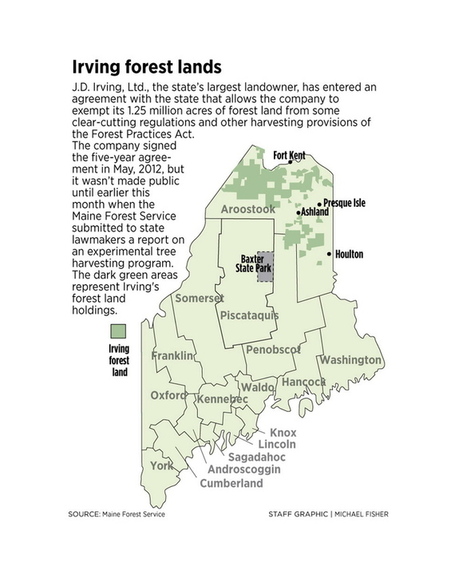
State forestry officials have entered into an agreement with J.D. Irving Ltd., Maine’s largest landowner, that allows the company to exempt its 1.25 million acres of forestland from some clear-cutting regulations and other harvesting standards of the Forest Practices Act. The five-year agreement was signed in May 2012 but wasn’t made public until this month, when the Maine Forest Service gave lawmakers a report on an experimental tree harvesting program known as Outcome Based Forestry.
The program had not drawn any participants since it was established in 2001, but now interest among major timberland owners is on the rise, as word spreads about the deal that allows J.D. Irving to do individual clear-cuts of as much as 250 acres without state approval.
|
|
Scooped by
Prentiss & Carlisle
November 11, 2013 11:10 AM
|
The mystery land manager tapped to manage one of the largest, most complex logging operations in history turns out to be mostly a land broker that bundles timber sales. Good Earth Power last week announced it will contract with The Campbell Group to manage the first 300,000 acres of a thinning and forest restoration contract that could one day encompass some 2.6 million acres. The Campbell Group manages 3 million acres as a land and timber broker, but generally hasn’t actually operated the timber-cutting crews that will actually implement an unprecedented plan to use the timber industry to restore dense, healthy, fire-prone forests to healthy conditions not seen for a century.
|
|
Scooped by
Prentiss & Carlisle
October 16, 2013 10:14 AM
|
Western timber companies have gone to court to lift the logging ban on national forests due to the government shutdown, arguing the government has no authority under timber sale contracts to force loggers to stop working.
Three wood products companies and a timber industry association filed the lawsuit Monday in U.S. District Court in Medford against the U.S. Forest Service and the U.S. Bureau of Land Management.
The lawsuit seeks a temporary restraining order lifting the logging shutdown, arguing direction from the Office of Management and Budget does not require suspension of operations on a federal contract so long as direct supervision is inessential to the contractor's work. It adds that some of the contracts involve work that is improving public safety by reducing wildfire danger and removing dead trees in danger of falling in campgrounds.
***
"It makes zero sense for the cash-strapped government to shut down operations that pay millions into the United States Treasury," said Tom Partin, president of the American Forest Resources Council, the timber industry group that filed the lawsuit. "A timber operation isn't something you can turn on and off like a light switch. Once equipment has to be moved out, it can be months before it can be moved back in.
"What is happening to our members is particularly frustrating when other businesses with contracts to operate on federal land, such as ski areas, are being allowed to continue working," Partin added in a statement
***
The Forest Service started sending out notices to 450 timber buyers last week, saying they had to wrap up operations and put measures like erosion controls in place. The BLM, which sells timber only in Western Oregon, followed suit.
Though some companies depend heavily on federal timber sales for their logs, national forests produce only about 5 percent of the nation's lumber supply. Since logging was deeply cut back on national forests in the 1990s to protect fish, wildlife and clean water, markets have turned to other sources, such as Canada and private lands.
|
|
Scooped by
Prentiss & Carlisle
August 26, 2013 10:06 AM
|
An Oregon conservation group has proposed a health initiative linking landowners with carbon-offset buyers, getting money to the older owners for health-care costs while more effectively managing their timber.
The initiative can work for woodlots as small as 20 acres, The Corvallis Gazette Times reported. *** The Forest Health Human Health program would allow family tree farmers to sell carbon credits based on the amount of carbon estimated to be digested by their trees each year.
Under the plan, timber harvesting could continue in the form of tree thinning or underbrush removal. The program is already in place in Columbia County.
A national 2005 study was the first time medical expenses were identified as potential key factors in the decision to sell family woodlands. *** Ninety percent of the payment would go into a health-care account and the landowner would receive an “ATreeM Card.” The other 10 percent would be dedicated to community health programs — for example, a scholarship fund to help educate doctors who will practice medicine in rural areas.
|
|
|
Scooped by
Prentiss & Carlisle
July 7, 2014 6:24 PM
|
A Supreme Court of Canada ruling on aboriginal land could eventually have as severe an impact on North American lumber supply as the mountain pine beetle, RBC Capital Markets warned on Monday.
The court’s unanimous decision on June 26 relates to a 30-year-plus land dispute between the Tsilhqot’in Nation and the British Columbia and Canadian governments. It entitles the B.C. First Nation to dictate what logging and other activities take place on its newly recognized 1,700 square kilometres of land.
Now with an established precedent to title, the provincial/federal governments in Canada will have to consult, and gain the consent of the respective First Nation(s) when development projects/timber harvesting concern unceded land, RBC analyst Paul Quinn told clients. He noted that B.C. has accounted for roughly 24% of North American lumber production during the past 10 years.
If the Supreme Court ruling leads to delays and limitations in harvesting sawlogs in B.C., Mr. Quinn expects a tighter lumber market and higher prices.
|
|
Scooped by
Prentiss & Carlisle
June 24, 2014 7:02 PM
|
UNESCO’s World Heritage Committee has voted to protect all Tasmanian forest from logging — striking down the Australian government’s attempt to withdraw 183,000 acres (74,000 hectares) from the U.N. list of cultural and natural wonders.
Canberra claimed that parts of the forest had already been degraded by the timber industry and should therefore be fair game for further logging. However, U.N. delegates in Doha, Qatar, sided with conservationists who claimed that most of the forest was unscathed and that only 8.6% of the 3.5 million acres (1.4 million hectares) had been damaged.
Prime Minister Tony Abbott told the Australian Broadcasting Corporation (ABC) that he was disappointed with the decision, believing that the untapped Tasmanian logging would aid his nation’s already floundering timber industry. “The application that we made to remove from the boundaries of the World Heritage listing — areas of degraded forest, areas of plantation timber — we thought was self-evidently sensible,” Abbott said.
|
|
Scooped by
Prentiss & Carlisle
May 12, 2014 10:17 AM
|
Timber companies that want to harvest near potentially dangerous landslide areas will now have to conduct geologic reviews before getting a logging permit from the state, officials said Friday.
Under the new standards announced by Commissioner of Public Lands Peter Goldmark, the state will require a geotechnical report when there’s a potential risk to public safety — even if the harvest area itself doesn’t include unstable territory. *** The Seattle Times reported in the wake of the mudslide that state officials had been relying on an outdated map to determine where loggers could harvest trees above the slide hill. A clear-cut can increase groundwater flows and destabilize landslide-prone slopes.
Had state officials utilized a newer map at the landslide hill, regulators likely would have restricted most of the 7.5 acres that were clear-cut in 2004. *** State rules have required timber companies to conduct geotechnical reports when harvesting on potentially unstable slopes. Under the new procedures, DNR will examine sites to determine whether there are potential public-safety risks due to unstable slopes outside of a harvest area.
DNR said sites will be analyzed on a case-by-case basis, and the state would require the geotechnical reports if it feels public safety could be an issue.
|
|
Scooped by
Prentiss & Carlisle
May 8, 2014 11:49 AM
|
A revamped state program which gets more private lands into timber production, ensures more forest planning and offers tax incentives to landowners has seen great gains over its first few months. The Qualified Forest Program encourages private property owners to manage their forestlands in an economically and environmentally sustainable way according to site-specific forest management plans. In exchange for enrolling their property in the program, landowners receive exemptions from local school operating taxes and the uncapping of the taxable value of property if the land changes ownership.
***
The new program lowers application fees, requires specific elements for forest management plans, doubles the amount of land private property owners can enroll, requires planned timber harvests to occur within three years and does not require public access to private land.
***
"The total acres that are enrolled in the program...for the 2014 tax year would be 147,824 acres," Harlow said. "About a 58 percent increase in the amount of acres that were in the program under the previous legislation."
***
State Sen. Tom Casperson, R-Escanaba, said lawmakers are hoping to extend a June 5 deadline for landowners to transfer from the Commercial Forest Act program to the new Qualified Forest Program, sparing property owners a financial CFA withdrawal penalty.
***
The increased timber production under the program helps balance the amount of timber harvested on private, state and federal lands. MDARD officials said no increased timber harvest is expected on federal lands, while state harvests are yielding roughly the same amount of timber being produced each year. Meanwhile, private lands are estimated to be producing up to five times the amount of timber annually harvested.
The Delta County Conservation District said 43 percent of the U.P., or 3.6 million acres, is owned by non-industrial private property owners. A Michigan State University survey of such landowners found only 20 percent of the state's 11 million acres of private forestlands are actively managed.
"We have reached a point in time that if we're going to keep our forest resource healthy, across all ownership patterns, we're going to have to get more from the private landowner," Rick Lucas, a veteran forester for Osceola, Lake and Mecosta counties, said. "And I think the QFP program will indeed hit the mark in that regard."
|
|
Scooped by
Prentiss & Carlisle
April 14, 2014 11:49 AM
|
The state of Oregon will consider selling the whole Elliott State Forest, where legal battles over logging and protections for threatened species have reduced revenues for schools.
Jim Paul, assistant director of the Department of State Lands, said Friday the forest has turned from an asset into a liability, costing the Common School Fund $3 million last year. He says the state has a responsibility to see if it can turn that around.
He adds that selling off the whole forest, whether to a timber company or conservation groups, is just one in a spectrum of possibilities that will be examined by department staff in coming months so the State Lands Board can make a decision.
***
The Elliott covers about 90,000 acres north of Coos Bay. It includes some of the last older forest in the Coast Range, where most forests are privately owned and heavily logged. As the state has tried to increase harvest levels in recent years to meet local demands for logs and revenue, it has run into difficulties meeting federal requirements to protect habitat for threatened northern spotted owls, marbled murrelets and coho salmon.
A lawsuit from conservation groups over protections for marbled murrelets, a seabird that nests in large old trees, has resulted in withdrawal of several timber sales. Protesters have occupied timber sales to prevent logging.
The State Lands Board, made up of the governor, state treasurer and secretary of state, decided last December to sell off five parcels from the forest to get a better idea of its value in light of logging restrictions to protect threatened species.
The deadline for bids on three of them was Friday. Paul said the names of the winners would not be disclosed until Wednesday.
|
|
Scooped by
Prentiss & Carlisle
March 24, 2014 2:59 PM
|
MOST people believed the island state of Tasmania had at last found peace after a 30-year war between environmentalists and loggers. Both sides signed a deal two years ago that gave everyone something: secure supplies for timber companies and protection for native forests. Now, though, Tony Abbott, Australia’s prime minister, has reignited the war. Australia, he says, has too much “locked-up forest”. Mr Abbott wants to open up a swathe of Australia’s most fought-over forest and hand it to loggers. His government has asked UNESCO to remove 74,000 hectares (183,000 acres) from the World Heritage-listed wilderness region that covers about a fifth of Tasmania.
***
Forests cover half of Tasmania: in Australia as a whole it is less than a quarter. Battles over access to the land harmed the logging industry. Fearing that supplies would be disrupted, customers in Asia had started looking elsewhere for their timber. For this reason alone, many loggers welcomed the calm that came with the peace as much as greens did. Ta Ann, a Malaysian-based outfit that turns eucalyptus logs into veneer, says it was ready to quit Tasmania, but the peace deal persuaded it to stay.
***
Questions remain about Mr Abbott’s reasons for stripping 74,000 hectares from World Heritage listing. He suggests the entire area had already been logged, “degraded” or planted with timber to be logged. The Wilderness Society, one of the environmental groups that signed the deal, calculates that just 10% of the area had in fact been logged; about 40% was “old-growth” forest, barely disturbed before; and much of the rest was natural vegetation.
At 7.6% Tasmania’s unemployment rate is Australia’s highest (compared with 6% nationally). Mr Abbott blames “Green ideology” for many of the island’s woes, even for Australia’s lowest life expectancy. He wants a “renaissance” of forestry in Tasmania. The industry employs around 4,000 people, about 2,000 fewer than six years ago. The Australia Institute, a think-tank, reckons that Tasmania’s industry can survive only with government subsidies. Delisting World Heritage regions, it argues, will create hardly any jobs. The World Heritage Committee is due to rule on the Abbott government’s request in June.
|
|
Scooped by
Prentiss & Carlisle
March 6, 2014 10:49 AM
|
Apart from the political aspects of the tensions between Russia and Ukraine, there are some concerns over the stability of the European and global timber market.
Russia is the world’s largest log exporter and the fourth softwood lumber export country in the world. Moreover, Russia covers more than one fifth of the global forests and accounts for almost 5% of the worldwide timber trade. *** What could worry most the timber industry in this case is a trade embargo Russia/Western countries that might dis-balance the entire global timber trade functionality.
There some tight connections between Russia and the EU concerning the wood industry. First of all, many major European timber companies have operations in Russia, especially the Northern European companies. Plus, Russia is the second extra-EU wood products exporter to the EU, after China. By November 2013, Russia exported wood products (under HS code 44) worth EUR 2,7 billion and has at the present a market share (excluding EU member states) of 15% on the EU market. The EU also exports wood products to Russia of nearly 1,2 billion per year. Overall, the EU-Russia timber trade is over 4 billion annually. If the Crimean crisis deepens, a possible trade embargo (partial or total) scenario will become very feasible, which could have disastrous consequences for the European timber industry.
|
|
Scooped by
Prentiss & Carlisle
December 31, 2013 8:18 AM
|
As Phil Adams’ pickup climbed Rabbit Mountain, the green scenery faded to black. Trees grew sparse and were entirely absent in places.
Still, fully loaded log trucks were coming down the mountain. At the top, loggers unhooked cables attached to charred trees dragged uphill. Except for burn spots, stacked timber appeared in good shape.
The land belongs to Roseburg Forest Products, and the company is urgently salvaging flame-damaged trees before they turn to mush. *** Since early September, RFP has salvaged 8 million board feet damaged in last summer’s 48,679-acre Douglas Complex fires. The company plans to log another 32 million board feet in the next 18 months.
The fires burned on a mix of private and Bureau of Land Management timberlands, leaving behind the contentious issue of how to restore the land.
While salvage operations are moving fast on private land, the BLM has yet to make firm plans. BLM spokesman Cheyne Rossbach said the agency is aware that dead timber loses value the longer it stays in the forest. *** The dissimilar approaches are noticeable from atop Rabbit Mountain. Much of RFP’s land has been logged. Meanwhile, dead trees, both standing and toppled over, cover the BLM land. The difference creates a quilt pattern across the rolling mountains. *** Rossbach said BLM is considering options, including harvesting dead timber, and will hold meetings in January to update the public and ask for comments.
Any plans to salvage timber have to go through environmental reviews and include leaving trees for wildlife habitat, he said.
“We don’t know yet what salvage will look like,” Rossbach said. “We currently have a team in place assessing the lands and what we need to do as far as recovery, and we are setting up another team to look at potential for salvage.”
|
|
Scooped by
Prentiss & Carlisle
November 27, 2013 11:07 AM
|
A deal Maine struck with Irving Woodlands, made public Friday, has sparked concern among environmental groups that the state has handed the company a “big loophole” to avoid state regulations on clearcutting.
Forestry experts, though, believe those concerns are misplaced and that the deal allows Irving, Maine’s largest landowner, to be more efficient in its harvesting techniques and reflects the evolution of modern forestry practices.
Irving signed the five-year deal with the Maine Forest Service in May 2012. It enters the company’s 1.25 million acres, almost all of which are in Aroostook County, into an experimental forestry program known as Outcomes Based Forestry, which was created by statute in 2001. The deal was publicly disclosed for the first time earlier this month in a report the Maine Forest Service prepared for the Legislature’s Agriculture, Conservation and Forestry committee, which met on Friday to discuss the program. *** Under the program, Irving is exempt from certain sections of the Forest Practices Act that cover clearcutting. But the company is still required to abide by other state statutes and sustainability goals, is still subject to oversight by the Maine Forest Service and needs to maintain third-party forest certification from groups such as the Forest Stewardship Council or the Sustainable Forestry Initiative. *** Irving Woodlands, which harvests more than a million tons of softwood and hardwood from only 2 percent of its land each year, denies it’s being given a loophole to avoid regulations.
“Outcome based forestry — including provisions regarding clear-cutting — requires more accountability measures that must be submitted to the Maine Forest Service on an annual basis,” Blake Brunsdon, Irving’s chief forester, said in a statement to the BDN. “We believe the forest management we practice is sustainable, based on good science and meets the rigorous standards of the independent Forest Stewardship Council and the Sustainable Forestry Initiative forest certification programs.”
In its first year of participation in the program, Irving claims its contractors’ earnings have increased 21 percent and its road construction and maintenance budget has decreased by $825,000, according to Mary Keith, a spokeswoman for J.D. Irving Ltd., Irving Woodlands’ parent company. In addition, Keith said entering the program was “a catalyst and the foundation” of the company’s decision to invest upwards of $30 million to construct a new sawmill in Ashland that will employ 63 people.
|
|
Scooped by
Prentiss & Carlisle
November 22, 2013 11:38 AM
|
There is so little oversight of a state program that has spent $44 million promoting sustainable forestry on private land that lawmakers should make significant changes to it or scrap it altogether, Minnesota's legislative auditor said Tuesday.
The Sustainable Forest Incentive Program was created in 2001 to encourage good forestry on private land by locking in agreements for at least eight years that require landowners to submit and abide by sustainable forest management plans. In return, they get incentive payments set at a flat $7 per acre. About 2,300 landowners participated this year, with over 737,000 enrolled acres. The idea behind the payments was to offset property taxes on private forest land, thus encouraging landowners not to develop it.
But Legislative Auditor James Nobles' report said lawmakers should consider ending the program and identifying better ways of encouraging sustainable forestry. The findings follow Gov. Mark Dayton's recent calls for next year's legislative session to focus on eliminating old, unneeded laws and programs.
Nobles told an oversight subcommittee his office "is not criticizing the concept of sustainable forest management. We are simply questioning whether this particular tool ... has been designed and implemented in a way that ensures that we are achieving measurable results."
|
|
Scooped by
Prentiss & Carlisle
November 8, 2013 9:28 AM
|
Rayonier Inc. (NYSE:RYN) announced today that on November 6, China's Ministry of Commerce (MOFCOM) issued the following preliminary determination regarding the import of Rayonier dissolving pulp products into China:
1) Rayonier's high purity cellulose acetate and other high purity products will not be subject to any duties as they are specifically exempted. 2) Rayonier's lower purity Fibernier grade product used in commodity viscose applications will be subject to a 21.7 percent interim duty effective November 7.
Paul Boynton, Chairman, President and CEO stated, "While we are pleased that MOFCOM recognized the unique characteristics of our high-purity cellulose specialty products, we intend to challenge the interim duty on commodity viscose as it appears to be based on inaccurate assumptions."
In February 2013, MOFCOM initiated an anti-dumping investigation of imports of dissolving wood, cotton and bamboo pulp into China from the U.S., Canada and Brazil during 2012. These determinations by MOFCOM are preliminary and subject to change upon the completion of its investigation and issuance of its final determination, which is expected in the first half of 2014.
Rayonier is currently reviewing the basis for MOFCOM's duty calculation and expects to submit a formal response next week. In addition, the Company is evaluating all potential product and market segment options that its broad range of capabilities provides in the event that MOFCOM's preliminary duty is not materially reduced or eliminated. Rayonier does not expect that MOFCOM's preliminary duty will materially affect its business results.
|
|
Scooped by
Prentiss & Carlisle
October 7, 2013 9:41 AM
|
The Maine Bureau of Parks and Lands, which manages 400,000 acres of forestlands, plans to significantly increase the amount of wood it cuts every year. At the request of the LePage administration, the BPL will increase the harvest nearly 30 percent between now and 2015. Compared to other large commercial landowners in Maine, the public lands will still contain more cords of wood per acre. But as Susan Sharon reports, the plan is generating some concern.
Audio: http://goo.gl/ungMwo
|





















For context, 14 million hectares is nearly twice the combined acreage of the four major timber REIT's -- Plum Creek, Potlatch, Rayonier and Weyerhaeuser.