Your new post is loading...



The previous post referenced the limitation of simply asking our two screening questions (“Big or small? Long or short?”) when evaluating potential disruptions. Some events affect businesses or investments locally, but not the entire industry or market and vice versa. Big changes can affect us locally, globally, or both. As we have long taught and written, timber markets are uniquely local. For strategy development, we want to specify the context of the disruption to best understand its absolute and relative risks, whether positive or negative.
Finance offers a useful analogy by distinguishing between systematic and unsystematic risks. Systematic risk, also called “undiversifiable” risk, refers to exposures and potential losses affecting the entire market or system, such as interest rates and recessions. Unsystematic risk includes “diversifiable” exposures specific to a given firm or industry. We have little, if any, control over systematic (global) risk, while unsystematic (local) risk can be mitigated and managed through diversification, insurance and other approaches.
***
This high-level framework prioritizes the relative importance of potential disruptions. It separates the local, tactical issues from the global and strategic. Now we apply this approach to a broader set of potential disruptions.
***
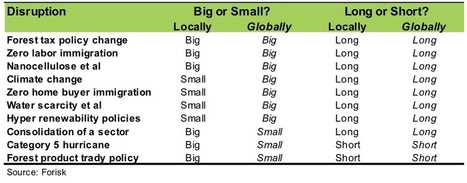
Figure 6 [above] summarizes an analysis and ranking for ten selected disruptions based on a forest owner point of view (as opposed to a wood user or manufacturer). This ranks first for global (strategic) exposures and second for local impacts. Each assessment has a “story” that changes based on the profile, objectives and assets of the firm.
Even at this level, the relative ranking highlights critical themes.
- Tax and environmental policies matter.
- People matter.
- Technology matters.
- Demand matters.
Also, time as a strategic idea remains malleable. Discussions with clients and colleagues about potential disruptions reinforce the arbitrary nature of “short” and “long” term in timber. The space and time required for impacts to realize themselves in forestry is beyond the immediate quarter or year (with respect to what the asset can and should do). Value is created consistently over long periods of time, and to the extent we put arbitrary 1 or 5 or 10-year time horizons on the asset, we constrain its performance and change our understanding of the associated risks.