Your new post is loading...

|
Scooped by
Prentiss & Carlisle
June 28, 2018 10:21 AM
|
In Wendell Falls Development, LLC v. Commissioner, the Tax Court ruled that Wendell Falls was not entitled to a charitable deduction on its donation of a conservation easement over a 125-acre parcel to the Smokey Mountain National Land Trust that restricted use such that a public park would be the only use allowable. The Court reasoned that as Wendell Falls would derive a substantial benefit from the park due to its location in the middle of 1,280 acres of Wendell Falls’s master-planned community, no deduction was allowed. Additionally, the Court reasoned that even without the substantial benefit, the easement did not diminish the value of the land because its highest and best use is as parkland even without the easement. Based on the absence of evidence in the record supporting the court’s conclusory reasoning, an appeal by Wendell Falls would not be unexpected. The impact of the decision on deductions allowed for contributions of conservation easements remains to be seen. However, the Tax Court’s decision, which appears to rely on speculation and unsupported valuation, is unlikely to be upheld. Wendell Falls purchased 27 contiguous parcels comprising 1,280 acres of unimproved land in Wake County, North Carolina between 2004 and 2007. Wendell Falls planned to subdivide the land into a master-planned community consisting of residential and commercial buildings. The community would also include an elementary school and a park. Wendell Falls considered placing the park upon 125 acres adjacent to a man-made lake and two creeks and considered charitable organizations for holding the conservation easement. *** In 2007, Wendell Falls sold the 125 acre area to Wake County for $3,020,000 with a precondition that the transferred land would be subject to a conservation easement restricting its use as a park. The county relied on an appraisal valuing the 125 acres at $3,020,000 for the 2007 sale. Wendell Falls concurrently granted Smokey Mountain National Land Trust a conservation easement on the transferred land, effectively restricting its use to a park and related structures. In 2008, Wendell Falls reported a $1,798,000 charitable contribution under IRC §170(c) on its timely-filed 2007 partnership tax return. The reported deduction was Wendell Falls’ appraised value of the easement at $4,818,000 less the $3,020,000 it received from the county on the sale. In 2009, it filed an amended return increasing the deduction to $4,818,000. In 2013, the IRS audited the amended return and reduced the deduction to $0. On appeal to the Tax Court, Wendell Falls supported its argument with an expert report valuing the easement at $5,919,000. The IRS’s expert report valued the easement at $1,600,000.
|
|
Scooped by
Prentiss & Carlisle
April 17, 2018 11:39 AM
|
In Wendell Falls Development, LLC v. Commissioner, T.C. Memo. 2018-45 [Here], the Tax Court seemed to determine that there is no deduction allowable for a conservation easement that “enhances” the value of other property owned by a donor taxpayer. The case involved a developer, Wendell Falls, that placed a conservation easement over certain property located within one of its ongoing development projects. Wendell Falls, then sold the easement-encumbered property (which was restricted to use as a park) to Wake County at what it claimed was a “bargain price.” At trial, none of the expert reports provided by the IRS nor the taxpayer determined that the contribution of the conservation easement “enhanced” the value of any other property owned by the taxpayer. However, disregarding the experts' opinions, the Tax Court concluded that the conservation easement enhanced the value of other property owned by the taxpayer – becausethe court inferred that the presence of a park benefited the yet-to-be-sold, adjacent lots. The Tax Court then took the unprecedented step of determining the presence of such enhancement caused the entire conservation easement donation to be nondeductible, citing U.S. v. American Bar Endowment, 477 U.S. 105, 116 (1986). The Tax Court's decision marks a radical departure from prior conservation easement jurisprudence, as well as the Treasury regulations pertaining to the valuation of conservation easement donations. The regulations specifically dictate how any increase in the value of other property owned by a taxpayeror related person is to be handled in the context of a “before and after” conservation easement valuation. The regulations account for this possibility by requiring any appraisal to account for the value of any such “enhancement,” by reducing the amount ofthe charitable deduction by such enhancement value. Indeed, the “substantial benefits” the court determined enhance the value of the eased property should have merely reduced the value of the taxpayer's claimed charitable deduction. The Tax Court focuses on the taxpayer's apparent “expectation” of substantial-enhancement benefits when donating the conservation easement. The expectation being that the property would continue to be utilized as a park once encumbered by the conservation easement and owned by Wake County. The court's opinion seems to blur the line between expectation of a post-contribution use that may result in enhancement value to other property owned by the taxpayer (which reduces the value of a charitable deduction) and quid pro quo (which disallows a charitable deduction altogether). Indeed, the Tax Court reasons that the taxpayer's deduction “is not allowable because of this expectation.” It is likely that many other donors could have the same or a similar expectation with respect to their properties once eased. In Wendell Falls Development, LLC, the experts for the taxpayer and the IRS all agreed that the conservation easement did not enhance the value of the taxpayer's other property. The Tax Court, however, disagreed with both experts, finding that the donation of the conservation easement createdan (unspecified amount of) enhancement to the value of other property owned by the taxpayer. Although this disregard of the unanimous conclusion of the experts was itself notable, the Tax Court's ruling that the presence of such enhancement caused the entire contribution to be nondeductible is significantly more consequential.
|
|
Scooped by
Prentiss & Carlisle
March 28, 2018 5:20 PM
|
One of the region’s state representatives is raising a red flag over state funding being used to the purchase of thousands of acres of private forest land in McKean, Cameron, Potter, Elk, Clinton and Jefferson counties.
During an informational meeting of the House Agriculture and Rural Affairs Committee held Monday, state Rep. Martin Causer, R-Turtlepoint, facilitated discussion on the Pennsylvania Infrastructure Investment Authority approving loans totaling $50.8 million, at an interest rate of 1 percent, to Lyme Timber Company, a timber management firm based in New Hampshire.
The money would be used toward the purchase of more than 60,000 acres of private forest land in Cameron, Clinton, Elk, Jefferson, McKean and Potter counties. About 9,000 acres of the land would be put into a permanent working forest conservation easement.
***
State Department of Conservation and Natural Resources Secretary Cindy Dunn told committee members the use of forest conservation easements was a top recommendation set out by the governor’s Green Ribbon Task Force on Forest Products, Conservation and Jobs.
“The parcelization and changing ownership of these forest tracks does raise a concern for us, especially in the Northern Tier of Pennsylvania,” she said. “It affects rural communities and jobs. It affects our mission as well. We take for granted that the Northern Tier will be forested forever, but I think without some delivered assistance, that would not be the case.”
A total of 70 percent of Pennsylvania’s forests are privately owned, she said. An easement conserves the land while also keeping it in private hands and on the local tax rolls, Dunn said.
|
|
Scooped by
Prentiss & Carlisle
June 22, 2017 6:52 PM
|
Nearly 22 square miles of important fish and wildlife habitat nine miles northwest of Whitefish could soon find its way into public hands. Montana Fish, Wildlife and Parks and The Trust for Public Land is working to conserve 13,398 acres of property, currently owned by Weyerhaeuser, through a complicated land deal that involves funding from a variety of sources.
***
The lands are part of the properties purchased by Weyerhaeuser in 2016 from Plum Creek Timber. The company indicated it planned to sell the property and gave the Trust for Public Lands the first option to buy the lands.
***
The proposal calls for The Trust for Public Lands to acquire the entire project area from Weyerhaeuser by the end of September. FWP proposes to purchase a conservation easement on 16 sections, or 10,218 acres. Once the Lazy Creek Conservation Easement is in place, the Montana Department of Natural Resources and Conservation would purchase the underlying fee ownership from the Trust. The funding would come from a variety of federal and state sources, including the U.S. Forest Service Forest Legacy Program, U.S. Fish and Wildlife Service Habitat Conservation Plan Land Acquisition Grant, hunter license dollars through FWP’s Habitat Montana Program and private funds from The Trust for Public Lands.
***
The Bonneville Power Administration will pay $11.5 million for the five other sections of land, or about 3,180 acres, in the Swift Creek drainage. BPA would retain a conservation easement on the land to conserve important native fish habitat. The BPA’s portion of the proposed project will serve as partial mitigation for fishery losses from the construction of Hungry Horse Dam.
|
|
Scooped by
Prentiss & Carlisle
October 5, 2016 11:01 AM
|
In an area recognized as one of the region’s most important wildlife
linkage zones and one of Idaho’s highest priority areas for benefiting
forest-based markets, approximately 5,568 acres of forestland has been
permanently conserved to benefit wildlife, local economies, clean water
and recreation.
***
These forests, located east of McArthur Lake between Sandpoint and
Bonners Ferry, were placed under conservation easements in September.
The conservation easements were conveyed to the Idaho Department of
Lands (IDL) through a partnership between The Molpus Woodlands Group,
LLC, on behalf of clients, the Idaho Department of Fish and Game, The
Nature Conservancy and the U.S. Forest Service.
***
“We are proud to work with The Nature Conservancy and the public agency
partners to dedicate these properties as working forests into
perpetuity. Our commitment to manage these properties on a sustainable
basis benefits long-term timber production, wildlife, and recreation,”
said Ken Sewell, Chief Operating Officer of Molpus. The conserved lands are located within the McArthur Lake Wildlife
Corridor, an area of Idaho nationally recognized for its scenic beauty,
outdoor recreation and wildlife. By protecting this area from
development, the project allows for permanent public access for
activities such as hiking, hunting and berry picking.
|
|
Scooped by
Prentiss & Carlisle
May 24, 2016 5:41 PM
|
The state Natural Resources Board will be asked Wednesday to approve purchase of an easement on 7,090 acres in Douglas County for $3.5 million. The request by the state Department of Natural Resources is a smart investment that will serve the resource, industry and those who love the outdoors. It also builds on a historic transaction that comprises more than 100 square miles and continues Wisconsin's tradition of preserving natural spaces for future generations. *** The agreements spell out requirements for continued logging, which will be managed by the Lyme Timber Co., and keep land open for hunting, fishing, hiking and other activities. The agreements also prohibit construction, deforestation and subdividing the land. Preservation of forest land as well as jobs in the logging industry. What's not to like? Make this purchase.
|
|
Scooped by
Prentiss & Carlisle
March 31, 2016 10:57 AM
|
State officials, environmentalists and the landowner say the deal is good for everybody, including taxpayers.
It allows Lyme Timber Company to continue harvesting trees on more than 8,000 acres in exchange for not cashing in with houses, hotels and strip malls. Company managing director Tim Morrow says the deal preserves a way of life.
“The hunting culture is strong there. This land will remain available for those local hunt clubs to continue their activities. In addition, that hunting activity brings economic activity as those folks come in every fall to pursue their hunting.”
Audubon of Florida lobbyist Charles Lee says the property couldn’t be a more tempting target for bulldozers or a better habitat for wildlife. Iconic species like the Florida black bear and American bald eagle call it home.
“It is one of the biggest conservation easements you’ve done in a while and we think it’s going to be important for future generations.”
Deborah Keller of The Nature Conservancy says the deal is part of a much larger effort.
She says the Lyme property will help the Big Bend Wildlife Management Area continue buffering 70 miles of coastline from development.
“This project is a connection to that project. It helps us create a continuous corridor of conservation area, and more importantly, working lands for this area. Ninety percent of Dixie County’s economy is based on the timber industry.”
Scott and the Cabinet approved the deal unanimously.
|
|
Scooped by
Prentiss & Carlisle
June 29, 2015 11:34 AM
|
More than 187,000 acres of forest in Minnesota fetches a lower price when you have to sell it all in one chunk.
That was the ruling this month of a Minnesota Tax Court judge who rejected the land appraisals from four Minnesota counties and delivered a victory to UPM Blandin, which owns the giant baby blue paper mill in Grand Rapids.
The judge ruled that Blandin’s forest — restricted by a conservation easement with the state — is worth about one-eighth the collective value quoted by the county’s assessors.
As a result, the tax base will decline in four counties; Itasca County, where most of the land is, will be hit hardest. The ruling also sets precedent for how swaths of forest in state conservation easements will be valued and taxed in the future.
|
|
Scooped by
Prentiss & Carlisle
April 16, 2015 4:18 PM
|
Technology giant Apple is partnering with The Conservation Fund to preserve more than 32,400 acres of timberland in Aroostook County.
The Arlington, Va.-based nonprofit announced Thursday that Apple's "precedent-setting" investment will help preserve Reed Forest as a working forest, ensuring that it will continue to produce a steady supply of sustainably harvested timber for paper and pulp mills. The forest, also known as Reed Plantation, is located in southern Aroostook County on the Mattawamkeag River, near the border of Penobscot and Washington counties. *** Apple's initiative with The Conservation Fund also includes the preservation of more than 3,600 acres of timberland in Brunswick County, N.C.
Apple's investment will allow The Conservation Fund to purchase both forests, place conservation easements on them and then sell both forests to buyers that will adhere to sustainable forestry practices, Robin Murphy, a spokesman for The Conservation Fund, told Mainebiz. The sale proceeds are then used to invest in preserving other forests, he added. While Apple may not source its paper from either forests in the future, Murphy said, the technology company's investment will help neutralize the impact of its paper consumption by increasing the country's supply of sustainable wood fiber. He said the production capacity of the two forests is equivalent to about half of the wood fiber used last year in packaging for Apple's products, including the iPhone, iPad and over devices.
|
|
Scooped by
Prentiss & Carlisle
February 19, 2015 11:42 AM
|
The second phase of a deal that creates the largest land conservation purchase in Wisconsin history goes before the Natural Resources Board next week at a time when the program's future is in jeopardy.
The Department of Natural Resources is proceeding with plans in northwest Wisconsin to buy a conservation easement on 21,189 acres for $5.6 million.
The measure comes as Gov. Scott Walker is proposing to freeze spending for such land purchases because of rising debt costs.
The DNR said the latest transaction would not be affected because funding comes in the current fiscal year and Walker's proposals would not take effect until July 1, the start of the state's new fiscal year.
***
If the latest deal is approved at a meeting in Madison on Feb. 25, the DNR will have paid a total of $16.9 million for conservation easements on 65,867 acres in Douglas County. The easements will protect the property from development, ensuring it remains open for public use in perpetuity.
The first phase of the deal occurred in May 2012, when the DNR struck an agreement with the Lyme Timber Co. of Hanover, N.H., using funds from the Knowles-Nelson Stewardship Fund.
Lyme Timber, a timberland investment management organization, will continue to own the land and manage it for timber production.
|
|
Scooped by
Prentiss & Carlisle
February 3, 2015 2:27 PM
|
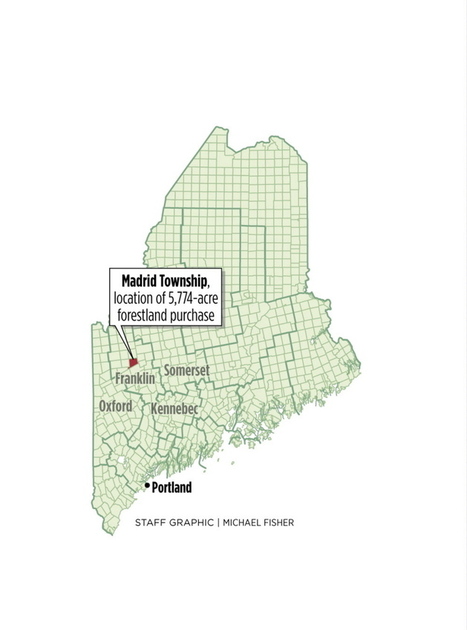
A conservation group has finalized a land deal to protect more than 5,700 acres of forestland and stream frontage in Franklin County that also features miles of snowmobile trails.The Trust for Public Land announced Monday that the organization used a $1.28 million grant from the federal Forest Legacy program plus other funding to purchase a conservation easement on 5,774 acres in Madrid Township.
The land, which is owned by Linkletter Timberlands, will continue to be managed for timber but helps create a 77,000-acre block of conservation land in what is known as the High Peaks region. The conservation easement ensures the public will continue to have access to the land for recreation.
|
|
Scooped by
Prentiss & Carlisle
August 21, 2014 1:33 PM
|
A South Carolina timber company is protesting the Internal Revenue Service's disallowance of a $2.13 million charitable contribution deduction arising from the company's grant of a conservation easement on a 1,000-acre property, saying the IRS erred in finding that the easement had no value.
Petitioner Salt Point Timber LLC granted the easement in perpetuity to a conservation organization known as Lord Berkeley Conservation Trust and deducted $2.2 million from its tax returns in 2009.
***
Salt Point claims that a separate IRS audit had valued the easement at $1.2 million. “As such, the IRS appraisal itself is evidence of the arbitrariness and unreliability of the IRS valuation at zero,” the petition said.
The easement, located in Berkeley County, South Carolina, preserves views of natural, environmentally significant habitat on the Cooper River, Salt Point says. “Because of the easement, views of these areas will not be marred by residential or commercial development, as can be seen upstream, downstream and directly across from the easement property,” it said. The easement also prohibits or restricts the construction of roads, golf courses and residences, according to the petition. ***
The case is Salt Point Timber LLC v. Commissioner of Internal Revenue, case number 18057-14, in the U.S. Tax Court.
|
|
Scooped by
Prentiss & Carlisle
July 22, 2014 1:39 PM
|
When a huge swath of forestland along the Klickitat River is formally secured for conservation by next year, it won't just be environmental advocates celebrating.
Protecting some 14 square miles of land — about 9,000 acres — also has the backing of local leaders and federal lawmakers from both parties. Spearheading the effort is the Columbia Land Trust, a nonprofit based in Vancouver. ***
The land won't have to change hands to be protected. A nearly $4 million grant will allow the state Department of Natural Resources to secure the area by purchasing a conservation easement, Kearney said.
The move will extinguish development rights and assures that none of the landscape will be lost to second homes or resorts — a real threat in forestlands across the country, including Washington, according to the land trust. But it also keeps the area in working forestry, allowing timber harvests to continue. The land is privately owned by Hancock Natural Resource Group.
"It doesn't erode that economic resource," Kearney said, noting recreational assets are also preserved. "It keeps the traditional access for hunting and fishing."
Like many of the Columbia Land Trust's efforts, the Klickitat Canyon Working Forest project has been years in the making. The organization wrote a grant proposal in 2012, and learned earlier this year that it had netted $3.975 million from the Land and Water Conservation Fund, through its Forest Legacy Program.
DNR is just beginning the process of acquiring the easement that will conserve the land. The transaction will likely be complete in 2015, Kearney said.
|
|
|
Scooped by
Prentiss & Carlisle
May 24, 2018 8:59 AM
|
Plans by the state to spend $7.2 million on a large conservation easement in northwest Wisconsin have won approval by the Natural Resources Board. The fast-moving proposal announced less than two weeks ago by Gov. Scott Walker would guarantee public hunting, fishing and trapping rights on nearly 21,000 acres of privately-owned land near Hayward. The landowner could do sustainable timber harvesting. The Wisconsin Department of Natural Resources is calling the project the Lake of the Pines Conservation Easement. DNR Real Estate Section Chief James Lemke said people would be able to drive on more than 20 miles of private roads. "The abilities to create a perpetual access rights for the public to drive licensed vehicles is very important for the usability of the property," Lemke told the board during a meeting Wednesday.Lemke said a $515,000 endowment fund — part of the purchase price — will help maintain the roads. Birchwood resident Linda Zillmer urged the Board to slow down on the proposal. But Board Chairman Terry Hilgenberg said the DNR did a very careful review. "Now, are there some skeletons out there, yet? Oh, probably. Nothing's 100 percent. But, I think we're about as close as we're going to get, on this one," Hilgenberg told the board. The Wisconsin Conservation Congress and the Wisconsin Wildlife Federation testified in favor of the easement. But Federation leader George Meyer reminded the board the agency's stewardship program will end in two years, unless state lawmakers renew it.
|
|
Scooped by
Prentiss & Carlisle
March 30, 2018 12:33 PM
|
About 5,000 acres of forestland near Bonners Ferry will be preserved under a conservation easement in an agreement announced Wednesday by Idaho Department of Lands officials.
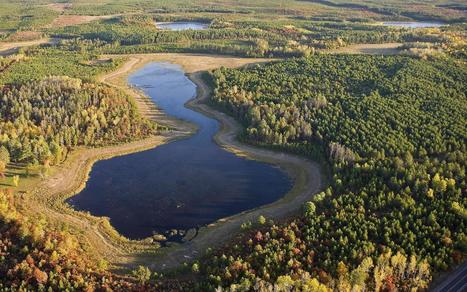
Conveyed to IDL in a partnership between Hancock Timber Resource Group, The Nature Conservancy and the U.S. Forest Service, the conservation easement will preserve forests for recreation, wildlife preservation and woodland management. Half of the preserved woodland is located near Hall Mountain and the other half east of McArthur Lake.
The view from the McArthur Lake East Forest Legacy Project, photo courtesy of The Nature Conservancy.
“Conservation easements and the Forest Legacy Program keep private working forests working,” said Karen Sjoquist, IDL Forest Legacy Program coordinator. “The continued use, protection and sustainability of these forests provide local jobs while protecting the social and environmental values that forests provide.”
Partnership planners identified the North Idaho acreage as prime candidates for conservation easements due to its natural beauty and vibrant natural life. The easement will establish permanent public access for hunting, hiking and berry picking while allowing land to be managed for timber harvesting, water quality protection, habitat preservation and other matters of public concern, including grizzly bear management.
|
|
Scooped by
Prentiss & Carlisle
December 29, 2017 11:34 AM
|
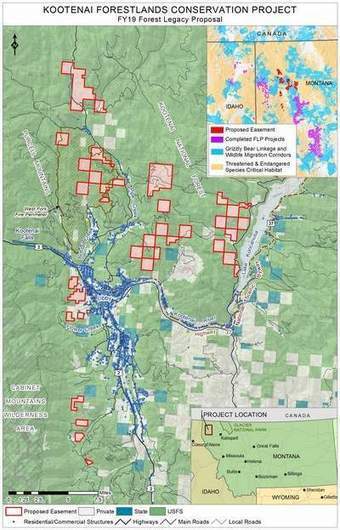
The Stimson Lumber Company owns forestland across the Pacific Northwest, but it sees challenges in Northwest Montana’s growing population.
Barry Dexter, the firm’s director of resources, says that developing areas’ lands “come out of timber production and go into mini-ranches or home sites for folks, and so that’s a little challenging for a fire management perspective, and it reduces the amount of land for the timber base.”
About 22,275 acres of the company’s land near Libby could avoid that outcome. If Stimson, conservation groups, state officials and Montana’s congressional delegation have their way, a conservation easement will allow forestry there to continue while preventing development.
***
Under a conservation easement, a landowner agrees to place certain restrictions on use of the land. Those restrictions are bought and held by a land trust or government agency, and stay on the land even if it’s sold.
***
“It’s forested land and would be maintained as a working forest with conservation values,” explained Ken McDonald, wildlife division administrator for Montana Fish, Wildlife and Parks.
The proposed easement, he stressed, “doesn’t take it out of the management scheme.” Stimson will retain the right to harvest timber on the land. But the easement “helps ensure [that] the management and the long-term use of that land is compatible with wildlife.”
Montana chose the property as its sole entry in what’s described as a highly competitive grant process. If it advances, an appraisal will determine its value. For now, the state’s requesting $6 million for the easement. It awaits assessment by a national review panel, which will rank the submitted proposals in mid-January.
|
|
Scooped by
Prentiss & Carlisle
October 14, 2016 1:55 PM
|
Grand Lake Stream, Maine – Named after the stream that flows through the town, the Grand Lake Stream community in eastern Maine greatly values its natural resources. With a population of 109, the small community is world-renowned for its excellent fishing, hunting, recreation and relaxation activities. The community’s natural resources-based economy provides livelihoods for local craftsmen, guides, sporting ventures, and forest industry workers. And with the recent implementation of the Finite Carbon – Lyme Grand Lake Stream Improved Forest Management Project, the community’s newest venture at the crossroads of the environment and economy lies in carbon offset development. To protect their community’s forests and waters, improve fish and wildlife habitats, and support the natural resources-dependent economy of the community, the local residents founded the Downeast Lakes Land Trust (DLLT) in 2001. In 2012, DLLT raised funds enabling the Lyme Timber Company, a private timberland investment management organization, to grant a conservation easement to the state of Maine on 22,000 acres of forestland. The easement permanently protects the property from development and ensures sustainable timber management. In addition, by improving management practices to increase carbon stocking levels, the forest earned carbon offset credits for use in the California cap-and-trade program. From September 2013 to September 2015, the Lyme Grand Lake Stream Forest removed and sequestered an additional 599,217 metric tons of carbon dioxide equivalent (CO2e) emissions through its improved forest management practices, which were made in accordance with guidelines specified in the California Compliance Offset Protocol for U.S. Forest Offset Projects.
***
The sale of carbon offsets helped the Downeast Lakes Land Trust purchase the 22,000-acre property from Lyme Timber in July 2016. The acquisition was completed as part of an eight-year, $19.4 million campaign and helps fulfill a broader community-led effort to conserve 370,000 acres in the Downeast Lakes region.
|
|
Scooped by
Prentiss & Carlisle
August 11, 2016 2:24 PM
|
There has been significant discussion about the merits of stacking conservation payments over the past few years. A simple explanation for credit stacking is when landowners are paid for conservation practices on their property that provide multiple benefits to the environment. For example, an acre of forest could earn revenue from both carbon credits (for maintaining carbon stored in the ground) and endangered species habitat credits (for managing land to benefit species that are endangered, threatened or otherwise at-risk) — this acre generates extra value and therefore can earn revenue from multiple credit types. Credit types that might be stacked include: endangered species; water quality; wetlands; and carbon. Environmental credit stacking will be an important factor for forestland owners to consider as they attempt to generate adequate cash flow for their properties, and as the regulated carbon market grows.
One key issue that always seems to arise in the credit stacking debate is the potential for double-counting.
For instance, being required by law to do one thing, such as the creation of a wetland mitigation bank, but also receiving a second payment for another credit type, such a carbon. No one disputes that restoring a single property can deliver several ecosystem benefits; however, how these benefits are measured, and whether they can all be "counted" as ecosystem credits is often debated. The Electric Power Research Institute’s (EPRI) most recent work on credit stacking (PDF) attempts to sort out these issues, and suggests multiple benefits can be quantified while still being scientifically legitimate. An example is that the same agricultural practice can generate a measurable nutrient credit from reduced fertilizer use as well as create a carbon offset without double-counting.
|
|
Scooped by
Prentiss & Carlisle
April 26, 2016 12:50 PM
|
Gov. Rick Scott and the Cabinet on Tuesday will be asked to buy 5,236 acres of timber land in St. Johns County, to be used as a Northeast Florida conservation easement, for $5.795 million.
David Clark, the director of the Florida Department of Environmental Protection's Division of State Lands, said the deal allows the Meldrim family, which has owned the land since the early 1900s, to continue to harvest timber and maintain jobs in the area, while permanently limiting development.
"The easement will create a significant watershed buffer for the St. Johns River, protecting and maintaining the water and wetland systems of the state," Clark said.
The land, part of the 26,272-acre St. Johns River Blueway Florida Forever track, runs along the eastern shore of the St. Johns River, between Green Cove Springs and Palatka.
The land is adjacent to the Watson Island State Forest, which is on the west bank of the river.
The sales price is 89 percent of the property's appraised value, according to a Cabinet report which recommends approval of the purchase.
|
|
Scooped by
Prentiss & Carlisle
August 27, 2015 11:35 AM
|
More than 15,000 acres of Plum Creek Timber Co. land northwest of Whitefish will be conserved through an agreement announced Monday by the company and The Trust for Public Land. The acreage is almost fully surrounded by the Stillwater State Forest except for a couple of parcels that border private land, said Tom Ray, vice president of Northwest resources and manufacturing for Plum Creek.
Under the agreement, The Trust for Public Land will have an option to purchase 1,920 acres and establish a conservation easement on the remaining 13,414 acres that Plum Creek will continue to own and manage as a working forest.
***
All of the land in the agreement will be conserved, however, he added. Eventually the trust’s purchased property will be transferred into public ownership or to a conservation buyer. The agreement is subject to final conditions including appraisal and secured funding, Ray said.
|
|
Scooped by
Prentiss & Carlisle
June 12, 2015 12:02 PM
|
Naval Base Kitsap expanded the buffer around its operations Monday by purchasing a restrictive easement with Pope Resources on 3,392 timbered acres near the Dosewallips River.
The Navy is spending $4.9 million to prevent significant development or construction from ever occurring in the area. Pope agrees to continue to do no more than it is now — manage and harvest the trees.
At the same time, Washington State Parks bought 215 acres running two miles along the river’s length that will be added to Dosewallips State Park. It used a grant from the Salmon Recovery Fund and matching funds from the Navy for the purchase.
The Trust for Public Land, a national conservation organization, brokered the deal.
|
|
Scooped by
Prentiss & Carlisle
April 1, 2015 4:51 PM
|
Pope Resources announced on March 31 a $4.9 million conservation sale to The Trust for Public Land, consisting of a conservation easement covering 3,607 acres in Jefferson County.
Of the acreage, 215 acres were sold in fee, leaving 3,392 acres remaining under Pope Resources' ownership subject to the easement that precludes development but allows continuing timberland operations.
"We are pleased to enter into our second conservation transaction in the Hood Canal watershed involving the United States Navy and The Trust for Public Land," said Jon Rose, president of Olympic Property Group, a Pope Resources real estate subsidiary. "The easement and land sale will reduce potential future conflicts between Hood Canal naval operations and development of our property, while at the same time expanding public and riparian access to the Dosewallips River."
|
|
Scooped by
Prentiss & Carlisle
February 12, 2015 4:28 PM
|
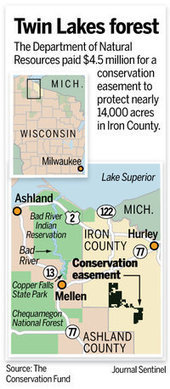
Nearly 14,000 acres of northern Wisconsin forestland will be set aside for timber production and public use in a deal between the state and a nonprofit group.
The Department of Natural Resources used $4.5 million from the Knowles-Nelson Stewardship Fund to purchase a conservation easement on 13,732 acres in Iron County.
The deal, which ranks among the top 10 in state land purchases, was finalized in late December between the DNR and the Conservation Fund, which announced details Monday.
The Conservation Fund is a nonprofit group that buys land, often for a short period, then resells the parcel to a new buyer with a requirement that the land remain protected.
The Conservation Fund purchased the parcel from a Brazilian company last summer. The land had been held by Consolidated Papers for generations before the Wisconsin-based company was sold and the land passed through several owners.
The Twin Lakes Legacy Forest is 89% forested, according to the DNR.
The property in the Towns of Knight and Mercer has six small lakes and three miles of frontage on LeClair and Apple creeks, both Class 1 trout streams.
|
|
Scooped by
Prentiss & Carlisle
December 24, 2014 9:31 AM
|
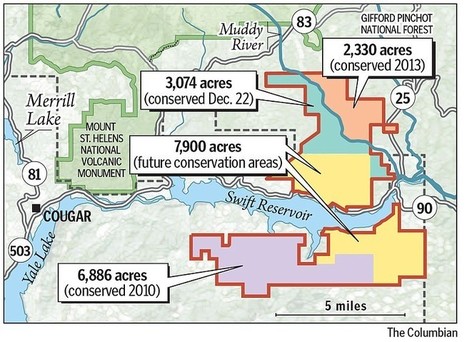
Columbia Land Trust on Monday announced the conservation of more than 3,000 acres of forestland near Mount St. Helens, the latest phase in an ongoing effort by the organization to prevent development in the area.
The Vancouver-based nonprofit purchased development rights on the land, which will remain under the ownership of timber company Pope Resources. It will also remain in active forestry and produce tax-generating timber harvests, according to the land trust.
"This landmark project shows what can be achieved when a timber company, a conservation group and public leaders put their heads together to find lasting conservation solutions that benefit both people and nature," Columbia Land Trust Executive Director Glenn Lamb said in a released statement.
The $1.1 million deal is part of the Mount St. Helens Forest Conservation project, which aims to protect more than 20,000 acres of land near Swift Reservoir in Skamania County from development. The land trust secured nearly 6,900 acres south of the reservoir through a conservation easement in 2010. The organization acquired another 2,300 acres in the outright purchase of a second parcel along the east side of Pine Creek in 2013. This agreement added 3,087 acres mostly through an easement, though the land trust also purchased 210 acres along the west bank of Pine Creek, protecting critical habitat for endangered bull trout and other wildlife, according to the organization. The deal was funded by a grant from the Washington Wildlife and Recreation Program.
|
|
Scooped by
Prentiss & Carlisle
August 7, 2014 5:13 PM
|
The Nature Conservancy, Texas A&M Forest Service, and the U.S. Forest Service have collaborated to purchase a conservation easement on 4,785 acres of forestland in the Longleaf Ridge area of East Texas, permanently protecting some of the best longleaf pine habitat in the state.
The groups purchased the easement for $2,277,000 from Crown Pine Timber LP, a limited partnership managed by Campbell Global, a timber investment and management firm based in Portland, Oregon. Campbell Global manages over 1 million acres of timberlands in East Texas on behalf of Crown Pine Timber.
The easement was funded through the Forest Legacy Program, a federal program managed by the USDA Forest Service. The Nature Conservancy provided $569,250 in matching funds.
This type of conservation – often called a “working forest” conservation easement – keeps forestlands in private ownership while conserving the land for future generations. Landowners and local communities continue to realize economic gain from timber management while the forest provides other benefits such as watershed protection, wildlife habitat, recreation and scenic values.
|