Your new post is loading...

|
Scooped by
James Schreier
September 4, 2013 3:06 AM
|
"All the problems of the world could be settled easily if men were only willing to think. The trouble is that men very often resort to all sorts of devices in order not to think, because thinking is such hard work." (Thomas Watson, IBM) The posts for this topic are related to thinking and information on brain research. The items posted are frequently directly related to one of my most popular management training programs -- Thinking Clearly and Analytically.
|
|
Scooped by
James Schreier
October 26, 10:29 AM
|
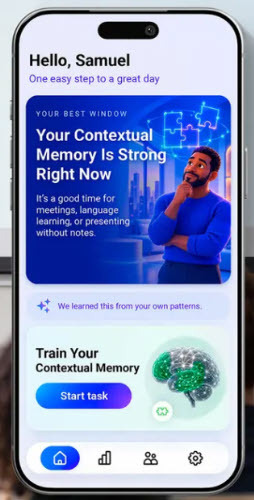
TIME’s write-up: “You may know you’re not at your sharpest after a bad night’s sleep. But do you know when you’re best at learning? Or primed for collaborating? CogniFit seeks to offer such insights by building your Digital Cognitive Twin. The AI model uses short cognitive exercises to establish a baseline of your cognitive abilities,…
|
|
Scooped by
James Schreier
October 12, 9:00 AM
|
From a return to "simple" smartphones to timers that hide notifications, there seems to be a market for ways to disengage from our digital devices. This physical key from the innovative company Autonomous AI is the first I have tried, and I was doubtful.
|
|
Scooped by
James Schreier
October 5, 9:00 AM
|
Across most of modern medicine, we have become very good at measuring the body, and surprisingly poor at measuring the mind. We routinely track blood pressure, glucose, heart rate, cholesterol, sleep and physical activity. We repeat these measurements because a single reading rarely tells the whole story. What matters is the trajectory: where someone is…
|
|
Scooped by
James Schreier
September 21, 9:00 AM
|
Even though it might be a dying pastime
|
|
Scooped by
James Schreier
September 14, 9:00 AM
|
Children naturally have a strong sense of imagination, and play is one of the best ways for them to express […]...
|
|
Scooped by
James Schreier
September 1, 12:55 PM
|
Part of soccer’s beauty lies in its unpredictability. Already in World Cup 2026, we have seen Morocco tie with five-time champion Brazil and Australia overturn the odds by beating Turkey. But few surprises will top a Cabo Verde team ranked 67th at the start of the tournament holding Spain – many pundits’ pick for the…
|
|
Scooped by
James Schreier
August 17, 12:04 PM
|
Five principles for designing brain-powered organizations (McKinsey & Company): … The McKinsey Global Institute estimates AI-powered agents and robots could unlock $2.9 trillion in annual US economic value by 2030. Our latest data shows that 79 percent of organizations have adopted gen AI, yet only 39 percent of respondents attribute any level of EBIT impact…
|
|
Scooped by
James Schreier
August 10, 9:00 AM
|
Researchers found that shifting this one norm delivered surprising cognitive benefits.
|
|
Scooped by
James Schreier
July 28, 9:00 AM
|
Some brains seem to defy Alzheimer's. Even when the disease's telltale plaques and tangles are present, certain individuals remain mentally sharp well into old age. This phenomenon, known as cognitive resilience, is one of the most intriguing puzzles in neuroscience today.
|
|
Scooped by
James Schreier
July 27, 9:00 AM
|
In a rare study looking at the relationship between cultural engagement and biological aging, scientists have found a potential link between spending time at the theater, visiting museums, and watching movies on the big screen and living healthier for longer.
|
|
Scooped by
James Schreier
July 23, 11:39 AM
|
Research suggests cannabis suppresses REM sleep, raising questions about memory, emotion and the purpose of dreams.
|
|
Scooped by
James Schreier
July 20, 9:00 AM
|
I have never heard a rock described as stupid. And the same would be true of a river, a hurricane, and even a thermostat. Stupidity seems to be a sophisticated form of behavior despite its ignominious associations.
|
|
|
Scooped by
James Schreier
October 26, 10:32 AM
|
A living model of how your mind performs—and what it may need next. Download CogniFit for iPhone or Android and start building your Digital Cognitive Twin™ today.
|
|
Scooped by
James Schreier
October 19, 9:00 AM
|
Language models identify psychiatric symptoms nearly as accurately as early-career clinicians (Medical Xpress): A study led by the Central Institute of Mental Health (CIMH) provides initial evidence that large language models can identify complex psychopathological findings in transcripts of psychiatric interviews with accuracy comparable to that of predominantly young clinicians. The study examined 10 language…
|
|
Scooped by
James Schreier
October 5, 9:00 AM
|
The truth is that smart people are often more easily fooled than most because they expect to see things that others miss.
|
|
Scooped by
James Schreier
September 28, 9:05 AM
|
Today, September 21st, marks World Alzheimer’s Day, a global initiative to raise awareness about Alzheimer’s disease and dementia. To observe it, however, we will NOT talk about Alzheimer’s. Instead, we will discuss the other (and more positive and preventive) side of the coin: Brain Capital and the Brain Economy. The Brain Economy concept and framework…
|
|
Scooped by
James Schreier
September 15, 11:35 AM
|
At least one in four former NFL players who died between 2016 and 2021 was found to have had chronic traumatic encephalopathy (CTE), a study says
|
|
Scooped by
James Schreier
September 7, 9:00 AM
|
An updated view of categorization reflects the modern understanding that the nervous system is more of a prediction engine than a filing cabinet.
|
|
Scooped by
James Schreier
August 24, 9:41 AM
|
Taxi and ambulance drivers are less likely than workers in almost any other job to die of Alzheimer’s Disease. That was the surprising result of a 2024 study(opens in new tab) examining the death certificates of nearly 9 million people in the US. These findings stopped me in my tracks because those two jobs rely on…
|
|
Scooped by
James Schreier
August 10, 9:00 AM
|
You're not bad at math. You've just not been zapped enough.
|
|
Scooped by
James Schreier
August 3, 9:00 AM
|
Want to learn more quickly, and retain more of what you learn? Neuroscience says boosting your memory is relatively easy.
|
|
Scooped by
James Schreier
July 27, 9:00 AM
|
Wharton research identifies cognitive surrender, a mode of thinking that emerges when employees rely on AI for decisions.
|
|
Scooped by
James Schreier
July 27, 9:00 AM
|
As more and more tasks are done by machines — especially now, with AI — people increasingly move from manual controller to supervisor. Designs must factor in human psychology or risk disastrous errors.
|
|
Scooped by
James Schreier
July 20, 9:00 AM
|
Returning a tennis serve depends on one of the brain’s most remarkable abilities: predicting the future.
|
|
Scooped by
James Schreier
July 13, 9:00 AM
|
We have more information than ever in history.
But critical thinking is catastrophically scarce.
That’s why we drown in noise, fakes, and AI illusions.
Algorithms feed us what we want to hear.
We believe in convenient truths.
And we live in the illusion of knowledge.
Truth is not about “true or false.”
Truth is in facts.
But people don’t choose facts, they choose comfort.
2,500 years ago, Socrates already saw this trap.
He didn’t seek ready-made answers.
He asked questions that destroyed illusions.
Here are his 7 rules of critical thinking, louder today than ever:
1. Define terms
→ most debates collapse on vague words.
2. Question assumptions
→ every idea hides a belief. Expose it.
3. Demand evidence
→ without facts, any opinion is just noise.
4. Test consequences
→ strong ideas survive reality checks.
5. Spot contradictions
→ consistency is the real test of truth.
6. Doubt the obvious
→ the most dangerous beliefs are the ones nobody questions.
7. Consider alternatives
→ the opposite view often reveals your blind spot.
This isn’t philosophy for philosophy’s sake.
It’s a survival skill in 2025.
💬 Which rule hits you the hardest?
—
Natan Mohart | 282 comments on LinkedIn
|


 Scoop.it!