[Anglican Church of Canada] For five days in April, First Nations translators gathered together in Guelph, Ont., Canada, for a workshop on developing the knowledge and skills to translate the Bible into their native languages.
Conducted by Wycliffe Bible Translators in partnership with the Canadian Bible Society and the Anglican Church of Canada, the Mother Tongue Translator Workshop brought together residents from First Nations communities engaged in the work of translating the Bible into Naskapi, Oji-Cree, and Plains Cree.
Translation project facilitators Bill and Norma Jean Jancewicz helped lead the workshop, which took place from April 20–24 in the Guelph Bible Conference Centre as part of the First Nations Bible Translation Capacity Building Initiative.
“In recent days, there have been more and more First Nations people who, in reclaiming their language, or doing education in their language, or…worship in their church, [are] finding that they need to have the Scriptures in their mother tongue—in their local language,” Bill said.
The workshop made extensive use of the collaborative translation software program ParaTExt, which provided source translation and resource documents to help participants check their work.
Among the participants was a five-person Oji-Cree Translation Committee from Kingfisher Lake, Ont., which included Ruth Kitchekesik, deacon at St. Matthew’s Anglican Church.
“I think language being a big part of our culture…and God being a central part of our lives, we want God to speak to us so we can understand him better,” Kitchekesik said, adding that it was only natural to want to translate the Bible into one’s own language to experience the word of God more directly.
Underscoring the need for new translations, Indigenous Anglicans in Kingfisher Lake are still currently using a 1662 version of the Book of Common Prayer in the Cree language.
The Naskapi contingent at the workshop hailed from the community of Kawawachikamach, Que. and included representatives from the Naskapi Development Corporation (NDC), the Naskapi Nation of Kawawachikamach (NNK), and Jimmy Sandy Memorial School.
Cheyenne Vachon, project co-ordinator for the Status of Women in Canada for NNK and lay reader at St. John’s Anglican Church, noted the difficulty of maintaining a balance between English or French and Naskapi, as projects such as translating the Bible into Naskapi aim to reinforce the native language.
“I don’t favour one or the other; I think both [languages] are very valuable in our lives now,” Vachon said. “But in our community, we should enforce our language first and [help] the kids to have a very good foundation before they move on to English or French.”
Plains Cree speaker Gayle Weenie—who travelled from Saskatoon, Sask., to attend the workshop—was well aware of the need to preserve one’s indigenous tongue.
As a youth, Weenie attended a residential school where she was permitted to speak only English. She recalled her sister picking her up from school, and the two siblings being unable to understand much of what the other was saying. Only later in the year did Weenie begin to pick up her Plains Cree again.
“At one time, I almost lost my language…Now today I’m so happy that I am able to speak it and use it with the elders,” Weenie said.
National Indigenous Anglican Bishop Mark MacDonald and Bishop Lydia Mamakwa of the Indigenous Spiritual Ministry of Mishamikoweesh (which encompasses Kingfisher Lake) each visited the workshop during the week.
Interview with Bishop Mamakwa on the Bible translation initiative.

ABU DHABI: The Abu Dhabi Fourth Conference for Translation, organised by the Kalima Project, opened on Sunday under the theme “Translation of Novels: Difficulties and Challenges”.
Offering four specialised workshops on translating literary texts from English, Spanish and Japanese into Arabic and from Arabic into English, the workshops, for intern students from national and international universities, will be administered by a group of highly experienced Arab translation scholars.
In addition to the workshops, this year’s conference will host general sessions that review translation theories and problematic issues, with a special focus on novels.
The Abu Dhabi Conference for Translation is one of the pivotal cultural initiatives of the Kalima Project, run by Abu Dhabi Tourism and Culture Authority, TCA Abu Dhabi, which has established solid strategies to enhance the translation movement into Arabic over the past three years.
Chair of the English Literature Department at the UAE University, Dr Siddiq Jawhar, who supervised several Masters and PhD theses at Arabic and regional universities, will supervise the Arabic-into-English translation workshop. This will tackle theory and application, as well as intensive practical exercises with the help of the latest educational tools. Specialising in 19th C literature, Professor Mohammed Asfour, Chairman of the English Department and Director of the Language Centre at Philadelphia University, Jordan, will run the English-to-Arabic workshop.
Accredited translator at the Spanish Ministry of Justice, Zainab Benyayah, PhD, University of Granada, Spain, will be leading the Spanish-into-Arabic translation workshop.
Dr. Al Mu’men Abdullah will lead the Japanese-to-Arabic translation workshop. An Associate Professor of Japanese linguistics at Tokyo University, Abdullah has a PhD degree from Gakushuin University, Japan, and has been working across the fields of academia, translation and international co-operation for 15 years and is one of the few Arab specialists in Japanese linguistics and literature.
The closing day of the conference will see Dr Khalid Al Masri heading a panel discussion session about translation’s challenges and different areas of specialisation, with the participation of acclaimed translators Subhi Hadid, Saeed Al Ghanemi and Fakhri Saleh.
WAM

In a word – google
Patsy McGarry
Topics:
Culture
Blair Project
Edward Kasner
James Newman
Larry Page
Milton Sirotta
Saddam Hussein
Sergey Brin
Mon, May 11, 2015, 01:00
First published:
Mon, May 11, 2015, 01:00
0
Google has got to be easily the best-known new word of our time. It is also said to be a mistake. At least some people insist this is the case.
It has been defined as “to search the Web using the search engine Google for information on a person or thing” and was nominated in 2002 as Word of the Year (why not?) by the American Dialect Society.
However, it lost out to WMD (Weapons of Mass Destruction). Remember this was the year before the US and UK invaded Iraq to destroy Saddam Hussein’s non-existent weapons of mass destruction and which led to the emergence of IS today. Such was the outcome of the Bush/Blair Project.
But, to google. We are told it derived its name from the word “googol”, said to have been coined in 1920 by a nine-year-old boy. Milton Sirotta, nephew of the US mathematician Edward Kasner, was asked by his uncle to invent a name for a very large number, 10 to the power of 100 (which is the number 1 followed by 100 zeros). The boy called it “a googol”.
So the word was used by Edward Kasner in his book Mathematics and the Imagination, co-authored with James Newman. Another mathematician brought it a step further when he invented the word “googolplex” to represent 10 to the power of a googol. I have no idea how many zeros that would result in, but it’s a lot.
Google, the company, was founded in 1998 by Larry Page and Sergey Brin while they were doctoral students at Stanford University in the US, and it is said the adopted the word as a name for their search-engine. Some say they intended to call it “googol”, because of the endless amount of data found on the information superhighway it allows access to, and that this became accidentally transposed to google. Will we ever know whether this was so?
Regardless, Google Inc opened at Menlo Park, California, in a sublet garage on September 7th, 1998. By 1999 it was named in Time magazine’s Top Ten Best Cybertech list.
By the end of 2014 it employed 53,600 worldwide, had assets valued at US$131.133 billion, and a net income of US$14.444 billion. For which there is only one adjective – googolactic.
Okay. It’s made up. But why not? inaword@irishtimes.com

Facebook is testing an internal search engine for its mobile app, according to a report from TechCrunch.
A few iOS users are seeing an “add a link” option next to the buttons to add photos, locations, and feelings. Users can search a keyword in the link function, and Facebook will suggest related news articles to post.
Posting links to Facebook from a smartphone is unwieldy as it is, so it’s likely this change aims to smooth out that process.
TechCrunch suggests this update could also be related to Facebook’s recent effort to get publishers to post content directly to the site.
By hosting content and allowing users to search for stories in its own app, Facebook is making it easy to read and share news without ever actually leaving Facebook.
More expectations
Facebook is an important distribution avenue for many digital news organisations, and the more it increases the ease with which users can share content, the more it solidifies its standing as a viable content host.
And with Google adding tweets and letting users order food from its search results, the bar for what a search engine can do is only getting higher.
Although it’s not clear how Facebook’s search engine determines the results of each query, TechCrunch reports it seems to be skewed toward a user’s frequently visited websites and stories with a high share rate.
There’s also no word on if or when this update will be available to everyone.
LUCKNOW: When a group of Muslims in Bundelkhand decided to write their 'mann ki baat' to Prime Minister Narendra Modi, they chose to do so in the language that he loves - Sanskrit.
Their 'mann ki baat' is a demand to set up an All India Institute of Medical Sciences-like Institute in their district. For this they have planned to sent 11,000 postcards written in Sanskrit to the PM. About 2,000 of these cards have already been sent.
The effort is a brainchild of the Bundeli Samaj which has pitched in its demand as the district is situated in the heart of Bundelkhand and does not have proper medical care facilities.
On why Sanskrit was chosen as the language for communication, the group's president Haji Muddan said, "We came to know that Sanskrit and Hindi were PM's favourite languages. And a message in someone's favourite language conveys in the best manner."
Another interesting aspect of the campaign is that madrassa students have been roped in to write these postcards. Mufti Samad of Madrassa Premnagar of Mahoba has roped in 80 students of his center for the campaign.
"Health facilities are pathetic in our region. For simple health problems we either head to Kanpur or Jhansi and when the disease is complex, Lucknow and Delhi are the destination," Samad said.
To associate people from different walks of life in the campaign, camps are being run at all prominent places like railway stations, bus stops and hospitals to make the campaign a success. A large number of schools have been approached, too.
Social activist Tara Patkar who's coordinating the campaign shared that those living in US, England, Australia and Saudi Arabia are also helping. "They are writing similar letters to the prime minister. We are also taking donations in the form of postcards, which are being distributed through camps," Patkar claimed.
He added that letter writing in Sanskrit was a part of a larger campaign launched in March wherein 1,000 letters are being posted to the PM every day. "The campaign was launched in March and no specific target has been fixed. We will continue to write till our voice is heard," stated Qazi Faraz, a member.
So far, 65, 000 post cards in different languages including 45,000 in Hindi, 5,000 in English, 5,000 in Urdu and remaining in Arabic and Pasto besides Bundeli dialect have been sent. After Sanskrit, the group would pick regional languages like Gurmukhi, Tamil, Telegu, Bengali, and Malyalam to press for the demand.
Stay updated on the go with Times of India News App. Click here to download it for your device.

With more than five active decades in the music industry, it's a given on why Julio Iglesias received an honorary degree from Berklee College of Music. After receiving an honorary doctorate degree of music from the Boston school at its commencement ceremony over the weekend, it's now safe to call him Dr. Iglesias! The Spanish crooner, who has sold over 300 million records globally and can sing in 14 languages, was honored for his contributions to American and international culture.
"I'm an artist who has sang in different languages, in a lot of different languages, and the most beautiful thing that has happened in my life as an artist is this honor from Berklee," the 71-year-old artist said at the ceremony, according to Hola.
Iglesias, known to the younger generation as Enrique Iglesias' dad, has been delighting fans with his romantic ballads since as early as the '60s. He's responsible of classic hits such as “La Vida Sigue Igual” and “Hey!,” amongst many others. He also has awesome duets with artists such as Willie Nelson and Diana Ross.
Iglesias joined Sony Music Entertainment CEO Doug Morris, drummer Harvey Mason, and Grammy Award-winning singer-songwriter Dee Dee Bridgewater, who all also received honorary doctorate degrees from the reputed music school.

A UK linguistics expert who was tasked to compile a set of recommendations as part of a Language Education Policy Profile for Malta said that there’s nothing wrong with code-switching as long as you are aware of it.
Code-switching occurs when a speaker alternates between two or more languages, or language varieties, in the context of a single conversation.
“There’s a difference when one recognises he is code-switching and let’s it happen and when a person does so without realising,” he continued.
The expert – one of a number who compiled the highly informative report – is Lid King, formerly the UK’s director of languages who was speaking during the launch of a report compiled by a number of experts from the Council of Europe Language Educational Policy Unit – based in Strasbourg – following a request by the Ministry of Education.
The report outlines the current position and possible future developments in language education in Malta.
Education Minister Evarist Bartolo said that code-switching could be positive due tot he fact that it helps pupils who are being ‘denied’ the right to speak their own language to speak other languages during a single conversation.
He said that we need to strengthen multilingualism.
“We have children attending our schools hailing from 50 countries with some the pupils of a whole class at times speaking as many as 20 languages,” he said.
The good thing about this report is that it hasn’t a one-size fits all solution for all schools, Mr Bartolo continued.
Philia Thalgott – the head of the Council of Europe’s English Language Policy Unit – said that it is “exceptional” that so many people in Malta speak so many different languages.
Among other observations, the report noted that the Maltese population appears to ease with its rather complex identity, affirming its specifically Maltese character which includes intercultural and inter-language competences as important aspects.
The experts made several visits to Malta between last year and this year and met as many as 200 stakeholders before publishing the report.

After the publication of six volumes of a Tulu lexicon (Tulu-Kannada-English dictionary) more than two-and-half decades ago, another mega work in Tulu, Tulu Jnati Padakosha (Tulu etymological dictionary), is in the offing.
A group of four experts are working to bring out the Tulu etymological dictionary and its cost would be borne by the Karnataka Tulu Sahitya Academy and Nitte University.
The Tulu lexicon was published by the Rashtrakavi Govinda Pai Research Centre, Udupi, in 1988.
Ashok Alva, a researcher at Regional Resource Centre for Folk Performing Arts, Udupi; Padmanabha Kekunnaya, a researcher and one of the assistant editors of Tulu lexicon; Kamalaksha, a retired professor of Kannada at Kannur University, Kerala; Saigeetha, a lecturer at Nitte University, have been working for the past six months on the etymological dictionary. The team will find out Tulu words in seven other languages, including Kannada, Tamil, Telugu and Malayalam. The others are Beary, Kodava and Sali (spoken by weavers).
Those Tulu words would be recorded only if it was found in at least three other languages, Mr. Alva told The Hindu . Its meanings in Kannada and English would be given. A Tulu word though spoken in different languages might have different meanings in different languages and these too will be recorded. The phonetic transliteration of Tulu words would be mentioned in the Jnati Padakosha.
According to Mr. Alva, it might require at least three years to complete the work. He said that in the first phase, the team are gathering Tulu words mentioned in dictionaries.
President of the academy M. Janaki Brahmavar said that Nitte University would sponsor the cost of the project for one year. The academy would sponsor the cost for two years.
She said that as the Jnati Padakosha would study the variations of a Tulu word in other languages it would be an interesting study.
Registrar of the academy K. Chandrahasa Rai has said that the academy has reserved Rs. 10 lakh for the project.

Council of Europe study shows that Malta provides a very positive context for multilingualism and that strengthening one language should never come at the expense of another
Martina Borg 11 May 2015, 12:33pmPrint VersionShare on facebookShare on twitterShare on pinterest_shareShare on google_plusone_shareMore Sharing Services
12
Education Minister Evarist Bartolo • Photo by Ray Attard
12
Council of Europe study shows that Malta provides a very positive context for multilingualism • Video by Ray Attard
At the launch of the Language Education Policy Profile earlier today, Education Minister Evarist Bartolo said that languages were the basis of learning and that an effective language policy would aim to strengthen all the languages learned without taking away from any one of them.
“I believe that strengthening one language should never come at the detriment of the other,” Bartolo said explaining that the new language education policy would aim to address this issue without imposing a one-size fits all attitude.
This view was confirmed by the study carried out by Council of Europe experts at the request of the Ministry of Education. The study, entitled the Language Education Policy Profile outlined the country’s current linguistic position and possible developments of language education in the future.
Chair of the Maltese Language Policy in Education Committee Charles Mifsud also explained that the study had involved various stages including the production of a country report by the relevant authorities, a week’s study visit by a group of experts from the various member states of the Council of Europe.
“The visits started in February 2014, and then again in June and November of 2014, as well as earlier this year, where the group of experts, made up of Elidir King from the UK, Jean-Claude Beacco from France, Marisa Cavalli from Val d’Aosta and Philia Thalgott as a representative of the Council of Europe. The visits saw the experts visit various schools on the island and also talk to various educators and stakeholders on the subject,” Mifsud said.
He added that the visits had revealed a strong willingness to strengthen language learning, but that there was not one single solution to be employed throughout the country.
“The study is aimed merely as a self-evaluation and it does not offer a definitive list of potential decisions,” said Rapporteur Elidir King.
Discussing the results of the study, King said that one of the most universal issues in the country was how to manage bilingualism, code switching and the new phenomenon presented by migrant languages.
King commented that the issue of code switching, whereby Maltese people tend to switch from one language to another, could be used as an asset rather than the liability it is currently treated as.
“Code switching can be used by educators to consolidate certain explanations that may be problematic to students,” Bartolo added to the observation.
Referring to the issue of migrant languages, King said that this was a relatively new issue around the world, but that countries like Malta could stand to gain a lot from learning world languages that were enjoying an increased presence in the country like Arabic or Chinese.
The study revealed that some of the main issues that needed to be addressed where the general perception that standards in language learning were dropping, the languages of schooling as well as gaps in teacher training programmes.
Words that express feelings and emotions and idiomatic expressions used to describe good and bad moodsSome words that express feelings and emotions :Positive emotions Negative Emotionsjoy - gaiety - delight - cheerfulness - merriment - vivacity - calm - satisfaction - enthusiasm - optimism - jubilation anger - despair - depression - loneliness - sadness - frustration - worry - fear Some idiomatic expressions used to describe good and bad moods :Good mood Bad moodThe news of my brother's success really lifted my spirits.Things are looking up today.Sam has been walking on air since he won a poetry prize.My spirits rose when I opened the box and found a nice watch.I'm feeling quite down actually.My heart sank when I saw the ambulance.Lara was in the depths of despair after she got that terrible grade.I've been really low recently.
Journal of Literary TranslationHome > No 10 (2015)The AALITRA ReviewThe AALITRA Review (ISSN 1838-1294), was established in March 2010 by the Australian Association for Literary Translation. AALITRA is a national organisation that promotes an interest in all aspects of literary translation. The Review is peer-reviewed and published on-line. The journal aims to publish high quality material concerned with literary translation, as well as translations of literary texts from other languages into English, or vice versa. It hopes to foster a community of Australian literary translators and to be a forum for lively debate concerning issues related to the translation of literary texts.No 10 (2015)May 2015Table of ContentsComplete IssueThe AALITRA Review No. 10 PDF 1-44ArticlesTranslation Plus: On Literary Translation and Creative Writing PDFNicholas Jose 5-17InterviewsAn Interview with Ruth Ahmedzai Kemp, Literary Translator PDFJennifer Stockwell 18-22ReviewsReview of Imma Monsó’s A Man of His Word (trans. Maruxa Relaño and Martha Tennent) PDFStewart King 23-24Review of Yu Hua’s The Seventh Day (trans. Allan H. Barr) PDFLintao Qi 25.27Review of Timur Vermes’s Look Who’s Back (trans. Jamie Bulloch) PDFChristian Griffiths 28-30Translations with CommentaryThe Inaugural AALITRA Translation Prize PDFLilit Thwaites, Kevin Windle, Anthony Cartwright, Dominique Hecq, Jacqueline Buswell
La traduction française du DSM-5, Manuel diagnostique et statistique des troubles mentaux, éditée par Elsevier-Masson, est bientôt disponible.
Le manuel de 1200 pages paraîtra le 17 juin 2015, rapporte le libraire et éditeur Sauramps Medical qui le propose en pré-commande. Il se détaillera aux alentours de 140 euros.
Le manuel propose une classification des troubles mentaux.

Podéis leer el título de este nuevo post del diccionario gastronómico como una pregunta o como una afirmación. Seguro que más de uno os habéis preguntado alguna vez cuál es el término correcto, escamar, descamar o desescamar, cuando se hace referencia a quitar las escamas del pescado.
Pues leed el título como una afirmación, porque los tres términos son correctos actualmente, según podemos ver en el Diccionario de la Lengua de la Real Academia Española. Desescamar, descamar y escamar (del latín desquamāre) significa quitar las escamas a los peces, siempre que hablemos en términos culinarios.
Como sabéis, estos términos también tienen otros significados otros ámbitos, y curiosamente diferentes entre sí, escamar, por ejemplo, no es lo mismo que descamar. Pero este no es el lugar para hablar sobre temas no relacionados con la gastronomía.
En la foto que ilustra estas líneas podéis ver que se está descamando el pescado con un cuchillo, puede hacerse, y bien si se tiene práctica y cuidado de no estropear la piel del pescado, pues en muchas recetas la piel se quiere conservar, pero hay utensilios especialmente diseñados para quitar las escamas de pescado.
De este utensilio de cocina os hablamos en el post Descamador de pescado, donde además de explicar cómo se utiliza y cómo actúa, os mostramos tres modelos distintos, pero hay muchos más.
Claro, hablamos de descamador de pescado, pero también podríamos hablar de escamador o desescamador de pescado ¿no? Pues curiosamente, la RAE no recoge ninguno de los tres términos, pero diciendo cualquiera de los tres nombres nos entenderemos.

Guest columnist Weston Kincade has been teaching middle and high school English since 2005. He currently teaches at Akron Digital Academy, a hybrid high school utilizing both traditional classroom instruction and an online curriculum. He is also the author of four published fiction novels and one short story anthology.
Kincade argues that cursive writing is no longer a necessary part of school curriculum.
Classrooms in today's society have changed a great deal over the last dozen years due to government expectations. A variety of skills and knowledge are being left out of the curriculum, per state and federal standards. Changes in some states have included dropping spelling from the curriculum, lessons on the Mexican-American War, and other locations have removed the arts from their curriculums entirely. This has led to heated debates between administrators, parents, teachers, educational unions, and politicians. One of the most prominent changes with growing concern is the loss of cursive writing -- but why?
For over a decade most students in U.S. schools have not been taught cursive, so it is nothing new. The move away from cursive began with the invention of movable type, then advanced with the development of the typewriter and later computers.
The technological revolution that started in the 1970s and '80s brought many new types of written communication: email, texting, instant messages, and even electronic books. This changed society immensely, and in doing so sometimes outdated skills fall by the wayside. Look at the abacus as a prime example. With the invention of the calculator the abacus quickly became archaic.
Modern society is based on computers. The average household has at least one computer, and the majority has Internet access. People already have individual designations -- Social Security numbers -- so most things can be sorted and arranged mathematically.
Look at the abacus as a prime example. With the invention of the calculator the abacus quickly became archaic
In a digital society where software programs, apps, video games, websites, and even our automobiles are built on computers, cursive is no longer a needed skill. Its heyday has come and passed. The world is growing smaller, and change is ever present. We cannot fear it, only embrace the changes or be left behind.
Many people are frustrated by this. According to Cory Turner with National Public Radio's KQED News, "the arguments in favor of cursive usually revolve around heritage or tradition". I can understand the draw. History has an important place in society and cursive is a method of writing that is unique and individual, like a literary fingerprint. Looking at someone's handwriting can tell you about that person; it represents them.
However when you look at cursive as a tool and consider whether such skills are necessary in modern society, cursive is simply one form of communication. The world is full of different languages, some old some new, but all of them are constantly changing -- much like ancient Egyptian hieroglyphs.
Today the ability to read hieroglyphs is a skill taught mainly to historians, archaeologists and genealogists. The same will probably prove true for cursive in the future. But languages have one important thing in common, literacy. Like the ancient Egyptians, our languages and methods of communicating will change. The most important thing for our children and future generations is that we keep communicating and using the written word.
Weston can be reached at kincadefiction.blogspot.com.

Riyadh: Riyadh-based King Abdullah International Center for Arabic Language (KAICAL) has disclosed that Urdu ranked second and Arabic fourth among the major international languages.
Quoting a report, KAICAL said that according to a study on languages, Chinese is the most widely spoken language. However, English occupies the top slot in terms of the number of countries that speak the language, followed by Arabic.
The study revealed that although the number of languages in the world stands at 7,102, the European continent has only 286 languages.
A total of 2,301 languages are spoken in Asia, 2,138 in Africa, 1,313 in the Pacific region and 1,064 languages in the Americas.
According to the study by Ulrich Ammon, professor of languages at the University of Duesseldorf, about two-third of the world’s population speaks 12 major languages.
Ammon, who took 15 years to complete his project, said that 1.39 billion people speak Chinese, with all its dialects; while 588 million people speak Urdu followed 527 million speakers of English and 467 million Arabic.
Spanish is the fifth major international language spoken by 389 million people, followed by Bengali with 250 million speakers.
The rest of the languages are: Russian (254 million), Portuguese (193 million), German (132 million), Japanese (123 million), French (118 million) and Italian (67 million), according to the report published by “The Washington Post.”
English is spoken in 101 countries, followed by Arabic in 60 countries, French (51 countries), Chinese (33), Spanish (31), Persian (29), German (18), Russian (16), Malay (13) and Portuguese (12 countries).

An anglophone triumph in the battle for science
I
n 1974, Psychologische Forschung, a renowned German journal, renamed itself Psychological Research and asked contributors to submit papers in English. If they insisted on writing in German or French, they should provide an English title and summary.
Considering how much research was once written in German, this was a signal change. After jostling with rival languages for centuries, English was now science’s ruling tongue.
More
ON THIS STORY
‘We Love Death as You Love Life’, by Raffaello Pantucci
‘Hubris’, by Meghnad Desai
‘The Killing Compartments’ — book review
The Future of Violence, by Wittes and Blum
‘Climate Shock’, by Gernot Wagner and Martin Weitzman
IN BOOKS
How reading can change prisoners’ lives
‘Boko Haram’, by Mike Smith
Literary Life The Bodleian’s ‘Marks of Genius’ exhibition
Literary Life Kazuo Ishiguro interview
Sign up now
FirstFT is our new essential daily email briefing of the best stories from across the web
Michael Gordin recounts the ascent of English in science with verve, but throughout this impressive book a question lurks. English is now the dominant language in many other fields, from business to sport. What is so special about science?
Part of the answer is that it is Gordin’s field: he is a Princeton history professor who specialises in science history. But he argues that language in science is particularly important. Because scientists build on one another’s findings, mutual comprehension becomes essential. As a result, science “has been anglophone longer and more completely than any other domain”.
He could have added another justification for studying the rise of English through a scientific lens: the story of language and science has been particularly wracked by history’s great events, from the jostling for national dominance in Europe to the rise and defeat of Nazism and the cold war.
Gordin is honest about his book’s American-European focus. While he gives space to other scientific languages, including Arabic, Sanskrit and Chinese, he says: “I cannot write a history from sources I cannot read and understand.”
He can understand an impressive range of languages — English, French, German, Russian, Latin and Esperanto — but his principal focus is the triumvirate of languages that dominated after Latin’s shrivelling.
English, German and French were the languages that a 19th or early 20th century scientist needed. Not all managed to learn them. Austrian physicist Leopold Pfaundler wrote in 1910 that, while every scholar should have mastered the three languages, “for the majority of German scholars and men of science this may hold good, but in the case of the French it is less true, and in the case of the English least of all”. Even then, Pfaundler wrote, the triumvirate was not enough. There were also scientists writing in Italian, Dutch, Russian, Polish, Czech and other languages. Science was thriving but was being conducted in too many languages for people to keep up. There had to be a solution to this scientific Babel.
To many, the answer was a specially constructed language. “Today most people who are not Esperantists consider it, frankly, borderline ridiculous,” Gordin writes. He does not. His recounting of those who took Esperanto seriously is sympathetic.
There were other attempts at constructed languages. such as Solresol, which could be sung, Volapük, which was said to have come to a priest in his sleep, and Ido, an Esperanto offspring. But the two world wars ended the need for a constructed language. The conflicts removed German from contention and opened the way for English dominance.
In 1913, 72 per cent of Californian high schools taught German. Descendants of German immigrants spoke it in the Midwest. But when the US entered the first world war, there was a fierce reaction against German. Cities banned it. One Ohio council fined people $25 for speaking it.
With the rise of the Nazis, many of the Jewish and dissident professors who were thrown out of Germany ended up in English-speaking countries, shifting the balance of power. Even after the war, the rise of English did not seem inevitable. When the Soviet Union triggered the space race with Sputnik’s launch in 1957, Americans worried that the future of science was at least partly Russian.
But communism’s collapse and the triumph of English-speaking, and particularly American, technology left scientists everywhere in little doubt of what language they needed to learn.
It was a triumph for English and for science; but, as a linguist, Gordin understands how alienating many non-native English speakers find working in a tongue that is not their own — particularly when their anglophone counterparts “have given up all pretence of learning foreign languages”.
The writer is an FT columnist
Scientific Babel: The Language of Science from the Fall of Latin to the Rise of English, by Michael Gordin, Publisher (Profile Books, £25)

Riyadh-based King Abdullah International Center for Arabic Language (KAICAL) has disclosed that Arabic ranked fourth among the major international languages.
Quoting a report, KAICAL said that according to a study on languages, Chinese is the most widely spoken language. However, English occupies the top slot in terms of the number of countries that speak the language, followed by Arabic.
The study revealed that although the number of languages in the world stands at 7,102, the European continent has only 286 languages.
A total of 2,301 languages are spoken in Asia, 2,138 in Africa, 1,313 in the Pacific region and 1,064 languages in the Americas.
According to the study by Ulrich Ammon, professor of languages at the University of Duesseldorf, about two-third of the world’s population speaks 12 major languages.
According to Ammon, who took 15 years to complete his project, 1.39 billion people speak Chinese, with all its dialects; while 588 million people speak Urdu followed 527 million speakers of English and 467 million Arabic.
Spanish is the fifth major international language spoken by 389 million people, followed by Bengali with 250 million speakers.
The rest of the languages are: Russian (254 million), Portuguese (193 million), German (132 million), Japanese (123 million), French (118 million) and Italian (67 million), according to the report published by “The Washington Post”
English is spoken in 101 countries, followed by Arabic in 60 countries, French (51 countries), Chinese (33), Spanish (31), Persian (29), German (18), Russian (16), Malay (13) and Portuguese (12 countries).
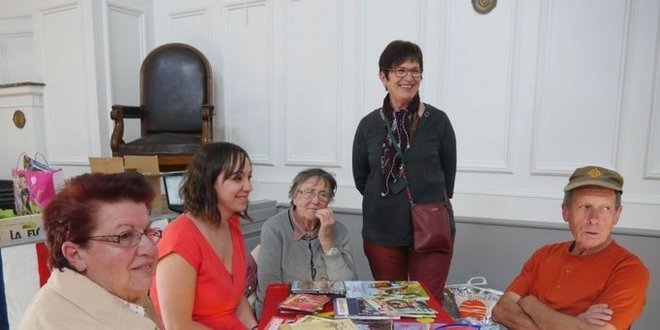
Une table, une langue : l’expérience du café polyglotte a été reconduite avec succès dans le cadre de la semaine de l’Europe. L’occitan était convié.
La table occitane du café polyglotte européen.
© PHOTO A.L.
A
près un premier essai réussi mardi dernier au lycée Odilon Redon, l'expérience du café polyglotte était reconduite jeudi dans le cadre de la semaine de l'Europe de Lesparre. Le lieu choisi était cette fois celui des locaux du Calm, et plus particulièrement la salle d'audience de l'ancien tribunal, aménagée en bistrot. À chaque table était attribuée une langue, que chacun des participants se devait d'employer en fonction de ses capacités, avec éventuellement l'aide de ceux qui en savaient un peu plus. Les visiteurs ont ainsi picoré de table en table, mais l'une d'entre elles a fait l'objet d'un étonnement, puis d'un intérêt particuliers. Certains se sont en effet interrogés sur la présence d'une table où l'on parlait occitan au milieu des langues...
Attention, l’infographie qui suit est à mettre à vos favoris, à apprendre par coeur, et pourquoi pas même à imprimer pour la ranger dans votre portefeuille. Elle vous permettra en effet de commander une bière dans n’importe quel pays, ou presque.
Quoi de plus frustrant que de passer pour le touriste lambda lorsque l’on part en voyage à l’étranger : on vous le demande. Pour éviter d’avoir l’air du clapin de base lorsque vous irez commander une mousse au bière du coin cet été, commencez dès maintenant à assimiler ces 22 façons de réclamer une bière au serveur, qu’importe la destination où vous vous trouvez : Italie, Pologne, Suède, Chine, Corée du Sud, Fiji…
Indispensable ce papier, qu’on vous dit ! Ca vous a plu ? N’hésitez pas à partager !

En 1976 apareció la primera traducción completa del Ulises de Joyce realizada en España (José María Valverde) y en 1981 Joaquim Mallafré publicó la primera versión catalana. Ninguno de los dos sabía que en 1966 existía ya una traducción catalana, obra de Joan Francesc Vidal Jové, que nunca vio la luz. La descubrió cuarenta años después en el Archivo de Alcalá de Henares el catedrático Alberto Lázaro, mientras seguía el rastro de la obra de Joyce en la censura española. Al examinar los expedientes, se topó con la solicitud que el 7 de marzo de 1967 hacía la editorial AHR de Barcelona para publicar 1.000 ejemplares del Ulises en traducción catalana. En el interior de la caja encontró el libro entero: cuatro tomos con las galeradas escritas a máquina en papel de calco y el visto bueno del censor. Según el informe, contiene “fragmentos verdaderamente incomprensibles”, pero “las descripciones crudísimas no están hechas con afán pornográfico, como tampoco las irreverencias religiosas de algunos personajes tienen un tono proselitista”, de forma que, dado “su difícil lectura, solamente para una minoría”, concede su nihil obstat para su publicación. A su favor estaba que Planeta había publicado en 1964, en el libro maestros ingleses, la única traducción al español existente hasta el momento, la que hizo en 1945 José Salas Subirats, argentino de origen catalán.
Alberto Lázaro y Teresa Iribarren, profesora de la UOC, han indagado los pormenores de la publicación fallida del que hubiera sido el primer Ulises en lengua catalana. Joan Francesc Vidal Jové nació en Manresa en 1899 y murió en Newcastle en 1974. En su juventud había publicado el relato Per les donzelles de color de rosa y, después de licenciarse como abogado, estrenó varias obras de teatro. Con la República ocupó el cargo de secretario general de la Comisaría de Orden Público, ganándose la antipatía de los anarquistas que le amenazaron de muerte, sobre todo por la represión de la huelga de tranvías. Huyó a Francia en octubre de 1936. En París trabajó para la empresa Campsa Gestibus, que proveía suministros de todo tipo a la España republicana, Al terminar la Guerra Civil, se refugió en Nimes en un convento de agustinos asuncionistas, donde ayudó a poner orden en la biblioteca de los monjes. Regresó a España en 1941, cuando las tropas alemanas invadieron Francia. No lo tuvo fácil. En 1947 le procesaron por haber colaborado con la Generalitat republicana, con el agravante de ser miembro de la masonería, con el alias de Ausiàs March. Salió bien parado gracias a la intervención del abad Escarrer, que le devolvió el favor de haberle facilitado la salida de Catalunya con otros monjes de Montserrat en el barco Trevere.
Vidal Jové se ganó la vida como podía (vendedor de lámparas de bronce) y siguió escribiendo: Històries del meu temps (abans d’ara), y tradujo a Rodoreda, Espriu, Ramon Muntaner, Benguerel, Maragall, Rimbaud, Balzac, Zola, Rabelais… Su versión más célebre es Tirant lo Blanc, publicada en Alianza Editorial con prólogo de Vargas Llosa. Murió en Newscastle, donde vivía su hija Assumpció, casada con el filólogo Cheney.
Siempre según el relato de Alberto Lázaro, completado después por Teresa Iribarren, a partir del testimonio de la hija de Vidal Jové y del archivo familiar, en 1966 el editor Alfredo Herrero propuso a Vidal Jové traducir el Ulises de Joyce al catalán para la colección Renaixença. La editorial AHR estaba en las antípodas de lo que se considera una editorial literaria -había publicado una biografía de Franco o textos sobre los mártires de la iglesia- y quizá el editor, sin haber leído la obra, debió creer que el escándalo que rodeaba la novela de Joyce atraería al lector sensacionalista y acompañaría al ya editado El Decameró de Bocaccio. La correspondencia entre editor y traductor es un espejo de la chapuza hispánica. Le propone traducir una obra tan completa en cuatro meses. Vidal Jové logra que sean siete. Era la primera traducción integral que se hacía en España y hasta el momento sólo existía la versión española que hizo el argentino de ascendencia catalana José Salas Subirats, un vendedor de seguros y autor de libros de autoayuda, en 1945. Vidal Jové cumple, pero no llegó a ver publicado nunca el texto. Empieza entonces una larga persecución del editor Alfredo Herrero, para pedirle explicaciones. Teresa Iribarren tuvo acceso a una de las cartas: “Amigo Herrero: Cuando pienso en Vd. tengo una sensación de infinito, de misterio, de algo espectral, inconcreto e insólito”, le escribe. “Si no está Vd. en la cárcel (hoy todo es verosímil) escríbame Vd., telefonéeme. Si no es así –como espero– y no me contesta, únicamente los servicios de pompas fúnebres podrían justificarle. Y aun no, a sus herederos. Un abrazo, cordial y un tanto desesperado”. Iribarren sospecha que Alfredo Herrero no había gestionado los derechos de autor con los herederos de Joyce o bien desistió de llevar a cabo la colección catalana de clásicos. Posteriormente, Vidal Jové pidió a su amigo Tomàs Garcés, abogado de la editorial Selecta, que moviera en otras editoriales la traducción. Sin éxito, por lo que la primera versión íntegra en catalán del Ulises quedó olvidada en los archivos de la censura hasta que Alberto Lázaro la descubrió.
¿Qué valor tiene la traducción?. En principio tiene el defecto de que se trata de una traducción indirecta a través de la versión francesa, realizada en 1929 por Auguste Morel y Stuart Gilbert, y supervisada por Valéry Larbaud y el propio James Joyce. Vidal Jové se asesoró, además, con su yerno, el profesor Cheney y su hija, doctora en psiquiatría. Teresa Iribarren sostiene que, “es más musical y fresca que la de Joaquim Mallafré, que es la canónica”, pues “hay que tener en cuenta que Vidal Jové pensaba más en que el lector la comprendiera. En la de Mallafré, más cercana al original, predomina la equivalencia formal, y en la de Vidal Jové prevalece la equivalencia dinámica, con un catalán popular más genuino”. Iribarren reconoce que el texto incurre en algunas deficiencias formales, “pero el texto sería perfectamente publicable con algunas, las mínimas, correcciones”.
Catalunya y Joyce
James Joyce ejerció una influencia muy temprana en Catalunya, cuya huella quedó truncada por la Guerra Civil. Aunque las primeras traducciones parciales del Ulises fueron castellanas y gallegas, el principal promotor fue Juan Ramón Masoliver,q ue publicó publicó en 1930 fragmentos de la novela en la revista Hèlix (traducidos por un sacerdote, Manel Trens, que firmaba muy joyceanamente como M . Railways) y un ensayo de Lluís Montanyà. Esa versión fue, según cuenta Sónia Hernández en su tesis sobre Masoliver, la puerta de entrada del intelectual catalán en el mundo íntimo de James Joyce, encantado de ver que su obra era traducida al catalán.
En 1921 ya se da noticia de la irrupción de Joyce renovadora de la narrativa europea. En 1924 la revista publica la primera versión de textos de Joyce en España. A cargo de Josep Millàs-Raurell. En 1927 Josep Pla declara su admiración por el autor irlandés y en los foros catalanes las discusiones sobre las innovaciones de Joyce son ardientes, entre la voluntad de llevar la narrativa europea a la normalidad y la voluntad de una novelística autóctona que fidelice al lector, cosa para la que el alambicado Joyce no sirve como modelo: sólo Armengou, Millàs Raurell, Pla,
Soldevila, Esclasans, Sol y pocos más, dice Teresa Iribarren, contemplan la posibilidad de asimilar algunos de sus patrones literarios.

I’ve been writing about and researching LED light bulb technology recently, and I’ve had some questions about terminology. Some people are confused about LED lights vs. compact fluorescents and how they compare to incandescent bulbs.
Most people remember buying light bulbs according to their wattage. Small lamps might need a 40-watt bulb, while the light in your bathroom might be a 75-watt bulb. The higher the wattage, the brighter the light.
CFL and LED bulbs use much less electricity, so when you see that an LED bulb uses 8 watts, how bright is that? Many manufacturers use a unit of light called the lumen. Here’s what you need to know about lumens.
A 450-lumen bulb gives off about the same light as a 40-watt incandescent bulb.
850 lumens is about the same as a 60-watt bulb.
1,100 lumens is about the same as 75 watts.
1,600 lumens is about the same as 100 watts.
Most bulbs are labeled with lumens emitted and the equivalent number of watts (for us older folks).
Just for reference, some 800-lumen LED bulbs I recently bought use only 8.5 watts of electricity.
Unlike incandescents, you can use any brightness in any fixture, although some LED and CFL bulbs can’t be used in enclosed spaces.
The other term you’ll want to learn is color temperature, which is the color of the light.
Each bulb you see in the stores will list its color temperature, which is expressed with a number in degrees Kelvin.
Incandescent lights emitted light on the yellow end of the spectrum. If that’s what you like, look for bulbs with a color temperature of 2,700K. These bulbs are also called warm white or soft white.
If you prefer your light to have a more blueish cast, look for bulbs with a higher color temperature, such as 5,000K or even 6,500K, which is also sometimes labeled daylight.
Many bulbs are available in warm or daylight versions.
Also, when you’re buying a new type of bulb, make sure it will fit in the lamp you’re using.
Some of the LED bulbs I’ve tested have slightly larger bases, usually to help with cooling the bulbs. These are outside the normal shape of an incandescent bulb. These larger bulbs are fine for some uses, but they don’t fit smaller table lamps that have narrow harps that support the lampshade.

A teenager's chances of winning a place to study languages at a top UK university may be increasing, figures indicate.
A new analysis of Ucas statistics shows that many leading Russell Group universities have seen a sharp drop in applications for European language courses in the last five years.
It comes amid continuing concerns about language learning in schools and universities.
The Press Association's analysis looked at applications made through the main Ucas scheme to study European languages, literature and related courses at the 24 Russell Group universities and the number of acceptances. Would-be students may apply for more than one course.
The findings show that at a number of institutions, the proportion of applications accepted has risen in the last five years.
For example, in 2010, Bristol had 1,860 applications to study European languages, literature and related courses and 290 acceptances - a rate of 15.6%. In 2014, the institution had 1,235 applications and 240 acceptances - 19.4%.
King's College London had 1,165 applications in 2010 and 150 acceptances - 12.9%, and in 2014 there were 575 applications for these courses and 125 acceptances - 21.7%.
At Cambridge, there were 580 European language applications in 2010, and 165 acceptances, a rate of 28.4%, and in 2014 there were 385 applications and 170 acceptances, a rate of 44.2%.
Meanwhile at Oxford, there were 580 applications in 2010 and 165 acceptances - 28.4%, and in 2014 there were 515 applications and 165 acceptances - 32%.
Oxford said that their own admissions figures show an application success rate for modern languages of 31.6% in 2009, 29.1% in 2010 and 33.4% in 2014.
The acceptance figures cover a university offering a place and the student taking it up.
PROMOTED STORIES
Step Up Your Style with Fantastic Web Design (TOP10BEST)
Birth Pangs Of The Coming Great Depression (TalkMarkets)
Trailer Parks: The Hidden America (OZY)
Five Tips for Transitioning to the Cloud (CIO.com)
Is The Dollar Better Than Gold? (TalkMarkets)
Israel's New Besties (OZY)
Recommended by
Overall, across all of the 24 Russell Group institutions - including the London School of Economics and Imperial College which did not record any figures for European languages - there were 17,390 applications in 2010 and 2,765 acceptances - a rate of 15.9%.
In 2014 across these universities, there were 14,075 applications and 2,455 acceptances - 17.4%.
Ian Bauckham, headteacher of Bennett Memorial Diocesan School, in Tunbridge Wells, said that the number of applications for European modern foreign language (MFL) courses fell by nearly 20% between 2010 and 2014, meaning that the "reservoir of students" wanting to study languages has fallen markedly in this five-year period.
"Meanwhile, the average acceptance rate, so the proportion of applicants across the sample, who were accepted on to courses, has risen from 15.9% in 2010 to 17.4 % in 2015," he said.
"This is a smaller increase than you might expect from the reduction in the number of applicants, which indicates that the number of available places has almost certainly decreased. However, it is still true to say that it is marginally easier to get into a European language course in 2014 than in 2010, but only marginally.
"However, the biggest concern here is the 20% fall off in applications in five years. If this trend continues for another five years at the same rate then it is easy to see that numbers will have fallen very significantly over a ten-year period. The problem is that there is a 'cliff edge' - small and medium-sized departments will go down beyond the point of sustainability and we will start to lose MFL departments in universities."
Mr Bauckham added that as a result of the English Baccalaureate, there had been until very recently an increase in students taking languages at GCSE, but this had not fed through to A-levels and degree study.
"The conclusion from this is that there is something fundamentally wrong with what we are doing and how we are doing it. More of the same, or more compulsion to do languages at GCSE, will not rectify the problem. Fundamental reassessment of what we are doing is needed. If something is demonstrably not working, you don't carry on doing more of what has already proven itself to be ineffective."
Dr Wendy Piatt, director general of the Russell Group, said that their universities want to see more students studying languages at GCSE and beyond and offer a wide range of degrees that include the subject.
"If the UK is to engage fully with the wider world in business, diplomacy and academia then many more young people need to be studying languages," she said. "It is a real shame that so many students have missed out on taking languages over the last few years, and we hope to see entries increasing at GCSE and advanced level.
"However, it is important to remember that our universities have high entry requirements and they will only offer places to students who will flourish and succeed on their courses. Admission to university is and should be based on merit, and any decisions about admissions must also maintain high academic standards."
The figures do show that some universities are bucking the trend. For example, Warwick had 615 applications in 2010, the Ucas figures show, and 115 acceptances - 18.7%, and in 2014 there were 670 applications and 85 acceptances - 12.7%.
Professor Sean Hand, of Warwick's school of modern languages and cultures, said: "We have a strong offer for languages".
The institution has links with many overseas universities, and students can take three different languages and there is a strong research base, he said.
A Cambridge University spokesman said: "Cambridge accepts only the brightest and most committed of language students. Our typical entrant for Modern and Medieval Languages holds at least A*AA at A-Level.
"Applicants selected to be interviewed at Cambridge also have to demonstrate exceptional academic potential. To have the best chance of getting into Cambridge, we advise all potential applicants to study hard, read extensively and apply for the subject you love.
"Crude comparisons of admissions data give little sense of relative competition by subject."
Vicky Gough, Schools Adviser at the British Council, said: "It's disappointing to see a general decline in language degree numbers and the apparent lowering of A-level grade entry requirements may be a sign of a further weakening of demand for language degrees.
"However it may also be that universities are recognising that getting top grades in languages at A-level is tough and admissions departments are simply reflecting that in their entry requirements.
"Whatever the cause, languages are vital for the UK's place in the world and we need more people - not less - to learn languages to ensure we remain competitive on the global stage."

It appears that Facebook is looking to make the app version of the popular social network the place users need to go by delivering not only content related to who you know, but also news articles related to posts. According to TechCrunch Facebook is testing out a search engine to achieve that and that some users of the iOS version of the app are getting a look at it.
Meerkat Launches Android Prior To Periscope
The search feature will allow users to look up article based on a keyword and add it to their post. This search engine is located among Facebook’s other sharing options in a post. The placement of the link sharing function was important since it would’ve likely been considered pointless if users had to navigate from posting to elsewhere in the app and back.
The search engine comes along after users have said in the past that sharing links can be a bother on the mobile app or from the mobile site since there’s additional steps involved in searching for an article in a completely different app then copying and pasting the link on Facebook.
Game Over: You Can No Longer Play MS-DOS Games On Twitter
With the one-stop shop approach being big with sites now it seems like now is the right time for Facebook to complete it. For years the service has offered games, an outlet for artists, musicians, and companies to meet their audiences and customers, and of course connecting with people you know, so Facebook pretty much offered everything, it just needed to keep people in one place.

New Delhi: You found an interesting article on the web and want to share it with your Facebook friends, but the job is cumbersome when you are browsing through a mobile device; copying the link from the web browser, then pasting it in the app and then hitting the share button.
In order to keep you hooked to the site and help you easily share external links with your status updates, Facebook is testing a new feature that lets you search for websites and articles within the app and link them to your status updates.
The experimental in-app keyword search engine is prompting a new 'Add A Link' option for some mobile users. Upon putting in any word in the search engine, Facebook shows a list of matching links which you could share along with a caption.
Facebook is testing a new feature that lets you search for websites and articles within the app and link them to your status updates. (Facebook, via Shutterstock)
#facebook #add a link #search engine #status update
A report on Tech Crunch notes that the results based on the query include those posts and recently published sites that have been posted by lots of people and those that the user is most likely to share.
This feature, when rolled out to all Facebook users, will save them the time to Google for particular information. It could also get people sharing more news and other publisher made content easily, instead of scrolling through the News Feed to find content.
The feature could further help publishers push more content to Facebook and also add value to the social networking giant's recently announced plan to host content from other publishers directly on its site. It will be splitting the ad revenue with publishers for hosting their content.
|
Scoop it Creator
Charles Tiayon
FOLLOW US
|