On the slopes of Mount Telaithrion on the island of Evia, a group of young Greeks have left the busy city and created a self-reliant rural community.
Their goal is to eat only the organic produce they grow themselves, to free themselves from the national electricity grid, and to exchange what they grow or make instead of using money.
The project, whose ultimate goal is to create a school for sustainable living, was the idea of four Athenians who met online back in 2008 and bonded over their dissatisfaction with the daily grind of city life...
More self-reliance and resiliency - that is where we are directed as we start growing our own vegetables around the house or get together with others to try and find a new way to do things, like these young Greeks have done in the face of an economic crisis.
Recent rulings in India may make it harder for big pharmaceutical companies to maintain their monopolies and very high prices, especially in the Third World -
Do drugs really have to be as expensive as they are?
Do pharmaceutical companies have to make such large profits and do their marketing budgets have to be so large?
Does the system provide incentives for the industry to produce the drugs we most need or is too much research being devoted to the development of “me-too” drugs and to evergreening?
Would unethical behaviour in pharmaceutical companies ... be so common if there were not the same massive pressure to seek potential blockbusters and maintain them at all costs?
Copyrights and patents ... state mandated and state supported monopolies. As we see here in the case of pharmaceutical patents, they are subject to abuse.
We should be thinking about a better system that rewards real creation and invention, but does not feed abusive squatting on the rights that come with them.
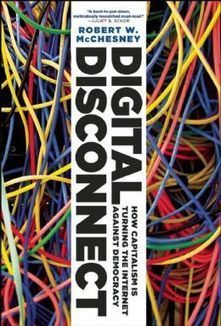
“Most assessments of the Internet fail to ground it in political economy; they fail to understand the importance of capitalism in shaping and, for lack of a better term, domesticating the Internet,” says Robert W. McChesney in his illuminating new book, Digital Disconnect: How Capitalism is Turning the Internet Against Democracy.
“The profit motive, commercialism, public relations, marketing, and advertising -- all defining features of contemporary corporate capitalism -- are foundational to any assessment of how the Internet has developed and is likely to develop.”
The guy is right - corporations have seized (or are trying to seize) control of the internet. But they do not have any idea of how hot an iron they are touching. With the combined power of all the people networked...
Someone said yesterday: "I see this as a swan song of corporations. They are doomed."
India’s average yield of wheat in 2011 was significantly below the yield from its best lands in 1890.
Increasing wheat yield has been the Indian scientists’ focus of effort, which implies that they have consistently short-changed the farmers and wasted public money without showing any results;
While the non-performing scientists lived off public money, India’s farmers continued to feed the nation.
Many radical farmers achieved record breaking yields from moderately good lands and many marginal hill farmers achieved huge yield gains yet their innovations neither discussed during national planning exercises nor properly studied.
This article shows with actual figures that genetic modification and "modern agricultural technologies" are a complete dud compared to traditional and also recent record yields achieved by conventional organic growing methods. Who needs Monsanto? Only the highly bribed politicians, it seems.
On any given night, up to 60,000 people stay in places they found on Airbnb. One of them is always the guy who co-founded the fast-growing online travel lodging service.
"In June 2010, I moved out of my apartment and I have been mostly homeless ever since, off and on," Brian Chesky said at the South by Southwest (SXSW) interactive, film and music festival.
"I just live in Airbnb apartments and I check in every week in different homes in San Francisco," where the company is based, he said. "It's the best way to take the pulse... The key is to always use your product."
(Get the whole article by clicking on the headline here)
"Desertification is a fancy word for land that is turning to desert," begins Allan Savory in this quietly powerful talk. And terrifyingly, it's happening to about two-thirds of the world's grasslands, accelerating climate change and causing traditional grazing societies to descend into social chaos.
Savory has devoted his life to stopping it.
He now believes -- and his work so far shows -- that a surprising factor can protect grasslands and even reclaim degraded land that was once desert."
We are part of this eco-system of planet earth. Unless we understand how it works and what's needed for it to continue to work, we can't be hopeful about the future...
To understand how we will feed a growing population with decreasing resources and a changing climate, we must shift our mindset to understanding that the food system is a living system.
Yes, the food system ... and agriculture ... are in need of reform. Some interesting ideas in this article about a new program (software) allowing better distribution of locally produced food.
Open Garden shares an internet connection with other devices, using Wi-Fi or Bluetooth. The goal of Open Garden is to share the last mile and promote the openness of wireless networks.
It automatically creates a mesh network between all the Open Garden-enabled devices and picks the fastest connection to route traffic. Their Open Garden Mesh Protocol enables people to create their own network.
Reversing the tendency to rely on "closed gardens" (or walled gardens) of phone and net access providers, Open Garden is free software that allows devices to network with one another, sharing available connections to the internet.
It's a win-win. Everyone who shares will also be better connected than if they were alone... We should have connectivity everywhere. This is a way to do it without waiting for the providers.
In an emergency situation where mobile networks are either down or overloaded and there’s no WiFi, cell phones are useless. Unlike land mobile radios, used by police and fire departments, they don’t have the ability to communicate directly with each other. Until now.
The Better Approach To Mobile Adhoc Networks (BATMAN) joins smartphones together in an ad-hoc, mesh network, capable of device to device communication. You can share files and even send messages with the right application.
Slowly, network decentralization is pushing more and more functions out towards the edges. Communication becomes much more resilient. It can adapt to circumstances, if the networking is done by our own devices, rather than central phone towers or internet service providers...
Our current situation is conducive to revolutionary thinking, if not yet in politics, then maybe in economics.
The BoE has spent £50 billion over the past six months to support bond prices. That could instead have financed a cash handout of £830 for every man, woman and child in Britain, or £3,300 for a typical family of four. In the United States, the $40 billion the Fed has promised to transfer monthly, with no time limit, to banks and bond funds, could instead finance a monthly cash payment of $500 per family – to be continued indefinitely until full employment is restored.
It seems that the trust in banks and the economists who back them is fast coming to an end. There is talk abut innovative solutions to the crisis, and one of those is to spend money not on bailing out banks or holding up bond prices (so the rich can continue to accumulate ever more money) but to actually help the people... what a novel idea! Well, actually not. It was proposed a century ago by some "rogue" economists but no one listened.
// oAnth: What sounds on a first glance quite marvelous, needs in my opinion to consider who is paying here to whom by which kind of interests and conditions. The question, where these huge amounts of money are coming from, seems to be not even noteworthy.
The states' fiscal sovereignty is completely questioned. It's an open revolution not in economic thinking, but in the foundations of the state's authority. In so far this discussion continues the neoliberal agenda on a less hidden manner as a clear opening to the area of neofeudalism and proves an ongoing obvious power shift.
It has IMHO nothing to do with a P2P decentralized economy.
------------------------
// oAnth: I have to correct my latest entry in so far, as I have misunderstood the source of the money, which is to spend. If I understand well now, it would be a more or less indirect debt cut by spending money, created by the central bank, directly to the population, but - but I would instantly like to add, the incentive to the exploitation circle would nevertheless in a long run only be to tame by additional much higher top income taxes.
Information is power. But like all power, there are those who want to keep it for themselves. The world’s entire scientific and cultural heritage, published over centuries in books and journals, is increasingly being digitized and locked up by a handful of private corporations. Want to read the papers featuring the most famous results of the sciences? You’ll need to send enormous amounts to publishers like Reed Elsevier.
There are those struggling to change this. The Open Access Movement has fought valiantly to ensure that scientists do not sign their copyrights away but instead ensure their work is published on the Internet, under terms that allow anyone to access it. But even under the best scenarios, their work will only apply to things published in the future. Everything up until now will have been lost.
That is too high a price to pay. Forcing academics to pay money to read the work of their colleagues? Scanning entire libraries but only allowing the folks at Google to read them? Providing scientific articles to those at elite universities in the First World, but not to children in the Global South? It’s outrageous and unacceptable.
“I agree,” many say, “but what can we do? The companies hold the copyrights, they make enormous amounts of money by charging for access, and it’s perfectly legal — there’s nothing we can do to stop them.” But there is something we can, something that’s already being done: we can fight back.
Those with access to these resources — students, librarians, scientists — you have been given a privilege. You get to feed at this banquet of knowledge while the rest of the world is locked out. But you need not — indeed, morally, you cannot — keep this privilege for yourselves. You have a duty to share it with the world. And you have: trading passwords with colleagues, filling download requests for friends.
Meanwhile, those who have been locked out are not standing idly by. You have been sneaking through holes and climbing over fences, liberating the information locked up by the publishers and sharing them with your friends.
But all of this action goes on in the dark, hidden underground. It’s called stealing or piracy, as if sharing a wealth of knowledge were the moral equivalent of plundering a ship and murdering its crew. But sharing isn’t immoral — it’s a moral imperative. Only those blinded by greed would refuse to let a friend make a copy.
Large corporations, of course, are blinded by greed. The laws under which they operate require it — their shareholders would revolt at anything less. And the politicians they have bought off back them, passing laws giving them the exclusive power to decide who can make copies.
There is no justice in following unjust laws. It’s time to come into the light and, in the grand tradition of civil disobedience, declare our opposition to this private theft ofpublic culture.
We need to take information, wherever it is stored, make our copies and share them with the world. We need to take stuff that’s out of copyright and add it to the archive. We need to buy secret databases and put them on the Web. We need to download scientific journals and upload them to file sharing networks. We need to fight for Guerilla Open Access.
With enough of us, around the world, we’ll not just send a strong message opposing the privatization of knowledge — we’ll make it a thing of the past. Will you join us?
Found as part of a eulogy on Exit Strata's site, this manifesto of Aaron Swartz is almost 5 years old. It is too important to just become a footnote in the corporate dominance wars. Aaron calls on every one of us to participate, to join forces in liberating information that is being locked up behind ever tighter and ever more agressively defended paywalls.
It is our cultural and scientific heritage that is being hijacked by nameless (and not so nameless) corporations. We are being reduced to "consumers" who are supposed to pay to even know what our friends and colleagues found and published.
It's time we listened to Aaron and that we ourselves started scanning and otherwise making copies of all those works that are within our reach ... and that we uploaded them to places where they can no longer be locked up.
A welcome help for important work. We need more transparency in government.
"The Sunlight Foundation is a nonprofit, nonpartisan organization that uses the power of the Internet to catalyze greater government openness and transparency, and provides new tools and resources for media and citizens, alike."
Oil and gas rigs are popping up in communities across the world as the fossil fuels industry races to exploit reserves with the controversial drilling technique known as fracking. In response, a global anti-fracking movement has emerged, and activists are winning victories in countries across world.
A report recently released by the international consulting group Control Risks warns the oil and gas industry that it has underestimated the "sophistication, reach and influence" of the global anti-fracking movement. The report contends the opposition is not simply a spotty, not-in-my-backyard phenomenon "masquerading as environmentalism," but a diverse and well-organized coalition that is unlikely to be swayed by the industry's well-funded public relation campaigns.
Fracking is a desperate attempt to force natural gas production and keep the fossil fuel business expanding, when, by rights, it should be contracting to leave space for renewable energies to fill.
Chemicals and water are pressurized and injected into bore holes, to create cracks in rocky strata for natural gas to emerge and become recoverable. Some of those chemicals and dirt released by the technique end up in the groundwater contaminating in the water supply.
We don't have to "wait until" anything. We have everything we need, right now, to create the future we want for our world.
For decades the prevailing wisdom has been that strong organizations are a necessary prerequisite to addressing the large-scale issues facing our communities and our world.
However, history has repeatedly shown us just the opposite. And when we consider the recent decades of history specifically within the nonprofit sector, we find that an emphasis on building strong organizations has been, in fact, an inwardly-focused distraction to creating the kinds of real change the outside world needs from us.
gribiotech giants are tightening their grip on agriculture worldwide.
Rather than trying to fight them directly, Urbsly will help create an alternative system that builds on open standards and data, enabling farmers and gardeners to compete on a level playing field, and ensuring that the technology is available to all.
"The big agribiotech companies’ strategy over the past few decades has been to buy into the seed industry at all levels, especially by acquiring the big seed producers and their holdings of many thousands of varieties (and, critically, their traits)."
This is a real problem on the horizon, for our food supply. The Urbsly initiative, which starts with the compilation of an open-source catalog of all seed varieties is very important and long overdue...
Collectivists have a favorite target. Big bad corporations. This is a complete scam. Why did Goldman Sachs turn out to be the biggest funder of Obama’s 2008 election bid? Why weren’t the corporate banksters who demanded and received those enormous bailouts, under both Bush and Obama, prosecuted for crimes?
Collectivists actually love big corporations. Collectivists just want to distract us from their real goals. And in order to enact those goals, they need banks, they need the military-industrial complex, they need Big Pharma and Big Oil...
Ben Gilroy explains the fundamental difference between his Direct Democracy Ireland Party and the other main stream parties... And why a vote for him will RETURN real democratic power to the people of Ireland.
We have to find a better way than what we have - voting for a representative every four or five years and just hoping, against all real experience, that they will do what we think they should be doing.
The problem is becoming really obvious now with politicians backing up the banks and big finance against the interests of the people who elected them.
The internet providers and copyright holders have begun using peer-to-peer (P2P) surveillance methods to try to sniff out when copyrighted content is uploaded or shared illegally.
A company called MarkMonitor has been contracted to join BitTorrent networks (the most common way to illegally share files) and search for the names of copyright-protected movies, music, and TV shows. The list of those names is provided by the MPAA, RIAA, and NCTA.
When MarkMonitor finds a file in violation, they snag the IP address of the user who's sharing the file and send it off to that user's internet provider, who issues a series of escalating warnings.
Hollywood has found a way to criminalize sharing. But will all those efforts to catch the criminals who don't intend to be Hollywood's clients end up hastening the movie industry's demise?
Perhaps entertainment will be different tomorrow and there will be a more direct line - artist-to-fan and vice versa - that leaves no room for Hollywood.
LAST night 40,000 people rented accommodation from a service that offers 250,000 rooms in 30,000 cities in 192 countries. They chose their rooms and paid for everything online. But their beds were provided by private individuals, rather than a hotel chain.
Hosts and guests were matched up by Airbnb, a firm based in San Francisco. Since its launch in 2008 more than 4m people have used it—2.5m of them in 2012 alone. It is the most prominent example of a huge new “sharing economy”, in which people rent beds, cars, boats and other assets directly from each other, co-ordinated via the internet.
Built entirely using HTML5 and other open Web standards, Firefox OS is a Linux-based open source operating system for smartphones and tablet computers. It has been demonstrated on Android smartphones and the Raspberry Pi.
Samsung and Intel are cooperating on the development of Tizen, another open source phone project situated within the Linux Foundation. The first embodyment of the system in phones will be Bada.
Media that spy on and data-mine the public are capable of destroying humanity's most precious freedom: freedom of thought.
Ensuring that media remain structured to support rather than suppress individual freedom and civic virtue requires us to achieve specific free technology and free culture goals.
In this talk, Eben Moglen offers suggestions about how the Free World should meet the challenges of the next decade.
Eben Moglen, one of the initiators of the "Freedom Box" project, makes some extremely important points on how to preserve the freedom of thought and the freedom of action we have fought to attain and preserve over the last millennium.
In the age of social media and commercial software, in the age of governments trying to know everything about everyone, I believe this is of great importance.
Please do take the time (it's about an hour) to watch this video.
Telcos and internet providers are robber barons. They will overcharge for their service and, if you're out in the countryside, you are out in the cold as far as they are concerned. You don't get the service.
Will the new p2p internet that is growing here and there eventually make the telcos redundant?
"I still think collaborative consumption is overrated compared to the other side of the sharing economy coin: collaborative creation.
The true potential of a networked, peer-to-peer economy is just starting to show with the maker movement. And it's not just about what we can consume together, it's about what we can create together."
If we consider a sliding scale that goes from being at the mercy of others (being the effect) to actually producing something useful (being the cause) then consuming, even in collaboration with others, is very much on the effect side of the scale. To be on the cause end of that scale, making (which means inventing, creating, constructing something) is the way to go.
We are being invited to use our collective intelligence to create, this is where there is an incredible amount of untapped potential. Clearly, meeting our needs through more sharing (collaborative consumption) uses similar skills, and also provides a stable foundation for making a brighter future for generations to come.
After an unsuccessful first attempt, the European Citizens’ Initiative for Unconditional Basic Income finally got accepted by the European Commission, thus opening the possibility for the organizers from 14 European countries to start collecting their signatures of support. This is the start of a 12-month European-wide campaign for basic income in Europe. The goal is to collect one million signatures.
A universal basic income could replace all those various pension schemes, many of which are being stripped of funds to pay for "urgent other expenditures". It could also make us independent of an ever contracting jobs market. As automation takes people out of work, we must devise a way to let everyone contribute to society in other ways than paid work. Basic income could be part of that needed re-organization.
Marabunta is a free and open networking protocol, software that allows users to communicate while remaining anonymous.
In contrast to other efforts, Marabunta achieves anonymity by broadcasting, rather than directly connecting to peers. Each peer has a limited number - something like 15 - of "brothers" forming a cell of the network, which are polled for presence and for news. If one sends a message that is new, it is re-broadcast to the rest of the "brothers". If not new, it is simply eliminated.
In this way, messages (they are like posts on a mailing list) propagate through the network at remarkable speed. Anonymity is relatively easy to achieve as no one connects directly to anyone else to send a specific message, making interception difficult.
While Marabunta works on wired networks, its cousin 'Enjambre' is an evolution of the protocol for use in wireless networks.
A pdf document describing Marabunta (in Spanish) is
To get content containing either thought or leadership enter:
To get content containing both thought and leadership enter:
To get content containing the expression thought leadership enter:
You can enter several keywords and you can refine them whenever you want. Our suggestion engine uses more signals but entering a few keywords here will rapidly give you great content to curate.


 Your new post is loading...


 Scoop.it!











More self-reliance and resiliency - that is where we are directed as we start growing our own vegetables around the house or get together with others to try and find a new way to do things, like these young Greeks have done in the face of an economic crisis.