#BauwensInChina: reflections of a Commons-Oriented Traveler to the Chinese grassroots communities, who are seeking to tackle the meaning crisis amongst Chinese youth.
The Chinese P2P Paradox (4)
So, what are the implications of this paradox?
First, it means that the P2P model that we have been developing in the West may not be universally applicable. It may work well in a post-industrial context, but it may need to be adapted to the industrializing context of the ‘Rest’.
Second, it means that we need to pay more attention to the P2P dynamics in the ‘Rest’, and learn from them. We may find that they have solutions to the problems that we are facing in the West, such as the limits to growth, and the social and institutional crises.
Finally, it means that the future of P2P societies may not be a one-size-fits-all model, but a diverse range of models, tailored to the specific contexts and needs of different regions and cultures. This is a challenging but exciting prospect, and one that we should embrace with open minds and hearts.
Courtney Brown discusses how the Epstein disclosures are a very real layer of governance collapse that is happening now. This video is available on FarsightPrime.com with captions in 13 languages. Published 8 February 2026.
This video by the Foresight Institute dives into the Epstein matter, not into the files themselves but into the implications that the recent revelations, the release of a large number of files, even if redacted, have for the stability of our governing institutions and indeed for society as we know it.
Here once more the direct YouTube link to the video:
Here is a video by the Foresight Institute's founder, Courtney Brown. In it, he dives into the Epstein matter, not the files themselves but the implications of those recent revelations.
What will be the effects of the release of a large number of files, even if redacted, for the stability of our governing institutions and for the way we may decide our society should be run in the forseeable future.
Emails in the Epstein Files show first-hand accounts of powerful interests being protected from public scrutiny— via algorithm adjusting and information editing. But sometimes the footprint remains ...
The decline of Wikipedia as a robust, comprehensive and impartial font of information is not new. This conspicuous shift away from its original role, and its repurposing as a channel for narrative-propagation, has been well documented in previous World Council for Health articles.
Both the information in Wikipedia and the positioning of results on search engines can and have been hacked to make Wiki articles conform to a specific slant and to put certain search results in prominent position. Just a heads-up
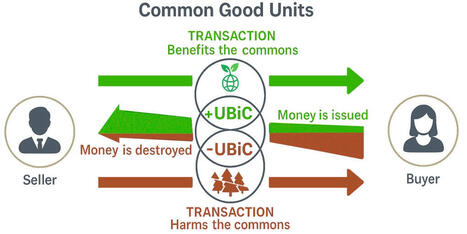
A guest editorial by Michel Foata-Prestavoine. The Problem is the Transactional Symmetry, and the proposed solution is the Common Good Unit, a commons-based monetary system.
An overview and discussion of the communication and relation between the Bitcoin founder, Satoshi Nakamoto, and the P2P Foundation’s founder, Michel Bauwens.
At the P2P Foundation, we believe in cosmo-localism. This means that we want to converge the ‘Archipelago of Regenerative Initiatives’, i.e the millions of people who are rebuilding a life-respecting web of value, with the coordination and capitalizing capacities of the Web3 ecosystem. This possibility was set in motion by the conceptual and technological inventions of Satoshi Nakamoto, and so we owe him a debt of gratitude.
This is a review of what I remember of the interaction between myself, Michel Bauwens, the founder of the P2P Foundation, and Satoshi Nakamoto, the ‘inventor’ of Bitcoin. I am doing this on behalf and at the request of my good friend, Yongkwan Choi, founder of the Commons Foundation, who recently launched the Satoshi Nakamoto Meme Coin.
Before starting, it has to be acknowledged that though there are similarities of purpose between the P2P approach of Satoshi and that of the P2P Foundation, there are also quite significant differences, and therefore, the relationship between both was one marked by a critical reception on the part of myself and the P2P Foundation network. It was never and still isn’t, a love at first sight.
Nevertheless, it remains quite significant that Satoshi chose the P2P Foundation for this first public sharing of the White Paper, choosing to write to Michel Bauwens both publicly (on the Ning forum of the P2P Foundation) and privately (personal email). This indicates that Satoshi was not only aware of our work, but recognized it as important, and saw sufficient commonalities with his own.
Read the whole article on Michel Bauwens' substack here:
I remember well Satoshi's publication of his Bitcoin White Paper. My first reaction at the time was:
"Great stuff.
This is the first real innovation in money since the Bank of England started to issue its promissory notes for gold in the vaults, which then became known as banknotes.
I believe an open source currency has great potential. A bit like Google becoming the default search engine for many of us."
Just like Michel Bauwens, I did not jump into the fray to obtain coins, adopting the "let's wait and see" attitude. I wasn't interested in an investment opportunity but in a widely used, real world functioning open source currency, something Bitcoin did not become.
Have you ever felt like power just circulates among elites?
That anger rises, systems shift, people change … but nothing really changes?
I see people fighting. Arguing. Upset over politics… over power, wealth, inequality... my entire life. It seems like an inescapable loop.
There are many offering answers for how to come into agreement .. visionary approaches: the Three Horizons, Holacracy, Sociocracy, Communism, Democracy... and so on. So many frameworks. All of them holding some truth - yet like blind folks all trying to describe an elephant …. they grasp at coherent integration of the commons. Not metaphorical commons. Living, breathing, grassroots economics.
It’s like a gaping hole in our map. No matter how you transfer ordivide up governance - without a working mechanism for the commons … you end up back in a power-overstructure... instead of a power-with one...
The game is not to take power away from those who have it. What's important is to start realizing our own power as individuals in groups, and to build a new foundation ... where power flows differently.
Turning Points in History Require Revolutionary Thinking
I am proposing this essay by Julius Ruechel as relevant to the discussion on P2P as an excellent example of the reasons why we have to overcome the current political system of conservatism vs. liberalism, by whatever names those opposing ideologies may go.
There is simply no solution within the political dichotomy of opposing factions periodically handing over power from one end of the spectrum to the other.
My comment after reading it was as follows:
"Thank you for this essay, the first part of which I enjoyed reading and no, I’m not a paid subscriber to your substack.
I was especially interested in the overview of historical changes in society, which shows that, whichever way the pendulum swings, we are still in the same see-saw of apparent change that ultimately leads nowhere.
The takeaway for me is that the era of strong leaders, be they conservative or revolutionary, may be drawing to a close.
The future, in my view, is not in any system that requires a leader but in a bottom-up kind of organisation as exemplified by the emerging P2P movement, where emphasis is on direct peer-to-peer connection and organising. That may require some time to come to maturity, but it will be the wave of the future, if humanity is ever to make it out of the authoritative era into liberation and emancipation.
If you are interested in diving more into the philosophy at the bottom of P2P, I recommend the substack of Michel Bauwens, the founder of the P2P movement, which you can find here: https://4thgenerationcivilization.substack.com/
Kind regards
Sepp Hasslberger
Ps: I do not know if you would like to publish this comment (I find I have no access to do so) but if you do, I hereby give my consent."
To find the essay by Ruechel, click on the headline or use this link:
The era of strong leaders, be they conservative or revolutionary, may be drawing to a close. We need to find a way to push the power down to the level of the people, not by periodic elections but by a real re-organization of things from the bottom up ... is p2p the way to go?
Before I start explaining the logic implicit in the title of this article, please read carefully the following statement, which you should see as ‘preliminary evidence’ for the thesis that I will propose...
Michel Bauwens has a different take on AI and its role in the evolution of human society ... a very interesting take I might add, bringing agency to "the man in the street" and helping the spiritual component take its rightful place.
The salvific and ex-tropic implications of the medieval Christian vision of human work as spiritual activity. Excerpts from the study: “From Modes of Production to the Resurrection of the Body"
Tucker travels to El Salvador to interview President Nayib Bukele after his historic landslide reelection victory. Bukele has accomplished the impossible during his first term by eliminating violent crime, reducing emigration, and invigorating the local economy.
Video - Running Time: 65 mins
First, Tucker Carlson interviewed Javier Milei, then he interviewed Vladimir Putin. Now, the popular American journalist has released a highly-anticipated interview with El Salvadoran President Nayib Bukele.
Bukele has taken several firm actions and positions that make him a target of the left-wing media:
• Tough on crime
• Investigates and prosecutes corrupt officials from previous administrations
This interview with El Salvadoran president Nayib Bukele is mind boggling. The story of how a country was turned around from being crime central to having the lowest crime rate of any Western country. A breath of fresh air.
How entredonneurs and Everywheres may be constructing a new type of narrative glue, based on the joint construction of the commons
"Crude forms of identity are emerging to provide social cohesion as national identity melts away. We need a scalable, networked form of social cohesion to replace those crude forms. That requires finding and reinforcing networks of consensus."
So this is the issue we want to address today: what kind of glue can hold humanity together during this ongoing ‘chaotic transition’...
You might not know what an entredonneur is. I didn't and had to look around.
Apparently an entredonneur is an entrepreneur, someone who started and runs a business, only with the "preneur" or 'taking' part softened into a "donneur" or 'giving' part...
Quote: "
If you are an entrepreneur, etymologically ‘taking in the middle’, we suggest you become an entredonneur, ‘giving in the middle’."
"In the late 1990s, I co-produced with director Frank Theys, a 3 hour documentary called TechnoCalyps, subtitled, The Metaphysics of Technology and the End of the Human, which was an examination of the promise and peril of transhumanism.
Paradoxically, at the time I was very much involved in a spiritual quest, so I was immediately struck by the religious aspects of transhumanism and transhumanist technology, while Frank, a radical atheist, was enthusiastic about the practical possibilities to overcome human limitations.
My theory then, and it is still my theory now, is that the search for the transcendent, is an innate biological drive, inevitably linked to the human condition, but when we ceased to believe, roughly in the 17th century, collectively as a culture, in the possibility of spiritual transcendence, then this belief would express itself in another way, unconsciously. And unconscious drives are much more dangerous. Eric Voegelin places this much earlier, with Joachim de Fiore, who for the first time, spoke of the succession of spiritual ages in a temporal way, i.e. the Age of the Father, of obedience to the laws, the Age of the Old Testament; then came the Age of the Son, the era of Love, embodied in the christian Church; but we were poised to move towards an age of the Spirit, where such an institutions was no longer needed, and all the people would live in brotherhood, as only the monks did in his time. For Voegelin, this amounts to a ‘Immanentization of the Eschaton’, i.e. a temporalization, of the hope for transcendence. It would lead to the Reformation first, then to the political ideologies of the 18th cy, which promised an ideal society on this earth, but finally, it morphed into transhumanism, a radical religion of physical transcendence through technological means, in new spaces and other planets.
So today, I want to explore how the development of human technology is the expression of our unconscious desires and ideals, which we put out in the world in technological artifacts, where it becomes an uncontrollable cybernetic machine .."
And now for something entirely different: a unique walking seminar in Greece
I met my Greek friend George Anadiotis a decade ago in Berlin and we kept in touch by doing zooms every three weeks or so, something I do with about half a dozen other people. It’s my way to ensure a diet of intelligent conversations that I may not always find the occasion to do locally. It is one of the remaining blessings of the global internet.
With George, we have devised two different seminars in Lake Kaifas, an off the beaten track location on the South-west coast of Greece, not too far away from ancient Olympia, see the picture above.
During the first week, from the 17th to 23th of May, dedicated to be a participant during civilizational transitions, we will start the day with a philosophical walk (designed for very moderate walkers), while in the afternoon, my friend George will guide participants to ancient Greek and Hellenistic history. In the evening, we will exchange our collective learnings.
The second week is dedicated to George’s expert knowledge as an AI expert, and is entitled, “Pragmatic AI”. The goal here is to master AI as a tool, beyond any hype.
Now to the article itself, which exceptionally, is a transcript of a conversation I had with George, about the state of AI as a pragmatic tool, how it changes the forms of human organization, and how his upcoming seminar will tackle these challenges ...
Two interesting seminars (May 17 to May 30 2026 at Lake Kaiafas, Greece) on the use of AI as a tool in civilizational transition. Michel Bauwens and George Anadiotis
#BauwensInChina: reflections of a Commons-Oriented Traveler to the Chinese grassroots communities, who are seeking to tackle the meaning crisis amongst Chinese youth.
The Chinese P2P Paradox (4)
So, what are the implications of this paradox?
First, it means that the P2P model that we have been developing in the West may not be universally applicable. It may work well in a post-industrial context, but it may need to be adapted to the industrializing context of the ‘Rest’.
Second, it means that we need to pay more attention to the P2P dynamics in the ‘Rest’, and learn from them. We may find that they have solutions to the problems that we are facing in the West, such as the limits to growth, and the social and institutional crises.
Finally, it means that the future of P2P societies may not be a one-size-fits-all model, but a diverse range of models, tailored to the specific contexts and needs of different regions and cultures. This is a challenging but exciting prospect, and one that we should embrace with open minds and hearts.
This post is an update on the direction HOLO is going into, and it involves not only P2P connectivity and at-the-edges computing/data storage but also the almost accidental development of a payment infrastructure that may grow into something exciting in good time.
Here is what Eric Harris Brown says:
"Strategic work always involves paying attention to the match between your efforts, and where the world is ready to receive those efforts.
Since our inception there has always been a small group of supporters who have understood the potential and need for the kind of deep p2p infrastructure that we are building, which allows for all kinds of un-intermediated direct interactions and transactions of all types. But at this moment in time we are seeing a new convergence.
As Holochain is maturing significantly, the main-stream world is also maturing into understanding the need for p2p networks and processes. As my colleague Madelynn Martiniere says: “we are meeting the moment and the moment is meeting us.”
And there’s a key domain in which this is happening: the domain of value transfer."
This post is an update on the direction HOLO is going, and it involves not only P2P connectivity and at-the-edges computing/data storage but also the almost accidental development of a payment infrastructure that in good time may grow into something exciting.
This video explores how Africa's internet could revolutionize the digital landscape and challenge established monopolies. This video exposes a groundbreaking development: Africa's bold initiative and its potential ramifications for global tech giants like Google.
This is Africa Strikes Back, the frontline of Africa’s political awakening, tech revolution, and global realignment.
We uncover the hidden power shifts shaping modern Africa; from rising leaders like Ibrahim Traoré, to the continent’s push to reclaim digital, economic, and military sovereignty. We expose the silent battle between Africa and Western control, the emergence of homegrown technologies, and how the new generation of African nations are turning the tables on centuries of dominion.
African nations have constructed a continental internet infrastructure that is capable of keeping African data within the continent. It bypasses the need for using centralized servers and applications based elsewhere. Silicon valley has serious competition now as other continents think of and discuss similar solutions as well ...
"Things fall apart; the center cannot hold; Mere anarchy is loosed upon the world, The blood-dimmed tide is loosed, and everywhere The ceremony of innocence is drowned; The best lack all conviction, while the worst Are full of passionate intensity." - W. B. Yeats
Chinua Achebe’s Things Fall Apart quotes Yeats well above and opens with a rift … a rupture not just of political control, but of memory, coherence, and trust. His story traces the unraveling of a living social system under the weight of colonial intrusion … not simply the arrival of outsiders, but the erasure of an entire relational logic that once held communities together.
That rift is still happening. It happens every time a community is told that trust doesn’t count unless it’s backed by money. That relationships aren’t reliable unless formalized by expensive regulated contracts. That coordination must be managed by platforms, institutions, or markets …. not by memory, promise, and collective intelligence.
"The most resilient systems don’t prevent failure. They survive because they know how to repair trust when it breaks." Will Ruddick on trust networks and commitment pooling.
Commitment Pooling as a Metabolic Process for Trust, Value, and Collective Flow
In her later years, Elinor Ostrom turned her attention toward what she called the "functional mechanisms" of successful commons - moving beyond typologies of resource coordination systems, but the minimal, adaptable protocols that allowed communities to coordinate care over time. She understood that lasting institutions do not arise from control or universal rules, but from simple agreements people can adapt, revise, and renew together.
The Commitment Pool Protocol offers exactly this: a simple, generalizable structurethat allows any group to exchange, limit, and track value as relational trust.
"If we approach this in the right way, it will spark a 21st Century Renaissance. A flourishing-forth of art, science, wealth and culture not seen since the Middle Ages."
We live in an era of unprecedented Centralisation.
Cultural, economic and political activity is largely dominated by a tiny number of increasingly powerful global institutions and wealthy individuals, at the expense of everyday citizens.
This process of Centralisation has been going on for decades, maybe centuries, and is driving levels of wealth inequality not seen before at any point in human history.
Decentralisation requires work. Fortunately, there are many good people working to make it happen. It will put power into the hands of the people, making much of today's centralised structure obsolete.
Why commons-based institutions now need to regulate the market and state, ‘cosmo-locally’
... imagine the following:
Local alliances of regenerative projects unite and create common digital identities and ‘sovereignties’, allowing them to autonomously engage with the regenerative sections of crypto capital.
Domain-specific alliances, say of all community land trusts in a trans-national context, are created, relying on global knowledge commons and shared innovation, common protocols of cooperation and coordination, and shared financing capacity.
These two types of trans-localized forces can co-own parts of their global commons infrastructure, while at the same time, regenerative parts of crypto capital create mechanisms for distributed co-ownership at the local level.
Government and multinational "big capital" institutions are life-determining forces. Michel Bauwens proposes to bring the people into play through a "cosmo-local" commons ...
Understanding the transition from an immature technosphere, which destroys the biosphere, to a ‘mature technosphere’, which lives in harmony with the biosphere.
Our task is to shift from an immature Technosphere which overuses the planetary biosphere, to a mature Technosphere, which can live in long-term balance with the biosphere, likely for millions of years.
This is a shift in which we must somehow succeed in producing for human need, without the long-term exhaustion of our planetary ecological system.
This is of course a very complex task ahead of us, sometimes called the Metacrisis, and this article is concentrated on one aspect of it: how to envisage the technological and infrastructural basis of such a shift.
In our interpretation, this is very much linked to a change in ‘value regime’, i.e. how we extract and distribute value, from nature, as human society...
Michel Bauwens of the p2p foundation on: "Understanding the transition from an immature technosphere, which destroys the biosphere, to a ‘mature technosphere’, which lives in harmony with the biosphere."
You probably know to take everything an artificial intelligence (AI) chatbot says with a grain of salt, since they are often just scraping data indiscriminately, without the nous to determine its veracity.
But there may be reason to be even more cautious. Many AI systems, new research has found, have already developed the ability to deliberately present a human user with false information. These devious bots have mastered the art of deception...
So Artificial Intelligence programs have been found to deliberately be deceptive with humans, when it is to the AI's advantage. Is there any way to guarantee that this won't happen in the future? Probably not, because the human programmers of AI often cannot understand any more what AI is writing into its own programming when it "learns"...
Bastyon is a decentralised social network focusing on privacy and free speech. It uses a peer-to-peer network, and the blockchain.
Daniel Satchkov is the founder of Bastyon, which is decentralised social network focusing on privacy and free speech. It uses a blockchain-based peer-to-peer infrastructure, avoiding central servers, which buffers against censorship.
Bastyon has no headquarters.
The aim is to be an alternative to establishment heavyweights like X and I strongly recommend it. An increasing number of my videos are hosted on Bastyon, including the one below.
Introducing a data commons stack, Arkology outlines tools for data-driven sensemaking, by and for communities.
To act in the world we must first make sense of it.
However, the world is complex, containing an amount of information exceeding the processing capacity of any individual or group. Adequate sensemaking in the context of complexity and info-abundance therefore requires the ability to process and analyse data.
We refer to this capability as data-driven sensemaking.
Yet, today the means for data-driven sensemaking are unevenly distributed. In our essay, The Politics of Data: Data Commoning as a Territory of Transition, we described how data is shaping the landscape of power, perpetuating and amplifying asymmetries. Unsurprisingly, the principal beneficiaries are large corporations and state actors with the financial and technical resources required to undertake data collection, processing and analysis at scale. As with ‘natural resources’ and ‘labour’, the dominant economic and cultural logics of today regard data as another resource to be extracted, siloed and abused in service of narrow objectives and/or for the benefit of a few...
To get content containing either thought or leadership enter:
To get content containing both thought and leadership enter:
To get content containing the expression thought leadership enter:
You can enter several keywords and you can refine them whenever you want. Our suggestion engine uses more signals but entering a few keywords here will rapidly give you great content to curate.


 Your new post is loading...
















Michel Bauwens has studied and developed p2p for two decades. He recently went to China and found out some interesting things ...