Your new post is loading...
Argentina's embassy in London said new laws had been passed by the country's congress to clamp down on exploration it claims is in breach of UN decisions.
The UK's Foreign Office insisted the activities were legitimately controlled by the islands' government.
Islanders recently voted overwhelmingly to remain a British overseas territory.
The embassy said legislation "provides for prison sentences for the duration of up to 15 years; fines equivalent to the value of 1.5 million barrels of oil; the banning of individuals and companies from operating in Argentina; and the confiscation of equipment and any hydrocarbons that would have been illegally extracted"
It said in a statement: "The Argentine government has protested against and rejected all of the United Kingdom's attempts to promote and authorize such hydrocarbon exploration and exploitation activities in the area of the Argentine continental shelf.
"These attempts are manifestly contrary to Resolution 31/49 of the United Nations General Assembly, which requires the UK and Argentina to refrain from taking decisions that would imply introducing unilateral modifications into the situation of the Malvinas Islands while the sovereignty dispute between the two countries is still pending."
In a referendum in March, Falkland Islanders decided by 1,513 votes to three to remain a UK overseas territory but Argentina - which calls the islands the Malvinas - has stepped up its claims to them at the United Nations.
Click headline to read more--
Broadband rollouts in parts of Europe are likely to get substantially cheaper and easier, after a committee of the European Parliament backed plans to encourage access to existing infrastructure.
When you’re laying fiber in the ground, it’s a bit of a no-brainer to do it in ducts that already exist – sewage pipes and drainage systems, for example – particularly as most of the cost of a rollout lies in civil works.
Countries such as the UK and France already promote this kind of infrastructure-sharing, but now the same idea seems set to spread across the EU. On Thursday, the European Parliament’s industry committee said it had approved a draft law that would give broadband firms the right to “access ‘promptly’, via a single information point, at least information on the location, route, size, type and current use, name of owner and a contact point for existing infrastructure.”
They will also be able to access better information about upcoming civil works, and information will only be denied if “security or fundamental public or individual interests are at risk.”
Click headline to read more--
Irish incumbent Eircom today announced an increase to its planned national fibre footprint from 1.2 million homes and businesses to 1.4 million homes and businesses across Ireland.
This means that by July 2016, 70% of the country should have access to fibre broadband speeds of up to 100Mbps via the network. Eircom’s fibre rollout programme is currently ahead of schedule and the company is on track to pass 700,000 premises by the end of the year.
Today’s announcement means that an additional 562 communities across all 26 counties will be able to avail of the operator’s ‘eFibre’ high speed service.
Back in October, we wrote about the absolutely ludicrous situation in which the City of London Police ordered registrars to take down a bunch of websites and point them to a page designated by the police (which pointed to some commercial services in London). There was no court order. There was no court involved at all. No one had been charged, sued, tried or anything. Just the City of London Police, their brand new "Intellectual Property Crime Unit" (set up at the urging of the RIAA), and a demand that the website domains be yanked and that the registrars bar them from being transferred out. While some registrars, such as the incredibly misnamed "Public Domain Registry," caved immediately to the completely bogus request, EasyDNS strongly and publicly refused (telling the police to come back with a court order) while also questioning (1) whatever happened to due process and (2) how any registrar could do this when it clearly violated ICANN's policy on transferring domain names.
Given this, EasyDNS went even further and filed a "request for enforcement" against Public Domain Registry, for locking the domains from being transferred out (and to EasyDNS). As EasyDNS notes, PDR's decision to lock the domains, despite being asked to do so by the police, violated ICANN's policies. ICANN's policies are pretty straightforward: the only times a registrar can deny a transfer-out request is in a few specific cases. And "asked by random police" isn't one. Instead there's "court order by a court of competent jurisdiction." But, again, there's been no court order.
Given this, the fact that PDR is denying to transfer the domains to EasyDNS it seems like an open and shut case that PDR is violating the rules. Verisign, which oversees all of this, should have made quick work of this in telling PDR to get on with the transfers. Instead... it totally punted, issuing one of the most bizarre statements you can imagine:
Click headline to read more--
“Control oil and you control nations,” said US Secretary of State Henry Kissinger in the 1970s. ”Control food and you control the people.”
Global food control has nearly been achieved, by reducing seed diversity with GMO (genetically modified) seeds that are distributed by only a few transnational corporations. But this agenda has been implemented at grave cost to our health; and if the Trans-Pacific Partnership (TPP) passes, control over not just our food but our health, our environment and our financial system will be in the hands of transnational corporations.
According to an Acres USA interview of plant pathologist Don Huber, Professor Emeritus at Purdue University, two modified traits account for practically all of the genetically modified crops grown in the world today. One involves insect resistance. The other, more disturbing modification involves insensitivity to glyphosate-based herbicides (plant-killing chemicals). Often known as Roundup after the best-selling Monsanto product of that name, glyphosate poisons everything in its path except plants genetically modified to resist it.
Glyphosate-based herbicides are now the most commonly used herbicides in the world. Glyphosate is an essential partner to the GMOs that are the principal business of the burgeoning biotech industry. Glyphosate is a “broad-spectrum” herbicide that destroys indiscriminately, not by killing unwanted plants directly but by tying up access to critical nutrients.
Because of the insidious way in which it works, it has been sold as a relatively benign replacement for the devastating earlier dioxin-based herbicides. But a barrage of experimental data has now shown glyphosate and the GMO foods incorporating it to pose serious dangers to health. Compounding the risk is the toxicity of “inert” ingredients used to make glyphosate more potent. Researchers have found, for example, that the surfactant POEA can kill human cells, particularly embryonic, placental and umbilical cord cells. But these risks have been conveniently ignored.
The widespread use of GMO foods and glyphosate herbicides helps explain the anomaly that the US spends over twice as much per capita on healthcare as the average developed country, yet it is rated far down the scale of the world’s healthiest populations. The World Health Organization has ranked the US LAST out of 17 developed nations for overall health.
Click headline to read more--
In their obsessive war on piracy, the copyright industries have tried various approaches. For a while, the "three strikes and out" was popular, until it became clear that it was completely ineffectual. At the moment, the preferred method is to try to force ISPs to block access to sites holding material that infringes on copyright. The UK led the way, and has now made the whole process pretty routine, as a recent post on the TechnoLlama blog explains:
The blocking order follow a now familiar pattern established in 20th Century Fox v BT: lawyers for the film and/or music industry go to court against UK ISPs to try and obtain an injunction that will block access on those to a specific website. The subject websites are not included as co-defendants, and their guilt tends to be assumed, or dealt with separately. The websites are then blocked at the ISP level, meaning that any person who enters "www.thepiratebay.sx" into their browser will receive a notice stating that the site is not available.
The fact that it is easy to circumvent these blocks doesn't seem to worry the industry much: either the only concern is to make it hard for less tech-savvy users to access a site, or maybe a symbolic victory is all that is required. In any case, the approach is beginning to spread in Europe. For example, Switzerland is currently reviewing the operation of copyright in a digital world, and blocking content is likely to be one of the recommendations from the AGUR12 working group -- following the usual heavy-handed hints by the USTR, as TorrentFreak explains:
Click headline to read more--
A new report from the World Economic Forum ranks the 10 most important global trends, based on a poll of 1,592 leaders from academia, business, government, and non-profits.
Here are some data points that compare and contrast the public’s views around the world with the trends identified by the experts.
Click headline to read more--
Can you drop by your local supermarket and walk out with a year of free home broadband service? In the United Kingdom, Tesco shoppers can.
For several weeks, Tesco shoppers have been offered a “Broadband and Phone Deal” that will return $117 in savings during the first year by waiving the cost of the broadband part of the package.
Tesco Broadband normally runs around $9.75 a month on a one year contract for up to 14Mbps unlimited-use service including free installation and a free wireless modem/router combo. Customers are asked to pay a $24 monthly BT line rental charge, but part of these fees are returned to Tesco shoppers as part of the supermarket chain’s rewards program which supplies vouchers based on the amount spent on Tesco products and services.
Click headline to read more--
In a few short months, Bitcoin has gone from novelty to full-blown mania. In the last month alone, the virtual currency blew through the $400 and $700 mark and charmed Washington DC. Now, it has risen over 6 percent in the last week and cracked $1,000 on a popular exchange. This tweet sums up the price:
Adam Nash @adamnash Follow
BTC Prices: 1BTC = $1 Feb 2011 1BTC = $10 Jun 2011 1BTC = $100 Apr 2013 1BTC = $1000 Nov 2013 (via @coindesk)
The $1,000 hype has led to a spirited discussion on sites like Hacker News where some people suggest the price is heading ever upwards:
Click headline to read more--
Like many other parts of the world, Spain's Basque Country is currently faced with an increasing population of senior citizens placing strain upon the limited resources of the health care system. That's why the Teki project was instituted. It allows patients with chronic conditions to quickly check in with their doctors via an internet-connected Microsoft Kinect unit, thus reducing the number of time-consuming office visits, and catching problems before they require hospitalization.
Teki was developed by technology services company Accenture, along with partners including Microsoft.
Users receive a Kinect box that is hooked up to their TV and internet, along with a wireless heart rate monitor that measures the pulse via the finger, and a spirometer for measuring respiratory levels.
On a regular basis, via an interface on the TV screen, patients communicate with their doctor using video conferencing, voice communications, or text messaging. At that time, the doctor can check their vitals, inquire about their symptoms, and answer any questions.
Click headline to read more--
In late July, strange things started happening to Burma’s Internet. For about two weeks, the network—already sluggish at the best of times—sputtered and slowed to a crawl before going completely dark in the early morning of Aug. 5. The blackout came after numerous disruptions in the power supply to underground fiber-optic cables cut the country off from its only international subsea Internet cable. The timing of the outages, close to the 25th anniversary of the massive 1988 democratic uprising that brought activist Aung San Suu Kyi to prominence, raised a few eyebrows, but government engineers in the now nominally democratic state repeatedly denied any foul play, pointing instead to technical problems with the country’s Internet. After all, years of mismanagement by a paranoid military dictatorship had ravaged every sector in the country, including telecommunications.
When the Internet continued to suffer minor outages and slowdowns throughout the fall, many started asking: Why does Burma’s Internet break so much? The answer, surprisingly, tells us a lot about the current National Security Agency surveillance scandal in the United States.
People frequently think of the Internet as a gigantic cloud, magically connecting the world. In reality, at its core, the Internet is a series of long, hard wires that wrap around the world, connecting country to country and continent to continent. (The late Sen. Ted Stevens was sort of right!) Telecommunications infrastructure hasn’t changed much since the time of the telegraph—the materials in the cables have simply been upgraded from copper to fiberglass. The more long-haul international Internet links a country has with the outside world, the more stable its Internet is.
Burma officially hooks into the worldwide Internet in three places. The majority of traffic is routed over one “dry” link to Thailand and one “wet,” or subsea, cable connection known as SEA-ME-WE 3. A meager overland link to China also exists but has operated intermittently over the past few months because of upgrades, flooding, and technical glitches.
For scale, there are 10 subsea cables that connect into the New York City area alone. The United States has about 50 submarine cables in addition to a vast amount (currently not publicly quantified) of cross-border terrestrial Internet links.
Unlike the United States, Burma has never had an extensive wired infrastructure. Internet penetration rates are thought to be about 1 percent, but only 1 percent of all homes in the country have a fixed phone line. Cable television network? Forget it. Myanmar Post and Telecommunications, the government body that oversees the construction and functioning of the Internet, is essentially wiring the country from scratch.
Click headline to read more--
Google kicked off a project to build high-speed fiber-optic networks in parts of the world that lack fast broadband connections, starting with the Ugandan capital, Kampala.
The initiative, dubbed Project Link, aims to provide faster and more reliable Internet connections in areas where the current infrastructure is inadequate or nonexistent, the company announced Wednesday.
It picked Kampala because it's a dense urban center limited to "pre-broadband" speeds.
Google is involved with several projects around the world to provide faster broadband access, moves that indirectly help its business. It said it wants to help local businesses, schools and others to make better use of the Internet.
Google's fiber-optic network in Kampala is designed to help Internet service providers and mobile operators connect their customers to existing high-speed undersea cables that carry traffic to and from the continent.
Project Link is a business for Google. ISPs and operators who sign up for the service will pay fees, a Google spokeswoman said, though the company isn't disclosing specifics.
It's not saying yet if it plans to also build networks in other cities. For now, it's focused on serving the 3 million people in and around Kampala, the spokeswoman said.
Beyond basic access, local providers will be able to offer new mobile data plans or high-speed Internet to support new services. With a fast fiber-optic network in Kampala, for instance, ISPs can better support the city's entrepreneurs, Google said.
Click headline to read more--
None of the materials framing the World Summit for the Information Society (WSIS) provide a basis to recognize when the policies or technological solutions promoted as part of WSIS will affect the Internet. This basic oversight has critical implications as the World Telecommunications Development Conference (WTDC) approaches in early 2014. The implications relate not just to impacts on the Internet, but to impacts on developing countries, and on the objectives of the WSIS itself.
The following is an analysis of the 2010 WTDC Resolutions to identify where they need to be adapted to enable recognition of how the WSIS project will impact the Internet. It is organized based on the framework of Study Groups and Programmes for the work of ITU-D outlined in the Hyderabad Action Plan, issued at the 2010 WTDC.
We preface our commentary by first providing a description of the distinctions between the terms Internet, IP-based Networks and Next-generation Networks (NGNs), and then noting the important role of a number of 2010 Plenipotentiary Resolutions that are shaping the ITU’s WSIS activities.
Click headline to read more--
|
Over the weekend, NRC Handelsblad, a Dutch newspaper, reported that the NSA has infected more than 50,000 networks with malware globally. This report was followed by one in the New York Times, detailing the lengths the NSA is willing to go to in order to obtain more power.
On Saturday, the NRC published a heavily redacted slide, taken from information released by Edward Snowden, that shows the scope of the NSA's Computer Network Exploitation (CNE) efforts. According to slide, more than 50,000 networks worldwide are infected with the agency's malware. However, given that the slide dates to 2012, it's possible that the numbers are actually higher.
Additional proof that the data in the slide is legitimate, the NRC said, comes from the reports earlier this summer when Belgacom announced that the GCHQ (the British partner of the NSA) has infected their network and installed malware. The GCHQ was able to do this by infecting the systems used by employees as they visited a fake LinkedIn page.
According to the NRC report, supporting claims from the Washington Post as well as reports from Foreign Policy, the NSA's malware campaign was assigned to TAO (Tailored Access Operations), a department within the agency that employs more than 1,000 hackers. According to the Washington Post, CNE-operations such as the ones recently confirmed have been going on since 1998.
The NSA declined to comment on the NRC's story, or questions related to the redacted slide. Experts who have speculated on the story say that based on the numbers and the data within the slide, it appears that the NSA is targeting Telcos, banks, and ISPs.
Click headline to read more--
A British startup called Bluenio has revealed what it claims is the world’s first Bitcoin payment smartcard – or at least it will be if no others have popped up by the time it ships in March.
Bluenio is already in the middle of a Kickstarter campaign for the nio Card, which was initially pitched as a security chain for helping to cut down on the loss of smartphones and wallets. It still does that – it does a few things, actually — but on Friday the company said it would also function as a Bitcoin wallet-slash-payment-card that can transfer money “in a single tap” using near-field communication (NFC) technology.
“It’s a cool way to provide secure Bitcoin payments in a way you currently can’t do,” Bluenio co-founder Ben Hounsell told me. “The way of making a Bitcoin payment right now can be a little bit convoluted, or certainly not as easy as making a traditional chip-and-PIN payment or a tap. You have to scan a QR code, read it in, validate the payment, enter private keys… it can be quite irritating.”
“Having a card where you tap to make a payment securely bring s [Bitcoin] in line with more conventional ways of making payments.”
Click headline to read more--
The importance of public perception of scientific consensus has been established in a number of studies (e.g., here, here and here). Perhaps nothing underscores its importance more than the strenuous efforts that opponents of climate action have exerted in attacking consensus. For over two decades, fossil fuel interests and right-wing ideologues have sought to cast doubt on the consensus:
Consequently, it comes as no surprise that our paper Quantifying the consensus on anthropogenic global warming in the scientific literature has come under intense attack. Since published 6 months ago, nearly 200 articles have been published online attacking our paper. The attacks have come in the form of blog posts, Youtube videos, cartoons, papers, reports and conspiracy theories. The most entertaining conspiracy theories are Christopher Monckton's suggestion that the high-impact journal Environmental Research Letters was created for the purpose of publishing our paper and Anthony Watts' accusation that Dana Nuccitelli has vested interests in oil.
Attacks on any scientific consensus, whether it be human-caused global warming or the link between smoking and cancer, exhibit five characteristics of science denial. Similarly, the attacks against our paper have exhibited the same five characteristics. Some of these characteristics are on offer in an opinion piece by Anthony Cox published in the Newcastle Herald. I was granted the opportunity to publish a response in the Newcastle Herald, which was published today:
Click headline to read more--
Coal is a hard sell in the United States. The Obama administration has ratcheted up environmental restrictions on coal-fired utility plants, with more regulations to come, and fracking has flooded the market with cheap, cleaner, and abundant natural gas. Across the county, electric utilities are switching from coal to natural gas.
Outside the U.S., coal, the dirtiest carbon fuel, is outstripping demand for cleaner fuels. So Big Coal is following the path of Big Tobacco, selling a toxic product in foreign markets beyond the reach of U.S. regulatory agencies.
But coal is a heavier lift than tobacco. To move coal from mines in Montana and Wyoming to Asian markets, producers like Peabody Energy (which trades as "BTU" on the New York Stock Exchange) and coal shippers like the BNSF Railroad (which is owned by Warren Buffett’s Berkshire Hathaway holding company) need export terminals—huge transshipment facilities that receive and store mountains of coal, then load it onto huge seagoing bulk carriers.
This coal-rail combine started out with 10 prospective West Coast export sites, but a coalition of local, regional, and national environmental groups determined to stop the export of U.S. coal are engaged in a campaign that has reduced that list to three or four viable sites.
Until early this month, their best bet was the Gateway Pacific Terminal, which if permitted and built will export almost 50 million tons of coal per year from a site 20 miles north of Bellingham, Washington.
The Gateway project requires multiple permits from state and federal agencies. But because it is located in Whatcom County, it requires a permit from the seven-member Whatcom County Council.
Four council seats were on November’s ballot. When I was in Bellingham in September, reporting on the coal terminal, several environmental activists I talked predicted a flood of corporate contributions that would support a pro-coal council slate.
In fact, BNSF had already made one $20,000 contribution to the state Republican Party, which in turn made four $5,000 contributions to candidates assumed to be supporting the export terminal. (Candidates did not take public positions on the coal terminal because the council is a quasi-judicial body.)
"The big money will be spent late," campaign-finance watchdog Lisa McShane told me in September. No one, she said, wanted to show their hand too early on the Washington Public Disclosure Commission website.
The outside money did come in late: $836,843 to fund a campaign on which $6,723 was spent when the same four seats were on the ballot in 2009.
But Big Green outspent Big Coal.
Click headline to read more--
Such losses, says Ceres, a US-based non-profit organization which promotes environmentally sustainable business practices, are set to rise considerably in the years ahead as a result of climate change, imposing an ever bigger burden on the US taxpayer.
Federal and state disaster relief payouts last year alone are estimated to have cost every person in the US more than $300.
Yet according to a new report by Ceres, Inaction on climate change: the cost to taxpayers, the US administration, its agencies and state bodies are still not facing up to the grave financial implications of a warming world.
“Part of the reason for our collective shortsightedness is that the issue of climate change, and what to do about it, has become politicised in the US”, it says.
The report says there have been at least 200 weather-related natural catastrophes annually in North America in recent years, compared to around 50 a year in the early 1980s.
Click headline to read more--
The oil and gas industry and Gov. John Hickenlooper’s “plan A” was easy enough to spot when it came to their shared desire to increase oil and gas development in Colorado. For its part, the industry spent millions of dollars on advertising to convince the public that fracking is as American as apple pie. As for our oil and gas geologist-turned-governor, his mission was to use the power of the state to provide the threat of filing economically devastating lawsuits against municipalities that dared to try to stop fracking within their communities. But as we saw in 2012 and again during this November’s elections, “plan A” is failing badly. Longmont passed a fracking ban last year and is currently being sued by the state and the oil and gas industry. But in the most recent elections, despite Longmont’s travails, Lafayette passed a fracking ban and Boulder and Fort Collins each passed five-year moratoriums on the controversial extraction practice that uses a mixture of water, sand and more than 500 chemicals, many of which are known or suspected carcinogens, to extract oil and gas from shale formations. Broomfield also voted on a five-year fracking ban, which for now appears to have passed by 17 votes. However, the margin of victory was so close that it triggered an automatic recount that will not begin until Dec. 2. So after millions of dollars spent by the industry and an endless stream of threats from the governor, the anti-fracking momentum has done nothing but continue to grow as one community after another votes to restrict the hydraulic fracturing of oil and gas wells within city limits. But it’s far too soon for the citizens of those towns and others around the state who are desirous of similar protections to think victory is at hand. That’s why they call it “plan A.” Within days of the industry’s recent defeat at the ballot box, “plan B” was rolled out in the form of a new set of air quality regulations proposed by the governor and agreed to by the largest oil and gas producers in the state, Anadarko Petroleum Corporation, Encana Corporation and Noble Energy. Click headline to read more--
It has been only a few years since China was widely regarded as an unstoppable economic colossus. For three decades, its economy grew about 10 percent annually; China seemed to be gliding through the global economic storm.
Well, maybe not. Many economists — Chinese and foreign — think China’s economic model is unworkable. Without a new model, they say, China will someday face a collapse of growth or worse.
The outcome has huge implications for China’s internal stability and its global economic footprint. The precedent of Japan, a highflier laid low, suggests that rapid growth can’t be taken for granted.
First, some background.
What kind of community fracking bans make sense?
Federal and state governments largely have embraced the oil-and-gas boom sparked by hydraulic fracturing. Fracking is a key part of Obama's "all of the above" energy strategy. States such as Texas have long touted its economic benefits, while the candidates for governor in Pennsylvania have moved the debate past the question of whether to frack to the question of how to make the most money from it.
But fracking looks different to the places hosting gas wells, pipelines and compressor stations. At the local level, it transforms from a matter of energy policy to a matter of land-use policy as it leaves the abstract realm of commodity and enters the lived place of community. Fracking brings jobs, but it also brings hazardous industrial activities that are uniquely invasive, because they feed on minerals regardless of what lies above them - even when it is neighborhoods, public parks, playgrounds or schools. The fact that the surface estate is subservient to the mineral estate makes it difficult for local governments to protect the health and safety of their citizens and to ensure compatibility of neighboring land uses.
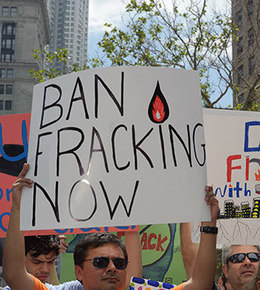
In the face of such challenges, an increasing number of towns and cities have decided to ban fracking. Indeed, municipal bans have become the hottest flash point in the jurisdictional battle over the authority to write the rules for fracking. Much will depend on whether they can survive legal tests of pre-emption and regulatory takings.
Proponents of local bans often justify them on the basis of rights, especially the right of local self-determination. This framing makes intuitive sense - if a well is planned near your home or your child's school, you have a right to be involved in that decision.
But the idea of local self-determination is riddled with quandaries. Modern cities are not that "local" to begin with; they are made possible by materials harvested from around the world. This position of utter dependence makes any appeal to "self-determination" problematic. Can cities in the age of globalization exercise sovereignty over energy systems?
Click headline to read more--
It's the biggest find in 50 years and the media is completely ignoring it...
It is 6 times larger than the Bakken, 17 times the size of the Marcellus formation, and 80 times larger than the Eagle Ford shale.
All told the recent discovery outside a sleepy Australian town contains more black gold than in all of Iran, Iraq, Canada, or Venezuela.
The current estimates of 233 billion barrels are just 30 billion barrels shy of the estimated reserves in all of Saudi Arabia.
Now, one renowned international energy expert predicts the proven reserves will be much bigger.
"The find may land at 300 or 400 billion barrels, making it one of the greatest unconventional oil discoveries any of us will see in our lifetimes," says Dr. Kent Moors and advisor to six of the top 10 oil producers and active consultant to 20 world governments.
"It represents a bona-fide redrawing of the global energy map as we know it," Moors says, "and the mainstream media is completely ignoring it."
Click headline to read more--
The 11th World Telecommunication/ICT Indicators Symposium (WTIS) will be held in Mexico from December 4-6, 2013. It will be co-hosted by ITU and the Federal Telecommunications Institute (IFT), Mexico's telecommunications and broadcasting regulator.
The WTIS, open to all the membership, is primarily targeted at those responsible for ICT statistics in relevant Ministries, regulatory agencies, telecommunication operating companies and national statistical offices. Experts interested in the subject of information society measurements are also welcome to attend the meeting.
"The WTIS 2013 will feature an international high-level panel debate on the topics of monitoring international development goals, including the Millennium Development Goals (MDGs), and information and communication technologies (ICTs) for development goals, as well as national coordination," ITU said in a statement.
"The other sessions of the WTIS 2013 will address topics such as data quality assurance, measuring ICT and gender, and digital broadcasting. It will also discuss the topic of big data and evolving areas in the mobile sector, such the measurement of machine-to-machine connections and LTE-advanced services. Countries are invited to present their data collection and dissemination platforms during the event," it said.
Click headline to read more--
30 countries have faster Internet than America, at least according to the most recent update from Speedtest.net.
Speedtest.net compares and ranks consumer download speeds around the globe, calculating the rolling mean in Mbps. It updated its list this week, and found the U.S. falls far short of countries that are hardly known for being technological powerhouses, including Moldova and Uruguay.
Mbps, which stands for megabit per second, is a unit of data transfer.
Hong Kong topped the list, followed by Singapore, Romania, South Korea, and Sweden.
Speedtest is powered By Ookla, a company that makes applications for broadband testing and Web-based network diagnostics. It claims that its solutions have been adopted by nearly every Internet Service Provider in the world, and that its measurements of speed and quality go “way beyond” what most speed tests do.
Various reports about Internet speed differ greatly, however. Akamai’s State of the Internet report from July put the U.S. at number nine, below South Korea, Japan, Hong Kong, Switzerland, the Netherlands, Latvia, the Czech Republic, and Sweden.
You’d think that in the country that invented the Internet, with one of the world’s most vibrant tech industries, we’d have the fastest Internet.
But America is a big country in terms of area of population, so building efficient broadband networks can be a challenge. A report from CNN earlier this year said a lack of competition among service providers is also a challenge.
However there is a big push in the U.S. right now to expand broadband access, in an effort to bolster wireless innovation, small businesses, and education.
Click headline to read more--
Harvesting power from the wind and the sun is nothing new. We've seen flying wind turbines and solar power plants that aim to provide clean renewable energy. UK-based New Wave Energy has a bolder idea in the works. The company plans to build the first high altitude aerial power plant, using networks of unmanned drones that can harvest energy from multiple sources and transmit it wirelessly to receiving stations on the ground.
The patent-pending technology aims to have drone networks hover in the sky harvesting both solar and wind power, while moving about at low speeds to keep track of the sun. The drones will operate at high altitudes where the winds are more stable and there's minimal chance of weather patterns or aircraft interfering with them.
"At 50,000 ft (15,000 m) there is very little air traffic and biodiversity, unless you go over the Himalayas," company director Michael Burdett tells Gizmag. "Implementing a system in these conditions will not obstruct any existing systems."
Each 20 x 20 m (65 x 65 ft) drone will have four rotors, multiple wind turbines and a flat base for generating solar power. It'll be able to power itself with the harvested energy and generate an additional 50 kW that can be transmitted wirelessly to the ground. Rectenna arrays installed inland or on offshore installations would receive the electromagnetic waves and convert them into usable power.
Click headline to read more--
|