

Boston and Cambridge’s decades-old district energy system is being retooled to shift away from gas and toward heat pumps and electric boilers.
Get Started for FREE
Sign up with Facebook Sign up with X
I don't have a Facebook or a X account


 Scoop.it!
Boston and Cambridge’s decades-old district energy system is being retooled to shift away from gas and toward heat pumps and electric boilers.

 Your new post is loading...
 Your new post is loading...
Your new post is loading...
Scoop.it!
From
ilsr

Across the nation, families and individuals are struggling to keep up with skyrocketing electric bills. Electricity prices have soared in recent years, dramatically outpacing both inflation and wage growth. Low‑income households, especially Black and Native American families, bear a disproportionate share of high energy costs. More and more households are falling behind on their utility bills, or having life-sustaining power cut off due to nonpayment.
Excessive utility profit rates are a key driver of these problems. In exchange for a legal monopoly over the public good of electricity, for-profit utilities agree to have their prices set by state regulators. Regulators also set the rates of profit – also known as return on equity – utilities can pay their investors. These approved profit rates are too high, and are costing U.S. customers an extra $300 per household, or $50 billion per year.
Scoop.it!

Israel’s bombing of Iran’s oil infrastructure will have major long-term environmental repercussions, experts have warned, as monitors admitted they were struggling to keep track of the environmental disasters arising from the widening war. Even as Iranians filled the streets to mark the appointment of a new supreme leader, the Shahran oil depot north-east of Tehran and the Shahr-e fuel depot to its south continued to burn on Monday, two days after they were bombed by Israeli warplanes. In the immediate aftermath of the attacks, Iran’s environmental agency and the Iranian Red Crescent Society had warned Tehran residents to stay at home, warning the toxic chemicals spread by airstrikes on five fossil fuel installations around the city could lead to acid rain and damage the skin and lungs.
Scoop.it!
From
www
Cities usually fade into darkness within minutes after sunset. Streetlights switch on across neighborhoods while construction crews shut down equipment for the night. Solar farms stop producing electricity as the final sunlight slips below the horizon. For most of human history, that transition from daylight to darkness has followed the same predictable rhythm everywhere on Earth. Yet the sky above Earth has been changing. Thousands of satellites now travel through low Earth orbit, and long-exposure images of the Milky Way frequently show bright streaks crossing telescope photographs. Astronomers have begun tracking how these spacecraft affect observations of faint stars and distant galaxies. The growing number of satellites has already reshaped parts of the night sky. A California startup now wants satellites to play a more active role after sunset. The company,Reflect Orbital, is developing spacecraft equipped with large mirrors designed to redirect sunlight toward the ground. The concept would allow specific locations to receive extra illumination even after darkness begins.
Scoop.it!

From
www
Researchers say they spotted three endangered blue whales off the coast of Southern New England in a 24-hour period last month.
Observers with New England Aquarium said it's the first time they have documented blue whales in their southern New England survey area.
Seeing blue whales outside of their Canadian feeding grounds is rare in the Atlantic, documenting them in two different areas of the ocean just hours apart is a first for Research Scientist Orla O’Brien.
Scoop.it!

In spring 2025, torrential rains fell on central Romania’s Harghita County in Transylvania, causing the waters of the Corund River to flood its banks. Speaking to reporters at a press conference in early May, county prefect Petres Sandor estimated that the river, which winds through towns nestled in the foothills of the Carpathian Mountains, had swelled to more than a hundred times its normal flow.
The river had also begun to seep into the Praid salt mine, home to one of the largest salt reserves in Europe and the economic lifeblood of surrounding communities.
In the weeks that followed, access to the Praid mine was suspended, staff and nearby households were evacuated, and the underground dams built in haste to stave off flooding collapsed. Officials made efforts to redirect the river and save the mine, but the damage had been done: By July, the flooded mine was forced to close indefinitely.
Romans were the first to mine for salt at Praid beginning around the 2nd century CE. When the area was under Hapsburg rule in the mid-1700s, larger-scale extraction began, and it continued until the mine’s recent closure, producing up to 100,000 metric tons of salt per year at its peak.
But in the modern era, Praid was not only an operational salt mine. It was also one of the region’s most popular tourist destinations, attracting half a million visitors a year to repurposed caverns that housed—nearly 122 meters (400 feet) belowground—a medical center; an Orthodox church; a movie theater; a museum; and an adventure park featuring arcades, zip lines, and a planetarium.
Scoop.it!

Researchers at Oak Ridge National Laboratory (ORNL) have successfully developed advanced modeling tools that could transform the nation’s thousands of abandoned coal mines into massive underground reservoirs for energy storage.
By creating high-fidelity hydrodynamic and chemical models, the team has cleared a major technical hurdle in determining how these defunct sites can be repurposed for Pumped Storage Hydropower (PSH). This development offers a dual solution for the US energy landscape. It provides the long-duration storage needed for a carbon-neutral grid while revitalizing former mining communities.
Scoop.it!

From
www
When the modern electric vehicle was still in its infancy, drivers worried that vehicles would need expensive battery replacements within a few years. But battery lifespans are exceeding expectations.
Scoop.it!
From
bsky
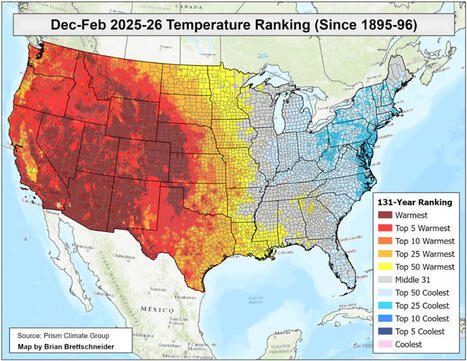
December 2025 through February 2026 was the 2nd warmest winter on record for the Contiguous U.S. according to Prism climate data. The widespread record to near record warmth in the west easily outweighed the cool temps in the east. 🔥🔥🔥
Scoop.it!
Proposed lower Alabama solar project stuck in the mud | by Catherine Dorrough | NewsFromTheSates.com
When the powers-that-be at Silicon Ranch first laid eyes on a gorgeous and available 4,500-acre parcel of timberland in northern Baldwin County, they probably believed they’d found an ideal site to build a utility-scale solar farm.
The unzoned property is plenty big enough to accommodate the 2,000 acres of solar panels they want to install; it’s adjacent to an existing high-voltage transmission line and has good highway access; and it looks like it’s in the middle of nowhere. Check, check, and check.
But it’s not quite that simple. The proposed solar farm, whose explicit purpose is to offset the power needs of Meta’s new data center in Montgomery more than 100 miles away, has gotten locals’ hackles up.
Scoop.it!
Key Senate defense leaders on Friday are privately pressing Anthropic and the Pentagon to resolve their dispute, a source familiar with the matter told Axios.
Why it matters: Pressure has been building on Congress to step in as the Pentagon and Anthropic engage in a prolonged public battle over the limits of the use of Anthropic's Claude AI in classified settings. Driving the news: Senate Armed Services Committee Chair Roger Wicker (R-Miss.) and Ranking Member Jack Reed (D-R.I.), along with Defense Appropriations Chair Mitch McConnell (R-Ky.) and Ranking Member Chris Coons (D-Del.) sent Anthropic and the Pentagon a private letter on Friday urging them to resolve the issue, the source said.
Scoop.it!

. Afunny thing happened on the way to President Donald Trump’s mission to obliterate renewable energy. Solar and wind energy use is surging, especially globally, but even in the United States.
Solar and wind electricity generation grew so much last year that they met 109% of new electricity demand worldwide, pushing these renewable sources past coal for the first time as a global energy supplier, according to an analysis by Ember Energy Research.* More than 600 gigawatts of solar electricity were added last year, led by China and also including India, Brazil, Vietnam, the European Union, Kenya, and Mozambique. African experts say much of the continent is leaning heavily into solar and wind as it electrifies new regions and industries, bypassing fossil fuels.
Meanwhile, investment in new clean energy, including storage, grid upgrades, efficiency measures, and electric vehicles, soared as of 2024 year-end to $2.2 trillion – double the investment in new fossil fuels projects of $1.1 trillion – according to the International Energy Agency. Globally, the future for renewable energy looks bright.
Scoop.it!

From
laist
On a sunny, early summer morning, Matthew Milner waited in his driveway in the Berkeley hills. It was his solar install day, and he was excited. He greeted the installers and walked them around to the back of his house. But instead of pointing to his roof, he pointed to his wooden backyard fence. That is where these solar panels would go, tilted, with their bottom edge on the ground, and top leaning against the fence’s wooden planks.
The installation wrapped up in two hours, demanded minimal paperwork, and damaged Milner’s wallet only marginally, as far as solar installations go. By noon, he plugged in an electrical cord that snaked from the panels into an outlet on the outside of his house. Immediately, solar power coursed toward his electrical panel and then flowed back through his home.
With that, he was offsetting his home’s energy use.
Milner is one of the solar-curious, who are testing the waters by purchasing a small, portable, plug-in display.
Scoop.it!

The farmer bends down, fingers stained the color of red clay, and holds up what looks like a perfectly ordinary green sprig. Morning mist still hangs over the terraced hills of southern Jiangxi, the kind that softens the edges of everything. The plant doesn’t look like treasure. Small leaves. Thin stem. Anonymous. The kind of thing you’d crush under your boot without a second thought. Yet the scientist next to him treats it like a rare jewel. He slips it into a labeled bag, eyes shining. The surrounding soil is loaded with rare earth elements, the invisible metals that power our smartphones, electric cars, and missiles. And this unremarkable weed, quietly, is drinking them up and concentrating them inside its own tissues.
A plant, acting like a living mine.
|
Scoop.it!

Thousands of authors including Kazuo Ishiguro, Philippa Gregory and Richard Osman have published an “empty” book to protest against AI firms using their work without permission.
About 10,000 writers have contributed to Don’t Steal This Book, in which the only content is a list of their names. Copies of the work are being distributed to attenders at the London book fair on Tuesday, a week before the UK government is due to issue an assessment on the economic cost of proposed changes in copyright law.
By 18 March ministers must deliver an economic impact assessment as well as a progress update on a consultation about the legal overhaul, against a backdrop of anger among creative professionals about how their work is being used by AI firms.
Scoop.it!

From
www
Scientists are deeply concerned about SpaceX's recent proposal to launch one million satellites into orbit around Earth. Their concerns range from a loss of the natural night sky and our access to space, to the environmental impact on our atmosphere.
Scoop.it!

Hektoria Glacier (Antarctica) retreated 8 kilometers (5 miles) in only two months; one-half of the structure collapsing in record time. This is the fastest glacier collapse ever, and the message to the world is very clear: Global Warming looks like it’s ahead of schedule. (Antarctica Just Saw the Fastest Glacier Collapse Ever Recorded, ScienceDaily d/d February 26, 2026)
The world climate system is starting to unravel faster than expected. Sea level rise estimates by major institutions such as the IPCC should probably be tossed out the window. Global warming is not waiting around for guesstimates. Hektoria Glacier is real time evidence that the consequences of global warming are ahead of expectations.
Scoop.it!

The pledge is nonbinding and unlikely to bring immediate relief on electricity bills. Making it real will fall to utilities and regulators.
In an effort to quell blowback on data centers, President Donald Trump announced at a White House roundtable on Wednesday the “Ratepayer Protection Pledge,” a set of nonbinding promises that Big Tech companies signed to keep household utility bills from skyrocketing.
“They need some P.R. help,” Trump said of the data centers, “because people think that if a data center goes in, their electricity prices are going to go up, and that’s not happening. It’s not going to happen.”
The pledge was signed by top officials from Google, Meta, Microsoft, OpenAI, Amazon Web Services, Oracle and Elon Musk’s xAI. While Trump has previously described it as “mandatory,” the pledge is voluntary, unlike a statute or enforceable federal regulation.
Scoop.it!
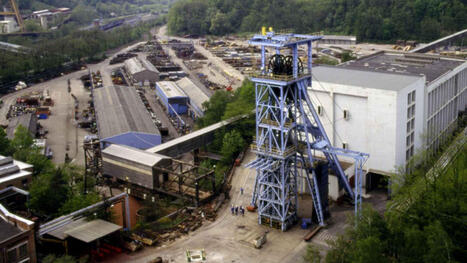
Almost a kilometer under old coal mines in Lorraine, France, scientists have found a pocket of natural hydrogen, called white hydrogen. Early tests suggest it burns clean and could be cheaper than factory-made green hydrogen.
Some reports call it “the last fuel of humanity”, a resource that might power our world for thousands of years. Behind that phrase, researchers and energy companies are racing to measure how much hydrogen is there and how hard it will be to extract.
Scoop.it!

From
www
The Finnish company Jolla is back with the Linux-powered Jolla Phone. It’s being positioned as an antidote to the US-dominated smartphone status quo of Android and iOS.
Scoop.it!

From
www
As AI labs gorge themselves on compute, data center operators have headed north in search of cheap and plentiful energy.
On the bank of the river that runs through the Swedish town of Borlänge, construction is underway on a sprawling new data center. The site previously housed a paper mill. When the developer, EcoDataCenter, broke ground in September, its CEO Peter Michelson declared, “The facility once produced paper, the raw material of the newspaper information age. Now, Borlänge will produce the raw material for AI and the next information age.”
The Borlänge facility is one of more than 50 currently under construction or soon to be developed across the Nordics—the region made up of Norway, Sweden, Finland, Denmark, and Iceland—as demand escalates for data centers suitable for training and running AI models. Nowhere else in Europe is data center capacity growing faster, according to research by consulting firm CBRE.
Scoop.it!

From
www
MADISON, Wis. — Earlier this month, Madison, Wis., was host to the city's 14th annual Frozen Assets Festival. "When our lakes are frozen, they are truly our greatest asset," says James Tye, executive director and founder of Clean Lakes Alliance, the nonprofit that hosts the festival.
This time of year, frozen lakes are a part of life here. The city was built on an isthmus — a thin strip of land between two bodies of water. Lake Mendota and Lake Monona border the city's historic downtown on either side, with the strip of land running about a mile wide at its thinnest. The lakes are visible from many places in town. In wintertime, ice fishing, skating, ice sailing and snowshoeing are all common sights.
Scoop.it!

28 February 2026 – CAPE COD, MA –After nearly a week of snow, cold, and power loss Cape Cod recovery is underway. This storm may be remembered as The Blizzard of February 23 and we find out how a behind-the-scenes structure helped us weather the storm.
A blizzard of historic proportions blizzard rolled onto Cape Cod Sunday night, pummeled Barnstable County with hurricane force winds throughout the day on Monday, dumped 17 to 20 inches of wet heavy snow, and knocked out power for more than 155,00. People will no doubt be referring to this as The February 23rd blizzard for the next 20 years. What role did the MACC play?Over at the Barnstable Multi Agency Coordination Center (MACC), a little known but well rehearsed process kicked into play. The regional emergency planning committee turns 15 sometimes turfy towns into a unified response during emergencies. Resource sharing, regional shelters, and perhaps, most importantly, coordinated communication helps Cape Cod punch above its weight during moments like the Blizzard of February 23rd.
Scoop.it!

As primary silver grades decline and solar demand surges, the industry must transition from viewing retired panels as waste to treating them as high-grade mineral reserves essential for the energy transition.
Silver has become one of the most important materials in the clean energy transition. It’s essential for solar photovoltaics, and solar is no longer a minor consumer of silver. It’s becoming one of the largest drivers of demand — at the same time that ore grades are declining and supply is getting harder to expand quickly.
In other words, even as solar gets cheaper and more efficient, its material foundation is tightening.
This is not just an academic concern.
Scoop.it!

Former FirstEnergy execs Chuck Jones and Mike Dowling face state criminal charges connected to HB 6 bailout maneuvers, for which Ohioans are still paying the price.
Ohio jurors will soon decide whether two former FirstEnergy executives are guilty of state criminal charges related to the House Bill 6 utility bribery scheme.
It’s a landmark moment for what is the largest corruption scandal in state history, in which utility execs allegedly bribed state officials to pass and protect a law to bail out uneconomic coal and nuclear plants and to gut the state’s clean energy standards. Its effects still reverberate today, nearly seven years after HB 6 became law, in the form of higher energy bills, dirtier air, and less solar and wind power across Ohio.
Scoop.it!

|





