Ideas from around the world to improve your classes....brought to you courtesy of the Rondebosch Boys' High School Library (If you would like to receive a weekly newsletter of the latest items in this Scoop just mail me at library@rondebosch.com)
Woe unto the administrator who ventures forth into the homework wars.
Scale it back, and parents will be at your door complaining about a lack of academic rigor. Dial it up, and you’ll get an earful from other parents about interference with after-school activities and family time.
After studying transcripts and data for more than 18,000 sophomore students nationwide, he found no significant relationship between time spent on homework and grades, but did find a positive relationship between homework and performance on standardized tests. “Homework should act as a place where students practice the skills they’ve learned in class,” Tai says. “It shouldn’t be a situation where students spend many hours every night poring over something [new].”
If kids can access information from sources other than school, and if school is no longer the only place where information lives, what, then happens to the role of this institution?
“Our whole reason for showing up for school has changed, but infrastructure has stayed behind,” said Diana Laufenberg, who taught history at the progressive public school Science Leadership Academy for many years. Laufenberg provides some insight into how she guided students to find their own learning paths at school.-Be flexible; Foster inquiry; Design architecture for participation; Teachers teach kids, not subjects; Provide opportunities for experiential learning; Embrace failure; Foster joy...
A really useful guide to why Finnish Education works so well. Topics include Equity in education; How trust and responsibility engender learning; Early childhood and basic education as part of life-long learning; General and vocational pathways at upper secondary level; highly educated teaching personnel and much more...
Throughout humankind's history, we've driven species after species extinct: the passenger pigeon, the Eastern mountain lion, the dodo .... But now, says Stewart Brand, we have the technology (and the biology) to bring back species that humanity wiped out. So -- should we? Which ones? He asks a big question whose answer is closer than you may think.
Access to successful learning for all students is a powerful equalizer that drives superior educational outcomes. The importance of equal access is credited with much of the academic progress in Finland, a country without private schools or standardized tests. "Since the 1980s, the main driver of Finnish education policy has been the idea that every child should have the same opportunity to learn, regardless of family background, income or geographic location. Education has been seen first and foremost not as a way to produce star performers, but as an instrument to even out social inequality."1
The technological advances of online game-based instruction and the breakthroughs in neuroscience learning research bring us an unprecedented opportunity for achieving this equity and quality education nationally and internationally.
I am certain you feel the pressure of the testing season soon to be upon us. We want our students to do their very best and we see and feel the urgency (hopefully not panic) that we want them to feel. True learning, which is more than answers on a standardized test, is a naturally urgent process if students are engaged and have a real reason to learn.
Spring vacation is just around the corner, and the dreaded state tests are inching ever closer. It is a time of year when you may be running out of ideas, patience and energy, and so is everyone around you (or so it seems). You have gone through three different behavior plans, but Madison is still acting out, and Sam continues to come late despite an untold number of phone calls home, detentions, planning sessions and positive reinforcement programs. The faculty room is rife with a combination of boring tasteless food, stale conversation and annoying complaints about you-name-it. You try to remind yourself that "no news is good news" because, although you are working your butt off, rarely if ever does anyone seem to notice.
We've all heard of the fight or flight response. We go into survival mode when threatened by something or someone. We either put up our dukes (literally or metaphorically) or take off running (literally or metaphorically). Students often go into survival mode when they feel threatened by an overwhelming cognitive task or confusing text, or when they are called on and don't know the answer, or are confronted or teased by another student (or a teacher!) Can one even learn in such a setting?
Inquiry—the process of satisfying our curiosity—and nonfiction are closely related. Readers turn to nonfiction for those how-to lessons as well as informational needs. In titles such as Bradley Hague’s Alien Deep: Revealing the Mysterious World at the Bottom of the Ocean (National Geographic, 2012), Sandra Markle’s The Case of the Vanishing Golden Frogs: A Scientific Mystery (Millbrook, 2012), or Loree Griffin Burns’s The Hive Detectives: Chronicle of a Honey Bee Catastrophe (Houghton, 2010), students witness scientists observing, inferring, and formulating new questions as they refine their understanding of the natural world. In effect, these titles provide readers with a window onto inquiry as it is unfolding. What kind of life exists deep within the ocean, why the Panamanian golden frogs are dying, and the cause of honey bee colony collapse disorder are real, perplexing questions requiring creative scientific problem solving.
When Tracy Edwards posted on Facebook last October that she was searching for a part-time writing instructor for a middle school program, Kip Glazer jumped im
Glazer also admits there are some necessary conditions to implement a successful virtual mentor-student relationship: Distance, School culture, Time, Technology access
If kids can access information from sources other than school, and if school is no longer the only place where information lives, what, then happens to the role of this institution?
“Our whole reason for showing up for school has changed, but infrastructure has stayed behind,” said Diana Laufenberg, who taught history at the progressive public school Science Leadership Academy for many years. Laufenberg provided some insight into how she guided students to find their own learning paths at school, and enumerated some of these ideas at SXSWEdu last week.
Getting enough sleep is as crucial as eating well and exercising. But with family life spinning faster and faster, solid shut-eye is sometimes hard to come by. That can hurt kids' health — and increase their weight.
When NPR, the Robert Wood Johnson Foundation and the Harvard School of Public Health asked parents and caregivers in our new whether getting a good night's sleep is important, families overwhelmingly told us that sleep is a high priority.
But almost all said that it's difficult to pull off. And studies suggest this is especially true for teenagers.
As we've reported in our series, families are feeling stretched by the competing demands on their time.
Celeste Higgins of Miami, Fla., knows the struggle. Her two kids, ages 12 and 16, have demanding academic schedules and play competitive sports. Higgins also has a full-time job, so she often finds herself sacrificing her own sleep to make sure her kids are on track and where they need to be, such as at a 7 a.m. regatta.
"There just aren't enough hours in the day," she says. Her son Rory, who has rowing team practice six days a week, is often up until about midnight doing homework. And his day starts at the crack of dawn, leaving about 6 or 6 1/2 hours for sleep each night.
Districts across the country are adopting value-aded measures (VAM) to their teacher evaluations due to state and federal pressure to "hold teachers accountable." At first glance, it makes sense. The best way to measure a teacher's effectiveness is to look at what students are learning. However, like New Coke and Crystal Clear Pepsi, VAM is a really bad idea that sounds great to the people at the top. Here are ten reasons why:
Loss of Leadership: When VAM scores become the dominant metric, administrators lose out on the opportunity to evaluate teachers and offer guidance on curricular decisions. After all, their input often makes up only a small percentage of new evaluations. The Immeasurable: So much of what teachers do are things that are observable, but not measurable. This includes guiding paradigm shifts, helping with conceptual development, fostering creativity and pushing critical thinking. VAM scores fail to grasp the immeasurable aspects of teaching. Bad Competition: VAM pits teachers against one another, because the demonstration of growth is ultimately what leads to teacher renewal. For all the talk of collaboration and shared leadership, what incentive do teachers have to work together if the bottom line is a VAM score.
The most common sentiment among readers of books on differentiated instruction (DI) is that DI is just good teaching.It’s whatever conscientious teachers do to increase students’learning over that which otherwise could be achievedby a one-size-fits-all approach. Simultaneously, DI buildslearner dexterity and self-advocacy so students can handleanything that is not differentiated for them.
Over the course of educational timelines, the textbook has reigned as the authority in content delivery. The textbook's reign has gone unmatched for many years, but its pedestal is beginning to wobble. This is not to say that credible information is no longer in bound books, rather that credible information options have taken on many new forms.
Over the past two years, I've been working with my district to transition from the popular textbook towards Open Educational Resources, or OER. One of the leading benefits of OER options is that they are free and open to educators. That in itself is a reason to inquire. The information has been vetted for credibility and some of it is derived from some of the world's top colleges and universities.
Financial Literacy Month is April -- just around the corner -- and it's never too early to prepare. Personally, I believe this is a great opportunity to use games in an intentional way to teach students financial literacy skills. Games can be used as a "hook" or anchor activity, as well an instructional activity that is revisited throughout a unit of instruction. A game can help scaffold the learning of important content as well as providing context for application of content. If you really trust the design of the game, it can also be an excellent assessment tool!
Standardized tests can be a wonderful teaching tool to enrich and deepen classroom learning.
What?! The prevailing wisdom states that standardized testing drains the life out of a classroom and saps students of interest and engagement, brings on unnecessary and at times crippling stress, and limits the view of what students are really learning in school.
Teaching to the test is a problem, for sure. But using the format of a standardized test as a teaching tool can be a boon to student learning. The question is how to do this successfully and in a way that captivates student interest.
Here at Edutopia, we talk a lot about project-based learning, or PBL. Whether you call it deeper learning, inquiry-, problem-, or challenge-based learning, all are variations on the same idea -- that young people can learn more deeply, and retain the information better, when they can work collaboratively in teams to explore and solve real-world problems. Many would say that PBL can be a more effective way to teach - but anyone who has tried it agrees that doing it well is not easy.
It's fairly simple to find video examples of what PBL looks like in the classroom at all levels -- just check Edutopia's video library! -- but where can you find specific tips on how to plan and carry out great PBL? What are the building blocks of rigorous and relevant projects? How can you address some of the challenges you'll meet? While it's unlikely that you will become a PBL pro just by watching videos, this playlist will provide some gateways to get you thinking about the nuts and bolts -- and lead you to some organizations with many more tools and resources for tackling PBL.
If this sounds interesting why not check out this introductory clip on Project Based Learning explained?
Well before the cleanup from Superstorm Sandy was in full swing, students could read about the weather system that slammed the East Coast in their textbooks.
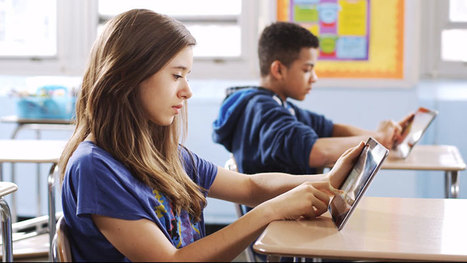
Welcome to the new digital bookcase, where traditional ink-and-paper textbooks have given way to iPads and book bags are getting lighter. Publishers update students' books almost instantly with the latest events or research. Schools are increasingly looking to the hand-held tablets as a way to sustain students' interest, reward their achievements and, in some cases, actually keep per-student costs down.
"We must use technology to empower teachers and improve the way students learn," said Joel Klein, a former New York City schools' chief who now leads News Corp.'s education tablet program. "At its best, education technology will change the face of education by helping teachers manage the classroom and personalize instruction."
Two professors say we've got to stop sending messages to young children — especially girls — that math is something to fear. Humans are actually hardwired to think mathematically, they say.
So what do we do about math anxiety? First and foremost we have got to stop sending messages to our young children — especially our girls — that math is something to fear. Humans are actually hardwired to think mathematically; we are born with basic building blocks to do math. We need stronger teacher preparation programs that focus on building mathematically competent and confident teachers. We need to provide better supports to our teachers and school leaders to prevent and reduce math anxiety from taking root. We also need to better integrate math into every day routines.
"I didn’t get invited to Craig's party . . . I'm such a loser."
"I missed the bus . . . nothing ever goes my way."
"My math teacher wants to see me . . . I must be in trouble."
These are the thoughts of a high school student named Jeremy. You wouldn't know it from his thoughts, but Jeremy is actually pretty popular and gets decent grades. Unfortunately, in the face of adversity, Jeremy makes a common error; he falls into "thought holes." Thought holes, or cognitive distortions, are skewed perceptions of reality. They are negative interpretations of a situation based on poor assumptions. For Jeremy, thought holes cause intense emotional distress
To get content containing either thought or leadership enter:
To get content containing both thought and leadership enter:
To get content containing the expression thought leadership enter:
You can enter several keywords and you can refine them whenever you want. Our suggestion engine uses more signals but entering a few keywords here will rapidly give you great content to curate.


 Your new post is loading...