

Published on May 6, 2014
Pluto Media's Koala Band helps kids learn musical concepts, connecting with each other IRL to meet up in tablet-based games they can play together and create their own content for.


 Your new post is loading...
 Your new post is loading...
Your new post is loading...
 Scoop.it!
Published on May 6, 2014 Pluto Media's Koala Band helps kids learn musical concepts, connecting with each other IRL to meet up in tablet-based games they can play together and create their own content for. 
No comment yet.
Sign up to comment
Scoop.it!

Students who have teachers who make them “feel excited about the future” and who attend schools that they see as committed to building their individual strengths are 30 times more likely than other students to show other signs of engagement in the classroom
Scoop.it!

A familiar routine: A teacher asks the class a question, several students raise their hands, the teacher selects one of those, the student responds, the teacher evaluates the student's response, and the cycle begins again. Teachers use this routine to assess where students are. Yet just about every aspect of this scenario actually gets in the way of learning—and it doesn't provide enough information on what most students in the class know and need to learn.
Scoop.it!
From
www

Sir Ken Robinson outlines 3 principles crucial for the human mind to flourish -- and how current education culture works against them. In a funny, stirring talk he tells us how to get out of the educational "death valley" we now face, and how to nurture our youngest generations with a climate of possibility. Creativity expert Sir Ken Robinson challenges the way we're educating our children. He champions a radical rethink of our school systems, to cultivate creativity and acknowledge multiple types of intelligence
Scoop.it!

Sixth grade students at Quest to Learn, a New York City public school, recently got a two-week break from regular class work to build a giant Rube Goldberg machine. The project, for example, required students to use physics and geometry skills to build a complex scheme of pulleys and tubes to accomplish the simple act of popping a balloon.
Scoop.it!
I see formative assessment as an ongoing exchange between a teacher and his or her students designed to help students grow as vigorously as possible and to help teachers contribute to that growth as fully as possible. When I hear formative assessment reduced to a mechanism for raising end-of-year-test scores, it makes me fear that we might reduce teaching and learning to that same level.
Scoop.it!

Many parents are beginning to grasp the idea that maybe what grandpa is always railing about off in the corner – “using your noodle,” and “good old American ingenuity,” and “we never threw anything away,” and “back in my day we started working in the farm/factory right when we was out of diapers” – is not so far off the mark. Austin Tinkering School (ATS) is addressing just that idea. As one possible antidote to “helicopter parenting” (over/hyper protective, super competitive, and controlling of every aspect of the child’s life, taking away their innate problem-solving and coping abilities), the school gives kids the place and space to mess around with power tools, saws, hammers, paint, and design problem solving starting as young as 3 years old. The school says, “Adults serve as collaborators rather than teachers for maximum engagement, interest, enthusiasm, and enjoyment.”
Scoop.it!
From
alturl
Consider how well professional development in your school system meets your criteria for how teachers and principals learn best. When you look at the tasks adult learners do in professional development sessions, what would you predict adults would know and be able to do if they did those tasks successfully? Too often, the answers to this question are similar at multiple levels of the system: We'd expect students/teachers/principals to be able to listen to directions, to give short answers in response to a question the teacher/facilitator asks, and to recall basic information or apply a procedure in a situation that looks like the one they just practiced.
Reeler Centre's insight:
Here's a great piece on creating and sustaining professional leadership in a school from a recent edition of Educational Leadership
Scoop.it!

From
fno
What are the best ways to combat the trend toward plagiarism? How can we best teach our students to value and practice original thinking? How can we structure research so that students must make answers rather than just finding them?
Reeler Centre's insight:
While some educators put their energy into catching wrongdoers after they submit a paper or report, this article suggests eliminating plagiarism by making sure students understand what it is before they start their research. The teacher must stress the importance of original thinking and make it clear that the thought process leading up to the writing of the report will be carefully reviewed as it takes place so students cannot conceal theft of ideas. Most importantly, the research task must require the building of a case, the solving of a problem, the making of a choice or some other thought product that cannot be found online or bought from a Web site like http://cheapessaysonline.com/
Scoop.it!
From
www
It took a life-threatening condition to jolt chemistry teacher Ramsey Musallam out of ten years of “pseudo-teaching” to understand the true role of the educator: to cultivate curiosity. In a fun and personal talk, Musallam gives 3 rules to spark imagination and learning, and get students excited about how the world works. As a high school chemistry teacher, Ramsey Musallam expands curiosity in the classroom through multimedia and new technology.
Scoop.it!
From
www
Who would dispute the idea that feedback is a good thing? Both common sense and research make it clear: Formative assessment, consisting of lots of feedback and opportunities to use that feedback, enhances performance and achievement. Yet even John Hattie (2008), whose decades of research revealed that feedback was among the most powerful influences on achievement, acknowledges that he has "struggled to understand the concept" (p. 173). And many writings on the subject don't even attempt to define the term. To improve formative assessment practices among both teachers and assessment designers, we need to look more closely at just what feedback is—and isn't.
Scoop.it!

From
www
When educators hear the terms flipped classroom and flipped learning, typically the first thing they think of is a teacher-created video that students watch at home, as though that were the essential ingredient. It's not. Flipped learning is not about how to use videos in your lessons. It's about how to best use your in-class time with students. That insight is causing educators in classrooms from kindergarten to college to reevaluate how they teach.
Scoop.it!
Leader and educator Sumantra Ghoshal contrasts his birthplace (Kolkata) and his hometown (Fontainebleau). "Typical of Ghoshal's colourful communication was what he called his “springtime theory”. He would tell his audiences about his annual visit to Calcutta to see his parents in July. “Imagine the heat,” he would say, “the humidity, the noise, the dirt. It sucks up all your energy, drains your brain, and exhausts your imagination.” And then he would take them to the forest of Fontainebleau, near INSEAD, where he was a professor at the time, and point to “the smell of the trees, the crispness in the air, the flowers, the grass underfoot. How one's heart lifts up, how the energy and creativity bubble away.” Go through the door of any business, he would say, and you can tell whether it is Calcutta or Fontainebleau. A manager's task is to create a working environment that is like Fontainebleau, not Calcutta." From The Economist http://www.economist.com/node/13760551
|
Scoop.it!

It may come as no surprise to teachers, but girls do better than boys in school, a new study finds. What may be a surprise is that this holds true at all ages, in all subjects including math and science and around the world, the American Psychological Association analysis found.
Scoop.it!
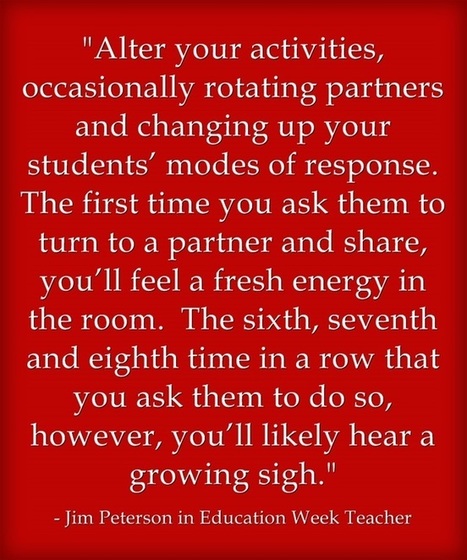
Jim Peterson and William & Pérsida Himmele provide practical suggestions on how to get our students participating more in class more of the time.
Scoop.it!
From
www
Leaving a high-flying job in consulting, Angela Lee Duckworth took a job teaching math to seventh graders in a New York public school. She quickly realized that IQ wasn’t the only thing separating the successful students from those who struggled. Here, she explains her theory of “grit” as a predictor of success. At the University of Pennsylvania, Angela Lee Duckworth studies intangible concepts such as self-control and grit to determine how they might predict both academic and professional success
Scoop.it!

From
www
Living rooms, dens, kitchens, even bedrooms: Investigators followed students into the spaces where homework gets done. For a quarter of an hour, the investigators from the lab of Larry Rosen, a psychology professor, marked down once a minute what the students were doing as they studied. A checklist on the form included: reading a book, writing on paper, typing on the computer—and also using email, looking at Facebook, engaging in instant messaging etc. Although the students had been told at the outset that they should “study something important, including homework, an upcoming examination or project, or reading a book for a course,” it wasn’t long before their attention drifted: Students’ “on-task behavior” started declining around the two-minute mark as they began responding to arriving texts or checking their Facebook feeds. By the time the 15 minutes were up, they had spent only about 65 percent of the observation period actually doing their schoolwork. “We were amazed at how frequently they multitasked, even though they knew someone was watching,” Rosen says. “It really seems that they could not go for 15 minutes without engaging their devices,” adding, “It was kind of scary, actually.”
Reeler Centre's insight:
“This is a concern we should have distinct from worrying about how much kids are online or how much kids are media multitasking overall. It’s multitasking while learning that has the biggest potential downside,”Rideout says. “I don’t care if a kid wants to tweet while she’s watching American Idol, or have music on while he plays a video game. But when students are doing serious work with their minds, they have to have focus.”
Scoop.it!

Features include “All Eyes Up Front,” which freezes devices during whole-class instruction to remove distractions; “Single Application Mode,” which locks a student or a group of students into a certain application for a specified amount of time
Scoop.it!
The dominant educational model in the United States is still "education as acquiring stuff." Even when modern technologies are used to support this model, the hordes of unemployed and underemployed students — OUR children — are proof that this model is broken and ineffective.
Scoop.it!

The strawberry yogurt smacked my arm, gushing down my dress. As the class of high schoolers erupted into laughter and tears burned my eyes, a thought erupted in my mind: "My teacher education program did not prepare me for this first year." Not only was I miserable, but students could not learn in the classroom I had created. Ten years—and two times almost quitting—later, I now love my teaching career and can do it well. Last month the National Council on Teacher Quality released a report evaluating teacher-prep programs, and the deficiencies found in so many of them reminded me of how ill-prepared I was. Rather than pile on, I want to share a few elements of what I think a quality teacher-preparation program should have for the sake of new teachers and the kids in their classes.
Scoop.it!
Here’s an extraordinary film of the great Swiss psychologist Carl Gustav Jung speaking at length about some of his key contributions to psychology. Jung on Film (above) is a 77-minute collection of highlights from four one-hour interviews Jung gave to psychologist Richard I. Evans of the University of Houston in August of 1957. In “Sitting Across From Carl Jung,” an article for the Association of Psychological Science, Evans explains how the interviews came about...
Scoop.it!
From
www
Scoop.it!
From
www
Why, why, why does our education system look so similar to the way it did 50 years ago? Millions of students were failing then, as they are now -- and it’s because we’re clinging to a business model that clearly doesn’t work. Education advocate Geoffrey Canada dares the system to look at the data, think about the customers and make systematic shifts in order to help greater numbers of kids excel. Geoffrey Canada has spent decades as head of the Harlem Children’s Zone, which supports kids from birth through college in order to break the cycle of poverty.
Scoop.it!
From
www
Scoop.it!
From
www
|




