


SimilarWeb data argue that search remains the dominant source of traffic to desktop sites.


 Your new post is loading...
 Scoop.it!
SimilarWeb data argue that search remains the dominant source of traffic to desktop sites.

No comment yet.
Sign up to comment
Scoop.it!

Billboards that watch you back aren't just the stuff of science fiction. Columnist Alan K'necht takes a look at the technologies that are transforming digital advertising.

Friilance's curator insight,
April 28, 2016 2:24 AM
The future of digital advertising: Ads that look back
Scoop.it!

IHOP, Bloomingdale's, National Geographic & Taco Bell share how they are taking advantage of the Gen Y and Millennial-centric platform.
Scoop.it!

Snapchat is making moves to change the way we communicate. Here's why you shouldn't wait to join the conversation.
Scoop.it!

Vermont senator gets top marks on issues including censorship, mass surveillance and net neutrality ... with Donald Trump ranked last
Scoop.it!

From
moz

Content marketing is big business, but are brands taking it far enough? Here Simon Penson argues that Brand as Publisher is the next step.
Scoop.it!

As an SEO professional, how can you improve your standing within an organization to achieve better results? The answer lies in evangelism.
Scoop.it!
Bad news for Chipotle last week, as a judge ruled it was at fault for firing an employee who tweeted a negative comment about working there.
Scoop.it!

Food deserts, or places where people have limited access to fresh food, are usually measured by the distance people have to travel to get to a large grocery store. What’s harder to measure is what the residents of these areas are actually eating day to day. To do so, researchers typically have to rely on surveys, which “obviously do not record every single meal, or the frequency of what people are eating,” says Munmun De Choudhury, an assistant professor of interactive computing at Georgia Institute of Technology. “Maybe [the surveys] happen every six months, or once a year … that’s a very aggregated sense of what people are eating.” RELATED STORIES Why Don't Convenience Stores Sell Better Food? Overcoming an Eating Disorder With Instagram Study: We'll Enjoy Food More If You Don't Instagram It In a recent study, De Choudhury and her colleagues propose another method: mining Instagram. All those artfully arranged plates, all that latte art, just waiting for someone to analyze it! So they did, looking at 3 million public food-related Instagrams that were tagged with food words (“chocolate,” “tofu,”) and geotagged by location. Using United States Census data, they divided areas into food deserts and non-food deserts, and compared each desert to a non-desert with similar demographics and socioeconomic status in the same region. That way, differences in what people were eating based on culture would hopefully be minimized. The researchers grouped the ‘grams into categories by type of food, using United States Department of Agriculture information to estimate the nutritional value of the foods. They also differentiated between cooking methods that would be likely to affect nutrition. Grilled chicken was a separate category from fried chicken, for example, but they didn’t get as specific as “chicken marsala.” In every region of the United States, the foods shown in Instagrams posted from food deserts had higher cholesterol, sugar, and fat than the posts from non-food deserts. Popular foods differed by region: In the southeast U.S., food-desert dwellers posted a lot of bacon, brisket, and grits, while non-food-desert dwellers posted more peaches, beans, and collard greens. In the Midwest, food deserts were full of hamburgers, hot dogs, and the generic descriptor “meat,” while kale, turkey, and spinach were more popular outside of food deserts. All of the photos below are public Instagrams used in the study: Instagrams From Food Deserts Courtesy Munmun De Choudhury Courtesy Munmun De Choudhury Courtesy Munmun De Choudhury Courtesy Munmun De Choudhury Instagrams From Non-Food Deserts Courtesy Munmun De Choudhury Courtesy Munmun De Choudhury Courtesy Munmun De Choudhury Courtesy Munmun De Choudhury Interestingly, food-desert foods did not have significantly more calories than non-food-desert foods, though it’s hard to tell from an Instagram how much of something someone actually ate. But the nutritional makeup of foods may make a bigger difference than calories anyway. “One of the more prominent health concerns in food deserts is cardiovascular risk,” De Choudhury says. “Heart attacks and so forth are correlated with consuming food that is richer in cholesterol and fat, not quite the sheer amount of calories.” The difference was marked enough that 80 percent of the time, the researchers were able to use a model to predict whether a given Instagram was from a food desert or not. There is the added snag here that the photos people choose to post on Instagram are things they assume their friends and followers want to see, meaning they may not be totally representative of their diets. But De Choudhury says that comparing food deserts and non-food deserts with similar demographics hopefully does a pretty good job of showing the difference that access to food can make on what people eat, and the foods they want to show off, even within the same culture. Related Video
Scoop.it!
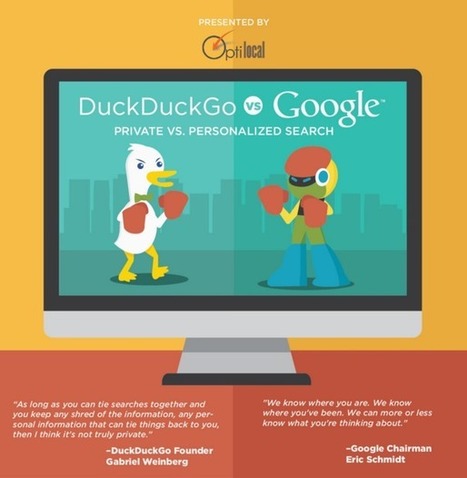
Another startup with a silly name? Sounds like something I’d like to get my teeth into. For the uninitiated among you (where have you been?), DuckDuckGo (DDG) is a private search engine that has seen exponential growth since its inception a few years ago. So why should you care? Because an increasing chunk of your target audience may well be heading to DDG in the coming years. Don’t believe me? Rand Fishkin of Moz fame said it will be "the fastest growing search engine of 2016." If you’re still not convinced, here are some enlightening stats about DDG that might make you pay attention. 1) It averages 10m queries a day According to its own traffic stats, DDG averages around 10m queries a day. This might not be up there with the likes of Google, but it means DDG is definitely a significant player in the search market. 2) 12m queries in a single day last December While average search queries are at 10m, DDG managed a 12m-query day back in December. 3) 350m queries last month DDG achieved an impressive 350m search queries for December 2015. 4) 3.41bn queries last year For the whole of 2015, DDG achieved 3.41bn search queries. Again, this might not seem much next to Google, but for a relatively young search engine it’s pretty significant. 5) 73% growth in 2015 Part of the reason these numbers are so significant is the pace at which DDG is growing. The 3.41bn 2015 number was up from 1.97bn in 2014 – a 73% YoY increase in search queries. 6) 22% increase in traffic from January to December 2015 Over the course of 2015, DDG’s monthly traffic grew by 22%. In December the site had 108m visits. 7) Tech fans love it DDG users show a strong affinity toward tech news sites, according to a report by SimilarWeb. Comparatively, Bing users show affinity to typical websites you would expect of average internet browser (Reddit, Amazon, Google, etc). 8) Average bounce rate is 31% The average bounce rate for DDG users is 31%, according to the same SimilarWeb report. This is significantly better than Bing users’ average bounce rate of 43%. 9) Average time on site is 9.5 minutes DDG users spend an average of 9.5 minutes on sites they visit through the search engine. By contrast, Bing users spend an average of just 7.5 minutes on each site. 10) It offers people what Google can’t (and won’t): true privacy This infographic from Tech.co and Optilocal has a pretty good run-down of the privacy differences between DDG and Google, along with a load of other interesting facts and stats. Click to see the full version 11) It does other things that Google can’t But privacy is just one feature DDG has over Google. DDG also offers functions such as the ability to view someone’s social media profile without leaving the search engine, the ability to easily expand shortened links or check whether websites are down, and there’s even a password generator. These little UX tweaks could be key to DDG attracting an increasing number of users away from Google, not just relying on the privacy issue but actually providing an even better user experience. 12) It’s the default search engine in the new Adblock Browser for mobile Ad blockers are here to stay. Let’s not kid ourselves about that. And there’s the old saying: ‘if you can’t beat them, join them.’ If DDG is the default search engine for arguably the most popular ad blocking app of them all, brands should take that very seriously. Failure to optimise for DDG on mobile could lead to brands missing out on an increasingly large mobile ad blocking audience. 13) It has signed the Acceptable Ads Manifesto This one is less about ad blocking but more about a clear commitment to creating a user experience that benefits people rather than brands. The Acceptable Ads Manifesto was created by Adblock Plus as a way to encourage brands to stop ruining the online user experience with crappy ads like the ones in the screenshot below. Here are the key points of the manifesto: It might be a PR move - in fact it almost certainly is – but it also suggests DDG is taking UX seriously and this can only have a positive impact on people wanting to use it. 14) It makes money without tracking people In short: DDG is not going anywhere. It isn’t just a political flash in the pan. It is a profitable business. In an ask-me-anything session on YCombinator’s Hacker News site last year, founder and CEO Gabriell Weinberg said: DuckDuckGo is actually profitable. It is a myth you need to track people to make money in Web search. Most of the money is still made without tracking people by showing you ads based on your keyword, i.e. type in car and get a car ad. These ads are lucrative because people have buying intent. All that tracking is for the rest of the Internet without this search intent, and that’s why you’re tracked across the Internet with those same ads. I will be writing a post about how to optimise for DDG in the near future, so keep your eyes peeled!
Scoop.it!

There appears to be a trend in Google’s actions towards publishers and the digital marketing industry that has me a bit concerned. It seems the company has become less and less transparent with publishers over the last couple years — and frankly, it has me a bit uneasy. Google transparency Now, there have always been bones of contention between Google and the SEO community; some believe that Google hates SEOs, while others believe that Google actually needs us. I was always in the camp that thought Google knew they needed the SEO community because they cannot control the end product. No matter how great the search results, the end product is still the website. If the websites returned by Google are not very usable or relevant, then people won’t use Google to find them. This has made the SEO industry an almost necessary go-between, giving Google a fairly direct method to affect site quality by getting SEOs to communicate their rules to publishers. However, in light of Google’s recent actions — such as bypassing standard SEO industry channels to announce major changes and representatives telling us they know five percent or less of the algorithms — I think we need to consider the possibility that they’ve begun to care much less about transparently communicating Google’s website guidelines to SEOs and publishers. Of course, those of us who spend our lives immersed in these algorithms know that is not likely to be a successful strategy. No matter how many helpful Webmaster Guidelines you put out, the average site owner will still never understand the intricacies of what makes a good site without help from a knowledgeable SEO practitioner. It will also do little to stop spam, as spammers represent money, and money can always get around Google. However, for the rest of us in the industry, SEO is starting to become a painful process. The loss of Matt Cutts Matt Cutts — Google’s former head of web spam who went on leave indefinitely back in July 2014 — was always a polarizing figure in search. Some thought he purposefully misdirected the industry, while others felt that you just needed to understand “Matt Speak,” and you could learn a lot from what he said (or more importantly, what he did not say). I fell into the latter category. However you slice it, Cutts had a very difficult role. I felt he did his best within the parameters of that role to help us understand how search worked and how it didn’t. He had a fine line to walk between the needs of the industry and the company he worked for, but I felt he did this well. The Cutts transparency effect Cutts played a large role in what was communicated to publishers and SEO professionals. There was advance notice of changes, sometimes months or years ahead. Publishers were told when algorithms were updated and guidelines were changed, and Cutts made himself available to answer questions via Twitter and YouTube videos and at industry events. Matt Cutts helped create the rules. He understood those rules, and he communicated those rules to us to the extent that he could. For all the controversy around his role, Cutts was the little bit of transparency between Google, its algorithms, SEOs and publishers. Then things changed. Google released Hummingbird, their entity-focused algorithm. Cutts went on leave soon after. Now we have machine learning and RankBrain, and spam-fighting algorithm updates like Penguin will soon be occurring in real time. Google is relying more and more on AI and seemingly less and less on humans. Whether or not that is a good thing is yet to be known. Personally, I find search quality outside of “micro-moments” like reviews, times and directions to be sorely lacking these days. More and more, I go to Facebook for answers because I can no longer find them in Google. Google uses AI to throw me a kitchen sink when it is not sure, and that kitchen sink rarely has much in it that’s useful for me. However, anecdotal experience is not evidence of anything. What I do know is that the information coming out of Google about organic search has become more and more frequently convoluted and often inaccurate — so much so that in private spaces behind social walls, there is a general dismissal of Google having much information to offer the industry at all. Google has gone deeper into their black box, and the little bit of transparency Cutts offered is gone. The rest of us are left guessing. Dangerous position I think this puts Google in a dangerous position. Having worked with very large publishers, I know these sites are looking less and less for Google organic traffic and more and more for traffic they can control. I have seen sites with more than 50 million visitors and less than 10 percent organic traffic relying more heavily on sources like Facebook (with traffic numbers as large as 50 and 60 percent). None of these sites are buying ads. Of course, these are not commercial sites, which are much more heavily reliant on Google. But with the recent introduction of four ads on top of commercial queries and the sheer aggressiveness of the penalty algorithms such as Penguin and Panda, how long will it be before Google tips the scales against itself? When will site owners no longer care? If I can get my traffic from anywhere, and I no longer care if that traffic comes from Google, where does Google go? And what does this mean for digital marketers? SEO is dead If we have seen them once, we have seen these articles hundreds of times. “SEO IS DEAD!” “THE SKY IS FALLING!” However, this is the first time in a decade I have started wondering if that writing may be on the wall, at least in terms of Google organic search. This is not because Google does not need organic results. It is not because it is adding more ads and carousels and Knowledge Graph panels. Google still needs organic users to sell ads. Google still needs publishers to care about ranking. The issue is that in my personal experience, those publishers that Google depends on are starting not to care as much about meeting Google Guidelines. Why put their money and effort into something that they cannot control? When Google attacked spammers, publishers could say, “I am not a spammer,” and justify the expense of SEO. However, now that algorithms attack every aspect of a website’s presence, publishers may feel very uncertain about those waters. Why risk your boat in unknown channels, when others seems so safe and calm? Diversification The necessity of diversification is likely the biggest driver of decreasing dependence on Google. If I can spend $50 on psychographically targeted Facebook ads, and those users convert well, why would I spend that money optimizing my website for search engines? If I have been hit by Penguin and am waiting 17 months for an update to get unpenalized, why do I bother trying at all? Or if an unknown quality update knocks me down, one Google does not even admits exists, when do I as a site owner stop rolling the proverbial rock up the proverbial hill? Of course, anyone who does SEO knows there are very valid reasons to care about organic search. We know the value, but I am just not sure that the site owners still do, and the lack of transparency at Google is not making that much easier. So what should a digital marketer do? If you are in a highly commercial space, your job has gotten a lot harder. Product listing ads (PLAs), Knowledge Graph panels, and now four ads at the top of the page are crowding out your site, even if it is in the top organic position. Optimizing for your commercially competitive queries will become more difficult, and the overall ad space has been reduced to seven slots total; thus, bidding may become much more competitive. If you are using informational search, SEO hasn’t gotten harder — it has just become much more irrelevant. Whereas Google used to be very good at returning exact query results, AI goes with the “broad net” approach. If Google does not have a specific “thing” it can return, it will often return a set of more general results, leaving words out of the query set. Often, the word it leaves out is the most relevant modifier. Then, let’s add to this the traffic-killing Knowledge Graph panels and direct answers/featured snippets. Google scrapes websites and other data sources and displays that information directly on the search results page so that users do not have to click to the actual site. If I were in that space, why would I still continue to care about Google’s engine? Google’s ivory tower Any way you look at it, Google has become almost solely about its bottom line. That is not new. However, over the last few years, it seems that it has become much less transparent and much more aggressive. Google, it seems, now sits in an ivory tower, removed from the real day-to-day needs of publishers. A lack of transparency, poor communication, hidden algorithm changes, site-killing updates that never seem to resolve — the list goes on — are all creating a negative climate that Google may come one day to regret. This general lack of care in the Google-SEO-Publisher relationship has fostered a lot of negative sentiment towards the Search giant, but even worse, it has created sheer apathy among certain publishers. Glimmers of yesteryear There have been some very recent efforts to reach out to the SEO community. The return of the Google Dance — which included a private, behind-the-scenes meeting with 50 SEOs during which they were able to provide feedback — shows a potentially renewed interest in fostering communications. Personally, I would have preferred to see a general feedback loop opened up instead of 50 individuals being selected for an off-the-record meeting. But it is a start, and of course, we all appreciate a good Google Dance. Many relationships have been forged there, including ones between the community and Google. So maybe we are seeing a new direction. There are glimmers of hope. Maybe these efforts will usher in a new era of necessary transparency — transparency that is not just important for publishers and digital marketers, but for Google, as well. If Google continues to act so aggressively with so little transparency, the apathy is only likely to grow — and there is nothing good for Google at the end of that road. As a famous movie once said, “You want me on that wall, you need me on that wall.” Okay, so we are not exactly Jack Nicholson in “A Few Good Men.” But without digital marketers, Google will have a very hard time convincing site owners of much of anything, including the need for Google in the first place. Anyone interested in a game of “Duck Duck Go?” Some opinions expressed in this article may be those of a guest author and not necessarily Search Engine Land. Staff authors are listed here. ABOUT THE AUTHOR Kristine Schachinger Kristine Schachinger has 17 years digital experience including a focus on website design and implementation, accessibility standards and all aspects of website visibility involving SEO, social media and strategic planning. She additionally specializes in site health auditing, site forensics, technical SEO and site recovery planning especially when involving Google algorithms such as Penguin and Panda. Her seventeen years in design and development and eight years in online marketing give her a depth and breadth of understanding that comes from a broad exposure to not only digital marketing, but the complete product lifecycle along with the underlying technology and processes. She is a well known speaker, author and can be found on LinkedIn, Google+ and Twitter. RELATED ARTICLES They Fooled Us All: Why Google May No Longer Announce Major Algorithm Updates How Google Won The PR Battle Over SEO, And Why That’s A Good Thing Google Has New Head Of Web Spam But Won't Be The "New Matt Cutts" Head Of Google's Web Spam Team Matt Cutts Is Going On Leave ALL THINGS SEO COLUMNCHANNEL: SEOGOOGLEGOOGLE: EMPLOYEESGOOGLE: SEOSEM INDUSTRYSEM INDUSTRY: COMMUNITY (Some images used under license from Shutterstock.com.)
Scoop.it!

As we become a planet of city-dwellers, planners and urban designers have an imperative to design communities that perform better than ever before. But what exactly does “performance” mean? Communities should have energy and water-saving systems, but at a high level there also needs to be a more holistic approach to creating a sense of place and connection, while at the same time being accessible to different demographics and vibrant all throughout the day. Here are five essential ingredients for designing a high-performance community. 1. Increased Mobility High performance communities, by design, require access to local and regional transit as well as ease of movement for multiple forms of transportation, such as walking, cycling, or other forms of alternative mobility. But it’s not enough for cities to have public transit; often the challenge is transporting people between that transit and their home or other destination. To achieve this new level of connectivity in communities, we need to change two things. First, there’s the widely-held mindset that streets are primarily used for driving. Instead, we need to establish a hierarchy of streets, where some streets are car-focused, others emphasize safety for cyclists, and others are wonderful spaces for people to just walk. The more connected a community, the more likely that people will feel comfortable switching between different modes of transit. A concept that is often mentioned in the discussion of connecting communities with transit is the “First-Last Mile,” which describes the challenge of connecting people to transit and overcoming the barrier of the first and last mile, typically ill-served by transit. It is this “last mile” barrier that leads many people to choose to drive rather than take public transit, and exemplifies how we need to improve connections between different modes of transit at their most useful scale to help people move easily from regional mobility to local access. 2. Focused Intensity When it comes to transportation, another performance-related design consideration is to develop communities where the highest intensity of uses – whether they are commercial or residential – are within a five-minute range of public transit, with development intensities tapering off the further away you get from these stations. As an example of this design principle in use today, the City of Fremont in California designed the new Warm Springs BART station with high intensity uses located within a five-minute walk of the BART station, medium intensities located between a five and 10 minute walk and low intensity uses designated for beyond these walking distances. Using such rules of thumb, the plan outlines areas for increased intensity of commercial or residential uses instead of mapping the location of every single use. This way, the plan can develop over time, and the community can mold to accommodate future innovations, shifting job climates, or growing housing centers to still maintain an ease of connectivity. 3. Pedestrian Focused In addition to using the streets for different modes of transit, we need to be better at designing the most fundamental mode: Walking. If we look to our sidewalks as a type of transit infrastructure, what do we need to do to get more people walking? Creating appropriately-sized blocks is critical to walkability performance metrics. Designing streets and blocks where the pedestrian encounters a crossroad of choice at least every 260 feet helps to ensure walkable blocks. An interval of 260 foot long blocks yields roughly 400 intersections per square mile, and the higher the number of intersections per square mile, the greater level of pedestrian network connectivity. A network of highly connected streets that provides the pedestrian with a more direct route and more choices for how to get from one place to another helps to encourage more people to get out of their car and walk. Great walking streets are wide enough for two or more people to walk next to each other comfortably, include trees and other landscape features, and are lined with retail and other active uses at the ground floor or stoops, stairs, front porches and doors in residential areas. In order to further encourage people to walk, neighborhood centers and other hubs of activity should be no more than a comfortable five- to 10-minute walking distance from homes and workplaces and include a variety of uses giving workers and residents the opportunity to fulfill their daily needs and enjoy urban life without using their cars. 4. Well-Loved Public Places The next principle in creating a high-performance community is to cultivate well-loved public spaces as a central part of a neighborhood. People love and are attracted to high quality public places that are comfortable, vibrant and accessible to all. A well-developed network of open spaces, such as green spaces, plazas or waterfront areas, regardless of climate, establishes a valuable community asset. These spaces which allow people to relax and decompress year-round positively contributes to highly livable and healthy residential and workplace neighborhoods now and into the future. A robust public realm framework where a variety of open spaces are within a short walk of all workers and residents will ensure our health and well-being and add greatly add to the livability of urban neighborhoods. As we ask more and more people to work and live in higher density communities it is critical that we provide public places where workers and residents can enjoy the outdoors, exercise, find a quiet place to sit, or allow their children to run around and play. For example, Perkins+Will’s design plan for Chaudière Island started by establishing a robust framework of public open spaces. This network included a variety of open space types, including: parks, plazas, children's playgrounds, and waterfront promenades, all within a convenient walk for all workers and residents. This framework of open spaces was connected by a network of pedestrian-focused streets and pathways, as well as dedicated bike lanes and multi-use paths. We analyzed wind patterns, solar access and seasonal weather changes in order to design these public spaces so they would be sunny and protected from wind in order to ensure that they would still be inviting even during the harsh winter months that affect most northern-climate cities. The more connected and comfortable a space is during the course of an entire year, the more well-loved and well-used it becomes. 5. Social Vibrancy A critical first step for any city or neighborhood is to determine a desired level of vibrancy. Will the community be a quiet residential district, or a thriving hotspot of activity? Will the community be an 8-hour, 12-hour, or 24-hour neighborhood? These questions are objective and do not place a greater value on one type of neighborhood over another. They simply help designers and policymakers determine the appropriate strategies necessary to achieve the desired outcomes. The number of people per square mile has a big impact on this outcome. A great example is Adams Morgan in Washington, DC, which is a 24-hour neighborhood due to its constant bustle of almost 30,000 residents coming and going at all hours of the day. The community has a popular nightlife scene with late-night bars and restaurants, appealing to both locals and visitors. The last half century of urban development throughout the United States has been characterized by low-density, suburban sprawl. This has created a loss of social vibrancy in our cities and communities. More and more people are seeking out and asking for places with a greater sense of vibrancy. This is the case in the San Francisco Bay Area. Over the last few decades, the Bay Area has become a global epicenter of food, arts, and culture. Vibrant urban cores such as San Francisco and Oakland are at the forefront of providing their residents the cultural amenities they demand. This is not an accident. There is a key set of ingredients and a simple recipe that has allowed this to occur. The recipe is a combination of access to effective transit and a focused intensity of residential and commercial density. Nowhere is this more apparent than in Downtown Oakland. Just 10 years ago, the Uptown Neighborhood in Oakland didn’t have much nightlife or tourists wandering off the beaten path. Now that the residential population has grown to over 20,000 people per square mile, the community is alive and bustling during the day, attracting new commercial tenants, and at night resulting in a burgeoning nightlife and cultural scene. By increasing residential density near transit, Oakland has served up a healthy and vibrant downtown that is attracting new businesses, shops, and restaurants. With large, multi-family buildings developers can often be more thoughtful about choosing a unique ground-floor cornerstone tenant, rather than a safe bet like a large well-known national chain store or bank. It not only sets the tone for the rest of the street, but also has the power to generate higher value for uses above. This design principle is at the heart of the planning of the ground floor of San Francisco’s Mission Rock. Tenants slated for the project’s commercial spaces will be carefully selected and are seen more as an amenity than a money maker, in order to create a livable community and set a desirable neighborhood tone. This was a lesson learned from the San Francisco Ferry Building, where the mix of local, small retailers on the ground floor has been key to the project’s success in creating highly desirable office space on the floors above. In both cases, the property management must be careful not to let the retail become a victim of its own success, ensuring that the special mix of local shops remains, rather than moving in chain retailers in an effort to increase rents. As more and more people choose to live in urban environments, we need to work hard to guide the retrofit and design of our cities to create high-performing places. We need to think more creatively about how we link our various modes of transit, and make sure to invest in our walking infrastructure. Comfortable spaces are well-loved by workers, residents, and visitors alike, and attention to social vibrancy injects round-the-clock life into a community. We’ve seen firsthand how incorporating these five principles shapes wonderful high-performance communities for people to work and live in. Noah Friedman is Senior Urban Designer, and Kristen Hall is an Urban Designer, at Perkins+Will’s San Francisco office.
Scoop.it!

In the past eight years the world has seen important changes – stemming from natural catastrophes, global warming, war, diseases, political and economic crisis among other things – all of which have a direct impact on the way we inhabit our planet and therefore how architects and planners are managing context-related designs for community living. The importance of socially engaged architecture was highlighted by this year's Pritzker Prize winner Alejandro Aravena, whose work appeals to the idea of an active, committed architect who seeks for a democratic urban environment. This development also resonates strongly with ArchDaily's mission statement "to improve the quality of life of the next 3 billion people that will move into cities in the next 40 years, by providing inspiration, knowledge and tools to the architects who will have the challenge to design for them." Therefore, in celebration of ArchDaily's 8th birthday, our Projects Team curated a selection of 24 exemplary projects divided into 3 categories. Each of these projects published over the past 8 years dedicate their design to find greater social, community, civil and humanitarian needs. Social Housing We selected 8 Social Housing projects located in various territories that search for better models of collective living. Some of them propose to re-think social housing as a progressive investment rather than as an expense, as well as projects that balance densification with maintaining local identity. Other building typologies explore flexibility and personalized spaces through the use of color, efficient energy use, or associating a traditional housing model to a light structure that forms a winter garden. In other cases, climate forced design to create organically developed prototypes that combine social traditions with an adequate material selection aimed at easing the fallout from natural catastrophes. Quinta Monroy / ELEMENTAL "CasaNova" Social Housing / cdm architetti associati 15 Social Housings in Riaillé / Mabire Reich Izola Social Housing / OFIS arhitekti Den Travoo / BOGDAN & VAN BROECK Post-Tsunami Housing / Shigeru Ban Architects Social Housing Apartments / VORA Arquitectura Social Complex in Alcabideche / Guedes Cruz Arquitectos Community Civil organizations around the world have actively engaged in architecture by demanding and taking part in urban development strategies, urban design plans and architecture oriented to local needs. As a result, organized, empowered communities arise around specific themes or initiatives: an ecofriendly scouts' center; flexible common areas around massive social housing projects; small “urban acupunture” interventions which highlight a natural seaside landscape; a remarkable overlook managed by a close collaboration between local community, architects, and tourism authorities; a multipurpose pavilion that triggers various uses such as dancing; a structure that uses local materials and construction intelligence to overcome natural disasters; a brick and steel sustainable structure to absorb the basic needs of a rapidly-growing population; or the creation of a cultural center orientated to both local residents and foreign tourist. Quilotoa Shalalá Overlook / Jorge Javier Andrade Benítez + Javier Mera Luna + Daniel Moreno Flores Punta Arenas Tourist Service Station / Colectivo Taller Independiente + Ruta 4 + Pico Estudio Camp Prairie Schooner / El Dorado Inc Urban Renovation Lormont / LAN Architecture Center for Educational, Professional and Sports Integration / Albert Faus 'The Flow' - A Multipurpose Pavilion / Department of ARCHITECTURE Diamond Island Community Center / Vo Trong Nghia Architects Disaster Responsive Shelter / Urban Intensity Architects + TAArchitects + Kyungsub Shin Public Space Spaces seen before as a residual – ignored for years by architects – today have become the main activators of the cities that have used these “residual spaces” as a great way to gather their citizens. Ports, industrial sites, riverbanks, hill slopes and dense urban spaces were once deserted and abandoned, but today they have found life through the occupation of a population that needs to meet each other and that understands that physical and spiritual health is in direct relation with high quality common spaces that enable encounters and sharing. Here we present a series of urban and public spaces – well thought-through and well designed – which don't pretend to be anything other than what they are, made to the correct scale to providing what the occupants really need. Paprocany Lake Shore Redevelopment / RS+ Hasle Harbour Bath / White Superkilen / Topotek 1 + BIG Architects + Superflex PROMENADA / Enota Children's Bicentennial Park / ELEMENTAL Ladeira da Barroquinha / Metro Arquitetos Associados The Luchtsingel / ZUS New Access to Gironella's Historic Center / Carles Enrich
|
Scoop.it!

Despite the numerous benefits of switching to HTTPS, many SEOs and website owners have not done so. For those feeling intimidated by the prospect of switching to HTTPS, columnist Patrick Stox breaks down the process.
Scoop.it!

Relying on teachers and parents to identify candidates for gifted programs appears to discriminate against minority and poor children.
Scoop.it!

In many ways, the monthly active user count is the most important number in tech.
Scoop.it!

As with anything new in the social universe, the most value Facebook Reactions will provide brands is the ability to further uncover the sentiment of your customers and prospects and shift your strategy accordingly.
Scoop.it!

Kids learn from podcasts, so why aren’t adults making more for them?
Scoop.it!

Hackers are a company's best last line of defense, and paying them to find security vulnerabilities is an increasingly common practice among all manner of companies, from Uber to GM.
Scoop.it!

What do you need to monitor on social media? Check out the social media monitoring lighthouse with social media monitoring tools!
Scoop.it!

Do you want to promote your local business to customers using Facebook? Discover how to target customers near your business with Local Awareness Ads on Facebook.
Scoop.it!

More than half of consumers now rely on mobile devices to stay connected to friends, work, email, social media and the Internet, for an average of three hours a day. By contrast, fewer than half of consumers still rely on their desktop computers to perform the same functions, according to data reported by media expert Mary Meeker and Smart Insights. Not surprisingly, Smart Insights also reports that marketers invested nearly $30 billion into mobile marketing during 2015. Though small businesses should leverage mobile as part of their marketing campaigns, they can maximize their investment by taking a moment to understand the unique demands that success in the channel requires. Here are three typical mobile marketing mistakes -- and how to avoid them: 1. Limiting the tactics a mobile marketing campaign includes. Mobile marketing may seem limited to short message service (SMS)/text messages, or display advertising within a mobile app -- but the tactics a mobile marketing campaign can and should include are far more robust. In fact, data reported by Eleventy Group reveals that 75 percent of Gmail’s 900 million users check their messages on a mobile device; 25 percent of mobile app use is dedicated to social media (particularly Facebook). The data also indicates that 70 percent of consumers prefer to receive mobile marketing messages via email, compared to less than 2 percent who say they want to receive text or SMS marketing messages. Choose a variety of mobile media mediums and tactics to engage mobile users in a “surround sound” approach. Focus on building mobile lists before deploying mobile campaigns (which may use mobile ad networks) buying email lists and printing mediums to support your campaigns. For example, retail brand The North Face expanded the reach of its mobile marketing campaign with printed media. Posters and signs directed prospects to elect to receive mobile marketing messages to get special offers when they were near one of the brand’s retail locations in the future -- using mobile’s geolocation capability. Replicate the same kind of promotion for your local customers, to develop your mobile user list, and drive traffic and sales when they’re in close proximity to your store. 2. Not making the transition between channels seamless. Whether your end goal is to increase engagement with your social media page, drive traffic to your website, or convert prospects into paying e-commerce customers, the mobile user’s experience must be seamless and aligned throughout. Customers who receive an email message that they check on their mobile device should be taken to an appropriate m-commerce platform that makes it easy for them to browse and pay -- all from their mobile device. To accomplish such usability, you may need to: Adjust mobile site layout, text, images and user flow accordingly. Incorporate mobile-specific site features like the ability to log in to an existing account using social media credentials, to contact your business directly, apply a promotion code with the touch of a button, and pay using drop down features that are conducive on a mobile device. 3. Not using creative tactics that attract a mobile audience. Mobile device screens are small, and mobile users are often distracted and impatient when using them. Though don’t mistake those challenges to mean you should limit creativity of your mobile marketing campaign. Video, for example, now accounts for more than 55 percent of user engagement on mobile devices, according to technology company Cisco. Mobile marketers can use the medium to deliver succinct but memorable messages that mobile users can see, hear and engage with -- just as they do with non-promotional videos. You can also take a creative cue from larger advertisers’ successful campaigns. The Brooklyn Nets basketball team executed a successful mobile marketing campaign with a scavenger hunt for free tickets. Using mobile messages and social media, it kept users engaged by consistently releasing clues about where tickets where hidden. Small-business marketers can create the same kind of enthusiasm by giving mobile users similar opportunities to win free services or products. Mobile marketing is a newer tactic to businesses of all sizes, and it may take some trial and error to master. Keep these common mistakes in mind when developing your mobile marketing program to develop a deeper understanding of the mobile tactics that resonate with your audience. Written by Kristen Gramigna, BluePay More from PR Newswire's Small Business PR Toolkit

pk verma's curator insight,
March 8, 2022 3:46 AM
SMS Marketing UAE | Promotional SMS | Promotional SMS Provider
Best Promotional SMS Provider in the GCC region. mobiShastra's Promotional SMS can be used for SMS Marketing UAE, India and Saudi Arabia. For more informaion visit our website https://mobishastra.com/promotional-sms.php
Scoop.it!

Is curated content part of your social media marketing? Looking for new ways to collect and share curated content? New tools are changing the way marketers compile and deliver handpicked content to their social media audiences. In this article you’ll discover four unique ways to curate social media content on Medium, Twitter, SlideShare, and your blog. #1: Select Stories on Medium Medium is a great platform for marketers because it allows you to distribute content quickly. You can write long-form articles, short pieces and tweets, and upload videos to share with the Medium community. When you publish articles, they’re shared with your followers and a network-wide feed where people find content based on tags and the amount of engagement posts receive. Medium also offers a content-curation opportunity that many people overlook. You can create your own publication and curate articles from authors around the web. To create a publication, go to the Publications page and click New Publication. From there, fill in the details for your publication and design the layout. You can choose the layout style (Grid, Stream, or List) and how many stories to include on the homepage. To curate content, search Medium for articles that are aligned with your publication’s message. If your publication is about satire, for example, research “satire” and look for relevant posts. Once you find an article that you want to republish, scroll to the bottom of the story and click the ellipsis icon. Then select Request Story from the drop-down menu and choose the publication you want to publish it to. Once you’ve selected the publication, you’ll see a request email to send to the story’s author. If the original author decides to let you use the story, they will submit it to your publication. You’ll receive an email from the author, and can click through to the story. From there, click on Edit at the top of the page then click on the Publish button. Now the story is added to your publication. #2: Collect Tweets on Twitter Some of the most popular Twitter accounts don’t necessarily share their own content. They seek out the best articles, videos, pictures, and stories related to a specific topic and share them with followers. To curate content on Twitter, you can share links or curate tweets from others. The first approach is the most popular. You find links to content online and share them as tweets on your account. The second approach is to use Twitter’s Curator platform. With this tool, you type in a few keywords, hashtags, or individual users and Twitter will deliver the most relevant or engaging content in a real-time stream. Once you’ve identified content you want to curate, you can publish your curated content directly to Twitter. #3: Clip Slides on SlideShare SlideShare recently rolled out their Clipping tool, which lets you clip and save the best slides from presentations to view or share later. It’s a great way to keep curated content organized by topic so you can deliver only the best insights. To get started, sign in to SlideShare and click My Clipboards in the SlideShare navigation bar. On the next page, click Create a Clipboard. Now enter a name and brief description for your clipboard and choose whether to make it public or private. Your clipboard name should be related to the story you’re going to tell with your slide collection. Once you’ve saved your new clipboard, it’s time to find slides to add. When you’re browsing SlideShare and find a slide that you want to save, hover over the top-right corner of the slide and click Clip slide. The slide is then added to your clipboard. Once you’re satisfied with the content you’ve curated, you’ll want to organize your content to tell the story in a compelling way. Include some of your own slides in the clipboard to achieve some of your objectives. Then share it with your followers on social media. If you want to see what a public clipboard looks like, you can check out Michelle Mazur: Presenting Tips & Tricks or Ann Handley: Content Marketing Truths. #4: Link Mentions and Blog Content From roundups to influencer quotes, content curation through blog posts is a tried and tested approach. The key is to differentiate yourself from the rest of the pack and make the most of those influencer mentions. Whether you curate an ultimate resource guide, a series of quotes on a hot news story or a collection of informative posts on a topic that’s relevant to your industry, be sure to include the Twitter username of everyone you source content from in your attribution. Then paste the URL of your post into Notifier. As Notifier scans your article for mentions of those Twitter usernames, it will create a pre-filled tweet to let each source know you’ve mentioned them. As you send each tweet, you effectively publish your curated content to Twitter because it includes a link back to your article. Wrapping Up Both content creation and curation have a role in content marketing. The number of companies and individuals who’ve been able to leverage this tactic successfully is growing. If you want to build authority in your industry, you can establish yourself as a leader by curating only the best and most unique articles in a specific space. Take advantage of these tools and insights to propel your content curation to the next level. What do you think? What tools are you using for content curation? How do you share and publish your curated content? Please share your thoughts and tips in the comments below!
Scoop.it!

This story first appeared in the March issue of Startups. To receive the magazine, click here to subscribe. The incremental creep of federal, state and local business regulations is enough to halt a startup plan in its tracks. But there are cities out there that are trying to end the insanity and make it easier for companies to do business. Last October, Docady, a free smartphone app that lets small-business owners scan and manage their licenses, contracts and any legal documents through their smartphones, identified five cities in America that are working to make it easier to do business. “The biggest differentiator between cities’ approach to regulations is the wait time involved in their bureaucratic processes,” says Nadav Naaman, cofounder and CEO of Docady. “The best cities for entrepreneurs are the ones that are digitizing this process.” San Francisco Image credit: Shutterstock.com The city launched a simple website for new businesses that walks users through its “10 Step Process to Start a Business.” Boston Image credit: Shutterstock.com Since 2014, Boston has steadily been moving its business-permit application process online, and all permit applicants can now track their approval process through the city’s website. New Orleans Image credit: Simply Photos | Shutterstock.com The Louisiana metropolis has a web app that lets entrepreneurs apply for permits and necessary licenses via their smartphones. Tampa Image credit: Shutterstock.com A new system allows business owners to submit permit applications or renewals online and confirm that their accounts are up to date. Raleigh, N.C. Image credit: Shutterstock.com The city made its “Business Resource Guide” available on its site, which lists all the resources within the city connected to business, including leads on local financial institutions.
Scoop.it!

The rise of influencer marketing doesn’t seem to be slowing, and it’s easy to see why. It is the inevitable result of content and social coming together, and many brands have already seen some impressive results from this channel. But with it comes a number of challenges that many marketers are struggling to overcome, as outlined in our recent report, The Rise of Influencers, in collaboration with Fashion and Beauty Monitor. In this post I’m going to cover the top three challenges that marketers face when it comes to working with influencers, and how you can overcome them. If you want to learn how to ace influencer marketing in three steps, join Fashion and Beauty Monitor’s webinar on 3rd March. 1. Identifying the right influencer This is the most commonly cited hurdle by the fashion and beauty marketers surveyed, with almost three quarters (73%) saying it was the biggest challenge in working with influencers. Q: What has been the biggest challenge in working with influencers? This could come down to an education gap, or it could be down to marketers simply lacking the right tools to effectively carry out influencer research. Brands are realising that it takes more than a quick Google or Twitter search to find relevant and valuable influencers. Frequently this task is outsourced to an agency that may or may not know any more about finding influencers than the brand does, so it becomes a convoluted process. A better approach is to bring talent in-house. British beauty blogger Jane Cunningham says: Employing a digital person who has no PR skills and, more importantly, no press contacts, is fairly pointless. 2. Measuring ROI The second biggest challenge is trying measure the return on investment (ROI), and therefore justifying spend on the channel. This issue certainly isn’t unique to influencer marketing. Brands and agencies alike have been struggling with ROI for many years, particularly when it comes to areas such as content and social. Perhaps instead of looking at direct financial return it would be more useful to consider the specific non-financial objectives of a campaign. 79% of respondents cite ‘web traffic generated’ as their biggest indicator of success, for example, while 54% say ‘press coverage generated’. Q: How do you measure the success of a campaign where influencers have been used as part of the strategy? These metrics might not translate easily onto the balance sheet, but that doesn’t mean they’re not valuable. 3. Getting their attention and engaging them The third most-cited challenge is approaching and engaging influencers, with 59% of respondents struggling with this issue the most. Part of this problem probably stems from the increasing popularity of influencer marketing. As more brands want to get on board, demand for influencers goes up, which means brands have to work harder to win them over. Currently the influencers have the power. To have the best chance of engaging an influencer, brands need to not only offer a financial reward but also propose ideas that are relevant and of interest to the influencer’s audience. After all, the influencers themselves have a brand to protect. Tim Bax at iCrossing does, however, issue a stark warning to those influencers who might be at risk of alienating the brands that provide them with an income: Influencers think that because they have some audience, they have the power. And of course they have some power, but they should be careful in how they use it. Download the full report today for lots more insight around influencer marketing.
|





