Motivation: An important problem in synthetic biology is to design a nucleotide sequence of an mRNA that confers a desirable expression level of a target protein. The secondary structure of protein-coding sequences (CDSs) is one potential factor that could have both positive and negative effects on protein production. To elucidate the role of secondary structure in CDSs, algorithms for manipulating secondary structure should be developed.
Results: We developed an algorithm for designing a CDS with the most stable secondary structure among all possible ones translated into the same protein, and implemented it as the program CDSfold. The algorithm runs the Zuker algorithm under the constraint of a given amino acid sequence. The time and space complexity is O(L3) and O(L2), respectively, where L is the length of the CDS to be designed. Although our algorithm is slower than the original Zuker algorithm, it could design a relatively long (2.7-kb) CDS in approximately 1 h.
Panton Arms 43 Panton Street CB2 1HL Cambridge, GB
7 Members Attending
Hi All
If you enjoy hacking 3D printers, consider joining us this Wednesday (18th) 6pm at the Panton Arms to discuss 3D printing cellulose! Tom Torode sends the following message:
"In brief:
I’m a biochemist that works on the cell walls of plants and algae. I’ve recently been working on a cool way to solubilise cellulose in a functional form and wo...
Hi All If you enjoy hacking 3D printers, consider joining us this Wednesday (18th) 6pm at the Panton Arms to discuss 3D printing cellulose! Tom Torode sends the following message: "In brief: I’m
The engineering ideal of Synthetic Biology presupposes that standard, interchangeable parts with a predictive behaviour compose organisms. In one word, organisms are literally recognized as machines. Yet living objects are the result of evolutionary processes without any purposiveness, not of a design by external agents. Biological components show massive overlapping and functional degeneracy, standard-free complexity, intrinsic variation and context dependent performances. However, although organisms are not full-fledged machines, synthetic biologists may still be eager for machine-like behaviours out of artificially modified biosystems.
The essential feature of the genetic code is the strict one-to-one correspondence between codons and amino acids. The canonical code consists of three stop codons and 61 sense codons that encode 20% of the amino acid repertoire observed in nature. It was originally designated as immutable and universal due to its conservation in most organisms, but sequencing of genes from the human mitochondrial genomes revealed deviations in codon assignments. Since then, alternative codes have been reported in both nuclear and mitochondrial genomes and genetic code engineering has become an important research field. Here, we review the most recent concepts arising from the study of natural non-standard genetic codes with special emphasis on codon re-assignment strategies that are relevant to engineering genetic code in the laboratory. Recent tools for synthetic biology and current attempts to engineer new codes for incorporation of non-standard amino acids are also reviewed in this article.
Border Sessions says: "Alexandra Daisy Ginsberg is a designer, artist and writer, developing experimental design approaches to imagine alternative ideals ...
Two years ago I was a part of a group (Biology of Host-parasite Interactions, Institut Pasteur, Paris) that changed genome editing in the malaria community for the better (Nat. Biotechnol., 2014). Given the timing, it shouldn’t be a surprise that the CRISPR system was involved. Today, that same laboratory enjoys a successful edit rate of over 90% in their work editing the genome of Plasmodium falciparum (the parasite that causes malaria). I attribute their success to technical expertise, thoughtful single guide RNA (sgRNA) design, and the abnormally low GC content of the Plasmodium falciparum genome. To put this last point into perspective, the Plasmodium falciparum genome contains only 0.66 million targetable NGG PAM sites whereas the human genome has about 300 million. With such a sparsely targetable genome, off-targeting is less of a worry and on-targeting likely more efficient. These insights are hard to appreciate without computational support. Indeed, rational sgRNA design is not possible without relying on some kind of pre-analysis. At the end of 2014, I began developing software to make sgRNA design accessible to all. At the time I thought there was room for improvement and a year later it became quite clear that others thought the same. Since January 2013 there have been 33 CRISPR software tools published and documented by OMICtools. It must be confusing for a newcomer to decide on the right software to use. With so much choice the question I have is, how did we get here in the first place?
CRISPR-Cas adaptive immune systems protect bacteria and archaea against foreign genetic elements. In Escherichia coli, Cascade (CRISPR-associated complex for antiviral defense) is an RNA-guided surveillance complex that binds foreign DNA and recruits Cas3, a trans-acting nuclease helicase for target degradation. Here, we use single-molecule imaging to visualize Cascade and Cas3 binding to foreign DNA targets. Our analysis reveals two distinct pathways dictated by the presence or absence of a protospacer-adjacent motif (PAM). Binding to a protospacer flanked by a PAM recruits a nuclease-active Cas3 for degradation of short single-stranded regions of target DNA, whereas PAM mutations elicit an alternative pathway that recruits a nuclease-inactive Cas3 through a mechanism that is dependent on the Cas1 and Cas2 proteins. These findings explain how target recognition by Cascade can elicit distinct outcomes and support a model for acquisition of new spacer sequences through a mechanism involving processive, ATP-dependent Cas3 translocation along foreign DNA.
The RNA-guided CRISPR-associated protein Cas9 is used for genome editing, transcriptional modulation, and live-cell imaging. Cas9-guide RNA complexes recognize and cleave double-stranded DNA sequences on the basis of 20-nucleotide RNA-DNA complementarity, but the mechanism of target searching in mammalian cells is unknown. Here, we use single-particle tracking to visualize diffusion and chromatin binding of Cas9 in living cells. We show that three-dimensional diffusion dominates Cas9 searching in vivo, and off-target binding events are, on average, short-lived (<1 second). Searching is dependent on the local chromatin environment, with less sampling and slower movement within heterochromatin. These results reveal how the bacterial Cas9 protein interrogates mammalian genomes and navigates eukaryotic chromatin structure.
The creation of complex systems whether electronic, mechanic, chemical, or biological can prove incredibly challenging. In this talk, I will outline my vision for "Bio-Design Automation" for synthetic biology.
The introduction of open source in the life sciences is increasingly being suggested as an alternative to patenting. This is an alternative, however, that takes its shape at the intersection of the life sciences and informatics. Numerous examples can be identified wherein open source in the life sciences refers to access, sharing and collaboration as informatic practices. This includes open source as an experimental model and as a more sophisticated approach of genetic engineering. The first section discusses the greater flexibly in regard of patenting and the relationship to the introduction of open source in the life sciences. The main argument is that the ownership of knowledge in the life sciences should be reconsidered in the context of the centrality of DNA in informatic formats. This is illustrated by discussing a range of examples of open source models. The second part focuses on open source in synthetic biology as exemplary for the re-materialization of information into food, energy, medicine and so forth. The paper ends by raising the question whether another kind of alternative might be possible: one that looks at open source as a model for an alternative to the commodification of life that is understood as an attempt to comprehensively remove the restrictions from the usage of DNA in any of its formats.
We are developing and implementing computational-experimental methods to reverse engineer and analyze gene regulatory network in microbes and higher organisms. We are designing and constructing synthetic gene networks for a variety of biotechnology and bioenergy applications. We are also using engineered gene networks to study general principles underlying gene regulation.
Combinatorial assembly of DNA elements is an efficient method for building large-scale synthetic pathways from standardized, reusable components. These methods are particularly useful because they enable assembly of multiple DNA fragments in one reaction, at the cost of requiring that each fragment satisfy design constraints. We developed BIOPARTSBUILDER as a biologist-friendly web tool to design biological parts that are compatible with DNA combinatorial assembly methods, such as Golden Gate and related methods. It retrieves biological sequences, enforces compliance with assembly design standards, and provides a fabrication plan for each fragment.
Plant synthetic biology promises immense technological benefits, including the potential development of a sustainable bio-based economy through the predictive design of synthetic gene circuits. Such circuits are built from quantitatively characterized genetic parts; however, this characterization is a significant obstacle in work with plants because of the time required for stable transformation. We describe a method for rapid quantitative characterization of genetic plant parts using transient expression in protoplasts and dual luciferase outputs. We observed experimental variability in transient-expression assays and developed a mathematical model to describe, as well as statistical normalization methods to account for, this variability, which allowed us to extract quantitative parameters. We characterized >120 synthetic parts in Arabidopsis and validated our method by comparing transient expression with expression in stably transformed plants. We also tested >100 synthetic parts in sorghum (Sorghum bicolor) protoplasts, and the results showed that our method works in diverse plant groups. Our approach enables the construction of tunable gene circuits in complex eukaryotic organisms.
This documentary film features the wave of cutting-edge technologies that now provide the opportunity to create predictive models of living systems, and gain...
The first period of plant genome editing was based on Agrobacterium; chemical mutagenesis by EMS (ethyl methanesulfonate) and ionizing radiations; each of these technologies led to randomly distributed genome modifications. The second period is associated with the discoveries of homing and meganuclease enzymes during the 80s and 90s, which were then engineered to provide efficient tools for targeted editing. From 2006 to 2012, a few crop plants were successfully and precisely modified using zinc-finger nucleases. A third wave of improvement in genome editing, which led to a dramatic decrease in off-target events, was achieved in 2009-2011 with the TALEN technology. The latest revolution surfaced in 2013 with the CRISPR-Cas9 system, whose high efficiency and technical ease of use is really impressive; scientists can use in-house kits or commercially available kits; the only two requirements are to carefully choose the location of the DNA double strand breaks to be induced and then to order an oligonucleotide. While this close-to- ultimate toolkit for targeted editing of genomes represents dramatic scientific progress which allows the development of more complex useful agronomic traits through synthetic biology, the social acceptance of genome editing remains regularly questioned by anti-GMO citizens and organizations
Since arriving at MIT last December, James Collins’ biggest challenge has been finding time to take on all of the research projects that appeal to him. “It’s truly an embarrassment of riches here in terms of opportunities,” says Collins, the Termeer Professor of Bioengineering, who joined MIT after 24 years at Boston University. “Kendall Square has such a high density of great institutions and great people. We’re spoiled here. You can just go walk for lunch and bump into world-class scientists.” Collins, a pioneer in biomedical engineering and synthetic biology, decided to move across the Charles River to become part of MIT’s Institute for Medical Engineering and Science (IMES) and Department of Biological Engineering. Since then, he has also joined forces with the Broad Institute and the Ragon Institute of Harvard, MIT and MGH, which is working to develop HIV vaccines. He has deployed an army of about 35 young scientists spread among three labs — at MIT, the Broad Institute, and Harvard’s Wyss Institute for Biologically Inspired Engineering — to tackle diverse projects such as combating antibiotic resistance, designing new diagnostic devices, and engineering microbes to help fight disease. All of these projects build on Collins’ central interest in engineering cells to perform useful functions. “We’re looking to engineer biology by creating synthetic gene circuits that can be used to reprogram and rewire cells,” he says. Engineering biology Born in New York City, Collins moved to New Hampshire with his family at the age of 10. His father, an aviation engineer, worked on projects for NASA and the military. Collins became interested in medical engineering after both of his grandfathers became disabled: One lost his vision and the other suffered a series of strokes. “I was struck by the fact that there was all this fantastic technology for shooting stuff into the sky and out of the sky, and little if anything was being done for these guys to restore the functions they had lost,” he says. After earning an undergraduate degree in physics from the College of the Holy Cross, Collins won a Rhodes Scholarship to study medical engineering at Oxford University. At Boston University, where he joined the faculty in 1990, Collins studied how people walk, run, and maintain balance, which led to the development of vibrating insoles that help people improve their balance. “We could take a 75-year-old and have them balance as well as a 25-year-old,” he says. He also worked on devices to improve locomotion, neural function, and cardiac function. In the mid-1990s, colleagues encouraged Collins to try bringing his engineering and physics expertise into the field of molecular biology. He and other pioneers of synthetic biology started trying to design genetic circuits to perform new and useful functions inside cells. At MIT, he is now engineering viruses and bacteria that can detect and kill harmful organisms such as Vibrio cholerae, which causes cholera, or bacteria that contribute to inflammatory bowel disease. These engineered microbes could also be programmed to attack tumors. In another project, Collins is working on detaching engineered genetic circuits from living cells. Paper or cloth spotted with cell extracts — consisting of enzymes, ribosomes, nucleic acids, and other cell components — could be used as cheap and rapid programmable diagnostics for diseases including Ebola, Lyme disease, and inflammatory bowel disease, Collins says. Enhancing antibiotics Another key research area in Collins’ lab is systems biology — the computational modeling of the complex interactions within and among living cells. Working with the Center for Microbiome Informatics and Therapeutics at IMES, as well as Graham Walker, an MIT professor of biology, he is trying to figure out the details of how bacteria respond to antibiotics, with an eye toward developing new ways to enhance the performance of existing drugs. “Our goal is not so much to come up with new standalone antibiotics, but new molecules that could boost the effectiveness of what we have. This would enable us to re-sensitize resistant strains to the antibiotics to which they’ve grown resistant, and to broadly increase the efficacy of our existing antibiotics,” he says. Collins and colleagues discovered that bacteria’s metabolic state — including how much energy they are using and producing, and whether they are dormant or dividing — has a significant influence on their susceptibility to antibiotics. They have also found that by altering microbes’ metabolic state, they can make them more susceptible to existing antibiotics, especially for persistent infections such as tuberculosis and strep throat. “This has largely been overlooked by the drug discovery community and the clinical community, but we think it’s a gold mine that can be harnessed to boost our existing arsenal of antibiotics,” Collins says.
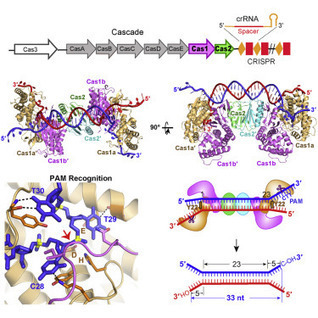
Bacteria acquire memory of viral invaders by incorporating invasive DNA sequence elements into the host CRISPR locus, generating a new spacer within the CRISPR array. We report on the structures of Cas1-Cas2-dual-forked DNA complexes in an effort toward understanding how the protospacer is sampled prior to insertion into the CRISPR locus. Our study reveals a protospacer DNA comprising a 23-bp duplex bracketed by tyrosine residues, together with anchored flanking 3′ overhang segments. The PAM-complementary sequence in the 3′ overhang is recognized by the Cas1a catalytic subunits in a base-specific manner, and subsequent cleavage at positions 5 nt from the duplex boundary generates a 33-nt DNA intermediate that is incorporated into the CRISPR array via a cut-and-paste mechanism. Upon protospacer binding, Cas1-Cas2 undergoes a significant conformational change, generating a flat surface conducive to proper protospacer recognition. Here, our study provides important structure-based mechanistic insights into PAM-dependent spacer acquisition.
To get content containing either thought or leadership enter:
To get content containing both thought and leadership enter:
To get content containing the expression thought leadership enter:
You can enter several keywords and you can refine them whenever you want. Our suggestion engine uses more signals but entering a few keywords here will rapidly give you great content to curate.


 Your new post is loading...


 Scoop.it!