Your new post is loading...

|
Scooped by
Gerd Moe-Behrens
April 28, 2016 5:13 PM
|
Cellular phenotypes underpinned by regulatory networks need to respond to evolutionary pressures to allow adaptation, but at the same time be robust to perturbations. This creates a conflict in which mutations affecting regulatory networks must both generate variance but also be tolerated at the phenotype level. Here, we perform mathematical analyses and simulations of regulatory networks to better understand the potential trade-off between robustness and evolvability. Examining the phenotypic effects of mutations, we find an inverse correlation between robustness and evolvability that breaks only with nonlinearity in the network dynamics, through the creation of regions presenting sudden changes in phenotype with small changes in genotype. For genotypes embedding low levels of nonlinearity, robustness and evolvability correlate negatively and almost perfectly. By contrast, genotypes embedding nonlinear dynamics allow expression levels to be robust to small perturbations, while generating high diversity (evolvability) under larger perturbations. Thus, nonlinearity breaks the robustness-evolvability trade-off in gene expression levels by allowing disparate responses to different mutations. Using analytical derivations of robustness and system sensitivity, we show that these findings extend to a large class of gene regulatory network architectures and also hold for experimentally observed parameter regimes. Further, the effect of nonlinearity on the robustness-evolvability trade-off is ensured as long as key parameters of the system display specific relations irrespective of their absolute values. We find that within this parameter regime genotypes display low and noisy expression levels. Examining the phenotypic effects of mutations, we find an inverse correlation between robustness and evolvability that breaks only with nonlinearity in the network dynamics. Our results provide a possible solution to the robustness-evolvability trade-off, suggest an explanation for the ubiquity of nonlinear dynamics in gene expression networks, and generate useful guidelines for the design of synthetic gene circuits.
|
|
Scooped by
Gerd Moe-Behrens
April 27, 2016 3:43 PM
|
An interview with Brendan Frey about realizing new possibilities in genomic medicine.
|
|
Scooped by
Gerd Moe-Behrens
April 27, 2016 9:36 AM
|
CRISPR-Cas9 has been demonstrated as a transformative genome engineering tool for many eukaryotic organisms; however, its utilization in bacteria remains limited and ineffective. Here we explored Streptococcus pyogenes CRISPR-Cas9 for genome editing in Clostridium beijerinckii (industrially significant but notorious for being difficult to metabolically engineer) as a representative attempt to explore CRISPR-Cas9 for genome editing in microorganisms that previously lacked sufficient genetic tools. By combining inducible expression of Cas9 and plasmid-borne editing templates, we successfully achieved gene deletion and integration with high efficiency in single steps. We further achieved single nucleotide modification by applying innovative two-step approaches, which do not rely on availability of Protospacer Adjacent Motif sequences. Severe vector integration events were observed during the genome engineering process, which is likely difficult to avoid but has never been reported by other researchers for the bacterial genome engineering based on homologous recombination with plasmid-borne editing templates. We then further successfully employed CRISPR-Cas9 as an efficient tool for selecting desirable "clean" mutants in this study. The approaches we developed are broadly applicable and will open the way for precise genome editing in diverse microorganisms.
|
|
Scooped by
Gerd Moe-Behrens
April 27, 2016 9:33 AM
|
Cells contain a finite set of resources that must be distributed across many processes to ensure survival. Among them, the largest proportion of cellular resources is dedicated to protein translation. Synthetic biology often exploits these resources to execute orthogonal genetic circuits, yet the burden this places on the cell is rarely considered. Here, we develop a minimal model of ribosome allocation dynamics capturing the demands on translation when expressing a synthetic construct together with endogenous genes required for maintenance of cell physiology. Critically, it contains three key variables related to design parameters of the synthetic construct covering: transcript abundance, translation initiation rate, and elongation time. We show that model-predicted changes in ribosome allocation closely match experimental shifts in synthetic protein expression rate and cellular growth. Intriguingly, the model is also able to accurately infer transcript levels and translation times after further exposure to additional ambient stress. Our results demonstrate that a simple model of resource allocation faithfully captures the redistribution of protein synthesis resources when faced with the burden of synthetic gene expression and environmental stress. The tractable nature of the model makes it a versatile tool for exploring the guiding principles of efficient heterologous expression and the indirect interactions that can arise between synthetic circuits and their host chassis due to competition for shared translational resources.
|
|
Scooped by
Gerd Moe-Behrens
April 27, 2016 9:27 AM
|
Legume laboratory discusses a recent effort to introduce an algal carbon concentration mechanism into higher plants for improved photosynthetic efficiency.
Source: Fast-Tracked Photosynthesis
We have previously written on the topic of increasing the efficiency of photosynthesis as a possible method of increasing crop growth and yield. By swapping out the predominant C3 photosynthesis system with the superior C4 system, it was estimated that rice and wheat yields could increase by 50%.
The Long Now Foundation recently published online a talk titled “Radical Ag: C4 and beyond” in which Jane Langdale of the Langdale Lab discusses the 60 odd plant species that have naturally evolved C4 photosynthesis and the efforts to use this knowledge to get C4 photosynthesis into rice.
A different method of supercharging photosynthesis?
And a recent paper in the Plant Biotechnology Journal (which is open access – yay!) investigated the possibility of using a carbon-concentrating mechanism (CCM) commonly found in a number of photosynthetic organisms like cyanobacteria and green algae.
Whilst C3 photosynthesis relies on CO2 passively diffusing to the chloroplasts, resulting in the enzyme which assimilates the carbon into the plant (RuBisCO) not being saturated with CO2, the microbial CCM increases the concentration of CO2 to RuBisCO and thereby increases photosynthetic efficiency.
In algae, the CCM consists of transporters of inorganic carbon at the plasma membrane, chloroplast envelope and carbonic anhydrases. These all work together to deliver the elevated concentration of CO2 to the RuBisCo enzyme.
In this paper, the researchers took a number of steps to check the plausibility of inserting this CCM into tobacco plants:
After choosing 10 critical components of the CCM, these components were tagged with fluorescent markers to determine where they were located within Chlamydomonas reinhardtii.
With the usual location of these proteins confirmed, the proteins were expressed in tobacco leaves to determine whether the same components were located in the same cellular locations.
Focusing on two inorganic carbon transporters within this selection of 10 components, the researchers showed that they both function as such when expressed in the outer membrane of a model single-celled organism (Xenopus oocytes) and when transformed into Arabidopsis thaliana.
Finally, they tested the growth of the Arabidopsis plants against wild-type plants of the same species.
The positives
The location of the 10 components were confirmed within the bacteria and 8 of these were located in the same cellular position when expressed in tobacco leaves. 1 protein was mistargeted whilst the researchers struggled to clearly identify the location of another.
Delving further into this issue, the researchers looked for a way to direct one of the proteins specifically to the chloroplast stroma using a specific transporter found in an online plant membrane protein database. Using this transporter and the tagged protein, they were able to demonstrate the ability to re-target a protein from a single celled organism to a specific part of the cell of a higher plant.
Taking two specific proteins for further study, the proteins were expressed in Arabidopsis plants and the location was confirmed as being the same as in the tobacco plants.
The negatives
Actually, the report specifically states that it wasn’t expected that Arabidopsis plants transformed with the two CCM components would have an altered rate of photosynthesis given the complexity of this machinery and the number of components missing. However, they tested and compared growth rates under normal and reduced CO2 concentrations, finding no difference between the transformed and wild-types. They also measured CO2 assimilation rates, again finding no difference.
Conclusion
The paper gives a great insight into complexity involved in demonstrating the plausibility of transforming plants for greater growth rates and, potentially, greater yield from food crops.
The ability to express and redirect proteins is impressive, but also impressive is the catalogue of plant proteins that is continually being built and which can be freely accessed and used for research.
Increasing CO2 sequestration rates is a focal point for many researchers in the quest to grow more food on the agricultural resources we have. Swapping out or supercharging the C3 photosynthesis present in most crops is one method with seeming potential and the detail of the work performed so far gives an exciting insight into the possibility of it coming to fruition.
|
|
Scooped by
Gerd Moe-Behrens
April 26, 2016 8:51 AM
|
Synthetic biology aims to design new biological systems for predefined purposes, such as the controlled secretion of biofuels, pharmaceuticals, or other chemicals. Synthetic gene circuits regulating an efflux pump from the ATP-binding cassette (ABC) protein family could achieve this. However, ABC efflux pumps can also drive out intracellular inducer molecules that control the gene circuits. This will introduce an implicit feedback that could alter gene circuit function in ways that are poorly understood. Here, we used two synthetic gene circuits inducible by tetracycline family molecules to regulate the expression of a yeast ABC pump (Pdr5p) that pumps out the inducer. Pdr5p altered the dose-responses of the original gene circuits substantially in Saccharomyces cerevisiae. While one aspect of the change could be attributed to the efflux pumping function of Pdr5p, another aspect remained unexplained. Quantitative modeling indicated that reduced regulator gene expression in addition to efflux pump function could fully explain the altered dose-responses. These predictions were validated experimentally. Overall, we highlight how efflux pumps can alter gene circuit dynamics and demonstrate the utility of mathematical modeling in understanding synthetic gene circuit function in new circumstances.
|
|
Scooped by
Gerd Moe-Behrens
April 26, 2016 8:48 AM
|
Flow cytometry is widely used to measure gene expression and other molecular biological processes with single cell resolution via fluorescent probes. Flow cytometers output data in arbitrary units (a.u.) that vary with the probe, instrument, and settings. Arbitrary units can be converted to the calibrated unit molecules of equivalent fluorophore (MEF) using commercially available calibration particles. However, there is no convenient, non-proprietary tool available to perform this calibration. Consequently, most researchers report data in a.u., limiting interpretation. Here, we report a software tool named FlowCal to overcome current limitations. FlowCal can be run using an intuitive Microsoft Excel interface, or customizable Python scripts. The software accepts Flow Cytometry Standard (FCS) files as inputs and is compatible with different calibration particles, fluorescent probes, and cell types. Additionally, FlowCal automatically gates data, calculates common statistics, and produces publication quality plots. We validate FlowCal by calibrating a.u. measurements of E. coli expressing superfolder GFP (sfGFP) collected at 10 different detector sensitivity (gain) settings to a single MEF value. Additionally, we reduce day-to-day variability in replicate E. coli sfGFP expression measurements due to instrument drift by 33%, and calibrate S. cerevisiae mVenus expression data to MEF units. Finally, we demonstrate a simple method for using FlowCal to calibrate fluorescence units across different cytometers. FlowCal should ease the quantitative analysis of flow cytometry data within and across laboratories and facilitate the adoption of standard fluorescence units in synthetic biology and beyond.
|
|
Scooped by
Gerd Moe-Behrens
April 26, 2016 8:46 AM
|
Bacteria navigate environments full of various chemicals to seek favorable places for survival by controlling the flagella’s rotation using a complicated signal transduction pathway. By influencing the pathway, bacteria can be engineered to search for specific molecules, which has great potential for application to biomedicine and bioremediation. In this study, genetic circuits were constructed to make bacteria search for a specific molecule at particular concentrations in their environment through a synthetic biology method. In addition, by replacing the “brake component” in the synthetic circuit with some specific sensitivities, the bacteria can be engineered to locate areas containing specific concentrations of the molecule. Measured by the swarm assay qualitatively and microfluidic techniques quantitatively, the characteristics of each “brake component” were identified and represented by a mathematical model. Furthermore, we established another mathematical model to anticipate the characteristics of the “brake component”. Based on this model, an abundant component library can be established to provide adequate component selection for different searching conditions without identifying all components individually. Finally, a systematic design procedure was proposed. Following this systematic procedure, one can design a genetic circuit for bacteria to rapidly search for and locate different concentrations of particular molecules by selecting the most adequate “brake component” in the library. Moreover, following simple procedures, one can also establish an exclusive component library suitable for other cultivated environments, promoter systems, or bacterial strains.
|
|
Scooped by
Gerd Moe-Behrens
April 25, 2016 6:15 AM
|
Genetically-encoded biosensors offer a wide range of opportunities to develop advanced synthetic biology applications. Circuits with the ability of detecting and quantifying intracellular amounts of a compound of interest are central to whole-cell biosensors design for medical and environmental applications, and they also constitute essential parts for the selection and regulation of high-producer strains in metabolic engineering. However, the number of compounds that can be detected through natural mechanisms, like allosteric transcription factors, is limited; expanding the set of detectable compounds is therefore highly desirable. Here, we present the SensiPath web server, accessible at http://sensipath.micalis.fr. SensiPath implements a strategy to enlarge the set of detectable compounds by screening for multi-step enzymatic transformations converting non-detectable compounds into detectable ones. The SensiPath approach is based on the encoding of reactions through signature descriptors to explore sensing-enabling metabolic pathways, which are putative biochemical transformations of the target compound leading to known effectors of transcription factors. In that way, SensiPath enlarges the design space by broadening the potential use of biosensors in synthetic biology applications.
|
|
Scooped by
Gerd Moe-Behrens
April 23, 2016 6:22 PM
|
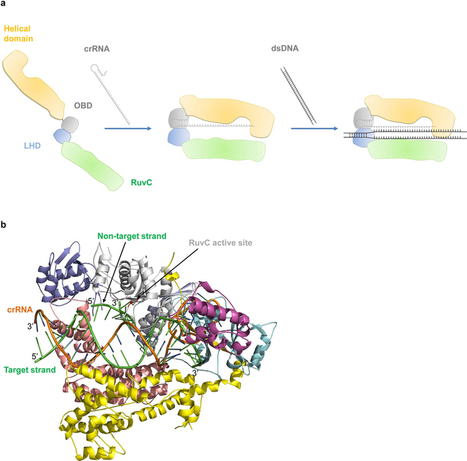
The CRISPR–Cas systems, as exemplified by CRISPR–Cas9, are RNA-guided adaptive immune systems used by bacteria and archaea to defend against viral infection1, 2, 3, 4, 5, 6, 7. The CRISPR–Cpf1 system, a new class 2 CRISPR–Cas system, mediates robust DNA interference in human cells1, 8, 9, 10. Although functionally conserved, Cpf1 and Cas9 differ in many aspects including their guide RNAs and substrate specificity. Here we report the 2.38 Å crystal structure of the CRISPR RNA (crRNA)-bound Lachnospiraceae bacterium ND2006 Cpf1 (LbCpf1). LbCpf1 has a triangle-shaped architecture with a large positively charged channel at the centre. Recognized by the oligonucleotide-binding domain of LbCpf1, the crRNA adopts a highly distorted conformation stabilized by extensive intramolecular interactions and the (Mg(H2O)6)2+ ion. The oligonucleotide-binding domain also harbours a looped-out helical domain that is important for LbCpf1 substrate binding. Binding of crRNA or crRNA lacking the guide sequence induces marked conformational changes but no oligomerization of LbCpf1. Our study reveals the crRNA recognition mechanism and provides insight into crRNA-guided substrate binding of LbCpf1, establishing a framework for engineering LbCpf1 to improve its efficiency and specificity for genome editing.
|
|
Scooped by
Gerd Moe-Behrens
April 23, 2016 8:52 AM
|
The screening and isolation of target microorganisms from mutated recombinant libraries are crucial for the advancement of synthetic biology and metabolic engineering. However, conventional screening tools present several limitations in throughput, cost, and labor. Herein, we describe a novel, microfluidic high-throughput screening (HTS) platform with several advantages. The platform utilizes a fluid array to compartmentalize bacterial cells in well-ordered separated microwells and allows long-term cell culture with a high-throughput. The platform enables the extraction of selected target cells from the fluid array for additional culture and post-analysis by using a capillary-driven sample relocation method. To confirm the feasibility of the platform, we demonstrated two different types of HTS methods based on the levels of reporter gene expression and cellular growth rate difference. For the reporter gene-based HTS, a spike recovery approach was taken to demonstrate that target cells are successfully screened out from a mixture containing non-target cells by repeating the culture and extraction processes. Additionally, the same platform allowed us to screen/sort target cells according to their cellular growth rate difference, which seems hard in conventional screening methods. Hence, the platform could be used for various microbiological assays, including the detection of cell-excreted metabolites, microbial biosensors, and other HTS systems.
|
|
Scooped by
Gerd Moe-Behrens
April 21, 2016 5:42 PM
|
At the Karolinska Institute in Stockholm, Fredrik Lanner is preparing to edit genes in human embryos. It’s the kind of research that sparked an international frenzy in April last year, when a Chinese team revealed that it had done the world’s first such experiments1.
But Lanner doesn’t expect his work, which will explore early human development, to cause such a fuss. A year of discussion about the ethics of embryo-editing research, and perhaps simply the passage of time, seems to have blunted its controversial edge — although such work remains subject to the same ethical anxieties that surround other reproductive-biology experiments. “At least in the scientific community, I sense more support for basic-research applications,” says Lanner, who gained approval for his experiments last June.
His instinct seems to be borne out by the fairly muted reaction to a 6 April report2 of an experiment to edit human embryos — only the second to be published. A team led by Yong Fan at Guangzhou Medical University in China used the gene-editing technology CRISPR–Cas9 to try to introduce a mutation that makes humans resistant to HIV infection.
|
|
Scooped by
Gerd Moe-Behrens
April 21, 2016 5:39 PM
|
The US Department of Agriculture (USDA) will not regulate a mushroom genetically modified with the gene-editing tool CRISPR–Cas9.
The long-awaited decision means that the mushroom can be cultivated and sold without passing through the agency's regulatory process — making it the first CRISPR-edited organism to receive a green light from the US government.
“The research community will be very happy with the news,” says Caixia Gao, a plant biologist at the Chinese Academy of Sciences’s Institute of Genetics and Developmental Biology in Beijing, who was not involved in developing the mushroom. “I am confident we'll see more gene-edited crops falling outside of regulatory authority.”
|
|
|
Scooped by
Gerd Moe-Behrens
April 27, 2016 7:12 PM
|
Twist Bioscience, a startup making and using synthetic DNA to store digital data, just struck a contract with Microsoft and the University of Washington to encode vast amounts of information on synthetic genes.
Big data means business and the company able to gather a lot of it is very valuable to investors and stockholders. But that data needs to be stored somewhere and can cost a lot for the upkeep.
Digital data stored on media also has a finite shelf life. But researchers have discovered new ways to stuff digital information over the last few years – including in our DNA, which can last thousands of years intact.
Just how much data can you store in your genes? According to Harvard scientists, about 700 terabytes can go on a single gram.
Or, to put it in layman’s terms, “[Using DNA,] you could fit all the knowledge in the whole world inside the trunk of your car,” Twist Bioscience CEO Emily Leproust told TechCrunch.
The cost of genetic sequencing has also plummeted recently, going from $2.7 billion to map out just one whole human genome in 2003 to now the ability to pull up your entire genome on your smartphone for under $1,000.
We don’t know what exactly Microsoft plans to put inside tiny strands of DNA but the new technology presents an interesting way to keep a lot of data in a small amount of space for a really long time.
Twist Bioscience recently acquired the Israel-based Genome Compiler Corporation and announced a teeny tiny funding round of $2.6 million this month – an odd contrast to the $81 million raised earlier in January to build out its synthetic DNA manufacturing platform.
|
|
Scooped by
Gerd Moe-Behrens
April 27, 2016 3:42 PM
|
“If I had only learned science the way it was taught to me in the classroom, I probably never would have become a scientist,” says Natalie Kuldell, a faculty member in MIT’s Department of Biological Engineering. “It was only in high school when I had a chance to work in an investigative lab that I realized how creative and fun science could be.”
|
|
Scooped by
Gerd Moe-Behrens
April 27, 2016 9:34 AM
|
Protein expression and selection is an essential process in the modification of biological products. Expressed proteins are selected based on desired traits (phenotypes) from diverse gene libraries (genotypes), whose size may be limited due to the difficulties inherent in diverse cell preparation. In addition, not all genes can be expressed in cells, and linking genotype with phenotype further presents a great challenge in protein engineering. In this paper, we present a DNA gel-based platform that demonstrates the versatility of two DNA microgel formats to address fundamental challenges of protein engineering, including high protein yield, isolation of gene sets, and protein display. We utilize microgels to show successful protein production and capture of a model protein green fluorescent protein (GFP), which is further used to demonstrate a successful gene enrichment through fluorescent activated cell sorting (FACS) of a mixed population of microgels containing the GFP gene. Through psoralen crosslinking of the hydrogels, we have synthesized DNA microgels capable of surviving denaturing conditions while still possessing the ability to produce protein. Lastly, we demonstrate a method of producing extremely high local gene concentrations of up to 32,000 gene repeats in hydrogels 1-2 μm in diameter. These DNA gels can serve as a novel cell-free platform for integrated protein expression and display, which can be applied towards more powerful, scalable protein engineering and cell-free synthetic biology with no physiological boundaries and limitations.
|
|
Scooped by
Gerd Moe-Behrens
April 27, 2016 9:30 AM
|
"As summer approaches we are edging closer to the start of the 2016 iGEM competition. Here the Leiden iGEM team introduce their project which aims to use E. coli to convert a toxic compound found in Martian soil into oxygen. This research could aid ongoing efforts to make life on the red planet possible. We’re looking forward to seeing how things develop!
by Leiden iGEM 2016
Colonising Mars
It’s just a matter of time before Mars is colonised, but before that can happen there are some problems that first need to be resolved, problems that the students are well aware of. The prime problem is that there has to be a sustainable and self-maintaining atmosphere that can support human life. The students have come up with an idea for creating such an atmosphere and have developed the idea into a workable plan.
|
|
Scooped by
Gerd Moe-Behrens
April 26, 2016 8:52 AM
|
To collaboratively design synthetic biology systems, it is important to communicate both the structural and functional aspects of a design in a standard manner. This paper presents the Synthetic Biology Open Language (SBOL) 2.0 and demonstrates how this standard enables effective collaborative design across different institutions and tools. SBOL 2.0 serves the diverse interests of the synthetic biology community. The standard includes the ability to describe both functional and structural aspects of a design, including DNA, RNA, small molecules, and proteins, as well as their interactions as part of functional modules. SBOL 2.0 has been developed via consensus, with careful consideration of recent design trends in synthetic biology and real use cases submitted by members of the commercial biotechnology community. The standard thus provides researchers with a standardized representation for describing, manipulating, and reproducing biological designs across the synthetic biology community. This paper demonstrates how a set of SBOL-enabled tools can form a complex workflow to share and exchange designs for representative use cases between different organizations and tool suites. We also describe the development support in the form of software libraries, which facilitate the integration of the SBOL 2.0 standard into software tools.
|
|
Scooped by
Gerd Moe-Behrens
April 26, 2016 8:49 AM
|
One aim of synthetic biologists is to create novel and predictable biological systems from simpler modular parts. This approach is currently hampered by a lack of well-defined and characterised parts and devices. However, there is a wealth of existing biological information, which can be used to identify and characterise biological parts, and their design constraints in the literature and numerous biological databases. However, this information is spread amongst these databases in many different formats. New computational approaches are required to make this information available in an integrated format that is more amenable to data mining. A tried and tested approach to this problem is to map disparate data sources into a single dataset, with common syntax and semantics, to produce a data warehouse or knowledge base. Ontologies have been used extensively in the life sciences, providing this common syntax and semantics as a model for a given biological domain, in a fashion that is amenable to computational analysis and reasoning. Here, we present an ontology for applications in synthetic biology design, SyBiOnt, which facilitates the modelling of information about biological parts and their relationships. SyBiOnt was used to create the SyBiOntKB knowledge base, incorporating and building upon existing life sciences ontologies and standards. The reasoning capabilities of ontologies were then applied to automate the mining of biological parts from this knowledge base. We propose that this approach will be useful to speed up synthetic biology design and ultimately help facilitate the automation of the biological engineering life cycle.
|
|
Scooped by
Gerd Moe-Behrens
April 26, 2016 8:47 AM
|
|
|
Scooped by
Gerd Moe-Behrens
April 26, 2016 8:45 AM
|
Aim. The nascent field of bio-geoengineering stands to benefit from synthetic biologists’ efforts to standardise and in so doing democratise biomolecular research methods. At times Roseobacter clade bacteria can comprise up to 20% of a bacterio-plankton community in a given oceanic location, making them a prime candidate for establishment of synthetic biology chassis for bio-geoengineering activities such as bioremediation of oceanic waste plastic. Developments such as the increasing affordability of DNA synthesis and laboratory automation continue to foster the establishment of a global ‘do-it-yourself’ research community alongside the more traditional arenas of academe and industry. As a collaborative group of citizen, student and professional scientists we sought to test the following hypotheses: i) that an incubator capable of cultivating bacterial cells can be constructed entirely from non-laboratory items, ii) that marine bacteria from the Roseobacter clade can be established as a genetically tractable synthetic biology chassis using plasmids conforming to the BioBrickTM standard and finally, iii) that identifying and subcloning genes from a Roseobacter clade species can readily by achieved by citizen scientists using open source cloning and bioinformatic tools. Method. We cultivated three Roseobacter species, Roseobacter denitrificans, Oceanobulbus indolifex and Dinoroseobacter shibae. For each species we measured chloramphenicol sensitivity, viability over 11 weeks of glycerol-based cryopreservation and tested the effectiveness of a series of electroporation and heat shock protocols for transformation using a variety of plasmid types. We also attempted construction of an incubator-shaker device using only publicly available components. Finally, a subgroup comprising citizen scientists designed and attempted a procedure for isolating the cold resistance gene, Antifreeze protein type I (European Bioinformatics code = EDQ05862.1, locus code = OIHEL45_03590, referred to here as anf1), from Oceanobulbus indolifex cells and sub-cloning it into a BioBrickTM formatted plasmid. Results. All species were stable over 11 weeks of glycerol cryopreservation, sensitive to 17µg/ mL chloramphenicol and resistant to transformation using the conditions and plasmids tested. An incubator-shaker device, 'UCLHack-12' was assembled and used to cultivate sufficient quantity of Oceanobulbus. indolifex cells to enable isolation of the anf1 gene and its subcloning into a plasmid to generate the BioBrickTM BBa_K729016. Conclusion. The process of 'de-skilling' biomolecular techniques, particularly for relatively under-investigated organisms, is still on-going. However, our successful cell growth and DNA manipulation experiments serve to indicate the types of capabilities that are now available to citizen scientists. Science democratised in this way can make a positive contribution to the debate around the use of bio-geoengineering to address oceanic pollution or climate change.
|
|
Scooped by
Gerd Moe-Behrens
April 23, 2016 7:15 PM
|
The pretty set of modular parts is a small-scale bio lab that enables you to grow organisms and bend bits of DNA to your will.
|
|
Scooped by
Gerd Moe-Behrens
April 23, 2016 8:53 AM
|
Natural products are a group of bioactive structurally diverse chemicals produced by microorganisms and plants. These molecules and their derivatives have contributed to over a third of the therapeutic drugs produced in the last century. However, over the last few decades traditional drug discovery pipelines from natural products have become far less productive and far more expensive. One recent development with promise to combat this trend is the application of synthetic biology to therapeutic natural product biosynthesis. Synthetic biology is a young discipline with roots in systems biology, genetic engineering, and metabolic engineering. In this review, we discuss the use of synthetic biology to engineer improved yields of existing therapeutic natural products. We further describe the use of synthetic biology to combine and express natural product biosynthetic genes in unprecedented ways, and how this holds promise for opening up completely new avenues for drug discovery and production.
|
|
Scooped by
Gerd Moe-Behrens
April 23, 2016 8:51 AM
|
The cyanobacterial hepatotoxin microcystin is assembled at a non-ribosomal peptide synthetase (NRPS) complex. The enormous structural diversity of this peptide, which is also found in closely related strains, is the result of frequent recombination events and point mutations. Here, we have compared the in vitro activation profiles of related monospecific and multispecific modules that either strictly incorporate leucine or arginine or incorporate chemically diverse amino acids in parallel into microcystin. By analyzing di- and tri-domain proteins we have dissected the role of adenylation and condensation domains for substrate specificity. We have further analyzed the role of subdomains and provide evidence for an extended gatekeeping function for the condensation domains of multispecific modules. By reproducing natural point mutations, we could convert a monospecific module into a multispecific module. Our findings may inspire novel synthetic biology approaches and demonstrate how recombination platforms of NRPSs have developed in nature.
|
|
Scooped by
Gerd Moe-Behrens
April 21, 2016 5:40 PM
|
When the medical charity Médecins Sans Frontières called the worldwide shortage of snake antivenom a public-health crisis last September, Brazilian biochemist Paulo Lee Ho wasn’t surprised. He has spent his career at São Paulo’s Butantan Institute searching for better ways to create antivenom to treat bites from coral snakes.
Conventional methods rely on natural coral-snake venom, which is hard to come by: the snakes produce only small amounts with each bite and are hard to raise in captivity. So Ho and others have turned to proteomics and synthetic biology in the hope of improving the quality and availability of antivenom. “We need a new way to meet the demand for antivenom from the Ministry of Health,” he says.
|