Your new post is loading...

|
Scooped by
Gerd Moe-Behrens
January 24, 2017 12:25 PM
|
Chimeric Antigen Receptor (CAR) T cell therapy has had unprecedented success in the treatment of haematological malignancies, this is especially true in clinical trials targeted against CD19 for the treatment of paediatric Acute Lymphoblastic Leukaemia (ALL) and Chronic Lymphocytic Leukaemia (CLL). However, clinical evidence of on-target off-tumour toxicity was observed in anti-CD19 CAR trials as well as other CAR trials. Here we have developed a CARs platform that can potentially discriminate a cancerous tissue from normal tissue by recognizing multiple antigens presented on each cell type. Using Boolean logic we have programed the T-cell to only activate when two antigens are present (Boolean’s AND gate); only in the absence of one antigen (Boolean’s ANDNOT gate); when both or either antigens is present (Boolean’s OR gate). We engineered the mechanism through co-localisation or kinetic segregation of the dual CARs inspired by how TCR and co-receptors work. We further found that CAR triggering responses are governed by a local balance in kinase/phosphatase activity. This platform increases the specificity and safety of the engineered T cells through the recognition of a profile of antigens rather that relying on the restricted expression of one tumour associated antigen (TAA). Logic gated CARs could reduce on-target off-tumour toxicity and open the therapy to numerous cancerous tissues where no appropriate TAAs have yet been identified.
|
|
Scooped by
Gerd Moe-Behrens
January 19, 2017 7:44 AM
|
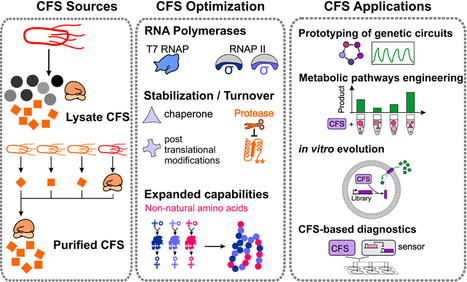
The advent of synthetic biology has ushered in new applications of cell-free transcription-translation systems. These cell-free systems are reconstituted using cellular proteins, and are amenable to modular control of their composition. Here, we discuss the historical advancement of cell-free systems, as well as their new applications in the rapid design of synthetic genetic circuits and components, directed evolution of biomolecules, diagnosis of infectious diseases, and synthesis of vaccines. Finally, we present our vision on the future direction of cell-free synthetic biology.
|
|
Scooped by
Gerd Moe-Behrens
January 19, 2017 7:33 AM
|
The ability to interconvert information between electronic and ionic modalities has transformed our ability to record and actuate biological function. Synthetic biology offers the potential to expand communication ‘bandwidth’ by using biomolecules and providing electrochemical access to redox-based cell signals and behaviours. While engineered cells have transmitted molecular information to electronic devices, the potential for bidirectional communication stands largely untapped. Here we present a simple electrogenetic device that uses redox biomolecules to carry electronic information to engineered bacterial cells in order to control transcription from a simple synthetic gene circuit. Electronic actuation of the native transcriptional regulator SoxR and transcription from the PsoxS promoter allows cell response that is quick, reversible and dependent on the amplitude and frequency of the imposed electronic signals. Further, induction of bacterial motility and population based cell-to-cell communication demonstrates the versatility of our approach and potential to drive intricate biological behaviours.
|
|
Scooped by
Gerd Moe-Behrens
January 19, 2017 7:23 AM
|
Microelectronics has transformed our lives. Cellphones, earbuds, pacemakers, defibrillators – all these and more rely on microelectronics’ very small electronic designs and components. Microelectronics has changed the way we collect, process and transmit information.Such devices, however, rarely provide access to our biological world; there are technical gaps. We can’t simply connect our cellphones to our skin and expect to gain health information. For instance, is there an infection? What type of bacteria or virus is involved? We also can’t program the cellphone to make and deliver an antibiotic, even if we knew whether the pathogen was Staph or Strep. There’s a translation problem when you want the world of biology to communicate with the world of electronics.$$!ad_code_content_spilt_video_ad!$$The research we’ve just published with colleagues in Nature Communications brings us one step closer to closing that communication gap. Rather than relying on the usual molecular signals, like hormones or nutrients, that control a cell’s gene expression, we created a synthetic “switching” system in bacterial cells that recognizes electrons instead. This new technology – a link between electrons and biology – may ultimately allow us to program our phones or other microelectronic devices to autonomously detect and treat disease.Communicating with electrons, not moleculesOne of the barriers scientists have encountered when trying to link microelectronic devices with biological systems has to do with information flow. In biology, almost all activity is made possible by the transfer of molecules like glucose, epinephrine, cholesterol and insulin signaling between cells and tissues. Infecting bacteria secrete molecular toxins and attach to our skin using molecular receptors. To treat an infection, we need to detect these molecules to identify the bacteria, discern their activities and determine how to best respond.Microelectronic devices don’t process information with molecules. A microelectronic device typically has silicon, gold, chemicals like boron or phosphorus and an energy source that provides electrons. By themselves, they’re poorly suited to engage in molecular communication with living cells.Free electrons don’t exist in biological systems so there’s almost no way to connect with microelectronics. There is, however, a small class of molecules that stably shuttle electrons. These are called “redox” molecules; they can transport electrons, sort of like wire does. The difference is that in wire, the electrons can flow freely to any location within; redox molecules must undergo chemical reactions – oxidation or reduction reactions – to “hand off” electrons.
Turning cells on and offCapitalizing on the electronic nature of redox molecules, we genetically engineered bacteria to respond to them. We focused on redox molecules that could be “programmed” by the electrode of a microelectronic device. The device toggles the molecule’s oxidation state – it’s either oxidized (loses an electron) or reduced (gains an electron). The electron is supplied by a typical energy source in electronics like a battery.We wanted our bacteria cells to turn “on” and “off” due to the applied voltage – voltage that oxidized a naturally occurring redox molecule, pyocyanin.Electrically oxidizing pyocyanin allowed us to control our engineered cells, turning them on or off so they would synthesize (or not) a fluorescent protein. We could rapidly identify what was happening in these cells because the protein emits a green hue.In another example, we made bacteria that, when switched on, would swim from a stationary position. Bacteria normally swim in starts and stops referred to as a “run” or a “tumble.” The “run” ensures they move in a straight path. When they “tumble,” they essentially remain in a one spot. A protein called CheZ controls the “run” portion of bacteria’s swimming activity. Our electrogenetic switch turned on the synthesis of CheZ, so that the bacteria could move forward.We were also able to electrically signal a community of cells to exhibit collective behavior. We made cells with switches controlling the synthesis of a signaling molecule that diffuses to neighboring cells and, in turn, causes changes in their behavior. Electric current turned on cells that, in turn, “programmed” a natural biological signaling process to alter the behavior of nearby cells. We exploited bacterial quorum sensing – a natural process where bacterial cells “talk” to their neighbors and the collection of cells can behave in ways that benefit the entire community.$$!ad_code_content_spilt_video_ad2!$$Perhaps even more interesting, our groups showed that we could both turn on gene expression and turn it off. By reversing the polarity on the electrode, the oxidized pyocyanin becomes reduced – its inactive form. Then, the cells that were turned on were engineered to quickly revert back to their original state. In this way, the group demonstrated the ability to cycle the electrically programmed behavior on and off, repeatedly.Interestingly, the on and off switch enabled by pyocyanin was fairly weak. By including another redox molecule, ferricyanide, we found a way to amplify the entire system so that the gene expression was very strong, again on and off. The entire system was robust, repeatable and didn’t negatively affect the cells.Sensing and responding on a cellular levelArmed with this advance, devices could potentially electrically stimulate bacteria to make therapeutics and deliver them to a site. For example, imagine swallowing a small microelectronic capsule that could record the presence of a pathogen in your GI tract and also contain living bacterial factories that could make an antimicrobial or other therapy – all in a programmable autonomous system.This current research ties into previous work done here at the University of Maryland where researchers had discovered ways to “record” biological information, by sensing the biological environment, and based on the prevailing conditions, “write” electrons to devices. We and our colleagues “sent out” redox molecules from electrodes, let those molecules interact with the microenvironment near the electrode and then drew them back to the electrode so they could inform the device on what they’d seen. This mode of “molecular communication” is somewhat analogous to sonar, where redox molecules are used instead of sound waves.These molecular communication efforts were used to identify pathogens, monitor the “stress” in blood levels of individuals with schizophrenia and even determine the differences in melanin from people with red hair. For nearly a decade, the Maryland team has developed methodologies to exploit redox molecules to interrogate biology by directly writing the information to devices with electrochemistry.Perhaps it is now time to integrate these technologies: Use molecular communication to sense biological function and transfer the information to a device. Then use the device – maybe a small capsule or perhaps even a cellphone – to program bacteria to make chemicals and other compounds that issue new directions to the biological system. It may sound fantastical, many years away from practical uses, but our team is working hard on such valuable applications…stay tuned!This article was originally published on TheConversation.
|
|
Scooped by
Gerd Moe-Behrens
January 17, 2017 5:38 PM
|
This eBook looks at how CRISPR is transforming genome engineering and provides crash course in everything a new CRISPR researchers and scientist needs to know.
|
|
Scooped by
Gerd Moe-Behrens
January 17, 2017 7:28 AM
|
Synthetic biology advances the rational engineering of mammalian cells to achieve cell-based therapy goals. Synthetic gene networks have nearly reached the complexity of digital electronic circuits and enable single cells to perform programmable arithmetic calculations or to provide dynamic remote control of transgenes through electromagnetic waves. We designed a synthetic multilayered gaseous-fragrance-programmable analog-to-digital converter (ADC) allowing for remote control of digital gene expression with 2-bit AND-, OR- and NOR-gate logic in synchronized cell consortia. The ADC consists of multiple sampling-and-quantization modules sensing analog gaseous fragrance inputs; a gas-to-liquid transducer converting fragrance intensity into diffusible cell-to-cell signaling compounds; a digitization unit with a genetic amplifier circuit to improve the signal-to-noise ratio; and recombinase-based digital expression switches enabling 2-bit processing of logic gates. Synthetic ADCs that can remotely control cellular activities with digital precision may enable the development of novel biosensors and may provide bioelectronic interfaces synchronizing analog metabolic pathways with digital electronics.
|
|
Scooped by
Gerd Moe-Behrens
January 14, 2017 3:20 PM
|
Francisco Mojica was not the first to see CRISPR, but he was probably the first to be smitten by it. He remembers the day in 1992 when he got his first glimpse of the microbial immune system that would launch a biotechnology revolution. He was reviewing genome-sequence data from the salt-loving microbe Haloferax mediterranei and noticed 14 unusual DNA sequences, each 30 bases long. They read roughly the same backwards and forwards, and they repeated every 35 bases or so. Soon, he saw more of them. Mojica was entranced, and made the repeats a focus of his research at the University of Alicante in Spain.
It wasn't a popular decision. His lab went years without funding. At meetings, Mojica would grab the biggest bigwigs he could find and ask what they thought of the strange little repeats. “Don't care about repeats so much,” he says that they would warn him. “There are many repeats in many organisms — we've known about them for years and still don't know how many of them work.”
|
|
Scooped by
Gerd Moe-Behrens
January 14, 2017 8:14 AM
|
|
|
Scooped by
Gerd Moe-Behrens
January 13, 2017 8:27 AM
|
|
|
Scooped by
Gerd Moe-Behrens
January 12, 2017 8:27 AM
|
Genome integration is a powerful tool in both basic and applied biological research. However, traditional genome integration, which is typically mediated by homologous recombination, has been constrained by low efficiencies and limited host range. In recent years, the emergence of homing endonucleases and programmable nucleases has greatly enhanced integration efficiencies and allowed alternative integration mechanisms such as non-homologous end joining and microhomology-mediated end joining, enabling integration in hosts deficient in homologous recombination. In this review, we will highlight recent advances and breakthroughs in genome integration methods made possible by programmable nucleases, and their new applications in synthetic biology and metabolic engineering.
|
|
Scooped by
Gerd Moe-Behrens
January 12, 2017 6:51 AM
|
Circulate - the go-to location for circular economy related news and insight.
|
|
Scooped by
Gerd Moe-Behrens
January 10, 2017 8:00 AM
|
The chemical synthesis of DNA oligonucleotides and their assembly into synthons, genes, circuits, and even entire genomes by gene synthesis methods has become an enabling technology for modern molecular biology and enables the design, build, test, learn, and repeat cycle underpinning innovations in synthetic biology. In this perspective, we briefly review the techniques and technologies that enable the synthesis of DNA oligonucleotides and their assembly into larger DNA constructs with a focus on recent advancements that have sought to reduce synthesis cost and increase sequence fidelity. The development of lower-cost methods to produce high-quality synthetic DNA will allow for the exploration of larger biological hypotheses by lowering the cost of use and help to close the DNA read–write cost gap.
|
|
Scooped by
Gerd Moe-Behrens
January 10, 2017 7:53 AM
|
Each of our bodies is utterly unique, which is a lovely thought until it comes to treating an illness -- when every body reacts differently, often unpredictably, to standard treatment. Tissue engineer Nina Tandon talks about a possible solution: Using pluripotent stem cells to make personalized models of organs on which to test new drugs and treatments, and storing them on computer chips. (Call it extremely personalized medicine.)
|
|
|
Scooped by
Gerd Moe-Behrens
January 24, 2017 12:19 PM
|
As a synthetic biology enthusiast, I am fascinated by the power of the biological tools that are being developed to solve the very immediate and practical problems that our society is facing today. Synthetic biology was born in an academic environment but was readily embraced by industry, with an impressive number of start-ups having been created in the past few years. The industrial advancements in the field are just as impressive as the research developed by the more theoretically oriented academia, and for this reason, I have started a series of interviews with people that are at the core of the synbio industry and can give us insights from their different perspectives.
I also encourage interested synbio people and companies that would like to share their stories with us to get in touch! In our next post, we could be speaking about you!
|
|
Scooped by
Gerd Moe-Behrens
January 19, 2017 7:40 AM
|
Synthetic nucleobases presenting non-Watson Crick arrangements of hydrogen bond donor and acceptor groups can form additional nucleotide pairs that stabilize duplex DNA independent of the standard A:T and G:C pairs. The pair between 2-amino-3-nitropyridin-6-one 2'-deoxyriboside (presenting a {donor-donor-acceptor} hydrogen bonding pattern on the Watson-Crick face of the small component, trivially designated Z) and imidazo[1,2-a]-1,3,5-triazin-4(8H)one 2'-deoxyriboside (presenting an {acceptor-acceptor-donor} hydrogen bonding pattern on the large component, trivially designated P) is one of these extra pairs for which a substantial amount of molecular biology has been developed. Here, we report the results of UV absorbance melting measurements and determine the energetics of binding of DNA strands containing Z and P to give short duplexes containing Z:P pairs as well as various mismatches comprising Z and P. All measurements were done at 1 M NaCl in buffer (10 mM Na cacodylate, 0.5 mM EDTA, pH 7.0). Thermodynamic parameters (∆H°, ∆S° and ∆G°37) for oligonucleotide hybridization were extracted. Consistent with the Watson-Crick model that considers both geometric and hydrogen bonding complementarity, the Z:P pair was found to contribute more to duplex stability than any mismatches involving either non-standard nucleotide. Further, the Z:P pair is more stable than a C:G pair. The Z:G pair was found to be the most stable mismatch, forming either a deprotonated mismatched pair or a wobble base pair analogous to the stable T:G mismatch. The C:P pair is less stable, perhaps analogous to the wobble pair observed for C:O6-methyl-G, in which the pyrimidine is displaced into the minor groove. The Z:A and T:P mismatches are much less stable. Parameters for predicting the thermodynamics of oligonucleotides containing Z and P bases are provided. This represents the first case where this has been done for a synthetic genetic system.
|
|
Scooped by
Gerd Moe-Behrens
January 19, 2017 7:30 AM
|
Although there is still some skepticism in the biological community regarding the value and significance of quantitative computational modeling, important steps are continually being taken to enhance its accessibility and predictive power. We view these developments as essential components of an emerging 'respectful modeling' framework which has two key aims: (i) respecting the models themselves and facilitating the reproduction and update of modeling results by other scientists, and (ii) respecting the predictions of the models and rigorously quantifying the confidence associated with the modeling results. This respectful attitude will guide the design of higher-quality models and facilitate the use of models in modern applications such as engineering and manipulating microbial metabolism by synthetic biology.
|
|
Scooped by
Gerd Moe-Behrens
January 18, 2017 6:49 AM
|
The goal of SB7.0 is to unite the international synthetic biology communities to take a fresh look at the key topics and challenges that our field face.
|
|
Scooped by
Gerd Moe-Behrens
January 17, 2017 3:56 PM
|
A real-time interactive, fully automated, low-cost and scalable biology cloud experimentation platform could provide access to scientific experimentation for learners and researchers alike.
|
|
Scooped by
Gerd Moe-Behrens
January 15, 2017 10:28 AM
|
Genome integration is a powerful tool in both basic and applied biological research. However, traditional genome integration, which is typically mediated by homologous recombination, has been constrained by low efficiencies and limited host range. In recent years, the emergence of homing endonucleases and programmable nucleases has greatly enhanced integration efficiencies and allowed alternative integration mechanisms such as non-homologous end joining and microhomology-mediated end joining, enabling integration in hosts deficient in homologous recombination. In this review, we will highlight recent advances and breakthroughs in genome integration methods made possible by programmable nucleases, and their new applications in synthetic biology and metabolic engineering.
|
|
Scooped by
Gerd Moe-Behrens
January 14, 2017 12:02 PM
|
We propose and solve analytically a stochastic model for the dynamics of a binary biological switch, defined as a DNA unit with two mutually exclusive configurations, each one triggering the expression of a different gene. Such a device has the potential to be used as a memory unit for biological computing systems designed to operate in noisy environments. We discuss a recent implementation of this switch in living cells, the recombinase addressable data (RAD) module. In order to understand the behavior of a RAD module we compute the exact time-dependent joint distribution of the two expressed genes starting in one state and evolving to another asymptotic state. We consider two operating regimes of the RAD module, a fast and a slow stochastic switching regime. The fast regime is aggregative and produces unimodal distributions, whereas the slow regime is separative and produces bimodal distributions. Both regimes can serve to prepare pure memory states when all cells are expressing the same gene. The slow regime can also separate mixed states by producing two subpopulations, each one expressing a different gene. Compared to the genetic toggle switch based on positive feedback, the RAD module ensures more rapid memory operations for the same quality of the separation between binary states. Our model provides a simplified phenomenological framework for studying RAD memory devices and our analytic solution can be further used to clarify theoretical concepts in biocomputation and for optimal design in synthetic biology.
|
|
Scooped by
Gerd Moe-Behrens
January 13, 2017 8:56 AM
|
A new way to control a powerful but finicky process called the polymerase chain reaction raises the possibility of a “DNA photocopier” small enough to hold in your hand. Such a device could identify the bacteria or virus causing an infection even before the symptoms appear.
Kary Mullis developed PCR in 1983 and received the Nobel Prize for his invention. A key advance in the field of molecular biology, it can make billions of identical copies of small segments of DNA for use in molecular and genetic analyses.
Vanderbilt University biomedical engineers Nicholas Adams and Frederick Haselton came up with an out-of-the-box idea, which they call adaptive PCR. It uses left-handed DNA (L-DNA) to monitor and control the molecular reactions that take place in the PCR process.
Left-handed DNA is the mirror image of the DNA found in all living things. It has the same physical properties as regular, right-handed DNA but it does not participate in most biological reactions. As a result, when fluorescently tagged L-DNA is added to a PCR sample, it behaves in an identical way to the regular DNA and provides a fluorescent light signal that reports information about the molecular reactions taking place and can be used to control them.
In order to test their idea, Adams and Haselton recruited William Gabella, research assistant professor of physics, to create a working prototype of an adaptive PCR machine and then they tested it extensively with the assistance of biomedical engineering undergraduate Austin Hardcastle.
|
|
Scooped by
Gerd Moe-Behrens
January 13, 2017 8:24 AM
|
The Synthetic Biology Open Language (SBOL) is a community-driven open language to promote standardization in synthetic biology. To support the use of SBOL in metabolic engineering, we developed SBOLme, the first open-access repository of SBOL 2.0-compliant biochemical parts for a wide range of metabolic engineering applications. The URL of our repository is http://www.cbrc.kaust.edu.sa/sbolme.
|
|
Scooped by
Gerd Moe-Behrens
January 12, 2017 6:56 AM
|
Modern medicine has found many ways to use a pill of chemicals to improve human health for people around the world. Drugs are taken for infections, cancer treatment, metabolic disorders, and every other ailment. Despite the impact of chemical medicines, there are many problems that need a smarter solution with more targeted benefits. One smarter medicine to keep an eye on in 2017 and beyond is the use of engineered microbes to produce therapeutics or diagnostic signals within the human body. Living medicines designed to respond to cues in the human body can create new kinds of treatments or diagnostics that would be impossible with a traditional drug.
Our ability to reliably engineer microorganisms to do our bidding (synthetic biology) and our knowledge of the importance of balancing the vast community of bacteria in our gut (human gut microbiome) are both fairly new developments. Beyond just a combination of two buzzwords, synthetic biology applied to the microbes in our gut gives us a new treatment approach that uses a living product instead of a chemical.
Synthetic biologists put bits of DNA in the cells of an organism so that it does some new job in addition to all of its normal functions to survive. Meanwhile, studies of the human gut microbiome have lead to the realization that bacteria may be constantly influencing our health. While this microbiome knowledge has lead to fads in probiotic use, a more powerful application may be using probiotics engineered to address the specific problem for each patient.
Sense and destroy
A clear example of an engineered therapeutic was published in 2011 that created E. coli that could sense and destroy the pathogen Pseudomonas aeruginosa. The researchers from Nanyang Technological University in Singapore put the quorum sensing ability from P. aeruginosa into E. coli and connected it to the production of the toxic proteins called pyocins. So when there’s a quorum of P. aeruginosa, the engineered E. coli turn on pyocin production to kill P. aeruginosa. Figure 1 below shows the overall system.
|
|
Scooped by
Gerd Moe-Behrens
January 11, 2017 3:31 PM
|
Recent advances in the field of programmable DNA-binding proteins have led to the development of facile methods for genomic localization of genetically encodable entities. Despite the extensive utility of these tools, locus-specific delivery of synthetic molecules remains limited by a lack of adequate technologies. Here we combine the flexibility of chemical synthesis with the specificity of a programmable DNA-binding protein by using protein trans-splicing to ligate synthetic elements to a nuclease-deficient Cas9 (dCas9) in vitro and subsequently deliver the dCas9 cargo to live cells. The versatility of this technology is demonstrated by delivering dCas9 fusions that include either the small-molecule bromodomain and extra-terminal family bromodomain inhibitor JQ1 or a peptide-based PRC1 chromodomain ligand, which are capable of recruiting endogenous copies of their cognate binding partners to targeted genomic binding sites. We expect that this technology will allow for the genomic localization of a wide array of small molecules and modified proteinaceous materials.
|
|
Scooped by
Gerd Moe-Behrens
January 10, 2017 7:58 AM
|
A new method for producing stronger artificial spider silk is reported in a study published online this week in Nature Chemical Biology. Spider silk is an attractive biodegradable material for many different applications, but producing artificial silk with the same properties as natural silk has historically been difficult.
Spider silk is made up of long chains of linked protein molecules. Inside silk glands, the proteins used to make the silk are kept in a very concentrated solution. When spinning silk, the spider secretes the protein solution through a narrow duct. Along the length of this duct, the acidity changes and the pressure increases, causing the protein molecules to link up in the chains that form the silk fiber.
Inspired by the way that spiders spin silk, Jan Johansson, Anna Rising and colleagues designed a spinning device that mimics the narrow duct and acidity changes met by silk protein in spider glands. Using this device on a special protein - a hybrid of two natural silk proteins that can be manufactured in a highly concentrated form - enabled the authors to produce artificial spider silk that has greater strength and elasticity than other artificial silks, and that is nearly as strong as natural spider silk.
The authors note that the biodegradable silk produced by this method is cheaper and easier to obtain than natural spider silk, and will potentially allow for the production of large amounts of silk for applications such as high-performance textiles and advanced medical devices.
|


 Scoop.it!