


 Your new post is loading...
 Scoop.it! 
Hackteria is a collection of Open Source Biological Art Projects instigated in February 2009 by Andy Gracie, Marc Dusseiller and Yashas Shetty, after collaboration during the Interactivos?09 Garage Science at Medialab Prado in Madrid. The aim of the project is to develop a rich web resource for people interested in or developing projects that involve DIY bioart, open source software and electronic experimentation. As a community platform hackteria tries to encourage the collaboration of scientists, hackers and artists to combine their experitise, write critical and theoretical reflections, share simple instructions to work with lifescience technologies and cooperate on the organization of workshops, festival and meetings. 
Scoop.it!
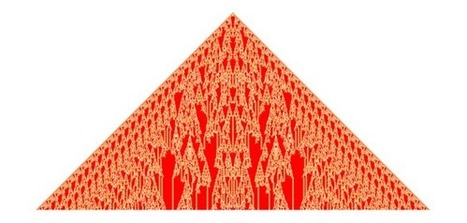
Looking to the Future of A New Kind of ScienceXconomyNKS will also no doubt be important in figuring out how to set up synthetic biological organisms.

Gerd Moe-Behrens's comment,
May 17, 2012 6:49 PM
I was especially curious about this remark "NKS will also no doubt be important in figuring out how to set up synthetic biological organisms."
Scoop.it!

Bacterial magnets and the bio-computer eraAsia Times OnlineStaniland expects to see these synthetic biology technologies in public use within the next 15 years.
Scoop.it!

Potential of Synthetic Biology - Genetic Engineering News (blog) http://t.co/fgGnQaos...
Scoop.it!

A new study consisting of inducing cells to express telomerase, the enzyme which -- metaphorically -- slows down the biological clock -- was successful.
Scoop.it!

A bioengineered thin film of M13 bacteriophage shows piezoelectric properties that are promising for small-scale device integration.
Scoop.it!
Review by Cheng A, Lu TK.
Scoop.it!
by Garg A, Lohmueller JJ, Silver PA, Armel TZ.
Scoop.it!
|

|
Scooped by
Gerd Moe-Behrens
May 14, 2012 5:02 PM
|
Scoop.it!

New approach is a promising first step toward the development of tiny devices that harvest electrical energy from everyday tasks
|
|
Scooped by
Gerd Moe-Behrens
May 14, 2012 9:04 AM
|
Scoop.it!
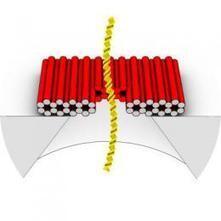

"The latest advance in solid-state nanopore sensors – devices that are made with standard tools of the semiconductor industry yet can offer single-molecule sensitivity for label-free protein screening – expands their bag of tricks through bionanotechnology. Researchers at the Technische Universitaet Muenchen have enhanced the capabilities of solid-state nanopores by fitting them with cover plates made of DNA. These nanoscale cover plates, with central apertures tailored to various "gatekeeper" functions, are formed by so-called DNA origami – the art of programming strands of DNA to fold into custom-designed structures with specified chemical properties...."
http://bit.ly/LIPjtE
additional ref
DNA Origami Gatekeepers for Solid-State Nanopores
by
Ruoshan Wei, Thomas G. Martin, Ulrich Rant, Hendrik Dietz
http://bit.ly/LIPjtE
|
|
Scooped by
Gerd Moe-Behrens
May 14, 2012 8:27 AM
|
Scoop.it!
In this fascinating talk Christopher Bradley shows us that our world is about to change radically thanks to the promise of Synthetic Biology. About Christopher Bradley Christopher is a student at NYU ...
|
|
Scooped by
Gerd Moe-Behrens
May 16, 2012 6:45 PM
|
Scoop.it!

This post points to one of the main challenges contemporary science is facing, the problem of big data (see Nature, SoapBox Science http://bit.ly/Jzz16M , actually an important part of what the Leukippos project is about). I did not look into the code for detail, however, the main strategy they are describing goes in the right direction. In my view provides systems theory the solution for the big data problem. We need to apply holistic thinking. On a technical side, we need a to provide the data both human and computer readable. This will allow us automated analysis, which will be readable by humans. The output data need to be structured hierarchical form the general to the detail. Eg we can structure in species, individual, organ organelle, protein, rna, dna, dna parts. Your search output will be at the highest level of abstraction, the most general group. You can than klick down to the detail. Moreover, a graphical representation of data will help to represent a huge amount of data on a small space. We will need for this a sematic web, and open and free accessible common database. This will demand open access publishing. Authors have also to deliver their data in a computer readable form. Projects like Wikidata doing some groundbreaking work for this. If I understand the app described in this paper goes in this direction described. The infrastructure, as I described it, has to be developed further in order to make this work. On a long run, I guess apps like this will be successfully. Finally, I would like to put another aspect for the solution of big data up to discussion: crowd sourcing. It has been shown in several apps like e.g. the Foldit game, that the crowd has the potential to analyze big data sets. In respect to genetic data certain ethical standards have to be meet (such as anonymity). However, this has a big potential.
|
|
Scooped by
Gerd Moe-Behrens
May 16, 2012 10:08 AM
|
Scoop.it!
by
Correa E, Sletta H, Ellis DI, Hoel S, Ertesvåg H, Ellingsen TE, Valla S, Goodacre R.
"Alginate is an important medical and commercial product and currently is isolated from seaweeds. Certain microorganisms also produce alginate and these polymers have the potential to replace seaweed alginates in some applications, mainly because such production will allow much better and more reproducible control of critical qualitative polymer properties. The research conducted here presents the development of a new approach to this problem by analysing a transposon insertion mutant library constructed in an alginate-producing derivative of the Pseudomonas fluorescens strain SBW25. The procedure is based on the non-destructive and reagent-free method of Fourier transform infrared (FT-IR) spectroscopy which is used to generate a complex biochemical infrared fingerprint of the medium after bacterial growth. First, we investigate the potential differences caused by the growth media fructose and glycerol on the bacterial phenotype and alginate synthesis in 193 selected P. fluorescens mutants and show that clear phenotypic differences are observed in the infrared fingerprints. In order to quantify the level of the alginate we also report the construction and interpretation of multivariate partial least squares regression models which were able to quantify alginate levels successfully with typical normalized root-mean-square error in predictions of only approximately 14 %. We have demonstrated that this high-throughput approach can be implemented in alginate screens and we believe that this FT-IR spectroscopic methodology, when combined with the most appropriate chemometrics, could easily be modified for the quantification of other valuable microbial products and play a valuable screening role for synthetic biology."
|
|
Scooped by
Gerd Moe-Behrens
May 15, 2012 1:43 PM
|
Scoop.it!

John S Chuang, Engineering multicellular traits in synthetic microbial populations, Current Opinion in Chemical Biology http://t.co/wwUzUXyG...
|
|
Scooped by
Gerd Moe-Behrens
May 15, 2012 1:41 PM
|
Scoop.it!
New discipline that exists at interface between engineering and biology is believed by many to signal the beginning of a new era.
|
|
Scooped by
Gerd Moe-Behrens
May 15, 2012 1:10 PM
|
Scoop.it!
"The vascular system of a leaf provides its structure and delivers its nutrients. When you light up that vascular structure with some fluorescent dye and view it using time lapse photography, details begin to emerge that reveal nature's mathematical formula for survival. When it comes to optimizing form with function, it's tough to beat Mother Nature. With support from the National Science Foundation (NSF), Rockefeller University mathematical physicist Marcelo Magnasco and his colleague physicist Eleni Katifori analyze the architecture of leaves by finding geometric patterns that link biological structure to function. They study a specific vascular pattern of loops within loops that is found in many leaves going down to the microscopic level. Magnasco says this research is a jumping off point for understanding other systems that branch and rejoin, including everything from river systems, to neural networks and even malignant tumors."
|
|
Scooped by
Gerd Moe-Behrens
May 15, 2012 11:58 AM
|
Scoop.it!
by
Byung Yang Lee, Jinxing Zhang, Chris Zueger, Woo-Jae Chung, So Young Yoo, Eddie Wang, Joel Meyer, Ramamoorthy Ramesh & Seung-Wuk Lee
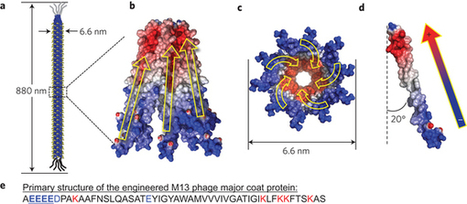
"Piezoelectric materials can convert mechanical energy into electrical energy1, 2, and piezoelectric devices made of a variety of inorganic materials3, 4, 5 and organic polymers6 have been demonstrated. However, synthesizing such materials often requires toxic starting compounds, harsh conditions and/or complex procedures7. Previously, it was shown that hierarchically organized natural materials such as bones8, collagen fibrils9, 10 and peptide nanotubes11, 12 can display piezoelectric properties. Here, we demonstrate that the piezoelectric and liquid-crystalline properties of M13 bacteriophage (phage) can be used to generate electrical energy. Using piezoresponse force microscopy, we characterize the structure-dependent piezoelectric properties of the phage at the molecular level. We then show that self-assembled thin films of phage can exhibit piezoelectric strengths of up to 7.8 pm V−1. We also demonstrate that it is possible to modulate the dipole strength of the phage, hence tuning the piezoelectric response, by genetically engineering the major coat proteins of the phage. Finally, we develop a phage-based piezoelectric generator that produces up to 6 nA of current and 400 mV of potential and use it to operate a liquid-crystal display. Because biotechnology techniques enable large-scale production of genetically modified phages, phage-based piezoelectric materials potentially offer a simple and environmentally friendly approach to piezoelectric energy generation."
http://bit.ly/K2otv3
Piezoelectric devices: Squeezed virus produces electricity
News and Views by S. Michael Yu
"A bioengineered thin film of M13 bacteriophage shows piezoelectric properties that are promising for small-scale device integration."
http://bit.ly/IVkaBy
|
|
Scooped by
Gerd Moe-Behrens
May 15, 2012 10:50 AM
|
Scoop.it!

David Armano
A process both true for business and science:
From: digital, digital media (google), digital buisnes (amazon), social (human)
to the present: social media (you tube, facebook, twitter)
to our future: social business (connected, adaptive, intelligent)
Digital: The Interactive Revolution
Digital Media: Information Goes Online
Digital Business: The Transactional Era
Social: The Human Web
Social Media: Global, Local, Mobile Connectivity At Scale
Social Business: Connected, Adaptive & Intelligent
Winners & Losers: Navigating Today And Tomorrow's World
|
|
Scooped by
Gerd Moe-Behrens
May 15, 2012 9:15 AM
|
Scoop.it!
Engineering and Control of Biological Systems: A New Way to Tackle Complex Diseases
by
Menolascina F, Siciliano V, di Bernardo D.
"The ongoing merge between engineering and biology has contributed to the emerging field of Synthetic Biology. The defining features of this new discipline are abstraction and standardisation of biological parts, decoupling between parts to prevent undesired cross-talking, and the application of quantitative modelling of synthetic genetic circuits in order to guide their design. Most of the efforts in the field of synthetic biology in the last decade have been devoted to the design and development of functional gene circuits in prokaryotes and unicellular eukaryotes. Researchers have used synthetic biology not only to engineer new functions in the cell, but also to build simpler models of endogenous gene regulatory network to gain knowledge of the "rules" governing their wiring diagram. However, the need for innovative approaches to study and modify complex signalling and regulatory networks in mammalian cells and multicellular organisms has prompted advances of Synthetic Biology also in these species, thus contributing to develop innovative ways to tackle human diseases. In this work, we will review the latest progress in synthetic biology and the most significant developments achieved so far, both in unicellular and multicellular organisms, with emphasis to human health."
http://1.usa.gov/JE4h3m
|
|
Scooped by
Gerd Moe-Behrens
May 15, 2012 6:56 AM
|
Scoop.it!

Microryza is a new way to fund
innovative research
|
|
Scooped by
Gerd Moe-Behrens
May 15, 2012 6:33 AM
|
Scoop.it!

"Tel Aviv, May 15: Now, there's a quick check for synthetic chemicals and poisons that contaminate water or food supplies and generate bodily reactions from minor illness to painful death.
Yosi Shacham-Diamand, professor of engineering at Tel Aviv University, and Shimshon Belkin of the Hebrew University of Jerusalem, have married biology and engineering to design a biosensor called the "Dip Chip," which detects toxicity quickly and accurately.
The Dip Chip contains microbes designed to exhibit a biological reaction to toxic chemicals, duplicating the biological responses of humans or animals. The bio-reaction is converted into an electronic signal that can be read by the user....."
http://bit.ly/IVylW2
|
|
Scooped by
Gerd Moe-Behrens
May 14, 2012 10:17 AM
|
Scoop.it!
Crowd funding: A new exiting option for financing biomedical research!
Crowd funding
Kicksatrter
http://www.kickstarter.com/
IndieGoGo
http://www.indiegogo.com/
RocketHub
http://www.rockethub.com/
Microryza
http://thenextweb.com/apps/2012/04/12/meet-microryza-crowd-funding-for-scientific-research/?utm_source=GooglePlus
https://www.microryza.com/
Crowdfunding is the future of science
http://scifundchallenge.org/blog/2012/05/09/crowdfunding-is-the-future-of-science/
Jobs act
http://watch.bnn.ca/#clip674892
http://watch.bnn.ca/#clip674899
http://watch.bnn.ca/#clip674902
|
|
Scooped by
Gerd Moe-Behrens
May 14, 2012 8:34 AM
|
Scoop.it!
Science at Cal - Terry Johnson - Synthetic Biology: Beating the Cell at its Own Game
Video
"Your body routinely produces 200 billion red blood cells every day, yet you could spend years at a lab bench attempting to artificially synthesize all of the raw materials that those cells are made of. Your cells manage to do that - and to assemble new cells out of those raw materials - with relative ease. Synthetic biology aims to design and construct biological systems to make valuable products or perform constructive tasks. The tremendous diversity in the natural world provides us with a versatile and complex set of biological tools. We'll discuss how synthetic biologists apply and hone these tools, and to what ends."
http://bit.ly/Jz6IEo




