A 3D system for culturing human articular chondrocytes in synovial fluid
by Brand JA, McAlindon TE, Zeng L. "Cartilage destruction is a central pathological feature of osteoarthritis, a leading cause of disability in the US. Cartilage in the adult does not regenerate very efficiently in vivo; and as a result, osteoarthritis leads to irreversible cartilage loss and is accompanied by chronic pain and immobility (1,2). Cartilage tissue engineering offers promising potential to regenerate and restore tissue function. This technology typically involves seeding chondrocytes into natural or synthetic scaffolds and culturing the resulting 3D construct in a balanced medium over a period of time with a goal of engineering a biochemically and biomechanically mature tissue that can be transplanted into a defect site in vivo (3-6). Achieving an optimal condition for chondrocyte growth and matrix deposition is essential for the success of cartilage tissue engineering. In the native joint cavity, cartilage at the articular surface of the bone is bathed in synovial fluid. This clear and viscous fluid provides nutrients to the avascular articular cartilage and contains growth factors, cytokines and enzymes that are important for chondrocyte metabolism (7,8). Furthermore, synovial fluid facilitates low-friction movement between cartilaginous surfaces mainly through secreting two key components, hyaluronan and lubricin (9 10). In contrast, tissue engineered cartilage is most often cultured in artificial media. While these media are likely able to provide more defined conditions for studying chondrocyte metabolism, synovial fluid most accurately reflects the natural environment of which articular chondrocytes reside in. Indeed, synovial fluid has the advantage of being easy to obtain and store, and can often be regularly replenished by the body. Several groups have supplemented the culture medium with synovial fluid in growing human, bovine, rabbit and dog chondrocytes, but mostly used only low levels of synovial fluid (below 20%) (11-25). While chicken, horse and human chondrocytes have been cultured in the medium with higher percentage of synovial fluid, these culture systems were two-dimensional (26-28). Here we present our method of culturing human articular chondrocytes in a 3D system with a high percentage of synovial fluid (up to 100%) over a period of 21 days. In doing so, we overcame a major hurdle presented by the high viscosity of the synovial fluid. This system provides the possibility of studying human chondrocytes in synovial fluid in a 3D setting, which can be further combined with two other important factors (oxygen tension and mechanical loading) (29,30) that constitute the natural environment for cartilage to mimic the natural milieu for cartilage growth. Furthermore, This system may also be used for assaying synovial fluid activity on chondrocytes and provide a platform for developing cartilage regeneration technologies and therapeutic options for arthritis." http://1.usa.gov/Ma3OJ8
Merlin Goldman "We know that there are still many challenges to large scale production of algae for bioenergy. We also predict that many of the companies hoping to achieve this might utilise non-energy uses first to generate revenue or move to a biorefinery model. We also expect experience of algae cultivation to be built up through its use in waste water cleanup. However, could synthetic biology be the shortcut to algal bioenergy challenges? TransAlgae are one company who have put genetic manipulation at the forefront of their attempts to commercialise algae. Their application is the ornamental fish industry to help meet production goals through faster growth, good morphology, and higher survival rates. You can register for the event here. Another notable example is Craig Ventner. In this extarct from an article in Scientific American by David Bellio. "Everybody trying to algae that are really robust and can withstand true industrial conditions on a commercial basis. You can't afford to shut down a plant for contamination. Most algae growers have to do that at a fairly frequent pace. On the cell biology and strain development side of things, we have a large, greenhouse test facility in La Jolla [Calif.] We don't claim to have instant answers. We are talking a systematic scientific approach to trying all the past technologies and new ones with new twists. The thing that will make the difference is the Algae is a farming problem: growing, harvesting, extracting. It's a work in progress, and we're working hard." http://bit.ly/M3mQkg
by John Timmer "Pests that carry a human antibody make poor hosts for parasites. One of the easiest and often most effective means of controlling the spread of malaria is to control the mosquitos that carry it to humans. Unfortunately, that has proven to be just as much of an evolutionary arms race as targeting malaria itself; mosquitos evolve resistance to pesticides almost as quickly as malaria has evolved resistance to drugs.
Recent efforts have focused on forms of control that don't impose a huge fitness burden on the mosquito population. This general approach has been tested in the wild on the mosquitos that carry Dengue fever, which scientists infected with bacteria that block the spread of the virus. Now, researchers are reporting that they've developed genetically modified mosquitos that turn mosquitos into a dead-end for the malarial parasite. Their method: have the mosquitos express antibodies against the parasite whenever it feeds on blood.
Antibodies have a relatively poor history when it comes to targeting malaria in humans. Vaccines against the parasite tend to be ineffective, because Plasmodium falciparum has evolved ways of evading an immune response, often completely changing the proteins that coat its surface in order to keep antibodies from recognizing it. But these changes are only triggered once the parasite is already inside the human body...." http://bit.ly/LkMXEm
Forster AC. "Synthetic biology is a powerful experimental approach, not only for developing new biotechnology applications, but also for testing hypotheses in basic biological science. Here, examples from our research using the best model system, Escherichia coli, are reviewed. New evidence drawn from synthetic biology has overturned several long-standing hypotheses regarding the mechanisms of transcription and translation: (i) all native aminoacyl-tRNAs are not equally efficient in translation at equivalent concentrations; (ii) accommodation is not always rate limiting in translation, and may not be for any aminoacyl-tRNA; (iii) proline is the only N-alkyl-amino acid in the genetic code not because of special suitability for protein structure, but because of its comparatively high nucleophilicity; (iv) the usages of most sense codons in E. coli do not correlate with cognate tRNA abundances and (v) class II transcriptional pausing and termination by T7 RNA polymerase cannot be assumed to occur in vivo based on in vitro data. Implications of these conclusions for the biotechnology field are discussed." http://1.usa.gov/NxgX1o
Manuel Montalbán-López, Liang Zhou, Andrius Buivydas, Auke J van Heel & Oscar P Kuipers "ntroduction: Lantibiotics are post-translationally modified antimicrobial peptides produced by bacteria from diverse environments that exhibit an activity against pathogenic bacteria comparable to that of medically used antibiotics. The actual need for new antimicrobials in therapeutics has placed them in the pipeline of antibiotic research, due not only to their high antimicrobial activity but also to the fact that they are directed to novel targets.
Areas covered: This review covers the different approaches traditionally used in bacteriocin discovery, based on the isolation of bacteria from different habitats and determining their inhibitory spectrum against a set of relevant strains. It also elaborates on more recent approaches covering organic synthesis and semi-synthesis of lantibiotics, genomic and proteomic approaches and the application of Synthetic Biology to the field of antimicrobial drug discovery.
Expert opinion: Lantibiotics show a great potential in fulfilling the requirements for new antimicrobials. Culture-dependent techniques are still applied to lantibiotic discovery producing successful results that can be furthered by employing high-throughput screening techniques and peptidogenomics. The necessity of culturing bacteria and growing them in specific conditions for lantibiotic expression, can hamper the discovery rate, especially in exotic or unculturable bacteria. Thus, a combination of genome mining procedures, to detect novel lantibiotic-related sequences, with heterologous production systems and high-throughput screening, offers a promising strategy. Furthermore, the characterization of the mechanism of action of many lantibiotics, and the development of “plug and play” peptide biosynthesis systems, offers the possibility of initiating the rational design of non-natural lantibiotics based on structure–activity relationships." http://bit.ly/MwjvJL
Giuseppe Gallo, Rosa Alduinaa, Giovanni Renzoneb, Andrea Scalonib, Anna Maria Pugliaa "Actinomycetes, filamentous Gram-positive bacteria, are usually exploited as bio-farms naturally producing a wide range of small biologically active metabolites, such as antibiotics, extensively used in medicine, food-industry, chemistry and bio-remediation strategies. The development of high throughput technologies, like proteomics, allows functional genomic studies aimed at shedding light on molecular mechanisms controlling the production of useful compounds and macromolecules. Differential proteomic analyses, performed by using Two Dimensional PolyAcrylamide Gel Electrophoresis (2D- PAGE) coupled to mass spectrometry (MS) procedures, revealed novel links between balhimycin production (a vancomycin-like antibiotic) and metabolic pathway regulation in Amycolatopsis balhimycina DSM5908. In particular, our investigation, performed by combining data from differential proteomic analyses carried-out using wild-type (Wt) and non-producing strains incubated in different growth conditions, showed that antibiotic production is always associated with the up-regulation of either specific enzymes of balhimycin (bal) biosynthetic gene cluster and enzymes related to central carbon metabolism, cell energy and redox balance. Thus this approach suggested new insights to improve fermentation technology strategies and revealed target genes for synthetic biology approaches aimed to improve antibiotic yield production." http://bit.ly/MdSEy4
*Analog Supercomputers for Synthetic Biology and Medicine*
This project exploits the astoundingly detailed similarity between the stochastic Boltzmann equations of chemistry and the stochastic Boltzmann equations of subthreshold analog electronics [1] to attempt to create a digitally programmable analog VLSI (Very Large Scale Integration) supercomputer chipset. The supercomputing chipset has the potential for lightning-fast exact simulations of biological intracellular (gene and protein) and extracellular (hormonal, immune, neuronal, and organ) networks including their noisy or stochastic properties. Thus, it is widely useful as a design and simulation tool in synthetic biology as well as a computational tool in medicine and systems biology. Such computational tools can shed insight into the analysis and synthetic design of treatments for cancer, diabetes, auto-immune diseases, antibiotic resistance, or neuronal diseases.
CYTOMORPHIC ELECTRONICS: Cell-inspired electronics for systems and synthetic biology. Chapter 24, pp. 753-786, in R. Sarpeshkar Ultra Low Power Bioelectronics: Fundamentals, Biomedical Applications, and Bio-inspired Systems, Cambridge University Press, Cambridge, February 2010. LOG DOMAIN CIRCUIT MODELS OF CHEMICAL REACTIONS: S. Mandal and R. Sarpeshkar, "Log-Domain Circuit Models of Chemical Reactions," Proceedings of the IEEE International Symposium on Circuits and Systems (ISCAS), Taipei, Taiwan, May 2009, pp. 2697-2700. CIRCUIT MODELS OF STOCHASTIC GENETIC NETWORS: S. Mandal and R. Sarpeshkar, "Circuit Models of Stochastic Genetic Networks," 2009 IEEE Symposium on Biological Circuits and Systems (BioCAS), Beijing, China, pp. 109-112, November 2009. ANALOG VERSUS DIGITAL: R. Sarpeshkar, “Analog Versus Digital: Extrapolating from Electronics to Neurobiology,” Neural Computation, Vol. 10, pp. 1601-1638, 1998.
An RF Cochlea The biological inner ear or cochlea is an amazing custom analog computer capable of the equivalent of 1GFLOPS of spectral-analysis and gain-control computations with 14uW of power on a 150mV battery and a minimum detectable signal of 0.05 angstroms. It achieves such efficiency because of the clever use of an active nonlinear transmission line implemented with fluids, membranes, active piezoelectret cells, micromechanics, and electrochemistry.The cochlea has an amazingly large input dynamic range of 120dB, analyzes frequencies over a 100-fold range in carrier frequency (100Hz-10kHz), and amplifies signals at 100kHz even though its cells have time constants of 1ms. We use inspiration from the cochlea to construct an RF cochlea a fast, ultra-broadband, low-power spectrum analyzer. Instead of working with sound waves from 100Hz to 10kHz as in the audio cochlea, we work with radio waves from 100MHz to 10GHz but the principles of wave processing are similar and inspired by the biological cochlea. The actions of fluid mass in the ear are mimicked with inductors, the actions of membranes in the ear with capacitors, and the actions of outer hair cells in the ear with active RF amplifiers. Electrically, the cochlea can be modeled as an active, nonlinear, adaptive transmission line with characteristic frequencies that scale exponentially with position. Nonlinear behavior is important in the biological cochlea, particularly for signal detection in noise and gain control. We are researching how the RF cochlea may be used as a front end for universal radios, software radios, and cognitive radios and improve the detection of radio signals in noise.
Selected Publications
RF COCHLEA SYSTEM: S. Mandal, S. Zhak, and R. Sarpeshkar, "A Bio-Inspired Active Radio-Frequency Silicon Cochlea," IEEE Journal of Solid-State Circuits, Vol. 44, No. 6, pp. 1814-1828, June 2009. RF FOVEA: S. Mandal, R. Sarpeshkar, "A Bio-Inspired Cochlear Heterodyning Architecture for an RF Fovea," IEEE Transactions on Circuits and Systems I: Regular Papers, Vol. 58, No. 7, pp. 1647 - 1660, 2011. RF COCHLEA CIRCUITS: S. Mandal, S. Zhak, and R. Sarpeshkar, "Circuits for an RF Cochlea", Proceedings of the International Symposium on Circuits and Systems (ISCAS 2006), Kos, Greece, pp 3610--3613, May 21--24, 2006. FIRST RF COCHLEA PAPER: S. M. Zhak, S. Mandal, and R. Sarpeshkar, "A Proposal for an RF ochlea", invited paper, Proceedings of the Asia Pacific Microwave Conference, New Delhi, India, 4 pages, December 15-18, 2004. Bio-inspired Projects in Sensing and Computing Other bio-inspired projects in the lab have led to interesting innovations and applications: A bio-inspired analog-to-digital converter built with two spiking neurons is currently at or near the state-of-the-art in energy efficiency (0.12 pJ per quantization level) for A-to-D converters. It was inspired by how spiking neurons perform pattern recognition with time rather than with voltage or current, and was the first time-based converter whose conversion time scaled linearly with bit precision instead of exponentially. A bio-inspired companding noise-reduction algorithm, inspired by the operation of the silicon and biological cochlea, led to an architecture for doing spectral analysis that has shown improvements in subjects for hearing in noise and for speech recognition in noise. A bio-inspired asynchronous interleaved sampling algorithm (AIS), inspired by the operation of winner-take-all spiking neurons, led to an algorithm for efficient low-power neural stimulation that preserves phase information well and is thus useful for encoding music or tonal languages (e.g. Chinese) in cochlear implants. A cochlear-implant chip processor that exploits this algorithm has just been built. Research in the lab on low-power wide-dynamic-range spike-based imagers and on a silicon cochlea promise improvements in imagers and audio processing in the near future. Some of Professor Sarpeshkar's early work on motion processing in Analog VLSI was inspired by motion processing in flies.
Selected Publications
BIO-INSPIRED SILICON VOCAL TRACT: K. H. Wee and L. Turicchia and R. Sarpeshkar, "An Analog Integrated-Circuit Vocal Tract," IEEE Transactions on Biomedical Circuits and Systems, Vol.2, No. 4, pp. 316-327, 2008. BIO-INSPIRED A-TO-D: Yang, H. and R. Sarpeshkar, “A Bio-inspired Ultra-Energy-Efficient Analog-to-Digital Converter for Biomedical Applications”, IEEE Transactions on Circuits and Systems I, special issue on Life Sciences and System Applications, Vol. 53, No. 11, pp. 2349-2356, November 2006. BIO-INSPIRED ASYNCHRONOUS SAMPLING (AIS ALGORITHM): J. Sit, A. M. Simonson, A. J. Oxenham, M. A. Faltys, and R. Sarpeshkar, “A low-power asynchronous interleaved sampling algorithm for cochlear implants that encodes envelope and phase information”, IEEE Transactions on Biomedical Engineering, Vol. 54, pp. 138-149, 2007. BIO-INSPIRED ASYNCHRONOUS SAMPLING (AIS PROCESSOR): J. Sit and R. Sarpeshkar, “A Cochlear-Implant Processor for Encoding Music and Lowering Stimulation Power,” IEEE Pervasive Computing, Vol. 1, No. 7, pp. 40-48, 2008. BIO-INSPIRED COMPANDING NOISE-REDUCTION ALGORITHM: L. Turicchia and R. Sarpeshkar, “A Bio-Inspired Companding Strategy for Spectral Enhancement,” IEEE Transactions on Speech and Audio Processing, Vol. 13, No. 2, pp. 243-253, March 2005 BIO-INSPIRED SILICON COCHLEA: R. Sarpeshkar, R.F. Lyon, and C.A. Mead, “A Low-Power Wide-Dynamic-Range Analog VLSI Cochlea,” Analog Integrated Circuits and Signal Processing, Vol. 13, pp. 123-151, 1997. BIO-INSPIRED VISUAL MOTION PROCESSING: R. Sarpeshkar, J. Kramer, G. Indiveri, and C. Koch, “Analog VLSI Architectures for Motion Processing: From Fundamental Limits to System Applications,&rdquo Invited Paper, Proceedings of the IEEE, Vol. 84, No. 7, pp. 969-987, 1996. HYBRID ANALOG-DIGITAL SYSTEMS INSPIRED BY SPIKING NEURONAL CIRCUITS IN BIOLOGY: R. Sarpeshkar and M. O'Halloran, "Scalable Hybrid Computation with Spikes," Neural Computation, Vol. 14, No. 9, pp. 2003-2024, September 2002. CORTEX-INSPIRED HYBRID ANALOG-DIGITAL FEEDBACK COMPUTATION: R. Hahnloser, R. Sarpeshkar, M. Mahowald, R. Douglas, and S. Seung, " Digital Selection and Analogue Amplification Coexist in a cortex-inspired silicon circuit," NATURE, Cover article, Vol. 405, pp. 947-951, 22 June 2000.
V. Malinova, W.P. Meier, E.K. Sinner "The topic synthetic biology appears still as an ‘empty basket to be filled’. However, there is already 24 plenty of claims and visions, as well as convincing research strategies about the theme of synthetic 25 biology. First of all, synthetic biology seems to be about the engineering of biology – about bottom- 26 up and top-down approaches, compromising complexity versus stability of artificial architectures, 27 relevant in biology. Synthetic biology accounts for heterogeneous approaches towards minimal 28 and even artificial life, the engineering of biochemical pathways on the organismic level, the mod- 29 elling of molecular processes and finally, the combination of synthetic with nature-derived materi- 30 als and architectural concepts, such as a cellular membrane. Still, synthetic biology is a discipline, 31 which embraces interdisciplinary attempts in order to have a profound, scientific base to enable 32 the re-design of nature and to compose architectures and processes with man-made matter. 33 We like to give an overview about the developments in the field of synthetic biology, regarding poly- 34 mer-based analogs of cellular membranes and what questions can be answered by applying synthetic 35 polymer science towards the smallest unit in life, namely a cell." http://bit.ly/LnHcBi
Pinheiro VB, Holliger P. "Life's diversity is built on the wide range of properties and functions that can be encoded in natural biopolymers such as polypeptides and nucleic acids. However, despite their versatility, the range of chemical functionalities is limited, particularly in the case of nucleic acids. Chemical modification of nucleic acids can greatly increase their functional diversity but access to the full phenotypic potential of such polymers requires a system of replication. Here we review progress in the chemical and enzymatic synthesis, replication and evolution of unnatural nucleic acid polymers, which promises to enable the exploration of a vast sequence space not accessible to nature and deliver ligands, catalysts and materials based on this new class of biopolymers." http://1.usa.gov/NMqPmN
"For more than a decade, synthetic biologists have promised to revolutionize the way we produce fuels, chemicals, and pharmaceuticals. It turns out, however, that programming new life forms is not so easy. Now some of these same scientists are turning back to nature for inspiration.
George Church is an imposing figure—over six feet tall, with a large, rectangular face bordered by a brown and silver nest of beard and topped by a thick mop of hair. Since the mid-1980s Church has played a pioneering role in the development of DNA sequencing, helping—among his other achievements—to organize the Human Genome Project. To reach his office at Harvard Medical School, one enters a laboratory humming with many of the more than 50 graduate students and postdoctoral fellows over whom Church rules as director of the school's Center for Computational Genetics. Passing through an anteroom of assistants, I find Church at his desk, his back to me, hunched over a notebook computer that makes him look even larger than he is......."
"The Horizon documentary series by the BBC aired this episode on Synthetic Biology and it opened my eyes to this new field of science that touches upon the significance of this type of science, it is a promise of new cures, or are we dealing with something that would potentially jeopardize life on earth."
Recent advances in Synthetic Biology are making the design of new life forms an increasingly real possibility. Driven by an engineering approach to biology, the future scientist/designer is envisioned as an architect of life, creating blueprints for living systems and organisms from a library of standardised, and replicable parts. However, life differs in many ways from the industrial paradigm we feel comfortable with. Adaptation, mutation and symbiosis are amongst the processes which make living organisms unstable, random and highly influenced by the context they are in. The current discourse surrounding biotechnologies promises to control these phenomena, using constant comparisons with the digital revolution. This project aims to explore what would happen if we were to embrace mutation as a driving force for design, rather than trying to force-fit life into our existing view of engineering. Taking this exciting time as an opportunity to question and challenge, we will take a new look at the way we design, produce, and relate to the world around us. Design will be used as a tool for exploration, imagination and discussion around our needs, desires, intentions and culture, with an underlying interest in the concept of Nature and our relationship to it.
This is a beautiful image of human brain cells, which can now be grown from adult skin cells. Cambridge University's Under the Microscope is a collection of ...
"The growing need to address current energy and environmental problems has sparked an interest in developing improved biological methods to produce liquid fuels from renewable sources. While microbial ethanol production is well established, higher-chain alcohols possess chemical properties that are more similar to gasoline. Unfortunately, these alcohols (except 1-butanol) are not produced efficiently in natural microorganisms, and thus economical production in industrial volumes remains a challenge. Synthetic biology, however, offers additional tools to engineer synthetic pathways in user-friendly hosts to help increase titers and productivity of these advanced biofuels. This review concentrates on recent developments in synthetic biology to produce higher-chain alcohols as viable renewable replacements for traditional fuel."
Sanna J. Ali "This essay explores the ethical issues surrounding the public policy debate of imposing a moratorium on synthetic biology research. In particular, this article explores the risks of synthetic biology research, including those of safety, intellectual property rights, and a shift in the global economy, while assessing whether these risks are dangerous enough to call for a moratorium." http://bit.ly/LhPZcH
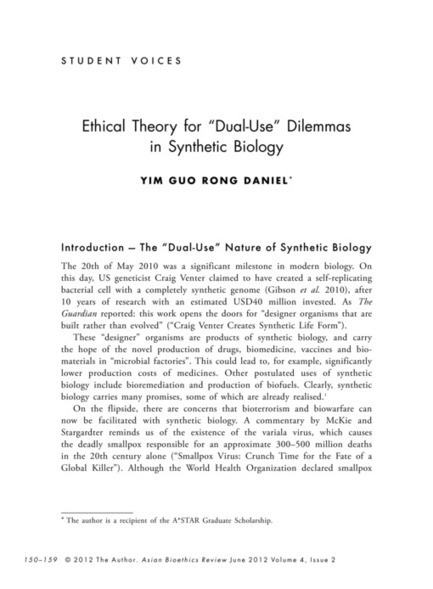
Ethical Theory for "Dual-Use" Dilemmas in Synthetic Biology
by Yim Guo Rong Daniel "The 20th of May 2010 was a significant milestone in modern biology. On this day, US geneticist Craig Venter claimed to have created a self-replicating bacterial cell with a completely synthetic genome (Gibson et al. 2010), after 10 years of research with an estimated USD40 million invested. As The Guardian reported: this work opens the doors for "designer organisms that are built rather than evolved" ("Craig Venter Creates Synthetic Life Form").
These "designer" organisms are products of synthetic biology, and carry the hope of the novel production of drugs, biomedicine, vaccines and bio-materials in "microbial factories". This could lead to, for example, significantly lower production costs of medicines. Other postulated uses of synthetic biology include bioremediation and production of biofuels. Clearly, synthetic biology carries many promises, some of which are already realised.
On the flipside, there are concerns that bioterrorism and biowarfare can now be facilitated with synthetic biology. A commentary by McKie and Stargardter reminds us of the existence of the variala virus, which causes the deadly smallpox responsible for an approximate 300-500 million deaths in the 20th century alone ("Smallpox Virus: Crunch Time for the Fate of a Global Killer"). Although the World Health Organization declared smallpox eradicated in 1980, the causative virus still exists for research purposes. With the advent of synthetic biology, and readily available information about "standard biological parts" in public databases"("Registry of Standard Biological Parts"), the assembly of synthetic viruses (not limited to the variala virus) for military use is a possibility, and the threat of bioterrorism is of great concern to many. The apparent benefits of synthetic biology are thus accompanied by prospective harms; it potentially can be used for both peaceful and destructive aims, illustrating the "dual-use" nature of the technology. ........" http://bit.ly/MwhVHY
Today we might witness the kickstart of a new field in #syntheticbiology
There are three papers in Nature which I would like to highlight:
1) *Structure, function and diversity of the healthy human micro biome* (open access - thanks a lot) The Human Microbiome Project Consortium "Studies of the human microbiome have revealed that even healthy individuals differ remarkably in the microbes that occupy habitats such as the gut, skin and vagina. Much of this diversity remains unexplained, although diet, environment, host genetics and early microbial exposure have all been implicated. Accordingly, to characterize the ecology of human-associated microbial communities, the Human Microbiome Project has analysed the largest cohort and set of distinct, clinically relevant body habitats so far. We found the diversity and abundance of each habitat’s signature microbes to vary widely even among healthy subjects, with strong niche specialization both within and among individuals. The project encountered an estimated 81–99% of the genera, enzyme families and community configurations occupied by the healthy Western microbiome. Metagenomic carriage of metabolic pathways was stable among individuals despite variation in community structure, and ethnic/racial background proved to be one of the strongest associations of both pathways and microbes with clinical metadata. These results thus delineate the range of structural and functional configurations normal in the microbial communities of a healthy population, enabling future characterization of the epidemiology, ecology and translational applications of the human micro biome." http://bit.ly/KwJzGZ
2) A framework for human micro biome research (open access - thanks again) The Human Microbiome Project Consortium "A variety of microbial communities and their genes (the microbiome) exist throughout the human body, with fundamental roles in human health and disease. The National Institutes of Health (NIH)-funded Human Microbiome Project Consortium has established a population-scale framework to develop metagenomic protocols, resulting in a broad range of quality-controlled resources and data including standardized methods for creating, processing and interpreting distinct types of high-throughput metagenomic data available to the scientific community. Here we present resources from a population of 242 healthy adults sampled at 15 or 18 body sites up to three times, which have generated 5,177 microbial taxonomic profiles from 16S ribosomal RNA genes and over 3.5 terabases of metagenomic sequence so far. In parallel, approximately 800 reference strains isolated from the human body have been sequenced. Collectively, these data represent the largest resource describing the abundance and variety of the human microbiome, while providing a framework for current and future studies." http://bit.ly/MJM3wM
3) Human gut microbiome viewed across age and geography by Tanya Yatsunenko, Federico E. Rey, Mark J. Manary, Indi Trehan, Maria Gloria Dominguez-Bello, Monica Contreras, Magda Magris, Glida Hidalgo, Robert N. Baldassano, Andrey P. Anokhin, Andrew C. Heath, Barbara Warner, Jens Reeder, Justin Kuczynski, J. Gregory Caporaso, Catherine A. Lozupone, Christian Lauber, Jose Carlos Clemente, Dan Knights, Rob Knight & Jeffrey I. Gordon "Gut microbial communities represent one source of human genetic and metabolic diversity. To examine how gut microbiomes differ among human populations, here we characterize bacterial species in fecal samples from 531 individuals, plus the gene content of 110 of them. The cohort encompassed healthy children and adults from the Amazonas of Venezuela, rural Malawi and US metropolitan areas and included mono- and dizygotic twins. Shared features of the functional maturation of the gut microbiome were identified during the first three years of life in all three populations, including age-associated changes in the genes involved in vitamin biosynthesis and metabolism. Pronounced differences in bacterial assemblages and functional gene repertoires were noted between US residents and those in the other two countries. These distinctive features are evident in early infancy as well as adulthood. Our findings underscore the need to consider the microbiome when evaluating human development, nutritional needs, physiological variations and the impact of westernization." http://bit.ly/MtHWHH
In respect to #synbio there has been an interesting comments on Microbiome Engineering by James Collins and his coworkers:
"The human microbiome—the microorganisms associated with the human body—is a complex ecosystem increasingly implicated as a regulator of host physiology. It numbers over 1000 species and outnumbers human cells by a factor of 10 to 100 (23). As microbiome constituents are typical- ly well-tolerated, naturally commensal microor- ganisms, they are potentially excellent vectors for deploying synthetic gene circuits to fight disease and correct aberrant conditions. Social interac- tions within and between species also play a crit- ical role in microbiome communities (24, 25) and could be harnessed. Along these lines, Duan and March recently used E. coli to prevent cholera infection by engineering a synthetic interaction between gut microbes (26). During cholera infection, Vibrio cholerae secrete virulence factors, such as cholera toxin (CT), only at low population density. To assess its own density, V. cholerae uses quorum sensing, a process in which autoinducer signaling molecules are both secreted and detected by mem- bers of a population. V. cholerae detects levels of cholera autoinducer 1 (CAI-1) and autoinducer 2 (AI-2), and when both are high, ceases expression of virulence factors. Duan and March took advan- tage of this mechanism and engineered E. coli that produce AI-2 to also secrete CAI-1 (Fig. 3). When infant mice ingested the engineered E. coli 8 hours before V. cholerae ingestion, their survival rate increased dramatically and cholera toxin in- testinal binding was reduced by 80%. Alternatively, a patient’s microbiome could be engineered to deliver therapeutic molecules di- rectly to the body. For example, commensal bac- teria strains have been engineered to secrete key molecules for potential disease treatment, includ- ing insulinotropic proteins for diabetes (27), an HIV fusion inhibitor peptide for prevention of HIV infection (28), and interleukin-2 for immu- notherapy (29). Although these studies showed effective expression of therapeutically relevant molecules, each would benefit from the develop- ment and use of synthetic circuits. By placing, for example, the expression of therapeutic molecules under the control of cell-based sensors that detect aberrant, pathological conditions, gene expres- sion could be turned on and tuned accordingly only when the prescribed molecular interventions are needed, reducing metabolic load on the bacte- ria and increasing their ability to assimilate into the micro biome." see: Synthetic Biology Moving into the Clinic, by Warren C. Ruder, Ting Lu, James J. Collins http://bit.ly/NBj82O
Morshed N, Chetty M, Nguyen VX. "BACKGROUND: Understanding gene interactions is a fundamental question in systems biology. Currently, modeling of gene regulations using the Bayesian Network (BN) formalism assumes that genes interact either instantaneously or with a certain amount of time delay. However in reality, biological regulations, both instantaneous and time-delayed, occur simultaneously. A framework that can detect and model both these two types of interactions simultaneously would represent gene regulatory networks more accurately. RESULTS: In this paper, we introduce a framework based on the Bayesian Network (BN) formalism that can represent both instantaneous and time-delayed interactions between genes simultaneously. A novel scoring metric having rm mathematical underpinnings is also proposed that, unlike other recent methods, can score both interactions concurrently and takes into account the reality that multiple regulators can regulate a gene jointly, rather than in an isolated pair-wise manner. Further, a gene regulatory network (GRN) inference method employing an evolutionary search that makes use of the framework and the scoring metric is also presented. CONCLUSION: By taking into consideration the biological fact that both instantaneous and time-delayed regulations can occur among genes, our approach models gene interactions with greater accuracy. The proposed framework is efcient and can be used to infer gene networkshaving multiple orders of instantaneous and time-delayed regulations simultaneously. Experiments are carried out using three different synthetic networks (with three different mechanisms for generating synthetic data) as well as real life networks of Saccharomyces cerevisiae, E. coli and cyanobacteria gene expression data. The results show the effectiveness of our approach."
To get content containing either thought or leadership enter:
To get content containing both thought and leadership enter:
To get content containing the expression thought leadership enter:
You can enter several keywords and you can refine them whenever you want. Our suggestion engine uses more signals but entering a few keywords here will rapidly give you great content to curate.


 Your new post is loading...