Ackermann M, Clément-Ziza M, Michaelson JJ, Beyer A.
"Expression quantitative trait loci (eQTL) mapping is a widely used technique to uncover regulatory relationships between genes. A range of methodologies have been developed to map links between expression traits and genotypes. The DREAM (Dialogue on Reverse Engineering Assessments and Methods) initiative is a community project to objectively assess the relative performance of different computational approaches for solving specific systems biology problems. The goal of one of the DREAM5 challenges was to reverse-engineer genetic interaction networks from synthetic genetic variation and gene expression data, which simulates the problem of eQTL mapping. In this framework, we proposed an approach whose originality resides in the use of a combination of existing machine learning algorithms (committee). Although it was not the best performer, this method was by far the most precise on average. After the competition, we continued in this direction by evaluating other committees using the DREAM5 data and developed a method that relies on Random Forests and LASSO. It achieved a much higher average precision than the DREAM best performer at the cost of slightly lower average sensitivity."
George Church, the co-author of Regenesis points to nanotechnology and genome engineering as emerging fields that have led us to the threshold of a new era of bioengineering.
"Synthetic biologists often seek to create gene networks that execute defined tasks, but the application of these networks in undefined systems offers important orthogonal tests of our ability to engineer biology. Miller et al. now explore the interplay of design and disorder in a conceptual framework suitable for creating a stable population of stem cells and differentiated β-cells. The authors first designed and modeled a system including four…"
Tomonori Kawano, Francois Bouteau and Stefano Mancuso
"The automata theory is the mathematical study of abstract machines commonly studied in the theoretical computer science and highly interdisciplinary fields that combine the natural sciences and the theoretical computer science. In the present review article, as the chemical and biological basis for natural computing or informatics, some plants, plant cells or plant-derived molecules involved in signaling are listed and classified as natural sequential machines (namely, the Mealy machines or Moore machines) or finite state automata. By defining the actions (states and transition functions) of these natural automata, the similarity between the computational data processing and plant decision-making processes became obvious. Finally, their putative roles as the parts for plant-based computing or robotic systems are discussed." http://bit.ly/NiXAnk
Liss M, Daubert D, Brunner K, Kliche K, Hammes U, Leiherer A, Wagner R.
"As synthetic biology advances, labeling of genes or organisms, like other high-value products, will become important not only to pinpoint their identity, origin, or spread, but also for intellectual property, classification, bio-security or legal reasons. Ideally information should be inseparably interlaced into expressed genes. We describe a method for embedding messages within open reading frames of synthetic genes by adapting steganographic algorithms typically used for watermarking digital media files. Text messages are first translated into a binary string, and then represented in the reading frame by synonymous codon choice. To aim for good expression of the labeled gene in its host as well as retain a high degree of codon assignment flexibility for gene optimization, codon usage tables of the target organism are taken into account. Preferably amino acids with 4 or 6 synonymous codons are used to comprise binary digits. Several different messages were embedded into open reading frames of T7 RNA polymerase, GFP, human EMG1 and HIV gag, variously optimized for bacterial, yeast, mammalian or plant expression, without affecting their protein expression or function. We also introduced Vigenère polyalphabetic substitution to cipher text messages, and developed an identifier as a key to deciphering codon usage ranking stored for a specific organism within a sequence of 35 nucleotides."
Joel M. Hymana, Erika I. Geiheb, Brian M. Trantowb, Bahram Parvina, and Paul A. Wender
"Interest in algae has significantly accelerated with the increasing recognition of their potentially unique role in medical, materials, energy, bioremediation, and synthetic biological research. However, the introduction of tools to study, control, or expand the inner-workings of algae has lagged behind. Here we describe a general molecular method based on guanidinium-rich molecular transporters (GR-MoTrs) for bringing small and large cargos into algal cells. Significantly, this method is shown to work in wild-type algae that have an intact cell wall. Developed using Chlamydomonas reinhardtii, this method is also successful with less studied algae including Neochloris oleoabundans and Scenedesmus dimorphus thus providing a new and versatile tool for algal research"
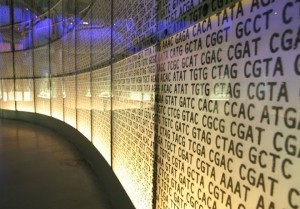
"DNA encodes the information for all the proteins inside the cell, their amino acid sequence, when and where to turn them on, and a whole lot of other things that we probably don’t fully understand yet. With the ability to write DNA, to synthesize our own arbitrary stretches of A’s, T’s, C’s, and G’s, we can create our own instructions for cellular proteins or we can encode sequences that would be “junk” to a cell but that we could read as a message. This week, George Church, Yuan Gao, and Sri Kosuri published a short paper demonstrating that not only could we encode a few phrases here and there, but write a whole book in DNA. The book, Church’s Regenesis: How Synthetic Biology Will Reinvent Nature and Ourselves, which will be published using more traditional means this fall, includes 53,426 words, 11 jpgs, and one JavaScript program. The text and images were converted to html format and then read as bits, 1′s and 0′s that can be easily encoded into DNA: A or C for 0 and T or G for 1. Having two possible letters for each bit means that the sequence won’t end up with long stretches of any single letter, a challenge for chemical DNA synthesis. The perl code they used to covert bits to DNA is available in the paper’s supplementary information (PDF)...." http://bit.ly/PJDLLx
"When it comes to storing information, hard drives don’t hold a candle to DNA. Our genetic code packs billions of gigabytes into a single gram. A mere milligram of the molecule could encode the complete text of every book in the Library of Congress and have plenty of room to spare. All of this has been mostly theoretical — until now. In a new study, researchers stored an entire genetics textbook in less than a picogram of DNA — one trillionth of a gram — an advance that could revolutionize our ability to save data.
A few teams have tried to write data into the genomes of living cells. But the approach has a couple of disadvantages. First, cells die — not a good way to lose your term paper. They also replicate, introducing new mutations over time that can change the data.
To get around these problems, a team led by George Church, a synthetic biologist at Harvard Medical School in Boston, created a DNA information-archiving system that uses no cells at all. Instead, an inkjet printer embeds short fragments of chemically synthesized DNA onto the surface of a tiny glass chip. To encode a digital file, researchers divide it into tiny blocks of data and convert these data not into the 1s and 0s of typical digital storage media, but rather into DNA’s four-letter alphabet of As, Cs, Gs, and Ts. Each DNA fragment also contains a digital “barcode” that records its location in the original file. Reading the data requires a DNA sequencer and a computer to reassemble all of the fragments in order and convert them back into digital format. The computer also corrects for errors; each block of data is replicated thousands of times so that any chance glitch can be identified and fixed by comparing it to the other copies...."
7.342 *Systems and Synthetic Biology*: How the Cell Solves Problems (MIT) A millennial challenge in biology is to decipher how vast arrays of molecular interactions inside the cell work in concert to produce a cellular function. Systems biology, a new interdisciplinary field of science, brings together biologists and physicists to tackle this grand challenge through quantitative experiments and models. In this course, we will discuss the unifying principles that all organisms use to perform cellular functions. We will also discuss key challenges faced by a cell in both single and multi-cellular organisms. Finally, we will discuss how researchers in the field of synthetic biology are using the new knowledge gained from studying naturally-occurring biological systems to create artificial gene networks capable of performing new functions. 7.342 Systems and Synthetic Biology: How the Cell Solves Problems (MIT) course is one of many Advanced Undergraduate Seminars offered by the Biology Department at MIT. These seminars are tailored for students with an interest in using primary research literature to discuss and learn about current biological research in a highly interactive setting. Many instructors of the Advanced Undergraduate Seminars are postdoctoral scientists with a strong interest in teaching. Source: Massachusetts Institute of Technology Language: English Author: Youk, Hyun Lisence Terms: Content within individual OCW courses is (c) by the individual authors unless otherwise noted. MIT OpenCourseWare materials are licensed by the Massachusetts Institute of Technology under a Creative Commons License (Attribution-NonCommercial-ShareAlike). For further information see http://ocw.mit.edu/terms/index.htm Tags: systems biology, synthetic biology, cell, cellular functions, biological systems, artificial gene networks, molecular interactions, molecular biology, genes, RNA, proteins, macromolecules, intracellular biochemical interactions, extracellular molecules, gene expression, stochastic gene expression, Course Publishing Date: Mar 30, 2011
Designer, researchers and scientists Alexandra Daisy Ginsberg, Christina Agapakis and Patrick Boyle in conversation with Intel Futurist Brian David Johnson...
"Professor Pamela Silver of Harvard Medical School (HMS) believes in biology’s potential to change the world.
For example: scientists routinely wield microbes against disease, using computers to turn bacteria into microscopic drug factories rapidly assembled from off-the-shelf biological parts; crops ease world hunger and convert sunlight into biomass; and the cells of astronauts remember if they’ve been damaged by gamma rays, alerting doctors before cancer starts to grow.
Silver, a leader in the relatively new field of synthetic biology, is working toward that future, running multiple projects in two labs that employ nearly two dozen fellows, graduate students, undergraduates, and staff...." http://bit.ly/PFv9C1
*Constructing a genome from parts: challenges and opportunities* - Tom Ellis
52 views Dr Tom Ellis' presentation at the 4th New Phytologist Workshop (Synthetic Biology). More videos and information from the Workshop can be found at: ...
*Synthetic biology and social issues* - Joyce Tait Prof. Joyce Tait's presentation at the 4th New Phytologist Workshop (Synthetic Biology). More videos and information from the Workshop can be found...
*Debugging synthetic biology* - Rainer Breitling
Prof. Rainer Breitling's presentation at the 4th New Phytologist Workshop (Synthetic Biology). More videos and information from the Workshop can be...
*Synthetic plant products for industry* - Rob Edwards
Prof. Rob Edwards' presentation at the 4th New Phytologist Workshop (Synthetic Biology). More videos and information from the Workshop can be found...
*Synthetic biology of antibiotic production* - Eriko Takano 29 views Prof. Eriko Takano's presentation at the 4th New Phytologist Workshop (Synthetic Biology). More videos and information from the Workshop can be fou...
*Synthetic biology from the perspective of protein design and engineering* - Dek Woolfson
Prof. Dek Woolfson's presentation at the 4th New Phytologist Workshop (Synthetic Biology). More videos and information from the Workshop can be fou...
*The sweet spot integrating neurobiology, robotics and synthetic biology* - Joseph Ayers
Prof. Joseph Ayers' presentation at the 4th New Phytologist Workshop (Synthetic Biology). More videos and information from the Workshop can be foun...
*Exploiting a plant virus for synthetic biology applications* - Keith Saunders
Dr Keith Saunders' presentation at the 4th New Phytologist Workshop (Synthetic Biology). More videos and information from the Workshop can be found...
*Polymers as containers and receivers for cell signals*: a new route into synthetic biology?
Prof. Cameron Alexander's presentation at the 4th New Phytologist Workshop (Synthetic Biology). More videos and information from the Workshop can b...
*Science outreach and synthetic biology* - Jenni Rant
Dr Jenni Rant's presentation at the 4th New Phytologist Workshop (Synthetic Biology). More videos and information from the Workshop can be found at...
*Synthetic biology: a combinatorial optimisation problem* - Douglas Kell
Prof. Douglas Kell's presentation at the 4th New Phytologist Workshop (Synthetic Biology). More videos and information from the Workshop can be fou...
How Cambia Is Strengthening the Agricultural Open Source Infrastructure
By Sam Finegold
"You probably associate the “open-source” licensing system with software (Linux and the Apache web server). But the original open source innovators weren’t coders: They were farmers. For centuries farmers optimized their crops and livestock by breeding and selection, and retained the best plants or animals and shared the seed or lines with other farmers, who then further improved on them. This represents the conventional model of open-source licensing: where a party can use and develop a product, and then use that technology to profit as long as they do not block others improving upon that technology. In the 20th century the business model of seed supply drifted away from open source. The many legal changes that occurred (The Plant Patent Act of 1930 and the Plant Variety Protection Act of 1970) gradually shifted emphasis onto private control of collections of genetic traits, or “germplasm.” As plant varieties became privatized and commoditized, corporations began to take more control of the innovation process. Economic and reputational incentives began to overshadow philosophical considerations of how publicly funded research translates into public good.[1] Sharing of technologies was deemphasized. By the mid-1980s patent policy allowed the full patent protection for open pollinated plants and genetic material and excluded farmers from reselling seeds to one another.[2] The last consolidation of control came during the 1990s when the developing world adopted the industrialized model of treating plant genes as items of “commerce.”[3] As germplasm became increasingly an object of profit rather than open-source sharing, corporations began to spend enormous amounts on security to protect their agricultural microbiological assets, many times in court. Monsanto, one of the world’s largest agricultural biotech firms, even contemplated using (but never used due to its unpopularity) a “terminator” plant that produced infertile seeds, which would prevent farmers from reusing the genetically modified organism, or GMO. Today six companies control 70 percent of agricultural biotech and continue to be embroiled in lawsuits with farmers and each other. This corporate control quashes innovation at the academic and small-business levels. An open-source platform for bioinnovation? The biotechnology revolution has failed to answer gaping problems facing humans: hunger, natural resource stewardship, and disease prevention. The agricultural biotechnology business model is structured such that corporations are the only players who can amass all of the necessary components of innovation...."
HMS professor leads effort to streamline biological engineering
"rofessor Pamela Silver of Harvard Medical School (HMS) believes in biology’s potential to change the world. She sees a future where scientists routinely wield microbes against disease, using computers to turn bacteria into microscopic drug factories rapidly assembled from off-the-shelf biological parts. She sees crops easing world hunger after being enhanced with the genes of extreme bacteria that give plants a second way to convert sunlight into biomass. She sees a future where the cells of astronauts remember if they’ve been damaged by gamma rays, alerting doctors before cancer starts to grow. Silver, a leader in the relatively new field of synthetic biology, is working toward that future, running multiple projects in two labs that employ nearly two dozen fellows, graduate students, undergraduates, and staff, all in an effort to discover or design biological elements that are simple and inexpensive. To Silver, who traces the discipline’s roots to a meeting at the Massachusetts Institute of Technology (MIT) a decade ago at which she was the only molecular biologist, synthetic biology seeks to take the trial and error out of biological engineering by creating biological elements whose properties are known and can fit together in predictable ways to build useful systems. “They posed the question [at the meeting], ‘Why can’t biology be faster, more predictable, and easier to engineer?’ For me, that was the foundation of synthetic biology,” Silver said....."
"Algae constitute a widespread, highly varied group of primarily photosynthetic organisms found in many ecological niches. The roughly estimated 300,000 species range in size and complexity from small to very large, and unicellular to multicellular, respectively. Moreover, their properties are equally diverse in terms of applications, having a potentially unique role in medical, materials, energy, bioremediation, and synthetic biological research. That being said, methods for investigating and making use of algal biology have been slow to emerge. Recently, however, scientists at Stanford University and Lawrence Berkeley National Laboratory have devised a general-purpose molecular technique that allows cargoes of various sizes to be transported through the algal cell wall and membrane, thereby accessing the intracellular algal space."
More information: A molecular method for the delivery of small molecules and proteins across the cell wall of algae using molecular transporters, PNAS August 14, 2012 vol. 109 no. 33 13225-13230, doi:10.1073/pnas.1202509109 http://bit.ly/TQbNgo
Martin Jinek, Krzysztof Chylinski, Ines Fonfara, Michael Hauer, Jennifer A. Doudna, Emmanuelle Charpentier
"Clustered regularly interspaced short palindromic repeats (CRISPR)/CRISPR-associated (Cas) systems provide bacteria and archaea with adaptive immunity against viruses and plasmids by using CRISPR RNAs (crRNAs) to guide the silencing of invading nucleic acids. We show here that in a subset of these systems, the mature crRNA that is base-paired to trans-activating crRNA (tracrRNA) forms a two-RNA structure that directs the CRISPR-associated protein Cas9 to introduce double-stranded (ds) breaks in target DNA. At sites complementary to the crRNA-guide sequence, the Cas9 HNH nuclease domain cleaves the complementary strand, whereas the Cas9 RuvC-like domain cleaves the noncomplementary strand. The dual-tracrRNA:crRNA, when engineered as a single RNA chimera, also directs sequence-specific Cas9 dsDNA cleavage. Our study reveals a family of endonucleases that use dual-RNAs for site-specific DNA cleavage and highlights the potential to exploit the system for RNA-programmable genome editing." http://bit.ly/NKtTxD
To get content containing either thought or leadership enter:
To get content containing both thought and leadership enter:
To get content containing the expression thought leadership enter:
You can enter several keywords and you can refine them whenever you want. Our suggestion engine uses more signals but entering a few keywords here will rapidly give you great content to curate.


 Your new post is loading...