Your new post is loading...

|
Scooped by
Gerd Moe-Behrens
July 23, 2018 6:19 PM
|
In synthetic biology, the control of gene expression requires a multistep processing of biological signals. The key steps are sensing the environment, computing information and outputting products1. To achieve such functions, the laborious, combinational networking of enzymes and substrate-genes is required, and to resolve problems, sophisticated design automation tools have been introduced2. However, the complexity of genetic circuits remains low because it is difficult to completely avoid crosstalk between the circuits. Here, we have made an orthogonal self-contained device by integrating an actuator and sensors onto a DNA origami-based nanochip that contains an enzyme, T7 RNA polymerase (RNAP) and multiple target-gene substrates. This gene nanochip orthogonally transcribes its own genes, and the nano-layout ability of DNA origami allows us to rationally design gene expression levels by controlling the intermolecular distances between the enzyme and the target genes. We further integrated reprogrammable logic gates so that the nanochip responds to water-in-oil droplets and computes their small RNA (miRNA) profiles, which demonstrates that the nanochip can function as a gene logic-chip. Our approach to component integration on a nanochip may provide a basis for large-scale, integrated genetic circuits.
|
|
Scooped by
Gerd Moe-Behrens
July 21, 2018 6:17 PM
|
Nature is a diverse and rich source of bioactive pathways or novel building blocks for synthetic biology. In this Perspective, we describe the emerging research field in which metagenomes are functionally interrogated using synthetic biology. This approach substantially expands the set of identified biological activities and building blocks. In reviewing this field, we find that its potential for new biological discovery is dramatically increasing. Functional metagenomic mining using genetic circuits has led to the discovery of novel bioactivity such as amidases, NF-κB modulators, naphthalene degrading enzymes, cellulases, lipases and transporters. Using these genetic circuits as a template, improvements are made by designing biosensors, such as in vitro–evolved riboswitches and computationally redesigned transcription factors. Thus, powered by the rapidly expanding repertoire of biosensors and streamlined processes for automated genetic circuit design, a greater variety of complex selection circuits can be built, with resulting impacts on drug discovery and industrial biotechnology.
|
|
Scooped by
Gerd Moe-Behrens
July 18, 2018 6:52 PM
|
Researchers are developing innovative biohybrid systems with information processing functionality.
|
|
Scooped by
Gerd Moe-Behrens
July 17, 2018 6:53 PM
|
July 17, 2018 -- To address a worldwide need for data storage that far outstrips today's capabilities, federal agencies and a technology research...
|
|
Scooped by
Gerd Moe-Behrens
July 16, 2018 7:08 PM
|
CRISPR has been heralded as one of the most important breakthroughs in modern science, but there could be a hidden and potentially dangerous side effect to the wonders of its genetic editing technology, a new study reveals.
A systematic investigation of CRISPR/Cas9 genome editing in mouse and human cells has discovered that the technique appears to frequently cause extensive mutations and genetic damage that the researchers say wouldn't be detected by existing DNA tests.
"This is the first systematic assessment of unexpected events resulting from CRISPR/Cas9 editing in therapeutically relevant cells," explains geneticist Allan Bradley from the Wellcome Sanger Institute in the UK.
"We found that changes in the DNA have been seriously underestimated before now."
It's not the first time scientists have raised alarm about the potential pitfalls of CRISPR.
In May last year, a team from Columbia University made headlines when they announced the genetic editing toolkit could introduce hundreds of off-target mutations to the genome.
Those claims were later retracted when the scientists involved in the original study were unable to replicate their own results, but since then other research has also suggested CRISPR could cause dangerous side effects.
To investigate these kinds of possibilities further, Bradley and fellow researchers examined the effects of the technique on mouse stem cells and human retinal epithelial cells.
"My initial experiment used CRISPR/Cas9 as a tool to study gene activity, however it became clear that something unexpected was happening," says the first author of the new study, PhD student Michael Kosicki.
"Once we realised the extent of the genetic rearrangements we studied it systematically, looking at different genes and different therapeutically relevant cell lines, and showed that the CRISPR/Cas9 effects held true."
Those effects included large deletions or mutations that happened even several thousand DNA bases (aka kilobases) away from the target site where CRISPR/Cas9 was used to make the edit.
Not only could such significant mutations of the DNA code have potentially harmful effects – by disrupting healthy gene and cellular functioning – but the researchers warn that standard DNA genotyping assays may not ordinarily pick up on these mistakes.
In the worst-case scenario, if such mangled edits were introduced into humans in a CRISPR/Cas9 treatment, important genes might end up being switched on or off, which could make for potentially serious health consequences.
"In the clinical context of editing many billions of cells, the multitude of different mutations generated makes it likely that one or more edited cells in each protocol would be endowed with an important pathogenic lesion," the authors write.
"Such lesions may constitute a first carcinogenic 'hit' in stem cells and progenitors, which have a long replicative lifespan and may become neoplastic [promoting abnormal growths] with time."
If such unforeseen side effects can indeed be introduced by using CRISPR/Cas9 to snip at the genome, the researchers say it's imperative for future clinical applications to address the risks.
And it's likely a lot more research will be needed to find out whether it's possible to prevent such editing errors from arising.
"It is important that anyone thinking of using this technology for gene therapy proceeds with caution," Bradley says, "and looks very carefully to check for possible harmful effects."
The findings are reported in Nature Biotechnology.
|
|
Scooped by
Gerd Moe-Behrens
July 14, 2018 7:21 PM
|
Cell-free synthetic biology is an exciting and new branch in the field of synthetic biology. Based on in vitro transcription and translation systems, this application-focused domain builds on decades of cell-free biochemistry and protein expression to operate synthetic gene networks outside of cellular environments. This has brought new and perhaps even unexpected advantages. Chief among these is the ability to operate genetically encoded tools in a sterile and abiotic format. Recent work has extended this advantage by freeze-drying these cell-free systems into dried pellets or embedded paper-based reactions. Taken together, these new ideas have solved the longstanding challenge of how to deploy poised synthetic gene networks in a biosafe mode outside of the laboratory. There is significant excitement in the potential of this newfound venue and the community has begun to extend proof-of-concept demonstrations in important and creative ways. Here I explore these new efforts and provide my thoughts on the challenges and opportunities ahead for freeze-dried, cell-free synthetic biology.
|
|
Scooped by
Gerd Moe-Behrens
July 13, 2018 12:43 PM
|
Synthetic biology is a growing interdisciplinary field, with far-reaching applications, which aims to design biochemical systems that behave in a desired manner. With the advancement in nucleic-acid-based technology in general, and strand-displacement DNA computing in particular, a large class of abstract biochemical networks may be physically realized using nucleic acids. Methods for systematic design of the abstract systems with prescribed behaviours have been predominantly developed at the (less-detailed) deterministic level. However, stochastic effects, neglected at the deterministic level, are increasingly found to play an important role in biochemistry. In such circumstances, methods for controlling the intrinsic noise in the system are necessary for a successful network design at the (more-detailed) stochastic level. To bridge the gap, the noise-control algorithm for designing biochemical networks is developed in this paper. The algorithm structurally modifies any given reaction network under mass-action kinetics, in such a way that (i) controllable state-dependent noise is introduced into the stochastic dynamics, while (ii) the deterministic dynamics are preserved. The capabilities of the algorithm are demonstrated on a production-decay reaction system, and on an exotic system displaying bistability. For the production-decay system, it is shown that the algorithm may be used to redesign the network to achieve noise-induced multistability. For the exotic system, the algorithm is used to redesign the network to control the stochastic switching, and achieve noise-induced oscillations.
|
|
Scooped by
Gerd Moe-Behrens
July 12, 2018 6:56 PM
|
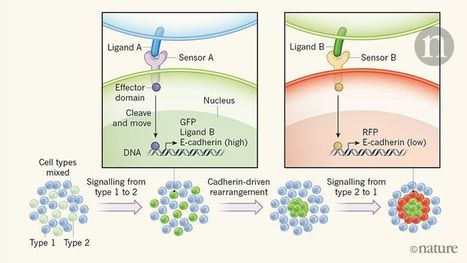
A common theme in the self-organization of multicellular tissues is the use of cell-cell signaling networks to induce morphological changes. We used the modular synNotch juxtacrine signaling platform to engineer artificial genetic programs in which specific cell-cell contacts induced changes in cadherin cell adhesion. Despite their simplicity, these minimal intercellular programs were sufficient to yield assemblies with hallmarks of natural developmental systems: robust self-organization into multidomain structures, well-choreographed sequential assembly, cell type divergence, symmetry breaking, and the capacity for regeneration upon injury. The ability of these networks to drive complex structure formation illustrates the power of interlinking cell signaling with cell sorting: Signal-induced spatial reorganization alters the local signals received by each cell, resulting in iterative cycles of cell fate branching. These results provide insights into the evolution of multicellularity and demonstrate the potential to engineer customized self-organizing tissues or materials.
|
|
Scooped by
Gerd Moe-Behrens
July 10, 2018 5:10 PM
|
With the emergence of inexpensive 3D printing technology, open-source platforms for electronic prototyping and single-board computers, ‘Do it Yourself’ (DIY) approaches to cultivation of microbial cultures are becoming more feasible, user-friendly and thus wider spread. In this perspective, we survey some of these approaches, as well as add-on solutions to commercial instruments for synthetic and system biology applications. We discuss different cultivation designs, including capabilities and limitations. Our intention is to encourage the reader to consider DIY solutions. Overall, custom cultivation devices offer controlled growth environments with in-line monitoring of, for example, optical density, fluorescence, pH, and dissolved oxygen, all at affordable prices. Moreover, they offer a great degree of flexibility for different applications and requirements and are fun to design and construct. We include several illustrative examples, such as gaining optogenetic control, and adaptive laboratory evolution experiments.
|
|
Scooped by
Gerd Moe-Behrens
July 9, 2018 3:07 PM
|
Researchers made a neural network out of DNA that can recognize handwritten numbers.
|
|
Scooped by
Gerd Moe-Behrens
July 7, 2018 7:05 PM
|
From bacteria following simple chemical gradients1 to the brain distinguishing complex odour information2, the ability to recognize molecular patterns is essential for biological organisms. This type of information-processing function has been implemented using DNA-based neural networks3, but has been limited to the recognition of a set of no more than four patterns, each composed of four distinct DNA molecules. Winner-take-all computation4 has been suggested5,6 as a potential strategy for enhancing the capability of DNA-based neural networks. Compared to the linear-threshold circuits7 and Hopfield networks8 used previously3, winner-take-all circuits are computationally more powerful4, allow simpler molecular implementation and are not constrained by the number of patterns and their complexity, so both a large number of simple patterns and a small number of complex patterns can be recognized. Here we report a systematic implementation of winner-take-all neural networks based on DNA-strand-displacement9,10 reactions. We use a previously developed seesaw DNA gate motif3,11,12, extended to include a simple and robust component that facilitates the cooperative hybridization13 that is involved in the process of selecting a ‘winner’. We show that with this extended seesaw motif DNA-based neural networks can classify patterns into up to nine categories. Each of these patterns consists of 20 distinct DNA molecules chosen from the set of 100 that represents the 100 bits in 10 × 10 patterns, with the 20 DNA molecules selected tracing one of the handwritten digits ‘1’ to ‘9’. The network successfully classified test patterns with up to 30 of the 100 bits flipped relative to the digit patterns ‘remembered’ during training, suggesting that molecular circuits can robustly accomplish the sophisticated task of classifying highly complex and noisy information on the basis of similarity to a memory.
|
|
Scooped by
Gerd Moe-Behrens
July 6, 2018 6:41 PM
|
Recently there have been notable synthetic successes in supramolecular polymerization. By contrast, it has long been known that DNA can undergo supramolecular polymerization (concatemerization). Concatemerization is a step-like polymerization and consequently suffers from broad molecular weight distributions and generally undesirable cyclization reactions. Here we demonstrate that another supramolecular polymerization of DNA, hybridization chain reaction (HCR), is in fact a living polymerization. After consumption of initial monomer, the polymerization can be continued with further addition of monomer, and the molecular weight can be varied by the ratio of monomer to initiator. In contrast to concatemerization, HCR produces polymers with narrow dispersity while avoiding cyclization. Identification of the living character of this supramolecular polymerization presents new opportunities in structural DNA nanotechnology and molecular biology.
|
|
Scooped by
Gerd Moe-Behrens
June 29, 2018 4:20 PM
|
Sensory perception often scales logarithmically with the input level. Similarly, the output response of biochemical systems sometimes scales logarithmically with the input signal that drives the system. How biochemical systems achieve logarithmic sensing remains an open puzzle. This article shows how a biochemical logarithmic sensor can be constructed from the most basic principles of chemical reactions. Assuming that reactions follow the classic Michaelis-Menten kinetics of mass action or the more generalized and commonly observed Hill equation response, the summed output of several simple reactions with different sensitivities to the input will often give an aggregate output response that logarithmically transforms the input. The logarithmic response is robust to stochastic fluctuations in parameter values. This model emphasizes the simplicity and robustness by which aggregate chemical circuits composed of sloppy components can achieve precise response characteristics. Both natural and synthetic designs gain from the power of this aggregate approach.
|
|
|
Scooped by
Gerd Moe-Behrens
July 21, 2018 6:20 PM
|
Synthetic biology applies engineering concepts to build cells that perceive and process information. Examples include cells engineered to perform basic digital or analog computation. These circuits serve as basis for the construction of complex integrated cellular networks that offer manifold applications in fundamental and applied research. Here, we introduce the concept of using design approaches and molecular tools applied in synthetic biology for the construction of interconnected biohybrid materials systems with information processing functionality. We validate this concept by modularly assembling protein and polymer building blocks to generate stimulus-responsive materials. Guided by a quantitative mathematical model, we next interconnect these materials into a materials system that acts as both a signal detector and as an amplifier based on a built-in positive feedback loop. The functionality and versatility of this materials system is demonstrated by the detection of enzymatic activities and drugs. The modular design concept presented here thus represents a blueprint for integrating synthetic biology-inspired information-processing circuits into polymer materials. As integrated sensors and actuators, the resulting smart materials systems could provide novel solutions with broad perspectives in research and development.
|
|
Scooped by
Gerd Moe-Behrens
July 20, 2018 6:17 PM
|
Synthetic biology aims at (re-)programming living cells like computers to perform new functions for a variety of applications. Initial work rested on transcription factors, but regulatory RNAs have recently gained much attention due to their high programmability. However, functional circuits mainly implemented with regulatory RNAs are quite limited. Here, we report the engineering of a fundamental arithmetic logic unit based on de novo riboregulation to sum two bits of information encoded in molecular concentrations. Our designer circuit robustly performs the intended computation in a living cell encoding the result as fluorescence amplitudes. The whole system exploits post-transcriptional control to switch on tightly silenced genes with small RNAs, together with allosteric transcription factors to sense the molecular signals. This important result demonstrates that regulatory RNAs can be key players in synthetic biology, and it paves the way for engineering more complex RNA-based biocomputers using this designer circuit as a building block.
|
|
Scooped by
Gerd Moe-Behrens
July 17, 2018 6:55 PM
|
Josh Hihath is trying to fuse biology and electrical engineering and to build new types of electronic memory based on DNA.Hihath, professor in the UC Davis Department of Electrical and Computer Engineering, is principal investigator of a grant just …Continue reading about DNA-ROM: New Grant Aims ...
|
|
Scooped by
Gerd Moe-Behrens
July 16, 2018 7:09 PM
|
CRISPR–Cas9 is poised to become the gene editing tool of choice in clinical contexts. Thus far, exploration of Cas9-induced genetic alterations has been limited to the immediate vicinity of the target site and distal off-target sequences, leading to the conclusion that CRISPR–Cas9 was reasonably specific. Here we report significant on-target mutagenesis, such as large deletions and more complex genomic rearrangements at the targeted sites in mouse embryonic stem cells, mouse hematopoietic progenitors and a human differentiated cell line. Using long-read sequencing and long-range PCR genotyping, we show that DNA breaks introduced by single-guide RNA/Cas9 frequently resolved into deletions extending over many kilobases. Furthermore, lesions distal to the cut site and crossover events were identified. The observed genomic damage in mitotically active cells caused by CRISPR–Cas9 editing may have pathogenic consequences.
|
|
Scooped by
Gerd Moe-Behrens
July 16, 2018 6:54 PM
|
The fusion of dead Cas9 with KRAB and the transcriptional repressor domain of the chromatin modifier MeCP2 leads to an efficient transcriptional silencer that can be applied to genome-scale screens and genetic circuits.
|
|
Scooped by
Gerd Moe-Behrens
July 14, 2018 7:20 PM
|
The omnipresence of salts in biofluids creates a pervasive challenge in designing sensors suitable for in vivo applications. Fluctuations in ion concentrations have been shown to affect the sensitivity and selectivity of optical sensors based on single-walled carbon nanotubes wrapped with single-stranded DNA (ssDNA-SWCNTs). We herein observe fluorescence wavelength shifting for ssDNA-SWCNT-based optical sensors in the presence of divalent cations at concentrations above 3.5 mM. In contrast, no shifting was observed for concentrations up to 350 mM for sensors bioengineered with increased rigidity using xeno nucleic acids (XNAs). Transient fluorescence measurements reveal distinct optical transitions for ssDNA- and XNA-based wrappings during ion-induced conformation changes, with XNA-based sensors showing increased permanence in conformational and signal stability. This demonstration introduces synthetic biology as a complementary means for enhancing nanotube optoelectronic behaviour, unlocking previously unexplored possibilities for developing nano-bioengineered sensors with augmented capabilities.
|
|
Scooped by
Gerd Moe-Behrens
July 12, 2018 7:07 PM
|
The observation that BRCA1- and BRCA2-deficient cells are sensitive to inhibitors of poly(ADP–ribose) polymerase (PARP) has spurred the development of cancer therapies that use these inhibitors to target deficiencies in homologous recombination1. The cytotoxicity of PARP inhibitors depends on PARP trapping, the formation of non-covalent protein–DNA adducts composed of inhibited PARP1 bound to DNA lesions of unclear origins1,2,3,4. To address the nature of such lesions and the cellular consequences of PARP trapping, we undertook three CRISPR (clustered regularly interspersed palindromic repeats) screens to identify genes and pathways that mediate cellular resistance to olaparib, a clinically approved PARP inhibitor1. Here we present a high-confidence set of 73 genes, which when mutated cause increased sensitivity to PARP inhibitors. In addition to an expected enrichment for genes related to homologous recombination, we discovered that mutations in all three genes encoding ribonuclease H2 sensitized cells to PARP inhibition. We establish that the underlying cause of the PARP-inhibitor hypersensitivity of cells deficient in ribonuclease H2 is impaired ribonucleotide excision repair5. Embedded ribonucleotides, which are abundant in the genome of cells deficient in ribonucleotide excision repair, are substrates for cleavage by topoisomerase 1, resulting in PARP-trapping lesions that impede DNA replication and endanger genome integrity. We conclude that genomic ribonucleotides are a hitherto unappreciated source of PARP-trapping DNA lesions, and that the frequent deletion of RNASEH2B in metastatic prostate cancer and chronic lymphocytic leukaemia could provide an opportunity to exploit these findings therapeutically.
|
|
Scooped by
Gerd Moe-Behrens
July 11, 2018 6:57 PM
|
Researchers from the University of Illinois at Chicago are the first to describe why CRISPR gene editing sometimes fails to work, and how the process can be made to be much more efficient.
CRISPR is a gene-editing tool that allows scientists to cut out unwanted genes or genetic material from DNA, and sometimes add a desired sequence or genes. CRISPR uses an enzyme called Cas9 that acts like scissors to cut out unwanted DNA. Once cuts are made on either side of the DNA to be removed, the cell either initiates repair to glue the two ends of the DNA strand back together, or the cell dies.
In a study published in the journal Molecular Cell, the researchers showed that when gene editing using CRISPR fails, which occurs about 15 percent of the time, it is often due to persistent binding of the Cas9 protein to the DNA at the cut site, which blocks the DNA repair enzymes from accessing the cut.
Senior author Bradley Merrill, associate professor of biochemistry and molecular genetics in the UIC College of Medicine, says that before now, researchers did not know why the process randomly failed.
"We found that at sites where Cas9 was a 'dud' it stayed bound to the DNA strand and prevented the cell from initiating the repair process," Merrill said. The stuck Cas9 is also unable to go on to make additional cuts in DNA, thus limiting the efficiency of CRISPR, he said.
Merrill, UIC graduate student Ryan Clarke, and their colleagues also found that Cas9 was likely to be ineffective at sites in the genome where RNA polymerases—enzymes involved in gene activity—were not active. Further investigation revealed that guiding Cas9 to anneal to just one of the strands making up the DNA double helix promoted interaction between Cas9 and the RNA polymerase, helping to transform a "dud" Cas9 into an efficient genome editor.
Specifically, they found that consistent strand selection for Cas9 during genome editing forced the RNA polymerases to collide with Cas9 in such a way that Cas9 was knocked off the DNA.
"I was shocked that simply choosing one DNA strand over the other had such a powerful effect on genome editing," said Clarke, the lead author of the paper. "Uncovering the mechanism behind this phenomenon helps us better understand how Cas9 interactions with the genome can cause some editing attempts to fail and that, when designing a genome editing experiment, we can use that understanding to our benefit."
"This new understanding is important for those of us who need genome editing to work well in the lab and for making genome editing more efficient and safer in future clinical uses," Merrill said.
The study findings are also significant because, in the genome editing process, the interaction between Cas9 and the DNA strand is now known to be the "rate-limiting step," said Merrill. This means that it is the slowest part of the process; therefore, changes at this stage have the most potential to impact the overall duration of genome editing.
"If we can reduce the time that Cas9 interacts with the DNA strand, which we now know how to do with an RNA polymerase, we can use less of the enzyme and limit exposure," Merrill said. "This means we have more potential to limit adverse effects or side effects, which is vital for future therapies that may impact human patients."
Explore further: Genome-editing tool could increase cancer risk
More information: Ryan Clarke et al, Enhanced Bacterial Immunity and Mammalian Genome Editing via RNA-Polymerase-Mediated Dislodging of Cas9 from Double-Strand DNA Breaks, Molecular Cell (2018). DOI: 10.1016/j.molcel.2018.06.005
|
|
Scooped by
Gerd Moe-Behrens
July 9, 2018 5:08 PM
|
This month, we'll be hearing talks by Stephanie Höhn (DAMTP) about her work on open source light sheet microscopy and Hadrien Peyret (John Innes Centre, Norwich) who is designing an open access plant...
|
|
Scooped by
Gerd Moe-Behrens
July 8, 2018 6:32 PM
|
Eng. Valerian Linus Sanga and Paul Thomas Nyakyi are co-founders of STICLab, a maker space in Dar es Salaam, Tanzania. During this talk, they will explain how maker spaces like STICLab and open source hardware can be leveraged to help tackle local problems around his community.
|
|
Scooped by
Gerd Moe-Behrens
July 7, 2018 6:35 PM
|
Synthetic genetic circuits can induce cells to form simple 3D structures reminiscent of those generated during early embryonic development. This advance will help engineers build tissues that have desirable structures.
|
|
Scooped by
Gerd Moe-Behrens
July 4, 2018 4:35 PM
|
The yeast cytoplasmically-localized pGKL1/TP-DNAP1 plasmid/DNA polymerase pair forms an orthogonal DNA replication system whose mutation rate can be drastically increased without influencing genomic replication, thereby supporting in vivo continuous evolution. Here, we report that the pGKL2/TP-DNAP2 plasmid/DNA polymerase pair forms a second orthogonal replication system. We show that custom genes can be encoded and expressed from pGKL2 in a straightforward manner, that error-prone TP-DNAP2s can be engineered, and that pGKL2 replication by TP-DNAP2 is both orthogonal to genomic replication in Saccharomyces cerevisiae and mutually orthogonal with pGKL1 replication by TP-DNAP1. This demonstration of two mutually orthogonal DNA replication systems with tunable error rates and properties should enable new applications in cell-based continuous evolution, genetic recording, and synthetic biology at large.
|