SynBioFromLeukipposInstitute
130.0K views | +2 today
SynBioFromLeukipposInstitute
Your new post is loading...
Scooped by Gerd Moe-Behrens
January 7, 2014 5:14 AM
Scoop.it!

synbio4all early birds platform presentation - YouTube

Ian explains in this screencast the synbio4all alpha version, give us feedbacks to help us craft the best platform that feets your needs. Follow the group ac...
Gerd Moe-Behrens's insight:

New SynBio learning platform http://bit.ly/1cLFO7D

No comment yet.
Scooped by Gerd Moe-Behrens
January 7, 2014 5:05 AM
Scoop.it!

Synthetic circuit of inositol phosphorylceramide synthase in Leishmania: a chemical biology approach

Gerd Moe-Behrens's insight:

by
Mandlik V, Limbachiya D, Shinde S, Mol M, Singh S

"Building circuits and studying their behavior in cells is a major goal of systems and synthetic biology. Synthetic biology enables the precise control of cellular states for systems studies, the discovery of novel parts, control strategies, and interactions for the design of robust synthetic systems. To the best of our knowledge, there are no literature reports for the synthetic circuit construction for protozoan parasites. This paper describes the construction of genetic circuit for the targeted enzyme inositol phosphorylceramide synthase belonging to the protozoan parasite Leishmania. To explore the dynamic nature of the circuit designed, simulation was done followed by circuit validation by qualitative and quantitative approaches. The genetic circuit designed for inositol phosphorylceramide synthase (Biomodels Database-MODEL1208030000) shows responsiveness, oscillatory and bistable behavior, together with intrinsic robustness."

http://bit.ly/1dseQTy

No comment yet.
Scooped by Gerd Moe-Behrens
January 4, 2014 9:51 AM
Scoop.it!

Biologists Modify Yeast to Produce Malaria Drug

Biologists Modify Yeast to Produce Malaria Drug | SynBioFromLeukipposInstitute | Scoop.it
Cheaper semi-synthetic supplies of artemisinin, along with a new malaria vaccine, may help keep the disease in check.
Gerd Moe-Behrens's insight:

Best of 2013:


http://bit.ly/1leuDwl

No comment yet.
Scooped by Gerd Moe-Behrens
January 3, 2014 2:52 PM
Scoop.it!

Regulating 23andMe to Death Won't Stop the New Age of Genetic Testing

Regulating 23andMe to Death Won't Stop the New Age of Genetic Testing | SynBioFromLeukipposInstitute | Scoop.it
23andMe is an example of what we call a 'big bang disruption'. Often, incumbents’ only competitive response -- or the only one they can think of -- is to run to the regulators.
No comment yet.
Scooped by Gerd Moe-Behrens
January 3, 2014 2:41 PM
Scoop.it!

Genetic Screens in Human Cells Using the CRISPR-Cas9 System

Gerd Moe-Behrens's insight:

by
Tim Wang, Jenny J. Wei, David M. Sabatini, Eric S. Lander

"The bacterial clustered regularly interspaced short palindromic repeats (CRISPR)–Cas9 system for genome editing has greatly expanded the toolbox for mammalian genetics, enabling the rapid generation of isogenic cell lines and mice with modified alleles. Here, we describe a pooled, loss-of-function genetic screening approach suitable for both positive and negative selection that uses a genome-scale lentiviral single-guide RNA (sgRNA) library. sgRNA expression cassettes were stably integrated into the genome, which enabled a complex mutant pool to be tracked by massively parallel sequencing. We used a library containing 73,000 sgRNAs to generate knockout collections and performed screens in two human cell lines. A screen for resistance to the nucleotide analog 6-thioguanine identified all expected members of the DNA mismatch repair pathway, whereas another for the DNA topoisomerase II (TOP2A) poison etoposide identified TOP2A, as expected, and also cyclin-dependent kinase 6, CDK6. A negative selection screen for essential genes identified numerous gene sets corresponding to fundamental processes. Last, we show that sgRNA efficiency is associated with specific sequence motifs, enabling the prediction of more effective sgRNAs. Collectively, these results establish Cas9/sgRNA screens as a powerful tool for systematic genetic analysis in mammalian cells."

http://bit.ly/1d6e0kv

No comment yet.
Scooped by Gerd Moe-Behrens
January 2, 2014 5:12 AM
Scoop.it!

Graham Holdings Co : The Evolving Nature of Synthetic Biology: A Panel Discussion on Key Science, Policy, and Societal Challenges Facing the International Community | 4-Traders

The Evolving Nature of Synthetic Biology: A Panel Discussion on Key Science, Policy, and Societal Challenges Facing the International Community
Remarks
E. William Colglazier, Ph.D.
Science and...
No comment yet.
Scooped by Gerd Moe-Behrens
January 1, 2014 6:06 PM
Scoop.it!

Applications of Membrane Computing in Systems and Synthetic Biology - Springer

Applications of Membrane Computing in Systems and Synthetic Biology - Springer | SynBioFromLeukipposInstitute | Scoop.it
No comment yet.
Scooped by Gerd Moe-Behrens
December 23, 2013 8:52 PM
Scoop.it!

If you like my work and wish to support it with a Christmas present

If you like my work and wish to support it with a Christmas present | SynBioFromLeukipposInstitute | Scoop.it

-

Gerd Moe-Behrens's insight:

 - I like bitcoins :-)

Thanks and Merry Christmas!

1KGaavmadSnGXYRxViVWVWkn4Rf5DQGPUP

No comment yet.
Scooped by Gerd Moe-Behrens
December 22, 2013 12:27 PM
Scoop.it!

Microbial Factories

Gerd Moe-Behrens's insight:

by
anonymous

"Humans have relied on microbes for millennia. Yeast brews our beer and raises our bread. Bacteria in our guts keep us healthy. Microscopic phytoplankton in the ocean produce half of the world’s oxygen.

 Thanks to genetic engineering, technology, and good old evolution, humans are about to enter into a new phase of our ancient partnership. We may soon create bacteria that eat plastic, emit light, and even tell us whether or not we’re healthy. When it comes to microbes, big things come from small packages."


 http://bit.ly/1hwybHf

No comment yet.
Scooped by Gerd Moe-Behrens
December 21, 2013 12:10 PM
Scoop.it!

Network Reverse Engineering Approach in Synthetic Biology

Gerd Moe-Behrens's insight:

by
Zhang, Haoqian; Liu, Ao; Lu, Yuheng; Sheng, Ying; Wu, Qianzhu; Yin, Zhenzhen; Chen, Yiwei; Liu, Zairan; Pan, Heng; Ouyang, Qi

"Synthetic biology is a new branch of interdisciplinary science that has been developed in recent years. The main purpose of synthetic biology is to apply successful principles that have been developed in electronic and chemical engineering to develop basic biological functional modules, and through rational design, develop man-made biological systems that have predicted useful functions. Here, we discuss an important principle in rational design of functional biological circuits: the reverse engineering design. We will use a research project that was conducted at Peking University for the International Genetic Engineering Machine Competition (iGEM) to illustrate the principle: synthesis a cell which has a semi-log dose-response to the environment. Through this work we try to demonstrate the potential application of network engineering in synthetic biology."

 http://bit.ly/1bYusgj

No comment yet.
Scooped by Gerd Moe-Behrens
December 19, 2013 3:53 PM
Scoop.it!

Genetic Microsurgery for the Masses

Gerd Moe-Behrens's insight:

Some of Science 2013 highlights:

1 *Genetic Microsurgery for the Masses*
 http://bit.ly/1fq51IE

2 *Dishing Up Mini-Organs*
 http://bit.ly/1ceEmQW

3 *Your Microbes, Your Health*

 http://bit.ly/1ceEL5Y

No comment yet.
Scooped by Gerd Moe-Behrens
December 19, 2013 12:42 PM
Scoop.it!

New paradigm for tumor theranostic methodology using bacteria-based microrobot

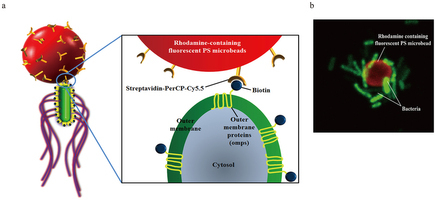
New paradigm for tumor theranostic methodology using bacteria-based microrobot | SynBioFromLeukipposInstitute | Scoop.it
Gerd Moe-Behrens's insight:

by

Sung Jun Park,Seung-Hwan Park,Sunghoon Cho,Deok-Mi Kim,Yeonkyung Lee,Seong Young Ko,Yeongjin Hong,Hyon E. Choy,Jung-Joon Min,Jong-Oh Park& Sukho Park

"We propose a bacteria-based microrobot (bacteriobot) based on a new fusion paradigm for theranostic activities against solid tumors. We develop a bacteriobot using the strong attachment of bacteria to Cy5.5-coated polystyrene microbeads due to the high-affinity interaction between biotin and streptavidin. The chemotactic responses of the bacteria and the bacteriobots to the concentration gradients of lysates or spheroids of solid tumors can be detected as the migration of the bacteria and/or the bacteriobots out of the central region toward the side regions in a chemotactic microfluidic chamber. The bacteriobots showed higher migration velocity toward tumor cell lysates or spheroids than toward normal cells. In addition, when only the bacteriobots were injected to the CT-26 tumor mouse model, Cy5.5 signal was detected from the tumor site of the mouse model. In-vitro and in-vivo tests verified that the bacteriobots had chemotactic motility and tumor targeting ability. The new microrobot paradigm in which bacteria act as microactuators and microsensors to deliver microstructures to tumors can be considered a new theranostic methodology for targeting and treating solid tumors."


http://bit.ly/19ViYtZ

No comment yet.
Scooped by Gerd Moe-Behrens
December 18, 2013 5:08 PM
Scoop.it!

Genspace - Event - Hacking LIFE, A Talk by Shiho Fukuhara

Genspace - Event - Hacking LIFE, A Talk by Shiho Fukuhara | SynBioFromLeukipposInstitute | Scoop.it
Gerd Moe-Behrens's insight:
8:00 PM to 10:00 PM on Wednesday, December 18Location: GenspaceOrganizers: Nurit Bar-ShaiHacking LIFE
A Talk by Shiho Fukuhara

When: Wednesday, Dec 18 2013, 8pm
Doors open at 7:30pm

Where: Genspace, The MEx Building
33 Flatbush Avenue,
Brooklyn NY 11217

Genspace Talks on 2nd Floor !
No comment yet.
Scooped by Gerd Moe-Behrens
January 7, 2014 5:06 AM
Scoop.it!

Reverse Engineering Molecular Hypergraphs

Analysis of molecular interaction networks is pervasive in systems biology. This research relies almost entirely on graphs for modeling interactions.
No comment yet.
Scooped by Gerd Moe-Behrens
January 4, 2014 9:54 AM
Scoop.it!

Researchers Closer To Developing Synthetic Cartilage

Researchers Closer To Developing Synthetic Cartilage | SynBioFromLeukipposInstitute | Scoop.it
Engineers from Duke University have developed a method for creating artificial replacement tissue for cartilage.
No comment yet.
Scooped by Gerd Moe-Behrens
January 3, 2014 3:03 PM
Scoop.it!

Now You Can Give Anyone A Small Tip For A Great Tweet — In Bitcoin

Now You Can Give Anyone A Small Tip For A Great Tweet — In Bitcoin | SynBioFromLeukipposInstitute | Scoop.it
Tippercoin is a free service that lets you show a little appreciation for free online "services."
malek's curator insight, January 4, 2014 8:40 AM

Micro tipping could easily change the landscape of social media, especially with the expected Bitcoin growth.

Scooped by Gerd Moe-Behrens
January 3, 2014 2:47 PM
Scoop.it!

Genome-Scale CRISPR-Cas9 Knockout Screening in Human Cells

Gerd Moe-Behrens's insight:

by
Ophir Shalem, Neville E. Sanjana, Ella Hartenian, Xi Shi, David A. Scott, Tarjei S. Mikkelsen, Dirk Heckl, Benjamin L. Ebert, David E. Root, John G. Doench, Feng Zhang

"The simplicity of programming the CRISPR (clustered regularly interspaced short palindromic repeats)–associated nuclease Cas9 to modify specific genomic loci suggests a new way to interrogate gene function on a genome-wide scale. We show that lentiviral delivery of a genome-scale CRISPR-Cas9 knockout (GeCKO) library targeting 18,080 genes with 64,751 unique guide sequences enables both negative and positive selection screening in human cells. First, we used the GeCKO library to identify genes essential for cell viability in cancer and pluripotent stem cells. Next, in a melanoma model, we screened for genes whose loss is involved in resistance to vemurafenib, a therapeutic RAF inhibitor. Our highest-ranking candidates include previously validated genes NF1 and MED12, as well as novel hits NF2, CUL3, TADA2B, and TADA1. We observe a high level of consistency between independent guide RNAs targeting the same gene and a high rate of hit confirmation, demonstrating the promise of genome-scale screening with Cas9."

http://bit.ly/1l7F3xK

No comment yet.
Scooped by Gerd Moe-Behrens
January 2, 2014 5:23 AM
Scoop.it!

Synthetic biology - James Collins - YouTube

Serious Science - http://serious-science.org
No comment yet.
Scooped by Gerd Moe-Behrens
January 1, 2014 6:13 PM
Scoop.it!

Synthetic biology changing the face of biotechnology

No comment yet.
Scooped by Gerd Moe-Behrens
January 1, 2014 2:53 PM
Scoop.it!

Happy New Year to all of you !!!

_

No comment yet.
Scooped by Gerd Moe-Behrens
December 23, 2013 7:52 PM
Scoop.it!

Happy Holiday

Happy Holiday | SynBioFromLeukipposInstitute | Scoop.it

-

Gerd Moe-Behrens's insight:

I wish you all the best.

No comment yet.
Scooped by Gerd Moe-Behrens
December 21, 2013 6:39 PM
Scoop.it!

How one publisher is stopping academics from sharing their research

Gerd Moe-Behrens's insight:

BY ANDREA PETERSON

"One of the world's largest academic publishers has launched a wide-ranging takedown spree, demanding that several different universities take down their own scholars' research.

Elsevier is a commercial firm that publishes some of the leading journals in many academic fields. In recent weeks, it has sent takedown notices to the academic social media network Academia.edu, as well as to the University of Calgary, the University of California-Irvine, and Harvard University.In these cases, Elsevier is within its legal rights to demand the material be taken down. The firm often requires researchers to surrender their copyrights in a paper as a condition of publishing it. But the takedown campaign goes against a long-standing industry practice in which journal publishers look the other way when academics post their own work.Elsevier's new hard-line posture is likely to intensify a debate over the future of academic publishing. Thanks to the Internet, academics no longer need traditional academic publishers to distribute their research to the world in paper form. And a growing number of researchers are beginning to wonder if legacy publishers are becoming more of an obstacle than an aid to distributing their work. Outrage over Elsevier's takedown spree could intensify their search for alternative models that allow academics to share their work directly—without companies like Elsevier taking such a big cut.The new wave of takedown requestsThe first signs of Elsevier crackdown trickled out online in early December, when Academia.edu saw a huge spike in takedown notices. "In the past we really got one or two takedowns a week," says Academia.edu CEO Richard Price, "Only very recently did Elsevier start sending take-downs in batches of thousands." Price says the company received around 2,800 take-down requests within the course of a few weeks. The site e-mailed notices to the academics affected, explaining why the papers were taken down.Many recipients took to Twitter to express their dismay. But given that Academia.edu is a for-profit company that competes with a similar platform purchased by Elsevier in April of this year, Mendeley, those takedown notices don't seem all that out of the ordinary.But it now appears that the Academia.edu takedowns were part of a broader effort to take down unauthorized copies of articles published in Elsevier journals from across the Internet. Universities were also targeted. Earlier this week, there were reports that the University of Calgary had received takedown requests and was warning faculty about posting their research online hit the academic blogosphere.According to Thomas Hickerson, Vice Provost and Librarian at the University of Calgary, the Canadian university received a letter from a firm called Digimarc, which identified 32 instances where they believed published versions of journal articles had been posted in violation of Elsevier's copyright. These unauthorized copies appeared on the personal pages of faculty, department, and lab class websites.The University complied with the removal request -- and they weren't the only ones. Both the University of California-Irvine and Harvard University have confirmed to the Washington Post that they received similar takedown requests.The letter to Harvard identified 23 articles that it requested be taken down from University-hosted pages in mid November. "We had not received takedown notices for scholarly articles before this, as far as we know," says Peter Suber, the Director of the Harvard Office for Scholarly Communication and the Harvard Open Access Project.How academic publishing worksTraditional publishers see themselves as central to the academic publishing process. And in the 20th century, when academic research was distributed in printed form, that perception was clearly correct. Without access to a printing press, a scholar has no way to distribute his findings to peers around the world.But the Internet threatens to dislodge firms like Elsevier from their central role in the publishing process. Modern online platforms allow papers to be distributed worldwide with the click of a mouse. Some have questioned whether companies like Elsevier are needed at all.Publishers, on the other hand, contend that they are as essential to the academic publishing process as ever. Printing presses aren't as necessary as they used to be, but conventional publishers point to their role in managing the peer review process that determines which research make it into many leading journals.However, that peer review process relies heavily on taxpayer investments and the work of researchers. Academics pursue research, often with the support of public funds. Then they submit an article based on that research to journal publishers, who turn around and send the draft back out to other academics who review the research.Publishers generally don't pay academics for writing the articles or participating in the peer-review process. Then, after an article passes peer-review, the journal publishers sell access to the published research back to the academic institutions on a subscription basis.With academics doing much of the work and the Internet reducing distribution costs, you might expect the cost of academic publishing to fall as the Internet makes communication more efficient. Instead, the opposite has happened. Subscription rates for top academic journals have skyrocketed in recent decades -- with one study reporting per journal subscription costs rose 215 percent between 1986 and 2003, despite the consumer price index only increasing 68 percent in that same time period.More recently, these rising costs coupled with scaled-back library budgets due to the Great Recession have left many universities struggling to maintain access to the body of scholarly work they helped produce. Even one of the world's wealthiest universities, Harvard, has felt the crunch. "Many large journal publishers have made the scholarly communication environment fiscally unsustainable and academically restrictive," said the Harvard Library Faculty Advisory council in a 2012 memo on the subject.But while libraries have been hurting, the system works quite well for the publishers. Elsevier represents the "scientific, technical and medical" segment of the business of its parent company, Reed Elsevier. The subsidiary generated over $1 billion profits in 2012 with a 34 percent profit margin, according to the company's financial disclosures. That year, Elsevier accounted for 52 percent of the Reed Elsevier's operating profits, with the disclosure reporting "approximately 65 percent of revenue came from subscription sales" like those to academic institutions.Open accessA growing number of academics believe they have a better way: open access. This approach emphasizes making peer-reviewed research available without restrictions online. It includes pushing for open-access journals with more flexible publishing terms, the creation of institutional repositories that host research produced by faculty, and legislative proposals like requiring federally funded research to be made available to the public within a certain time frame after its publication.One group advocating for this cause, the Scholarly Publishing and Academic Resources Coalition (SPARC), counts nearly 800 academic and research libraries around the world among its ranks. But it's not just about combating the rising costs of journal subscriptions -- many argue that broad dissemination of scholarly works is key to validating the contributions of individual researchers and continuing to build humanity's collective knowledge base."Academics are not paid for their journal articles," explains Suber, "they write journal articles entirely for impact or influence, not for money." And while formal peer review prior to publication is valuable, Suber says, the far more important process is the informal vetting papers receive after the fact by "everybody who has access to the paper." The more people who have access to the paper, the more effective that process is.Hickerson, of the University of Calgary, agrees, saying "scholarly dialogue and validation of results is really how academic science works." Being able to get feedback from the larger scientific community, "is the heart and soul of academe and it's really critical to the way research benefits society broadly," he argues. Restrictive licensing terms that keep articles behind a paywall hamper that process.Swayed by these arguments, nearly 200 institutions worldwide have implemented mandated open access policies that ask faculty to submitted their research to institutional repositories that Suber says provide a "lawful option" for preserving public access to research. But many policies include an opt-out option so faculty can abstain if a journal requires them to give them exclusive rights to the work, creating a loophole for commercial publishers to maintain their grasp on the knowledge market.There have also been proposals to require that publicly-funded research be made available to taxpayers. The National Institute of Health has such a policy thanks to legislation signed into law in 2008. Earlier this year, the White House released a memo asking most grant-making agencies to make plans for similar policies. Legislation on the topic has also been considered in Congress.But not everyone has enthusiastically supported the shift towards open access.Elsevier strikes back"I think it's fair to say that Elsevier has had some difficulties with the concept of open access becoming the norm in the scholarly publishing world," says SPARC Executive Director Heather Joseph.Elsevier and other legacy publishers clearly believe that the open access movement represent a threat to their hefty profit margins. And they haven't taken that threat lying down. Elsevier's own financial disclosures describe the movement as as among the "risk factors" for their business, saying:There is debate in government, academic and library communities, which are the principal customers for our STM publications, regarding whether such publications should be free and funded instead through fees charged to authors and from governmental and other subsidies or made freely available after a period following publication. If these methods of STM publishing are widely adopted or mandated, it could adversely affect our revenue from our paid subscription publications.One way Joseph says they've responded to the threat is being "very aggressive" in lobbying against policies promoting Open Access on the federal, local, and university level. For instance, Elsevier supported the "Research Works Act" in 2012, which would have rolled back an open access mandate for research funded through the National Institute of Health. The company dropped its support for the bill after a public backlash, including an academic boycott. That boycott, dubbed the "Cost of Knowledge" is ongoing, and has attracted over 14,000 signatories so far.But the company has also responded to the call for open access. Over 1,600 of their subscription journals support what they describe as open access publishing -- although "gold" open access that allows the users to freely disseminate the published version of their work requires the submitter to pay a substantial fee, ranging between $500-$5,000 dollars. Its "green" open access model is free, but places restrictions on how papers can be shared. Only early drafts of the paper, not the final version typeset by Elsevier, can be posted to institutional repositories or personal sites. And in some cases, papers can only be published after an embargo period.Elsevier declined to comment on the record for this story, but in a statement addressing the Academia.edu takedowns on its Web site posted on Dec. 6, it said the recent rash of takedown notices was not unusual. "We do issue takedown notices from time to time when the final version of the published journal articles has been, often inadvertently, posted," said a post from Elsevier VP and Head of Global Corporate Relations Tom Reller. "One key reason is to ensure that the final published version of an article is readily discoverable and citable via the journal itself in order to maximize the usage metrics and credit for our authors, and to protect the quality and integrity of the scientific record." It also notes that academics are free to share non-published versions of the research, or the final version if the author or funder has paid for the gold open access option.A Dec. 12 update acknowledging there was "indeed also a business-focused reason for takedown notices," and asking "what library will continue to subscribe if a growing proportion of articles is available for free elsewhere?" For Elsevier, it seems, the sharing of research had just gotten to a tipping point.Daniel Povey, a research scientist at the Center for Language and Speech Processing at Johns Hopkins University, said Elsevier requested a Digital Millenium Copyright Act takedown of his Google-hosted personal site earlier this year over the posting of a version of an article published by Elsevier. The article was a "pre-print" version that in theory was allowed by Elsevier's rules.Povey doesn't believe Elsevier sought the removal of a pre-print copy on purpose. "I think they just had some sort of algorithm that looks for similarities," he says. Povey filed a counterclaim, but says his site got taken down anyway. As a result, Povey says, he was forced to start self-hosting his personal site via Amazon.Both Suber and SPARC's Joseph believe that Elsevier's takedown campaign may inspire academics to give open access alternatives a closer look. But while open-access journals are becoming increasingly common, Elsevier and other for-profit publishers maintain control over some of the most prestigious journals. And in the publish-or-perish rat race of academia, many may feel like they don't have the luxury of choosing the open access options for fear that it might negatively impact their future employment prospects."I do hate Elsevier," says Povey, "but I don't expend a lot of my energy fighting them because you have to pick your battles." He says he felt badly about submitting to a journal published by Elsevier in the first place, but in his relatively small field "there's not really a lot of choice about which journals to publish through.""


http://wapo.st/1cbZOEH

No comment yet.
Scooped by Gerd Moe-Behrens
December 19, 2013 4:03 PM
Scoop.it!

Education Evolving: Teaching Biology Online

Gerd Moe-Behrens's insight:

2013 - the year advanced learning finally changed

ad MOOC

*Education Evolving: Teaching Biology Online* 
http://bit.ly/J8mI4d

*Open Learning at a Distance: Lessons for Struggling MOOCs* http://bit.ly/1jmPHCr
No comment yet.
Scooped by Gerd Moe-Behrens
December 19, 2013 12:53 PM
Scoop.it!

Internal Ribosome Entry Site (IRES) Mutant Library for Tuning Expression Level of Multiple Genes in Mammalian Cells

Internal Ribosome Entry Site (IRES) Mutant Library for Tuning Expression Level of Multiple Genes in Mammalian Cells | SynBioFromLeukipposInstitute | Scoop.it
Gerd Moe-Behrens's insight:

by

Esther Y. C. Koh, Steven C. L. Ho, Mariati, Zhiwei Song, Xuezhi Bi, Muriel Bardor, Yuansheng Yang 

"A set of mutated Encephalomyocarditis virus (EMCV) internal ribosome entry site (IRES) elements with varying strengths is generated by mutating the translation initiation codons of 10th, 11th, and 12th AUG to non-AUG triplets. They are able to control the relative expression of multiple genes over a wide range in mammalian cells in both transient and stable transfections. The relative strength of each IRES mutant remains similar in different mammalian cell lines and is not gene specific. The expressed proteins have correct molecular weights. Optimization of light chain over heavy chain expression by these IRES mutants enhances monoclonal antibody expression level and quality in stable transfections. Uses of this set of IRES mutants can be extended to other applications such as synthetic biology, investigating interactions between proteins and its complexes, cell engineering, multi-subunit protein production, gene therapy, and reprogramming of somatic cells into stem cells."


http://bit.ly/1hoshYK

No comment yet.
Scooped by Gerd Moe-Behrens
December 19, 2013 12:33 PM
Scoop.it!

Internet freedom

Gerd Moe-Behrens's insight:

*Academic Freedom and Electronic Communications*

"US faculty members are entitled to discuss issues relevant to the public on social media, argues a draft report. Academic Freedom and Electronic Communications, released on 3 December by the American Association of University Professors in Washington DC, notes that faculty members in some states have been suspended or dismissed for writing on Facebook or Twitter about controversial issues such as religion and gun control."

http://bit.ly/1dphrPc