
SynBioFromLeukipposInstitute
130.0K views |
+2 today


 Your new post is loading...
 Scoop.it!
Gerd Moe-Behrens's insight:
by "Synthetic gene circuits are often fragile, and environmental changes frequently alter their behavior," said Krešimir Josić, professor of mathematics in UH's College of Natural Sciences and Mathematics. "Our work focused on engineering a gene circuit not affected by temperature change." Synthetic biology is a field in which naturally occurring biological systems are redesigned for various purposes, such as producing biofuel. The UH and Rice research targeted the bacterium E. coli. "In E. coli and other bacteria, if you increase the temperature by about 10 degrees the rate of biochemical reactions will double – and therefore genetic clocks will speed up," Josić said. "We wanted to create a synthetic gene clock that compensates for this increase in tempo and keeps accurate time, regardless of temperature." The UH team, led by Josić and William Ott, an assistant professor of mathematics, collaborated with the lab of Matthew Bennett, assistant professor of biochemistry and cell biology at Rice. Josić, Bennett and Ott have been working together on various research projects for three years. The team also included UH postdoctoral fellow Chinmaya Gupta. According to Bennett, the ability to keep cellular reactions accurately timed, regardless of temperature, may be valuable to synthetic biologists who wish to reprogram cellular regulatory mechanisms for biotechnology. The work involved engineering a gene within the clock onto a plasmid, a little piece of DNA that is inserted into E. coli. A mutation in the gene had the effect of slowing down the clock as temperature increased. UH researchers created a mathematical model to assess the various design features that would be needed in the plasmid to counteract temperature change. Gupta showed that the model captured the mechanisms essential to compensate for the temperature-dependent changes in reaction rates. The computational modeling confirmed that a single mutation could result in a genetic clock with a stable period across a large range of temperatures – an observation confirmed by experiments in the Bennett lab. Josić's team then confirmed the predictions of the models using real data. "Having a mechanistic model that allows you to determine which features are important and which can be ignored for a genetic circuit to behave in a particular way allows you to more efficiently create circuits with desired properties," Gupta said. "It allows you to concentrate on the most important factors necessary in the design." "Throughout this work, we used mathematical models to find out what is important in designing robust synthetic gene circuits," Josić said. "Computational and mathematical tools are essential in all types of engineering. Why not for biological engineering?" Josić, Ott and Bennett's research is funded by the National Institutes of Health through the joint National Science Foundation/National Institute of General Medical Sciences Mathematical Biology Program."

Scoop.it!

Synthetic Biologist Dr. Jean Peccoud introduces a major rejuvenation of the PLOS Synthetic Biology Collection and calls on the community to lead the
Scoop.it!

Biopolymers have been used throughout history; however, in the last two centuries they have seen a decrease in their utilization as the proliferation of inexpensive and mass-produced materials from petrochemical feedstocks quickly became better-suited to meeting society's needs. In recent years, high petroleum pric
Scoop.it!
Gerd Moe-Behrens's insight:
by
Scoop.it!
From
www

Fluigi: Synthetic Biology Based Microfluidic Control Synthesis. Douglas Densmore.

Scott C Mohr's curator insight,
April 3, 2014 2:56 PM
I hope to see this field advance as microfluidic systems evolve and enable rapid development of synthetic circuits.
Scoop.it!
|


|
Scooped by
Gerd Moe-Behrens
April 1, 2014 3:51 PM
|
Scoop.it!
Gerd Moe-Behrens's insight:
by
Jakob Jakobsen Boysen, Sune Mølgaard Laursen
"Synthetic biology is the field of engineering new biological functions through composition and regulation of genes. The current trend of an exponential decrease in the cost of the enabling technologies indicates that sophisticated CAD tools will soon be of significant importance which will require the involvement of computer scientists and software engineers.
The overall goal of this thesis is to establish a foundation for the construction of these kinds of CAD tools in order to enable computer scientists and software engineers to more easily get engaged in the field of synthetic biology.
This thesis examines and explains how to model and simulate these gene compositions and how parallels to electronic design automation can be drawn by treating the simulated behaviour as logical lows and highs. By doing that new compositions of genes fulfilling some behavioural specifications can be proposed automatically.
The modelling framework DTU-SB employs many of the classical approaches to simulation as well as modelling and contributes with a novel way of performing genetic technology mapping oriented towards the practical issues that may arise in large gene compositions."
|
|
Scooped by
Gerd Moe-Behrens
March 28, 2014 3:07 PM
|
Scoop.it!
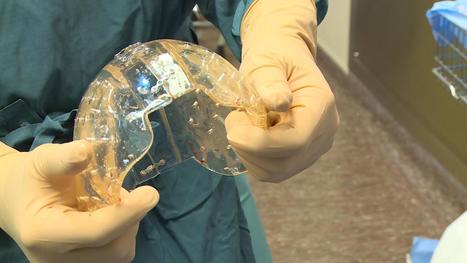
Another day, another advance in 3-D printing technology.Doctors in the Netherlands report that they have for the first time successfully replaced most of a h...
|
|
Scooped by
Gerd Moe-Behrens
March 27, 2014 2:45 PM
|
Scoop.it!

Synthetic biology has come a long way in recent years. In the last two decades alone, scientists have been able to go from synthesizing the genome of a relatively small virus, Hepatitis C, to...
|
|
Scooped by
Gerd Moe-Behrens
March 27, 2014 2:41 PM
|
Scoop.it!
Synthetic biology DIY chromosomes The Economist THE science of synthetic biology took an important step forward this week with the announcement in Science, by a team from Jef Boeke's laboratory at Johns Hopkins University, in Baltimore, of the...
|
|
Scooped by
Gerd Moe-Behrens
March 27, 2014 2:38 PM
|
Scoop.it!
We demonstrate a simple, accurate and versatile method to manipulate Parylene C, a material widely known for its high biocompatibility, and transform it to a substrate that can effectively control the cellular microenvironment and consequently affect the morphology and function of the cells in vitro. The Parylene C scaffolds are fabricated by selectively increasing the material's surface water affinity through lithography and oxygen plasma treatment, providing free bonds for attachment of hydrophilic biomolecules. The micro-engineered constructs were tested as culture scaffolds for rat ventricular fibroblasts and neonatal myocytes (NRVM), toward modeling the unique anisotropic architecture of native cardiac tissue. The scaffolds induced the patterning of extracellular matrix compounds and therefore of the cells, which demonstrated substantial alignment compared to typical unstructured cultures. Ca2+ cycling properties of the NRVM measured at rates of stimulation 0.5–2 Hz were significantly modified with a shorter time to peak and time to 90% decay, and a larger fluorescence amplitude (p < 0.001). The proposed technique is compatible with standard cell culturing protocols and exhibits long-term pattern durability. Moreover, it allows the integration of monitoring modalities into the micro-engineered substrates for a comprehensive interrogation of physiological parameters.
|
|
Scooped by
Gerd Moe-Behrens
April 4, 2014 2:43 PM
|
Scoop.it!

From
phys
(Phys.org) —Wearing a fitness tracker on your wrist or clipped to your belt is so 2013. Engineers at the University of Illinois at Urbana-Champaign and Northwestern University have demonstrated thin, soft stick-on patches that stretch and move with the skin and incorporate commercial, off-the-shelf ...
|
|
Scooped by
Gerd Moe-Behrens
April 4, 2014 2:06 PM
|
Scoop.it!

'Life Redesigned: The Emergence of Synthetic Biology' Lecture on Wednesday, April 30. Press release distribution provided by EIN News
|
|
Scooped by
Gerd Moe-Behrens
April 2, 2014 4:29 PM
|
Scoop.it!
From
rss2twi
Developing a culture of security for synthetic biology http://t.co/jKdGHtPYEe
|
|
Scooped by
Gerd Moe-Behrens
April 2, 2014 4:03 PM
|
Scoop.it!

Gerd Moe-Behrens's insight:
by
Chris J. Paddon & Jay D. Keasling
"Recent developments in synthetic biology, combined with continued progress in systems biology and metabolic engineering, have enabled the engineering of microorganisms to produce heterologous molecules in a manner that was previously unfeasible. The successful synthesis and recent entry of semi-synthetic artemisinin into commercial production is the first demonstration of the potential of synthetic biology for the development and production of pharmaceutical agents. In this Review, we describe the metabolic engineering and synthetic biology approaches that were used to develop this important antimalarial drug precursor. This not only demonstrates the incredible potential of the available technologies but also illuminates how lessons learned from this work could be applied to the production of other pharmaceutical agents.?
http://bit.ly/1pNVSiv
|
|
Scooped by
Gerd Moe-Behrens
April 2, 2014 3:53 PM
|
Scoop.it!

Gerd Moe-Behrens's insight:
by
D. Ewen Cameron, Caleb J. Bashor & James J. Collins
"The ability to rationally engineer microorganisms has been a long-envisioned goal dating back more than a half-century. With the genomics revolution and rise of systems biology in the 1990s came the development of a rigorous engineering discipline to create, control and programme cellular behaviour. The resulting field, known as synthetic biology, has undergone dramatic growth throughout the past decade and is poised to transform biotechnology and medicine. This Timeline article charts the technological and cultural lifetime of synthetic biology, with an emphasis on key breakthroughs and future challenges."
http://bit.ly/1higfgP
|
|
Scooped by
Gerd Moe-Behrens
April 1, 2014 4:55 PM
|
Scoop.it!
Post by BiologikLabs.
Synthetic Biology will soon be regrowing organs from our own cells.... http://t.co/vN6tweeSk7
|
|
Scooped by
Gerd Moe-Behrens
April 1, 2014 3:54 PM
|
Scoop.it!

LONDON — Scientists have built the clearest picture yet of how human genes are regulated in the vast array of cell types in the body — work that should help ...
|
|
Scooped by
Gerd Moe-Behrens
April 1, 2014 3:43 PM
|
Scoop.it!
Designer Chromosome Shows The Promise Of Synthetic Biology For more latest tech news and product reviews SUBSCRIBE to http://www.youtube.com/user/TechyGUYS S...
|
|
Scooped by
Gerd Moe-Behrens
March 27, 2014 2:50 PM
|
Scoop.it!
Gerd Moe-Behrens's insight:
an important new SynBio paper!
*Total Synthesis of a Functional Designer Eukaryotic Chromosome*
by
Narayana Annaluru et al
"Rapid advances in DNA synthesis techniques have made it possible to engineer viruses, biochemical pathways and assemble bacterial genomes. Here, we report the synthesis of a functional 272,871–base pair designer eukaryotic chromosome, synIII, which is based on the 316,617–base pair native Saccharomyces cerevisiae chromosome III. Changes to synIII include TAG/TAA stop-codon replacements, deletion of subtelomeric regions, introns, transfer RNAs, transposons, and silent mating loci as well as insertion of loxPsym sites to enable genome scrambling. SynIII is functional in S. cerevisiae. Scrambling of the chromosome in a heterozygous diploid reveals a large increase in a-mater derivatives resulting from loss of the MATα allele on synIII. The complete design and synthesis of synIII establishes S. cerevisiae as the basis for designer eukaryotic genome biology."
http://bit.ly/1l7VRnD





