"Despite the many great achievements of computers, no man-made computer can learn from its environment, adapt to its surroundings, spontaneously self-organize, and solve complex problems that require these abilities as well as a biological brain. These abilities arise from the fact that the brain is a complex system capable of emergent behavior, meaning that the system involves interactions between many units resulting in macroscale behavior that cannot be attributed to any individual unit.
Unfortunately, conventional fabrication methods used for today's computers cannot be used to realize complex systems to their full potential due to scaling limits—the methods simply cannot make small enough interconnected units.
Now in a new paper published in Nanotechnology, researchers at UCLA and the National Institute for Materials Science in Japan have developed a method to fabricate a self-organized complex device called an atomic switch network that is in many ways similar to a brain or other natural or cognitive computing device.
"Complex phenomena and self-organization—though ubiquitous in nature, social behavior, and the economy—have never been successfully used in conventional computers for prediction and modelling," James Gimzewski, Chemistry Professor at UCLA, told Phys.org. "The device we have created is capable of rapidly generating self-organization in a small chip with high speed. Furthermore, it bypasses the issue of exponential machine complexity required as a function of problem complexity as in today's computers. Our first steps form the basis for a new type of computation that is urgently needed in our ever increasingly connected world."...."
What sorts of breakthroughs are possible by modifying an organism’s genome – something researchers are now able to do ever more cheaply and efficiently?
The programmability of oligonucleotide hybridization offers an attractive platform for the design of assemblies with emergent properties or functions. Developments in DNA nanotechnologies have transformed our thinking about the applications of nucleic acids. Progress from designed assemblies to functional outputs will continue to benefit from functionalities added to the nucleic acids that can participate in reactions or interactions beyond hybridization. In that respect, peptide nucleic acids (PNAs) are interesting because they combine the hybridization properties of DNA with the modularity of peptides. In fact, PNAs form more stable duplexes with DNA or RNA than the corresponding natural homoduplexes. The high stability achieved with shorter oligomers (an 8-mer is sufficient for a stable duplex at room temperature) typically results in very high sequence fidelity in the hybridization with negligible impact of the ionic strength of the buffer due to the lack of electrostatic repulsion between the duplex strands. The simple peptidic backbone of PNA has been shown to be tolerant of modifications with substitutions that further enhance the duplex stability while providing opportunities for functionalization. Moreover, the metabolic stability of PNAs facilitates their integration into systems that interface with biology. Over the past decade, there has been a growing interest in using PNAs as biosupramolecular tags to program assemblies and reactions. A series of robust templated reactions have been developed with functionalized PNA. These reactions can be used to translate DNA templates into functional polymers of unprecedented complexity, fluorescent outputs, or bioactive small molecules. Furthermore, cellular nucleic acids (mRNA or miRNA) have been harnessed to promote assemblies and reactions in live cells. The tolerance of PNA synthesis also lends itself to the encoding of small molecules that can be further assembled on the basis of their nucleic acid sequences. It is now well-established that hybridization-based assemblies displaying two or more ligands can interact synergistically with a target biomolecule. These assemblies have now been shown to be functional in vivo. Similarly, PNA-tagged macromolecules have been used to prepare bioactive assemblies and three-dimensional nanostructures. Several technologies based on DNA-templated synthesis of sequence-defined polymers or DNA-templated display of ligands have been shown to be compatible with reiterative cycles of selection/amplification starting with large libraries of DNA templates, bringing the power of in vitro evolution to synthetic molecules and offering the possibility of exploring uncharted molecular diversity space with unprecedented scope and speed.
Biology provides numerous examples of self-replicating machines, but artificially engineering such complex systems remains a formidable challenge. In particular, although simple artificial self-replicating systems including wooden blocks1, 2, magnetic systems3, 4, modular robots5, 6 and synthetic molecular systems7, 8, 9 have been devised, such kinematic self-replicators10 are rare compared with examples of theoretical cellular self-replication11, 12, 13, 14, 15, 16, 17, 18. One of the principal reasons for this is the amount of complexity that arises when you try to incorporate self-replication into a physical medium19. In this regard, DNA is a prime candidate material for constructing self-replicating systems due to its ability to self-assemble through molecular recognition20. Here, we show that DNA T-motifs, which self-assemble into ring structures21, 22, can be designed to self-replicate through toehold-mediated strand displacement reactions23, 24. The inherent design of these rings allows the population dynamics of the systems to be controlled. We also analyse the replication scheme within a universal framework of self-replication25 and derive a quantitative metric of the self-replicability of the rings.
One goal of many synthetic biology researchers is to create in vitro diagnostic testing systems that produce results that are as accurate as those produced in today’s state-of-the-art clinical pathology laboratories, yet are much cheaper to run because they incorporate low-cost materials, such as paper.
Artificial RNA switches are an emerging class of genetic controllers suitable for synthetic biology applications. Aptazymes are fusions composed of an aptamer domain and a self-cleaving ribozyme. The utilization of aptazymes for conditional gene expression displays several advantages over employing conventional transcription factor-based techniques as aptazymes require minimal genomic space, fulfill their function without the need of protein cofactors, and most importantly are reprogrammable with respect to ligand selectivity and the RNA function to be regulated. Technologies that enable the generation of aptazymes to defined input ligands are of interest for the construction of biocomputing devices and biosensing applications. In this chapter we present a method that facilitates the in vivo screening of randomized pools of aptazymes in mammalian cells
Quorum sensing system, as a well-functioned population-dependent gene switch, has been widely applied in many gene circuits in synthetic biology. In our work, an efficient cell density-controlled expression system (QS) was established via engineering Vibrio fischeri luxI-luxR quorum sensing system. In order to achieve in vivo programmed gene expression, a synthetic binary regulation circuit (araQS) was constructed by assembling multiple genetic components including quorum quenching protein AiiA and arabinose promoter ParaBAD into the QS system. In vitro expression assay verified that the araQS system was only initiated in the absence of arabinose in the medium at high cell density. In vivo expression assay confirmed that the araQS system presented an in vivo-triggered and cell density-dependent expression pattern. Furthermore, the araQS system was demonstrated to function well in different bacteria, indicating a wide range of bacterial hosts for use. To explore its potential applications in vivo, the araQS system was used to control the production of a heterologous protective antigen in an attenuated Edwardsiella tarda, which successfully evoked efficient immune protection in fish model. This work suggested that the araQS system could program bacterial expression in vivo and might have potential uses, including, but not limited to, bacterial vector vaccine.
The biochemist at the University of California, Berkeley, helped make a monumental discovery: a relatively simple way to alter any organism’s DNA. But she is stuck in a patent fight over it.
The question about how art and science interact, and if art is an integrated part of scientific work, or should be banned from science, leads us back to discussions of the ancient Greek philosophers and their precursors. The fundamental question was: What is reality? Can we understand the world around us with the help of our senses, or is the world around us a product of our mental concepts? The answers to these questions never were straightforward, and have been heavily discussed during the last 2000 years. During the different periods of history, sometimes it was en vogue to believe that reality is defined by our senses (materialism) other times people preferred to believe that reality is mental (idealism).
The concept of idealism was profoundly formulated for the first time by Plato (428/7 - 348/7 BC). Later it was enlivened by different Neo-Platonic movements. E.g. Leonardo Da Vinci (1452 –1519), a follower of Neo-Platonism, did not make a clear distinction between art and science. If the reality of the world basically is a mental product, all mental products including art, play an as equally important role.
Idealistic scientific thinking fell out of favor by the end of the nineteenth century. The main paradigm was now materialism. Idealistic thinking was highly criticized as unscientific. The external world and its observation by experiments became the main subject of science. Reflection about how our brain is structuring the world, and its meaning for scientific discovery were excluded from scientific methodology. Materialistic, scientific approach survived as a leading paradigm until today. Such materialistic orientated science banned art and artistic thinking from science. Art was viewed as a separate area, which could not give valuable contributions to scientific discovery.
However, a number of twentieth century scientists are known to have concerned themselves with Neo-Platonic, artistic thinking, such as earlier described in e.g. Goethes (1749 – 1832) theory of color, a theory focused on the mental reception of color. Among these modern scientists are the logician and mathematician Kurt Goedel (1906 - 1978), the theoretical physicist Werner Heisenberg (1901 - 1976) the mathematical physicist and pioneer of chaos theory Mitchell Feigenbaum (born 1944), to mention a few. Feigenbaum has even said, “Goethe was right about color”! All the above-mentioned use mathematics as their scientific tool. Only mathematics and mathematical logic survived as a respectable science as the paradigm changed to materialism at the turn of the nineteenth century. Mathematics is a product of our brain and thus conceptually idealistic. On first sight a modern eye will often judge idealistic concepts as quite fantastic, naive, strange and far away from all reality. A modern scientist would use exactly these descriptions hearing what Plato claims in his Timaeus; the world is built out of triangles. However, this becomes less suspicious, if one stops to focus on the triangles and starts to reflect over the basic idea behind this concept. In modern theoretical physics we can find such thinking. In quantum theory, as an example, a mathematical model is used to describe the material world of atoms. The Schrödinger equation plays a central role in this theory. The sine function stands central in the solution of this equation. The sine is a function of an angle in the right triangle. So even with his triangles Plato might not have been so wrong and naive as it initially may look.
Neo-Platonic thinking in science again became acceptable during the last decades. E.g. Norbert Wiener (1894 - 1964, an American mathematician) reintroduced the concept self-organization in 1965 in the second edition of his "Cybernetics: or Control and Communication in the Animal and the Machine" During the years following this publication, the concept of self-organization became popular among scientist working in the field of complex systems. The work of Wiener was influential for the development and understanding of scientific concepts about complex systems. These concepts play an important role in modern scientific movements such as systems biology and synthetic biology.
Conceptual thinking plays an important role in the contemporary design and art movements. A new intersection between science and art is taking place, since scientific thinking is re-opened for such idealistic concepts. In the following years it will be interesting to see how design and art will influence the development of the field of synthetic biology and vice versa.
Recent advances in synthetic biology have provided tools to efficiently construct complex DNA molecules which are an important part of many molecular biology and biotechnology projects. The planning of such constructs has traditionally been done manually using a DNA sequence editor which becomes error-prone as scale and complexity of the construction increase. A human-readable formal description of cloning and assembly strategies, which also allows for automatic computer simulation and verification, would therefore be a valuable tool.
Last weekend, approximately 300 scientists, industry professionals, and students gathered at MIT Building 26 for The Mammalian Synthetic Biology Workshop 2.0.
Nanowerk is the leading nanotechnology portal, committed to educate, inform and inspire about nanotechnologies, nanosciences, and other emerging technologies
(Phys.org) —Two of the most exciting areas of science and technology, synthetic biology and genetic engineering, have just taken a step towards a brave new future in which large-scale synthetic biological circuits composed of bioengineered logic...
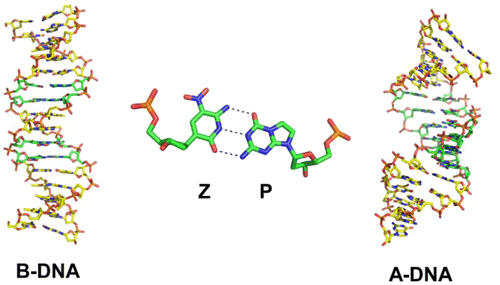
Expanded genetic systems are most likely to work with natural enzymes if the added nucleotides pair with geometries that are similar to those displayed by standard duplex DNA. Here, we present crystal structures of 16-mer duplexes showing this to be the case with two nonstandard nucleobases (Z, 6-amino-5-nitro-2(1H)-pyridone and P, 2-amino-imidazo[1,2-a]-1,3,5-triazin-4(8H)one) that were designed to form a Z:P pair with a standard “edge on” Watson–Crick geometry, but joined by rearranged hydrogen bond donor and acceptor groups. One duplex, with four Z:P pairs, was crystallized with a reverse transcriptase host and adopts primarily a B-form. Another contained six consecutive Z:P pairs; it crystallized without a host in an A-form. In both structures, Z:P pairs fit canonical nucleobase hydrogen-bonding parameters and known DNA helical forms. Unique features include stacking of the nitro group on Z with the adjacent nucleobase ring in the A-form duplex. In both B- and A-duplexes, major groove widths for the Z:P pairs are approximately 1 Å wider than those of comparable G:C pairs, perhaps to accommodate the large nitro group on Z. Otherwise, ZP-rich DNA had many of the same properties as CG-rich DNA, a conclusion supported by circular dichroism studies in solution. The ability of standard duplexes to accommodate multiple and consecutive Z:P pairs is consistent with the ability of natural polymerases to biosynthesize those pairs. This, in turn, implies that the GACTZP synthetic genetic system can explore the entire expanded sequence space that additional nucleotides create, a major step forward in this area of synthetic biology
By Gerd Moe-Behrens | Systemics, a revolutionary paradigm shift in scientific thinking, with applications in systems biology, and synthetic biology, have led to the idea of using silicon computers and their engineering principles as a blueprint for the engineering of a similar machine made from biological parts....
Video shows what biocomputer means. Any of several proposed systems using DNA or proteins to perform data processing (in synthetic biology). Biocomputer ...
To get content containing either thought or leadership enter:
To get content containing both thought and leadership enter:
To get content containing the expression thought leadership enter:
You can enter several keywords and you can refine them whenever you want. Our suggestion engine uses more signals but entering a few keywords here will rapidly give you great content to curate.


 Your new post is loading...
 Scoop.it!














by
Lisa Zyga
"Despite the many great achievements of computers, no man-made computer can learn from its environment, adapt to its surroundings, spontaneously self-organize, and solve complex problems that require these abilities as well as a biological brain. These abilities arise from the fact that the brain is a complex system capable of emergent behavior, meaning that the system involves interactions between many units resulting in macroscale behavior that cannot be attributed to any individual unit.
http://bit.ly/1LhoH19