Paramount Skydance announced that it was halting its merger with Warner Bros. Discovery until July of next year after a lawsuit from Democratic states. Paramount is also facing a lawsuit from the Writers Guild of America, which argues that the merger would lead to job losses for screenwriters and journalists.
Paramount Skydance is run by David Ellison, whose father, Larry Ellison, is the billionaire founder of Oracle and a prominent ally and financial backer of President Trump.
Meta's $50 billion AI data center in Louisiana is facing scrutiny over secrecy, energy demands, public incentives and its impact on locals.
Meta’s massive artificial intelligence data center in rural northeastern Louisiana has become a symbol of the extraordinary infrastructure race unfolding behind the rapid expansion of AI, with the project drawing scrutiny over its scale, energy needs, financing arrangements and the secrecy surrounding the deal that brought it to the region.
The project, known as Hyperion, is expected to represent an investment of more than $50 billion and span nearly 10 million square feet, making it the largest data center in Meta’s global fleet. The facility is designed to provide 5 gigawatts of computing capacity for AI workloads, including the training and development of large AI models.
The development has transformed Richland Parish, a predominantly rural area in northeast Louisiana, as Meta and its partners build the infrastructure required to support increasingly power-intensive AI systems.
The scale of the project has also raised questions about how the deal was negotiated.
The Trump administration announced Monday that it is exempting power plants that only serve data centers and do not connect to the broader grid from pollution limits that seek to prevent acid rain.
The administration announced new guidance on Monday clarifying that these “islanded” power plants do not have to be part of the Clean Air Act’s Acid Rain Program (ARP).
In the U.S. Market, everyone beat something in the June quarter, but investors only cared about what sat underneath the beat.
The market was not rejecting telecom, but it was separating valuable growth from expensive growth.
"That distinction reveals something much larger. The fastest-growing businesses in US telecom are increasingly built on infrastructure created for another purpose. Cable is selling mobile service through wholesale agreements and WiFi. Wireless carriers are selling home broadband through spectrum bought for smartphones. Verizon is selling dark fiber to hyperscalers building AI infrastructure."
The networks are still being built. AT&T alone plans to invest between $23 billion and $24 billion annually through 2028. But a growing share of the next dollar of revenue is coming from finding a second customer for an asset that already exists.
Paramount Skydance announced that it was halting its merger with Warner Bros. Discovery until July of next year after a lawsuit from Democratic states. Paramount is also facing a lawsuit from the Writers Guild of America, which argues that the merger would lead to job losses for screenwriters and journalists.
Paramount Skydance is run by David Ellison, whose father, Larry Ellison, is the billionaire founder of Oracle and a prominent ally and financial backer of President Trump.
Rep. Tim Burchett (R-TN) introduced a bill that would ban the federal purchasing and federal funding of Flock cameras, which he calls “unconstitutional."
In December 2025, the Trump administration created a federal task force to challenge state AI laws in court. A Commerce Department list of "onerous" laws is due around March 2026. This video, Part 1, explains a law the fight targets: California’s Transparency in Frontier Artificial Intelligence Act, which does not ban any AI system or impose liability for outcomes, but requires the most powerful AI developers in the world to document how they assess catastrophic risk.
What Part 1 covers:
• Why SB 53 exists: how Newsom's veto of SB 1047 led to a working group from Stanford, the Carnegie Endowment, and UC Berkeley, and a trust-but-verify transparency framework. The bill cleared the state Senate 37-0 on first passage. The enacted version passed the Assembly 59-7 and the Senate 29-8 in September 2025.
• The compute threshold: what 10²⁶ floating-point operations means in human terms, why compute is the one variable the industry can't easily obscure, and how the two-tier test isolates roughly 5–8 companies.
• The frontier AI framework: the four questions large developers must answer before deploying a model, what catastrophic risk means under the law, and what is explicitly excluded.
• Model security: why a frontier model's weights are a specific concern, and what Meta's 2023 LLaMA leak showed about the stakes.
Part 2 covers the self-reporting problem, whistleblower protections, CalCompute, and the federal collision.
What happens when telecom companies are allowed to walk away from providing basic, reliable phone service? Chris, Harold, and Arturo explore AT&T’s push to end its landline commitments in California and why network modernization shouldn’t leave vulnerable communities behind.
In this episode of Unbuffered, Chris is joined by Harold Feld, Senior Vice President at Public Knowledge, and Arturo Juarez from NextGen Policy for a conversation about the high-stakes battle over California’s Carrier of Last Resort (COLR) rules and what it means for the future of universal service.
In a recent request filed with the FCC, Starlink asked to increase the size of its broadband satellite fleet to 100,000. This coincided with the FCC’s announcement that it wants to ease the process for approving new satellites, so I have to think the idea will sail through. There was one extraordinary statement in this
filing that is the topic of today’s blog. SpaceX said it has the goal of handling the majority of the world’s Internet traffic. Elon Musk has always been one for huge hyperbole, so statements like this are not surprising. I want to examine a few reasons why that goal is ridiculous.
No carrier handles a large percentage of the world’s internet traffic today. According to statistics shown on Cloudflare Radar, the company with the biggest percentage of worldwide traffic today is Amazon, with 3.5% of all traffic. The companies that carry more than 2% of worldwide traffic include Cloudflare (2.2%), Comcast (2.5%), Amazon (2.4%), Microsoft (2.2%), Reliance/Jio (2.1%), and AT&T (2.1%). SpaceX is on the worldwide list at number 18 today, already carrying 0.7% of the world’s Internet traffic.
July 22, 2026 - Graham Media Group has opened a new coffee shop in Detroit that doubles as a community meeting center and a television studio connected to its local NBC affiliate.
The new space, called Fourgrounds, opened to the public on Wednesday. It operates as a traditional coffee shop while allowing the public to connect with reporters and other newsroom personnel at WDIV (Channel 4).
In a statement this week, Graham Media said the coffee shop will allow its local journalists to meet with members of the community to solicit story ideas and conduct news gathering outside the traditional newsroom setting.
Cheating as a business model exists because Americans can no longer sue big business. A Democratic Congress could fix this problem with one simple law. Plus, a defeat for Paramount-Warner, and more...
As usual, there’s a lot of monopoly-related news. There was an important win in the Paramount-Warner merger fight, the world of tech giants is in a civil war over open source AI models, and Lina Khan continues to annoy the superrich by becoming the Chair of one of the most important economic development posts in New York City.
Before getting to all of that in the full round-up I want to discuss a political opportunity to improve the lives of Americans very quickly.
In a few months, it’s likely that Congress will change hands. If it does, one thing Democrats could do is pass a law making it possible to sue big companies who cheat their customers, suppliers, or employees. Right now, it’s virtually impossible to do that, and the result is a degradation of our economic order so significant that we’ve had to invent a new word to describe it.
Today, our National Board adopted a resolution publicly opposing the Paramount Skydance acquisition of Warner Bros. Discovery, absent enforceable guarantees of continued and expanded production levels. The resolution affirms our strong support for the attorneys general from a dozen states and the Writers Guild of America, who have filed anti-trust lawsuits to block the massive leveraged buyout. At this moment, Paramount Skydance has agreed to delay the effective date until as late as next June.
We want you to know that SAG-AFTRA has been monitoring this transaction closely since Netflix made its initial offer to buy the historic studio. Throughout this process, we engaged with the various parties to thoroughly investigate the proposed acquisition and ensure your interests are protected.
More than 7,000 homes and small businesses in Sumter County now have access to Spectrum's high-speed internet, mobile, TV and voice services following the company’s latest broadband expansion.
The expansion is part of Spectrum’s more than $7 billion rural construction initiative, a nationwide project to extend fiber-optic infrastructure to underserved communities. The multi-year effort is expected to add more than 100,000 miles of fiber-optic network and bring broadband access to more than 1.7 million locations across the country.
Residents in the newly served areas can now subscribe to Spectrum Internet with download speeds up to 1 gigabit per second. The company says its residential service starts at 500 Mbps, with no data caps, modem fees or annual contracts.
The Federal Communications Commission today voted unanimously to overhaul its satellite licensing process, despite a request to postpone the vote by U.S. House space policy leaders.
FCC on July 1 published the Space Modernization Order outlining the changes, which include establishing “a licensing assembly line” to process applications for satellite licenses, potentially in batches as opposed to separate approvals for each satellite in a large constellation. The order is among several planned overhauls to U.S. space licensing that were prompted by various 2025 White House executive orders.
An FCC license is required for any satellite that will transmit or receive radio signals to communicate with operators on the surface for telemetry, tracking and command. However, the current licensing regulations contain “unnecessary and outdated rules,” the order reads, and the new framework would be easier to understand, especially for new entrants.
Outdated rules tying carriers to copper phone lines are diverting billions from fiber and wireless buildout, and the FCC should finish modernizing them.
But there’s an obstacle to next-generation networks that too few realize: Legacy rules that bind carriers to the copper networks of yore. These rules require carriers to constantly reinvest in copper wires, dedicate largely empty buildings to 1980s technology, and prevent telephone traffic from being routed and exchange efficiently.
These rules are enormously expensive. AT&T alone spends more than $6 billion each year maintaining copper lines. And AT&T is only one example: 2,425 voice service providers incur unnecessary costs to interconnect with and support the legacy network.
As data centres have grown in size and number in Australia, they have also become the subject of fierce public debate. So what’s the best way forward?
At first glance a data centre looks like a bland, boring warehouse. But these buildings, stacked with thousands of servers, are the beating heart of the internet and the booming artificial intelligence (AI) industry.
As data centres have grown in size and number in Australia, they have also become the subject of fierce public debate. State and federal governments, as well as the tech industry, are pushing for new data centres to be rapidly built in addition to the roughly 160 that already exist around the country.
How does geography impact AI performance? Our latest study examines how 5G latency varies across U.S. cities, exploring the role of infrastructure in cloud responsiveness.
Latency – the time it takes for data to travel from a user to a server and back – is becoming an important factor in AI performance. That’s because advanced AI services often do their calculations inside data centers hosting servers used by the likes of Google, Amazon Web Services (AWS), Oracle and Microsoft. Network latency is a part of the path necessary to extricate AI computations from a hyperscaler’s cloud and deliver them to an end user.
Further, time-sensitive AI applications – like real-time video analysis or voice chatting – will need low latency connections in order to quickly shuttle AI computations to the users (or robots or agents or whatever) who need them. As AI matures, these snappy connections may grow in importance.
But, as Ookla’s mobile 5G data shows, cloud latency can be impacted by a variety of factors including geographic location, internet routing infrastructure, and operators’ traffic steering, peering, and interconnect policies.
How a thirteen-year apprenticeship under McCarthy's chief counsel became the blueprint for a word doing very different work seventy years later.
One of the things I love most about research is that it rarely takes you exactly where you expect to go. I went looking for a rhetorical pattern and found a biography instead.
I had been tracking something simple at first: how often, and how casually, Donald Trump has started reaching for the word “communist” again.
Not “socialist.” Not “radical left.” Communist, specifically, applied to open borders, bail reform, transgender healthcare, opposition to voter identification, health-insurance policy, a sitting Minnesota governor and, in the same breath, to the very Democratic Party he also claims is secretly in the pocket of private insurers.
I wanted to know whether this was new. I wanted to determine whether it was strategic.
I did not expect to end up reading about a disbarred lawyer who died in 1986.
President Donald Trump announced a non-binding pledge by U.S. power producers and data centers on Thursday to fund or build energy infrastructure that would meet massive AI-related power needs while shielding consumers from high electricity costs.
Consumer advocacy groups and administration critics, however, dismissed the pledge as an empty promise to consumers.
Below is Section 1 and Section 8 presented that way, plus a short list of draft-only concepts that were dropped. (Underlined words in the draft executive order; boldfaced in the final order.)
Ensuring a National Policy Framework for Artificial IntelligenceBy the authority vested in me as President by the
Amazon Leo revealed more details about a proposed, global direct-to-device (D2D) constellation that, it said, will comprise 5,105 low-Earth orbit (LEO) satellites and complement the D2D satellites it will obtain via its acquisition of Globalstar.
As outlined in an application filed by Kuiper Systems LLC with the FCC on Saturday (July 25), the Amazon Leo D2D system will tap into mobile-satellite service (MSS) spectrum and also tap into various mobile service bands to provide "ubiquitous global coverage."
On May 21, 2026, the Georgetown Law Institute for Technology Law & Policy convened the Universal Broadband Summit, bringing together state broadband officials, industry associations, academics, local government organizations, union representatives, and civil society.
Across the board, Summit participants agreed that online connectivity is necessary for full participation in modern society, and that its benefits extend beyond individual households to a more engaged electorate, a more educated public, and a more productive economy.
In an interview with the Economist’s Editor in Chief Zanny Minton Beddoes, Elon Musk said that China may become the world leader in AI. The only thing now preventing it is China’s lower computing power. But that could change.
China already has the big advantage in electricity capacity versus the U.S., a 3 to 1 advantage:
China could develop its chips and increase its compute, as the Wall Street Journal just reported on China’s ambitions. If it does, that’s when China may surpass the U.S., in Musk’s view.
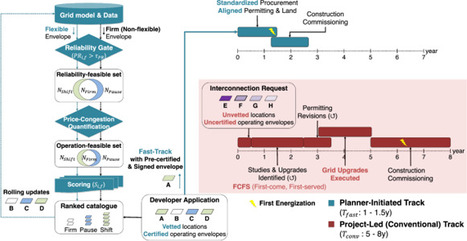
Explosive growth in energy-intensive AI data centers is outstripping the pace of power grid interconnection and transmission expansion. While operational flexibility has been proposed to mitigate this stress, existing processes are often reactive and evaluate projects only after they enter a multi-year interconnection queue.
To address this, we introduce a planner-initiated siting framework that integrates (i) reliability-gated screening, (ii) system-wide market-impact assessment under standardized flexibility envelopes (firm, pause, and shift), and (iii) entropy-weighted multi-criteria scoring to produce ranked, pre-certified catalogues of interconnection-ready locations. Applied to a synthetic 2000-bus Texas power system, the framework demonstrates that operational flexibility expands the siting frontier by 9-17% at 1 GW and 19-21% at 2 GW compared to firm operation.
Median all-hour average prices remain essentially unchanged ($24.32/MWh for the 2 GW cases), and the shift envelope attenuates peak-hour price dispersion by approximately 3.4% with minimal side effects during off-peak hours. Utilizing pre-certified envelopes to bypass major transmission reinforcements, this workflow enables first energization in 12-18 months-a conservative reduction of 3.5-4 years versus the conventional 5-8 year project-led process. This technology-agnostic framework provides a proactive decision-making tool for system operators and regulators to fast-track large flexible loads while preserving grid reliability and market stability.
The study presents a planner-initiated framework for siting data centers, integrating reliability screening and market-impact assessment. It expands feasible locations by 9-21% when accounting for operational flexibility and reduces interconnection time by 3.5-4 years, while maintaining stable prices and reducing peak-hour price dispersion.
Paramount Skydance on Friday officially delayed its attempted acquisition of Warner Bros. Discovery after a federal judge in the Northern District of California temporarily blocked the $111 billion deal at the request of a dozen Democratic attorneys general.
US District Judge Araceli Martínez-Olguín granted the temporary restraining order on Monday after finding that the plaintiffs—led by California Attorney General Rob Bonta—provided “compelling evidence that the combined firm resulting from the transaction will possess substantial market share in the wide-release theatrical distribution market.” She extended the order on Thursday.
Kalamazoo city commissioners directed staff to research a possible moratorium on new data centers Monday, following months of similar debate in surrounding townships.
The discussion, raised as New Business at the July 20 City Commission business meeting, did not result in a moratorium being adopted. Instead, City Attorney Aaron Leal will give a presentation at a future Committee of the Whole meeting explaining how moratoriums legally function, including limits on their duration, before commissioners decide whether to move forward.
To get content containing either thought or leadership enter:
To get content containing both thought and leadership enter:
To get content containing the expression thought leadership enter:
You can enter several keywords and you can refine them whenever you want. Our suggestion engine uses more signals but entering a few keywords here will rapidly give you great content to curate.


 Your new post is loading...