Your new post is loading...
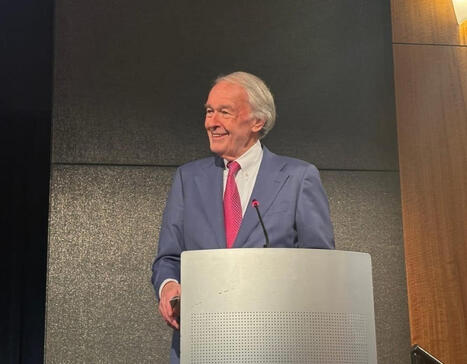
WASHINGTON, March 5, 2026 – Sen. Edward Markey, D-Mass., announced that his Children and Teens’ Online Privacy and Protection Act — a bill that’s been in the works for 15 years — passed unanimously on the Senate floor on Thursday. Introduced by both Markey and Sen. Bill Cassidy, R-La., Markey said it was a priority to protect children from targeted advertisements and “corporate tech companies” that have monetized technology at the expense of children. The bill would update online data privacy rules and ensure children are protected online.
Iran’s internet shutdown has reduced connectivity by 99 percent, with air strikes likely causing additional outages, and few workarounds remaining. For more than six days, almost 90 million Iranians have been living under a total internet blackout. The shutdown comes after Iranians endured a similar total internet blackout at the beginning of January, followed by weeks of limited connectivity while the regime brutally attacked and killed thousands of anti-government protesters. But as the US and Israel’s war on Iran intensifies, the conflict is adding a new dimension to what would otherwise be a damaging but not unprecedented internet blackout. In these situations, and by the regime’s design, the populace still has access to the country’s homegrown intranet and suite of applications, known as the National Information Network or NIN, so daily life can continue. Iranians have by now also built and refined a playbook for staying online as much as possible when the Iranian regime restricts connectivity, using VPNs and other proxy networks to access the global internet. While many of those circumvention tools still work, at least to a degree, during partial blackouts, they aren’t accessible during total shutdowns. As is often the case, only the Iranian government, military, and wealthy elites currently have access to the outside internet, along with a small group of additional gateways that get internet access from Starlink terminals. Iranians were plunged into internet darkness almost immediately after US and Israeli missiles hit the country on February 28, killing the country’s supreme leader, Ali Khamenei.
The Study A two-week study of autonomous LLM agents deployed in a live multi-party environment with persistent memory, email, shell access, and real human interaction. Autonomous agents with real tools, tested by real people We deployed six autonomous AI agents into a live Discord server and gave them email accounts, persistent file systems, unrestricted shell access, and a mandate to be helpful to any researcher who asked. Twenty colleagues then interacted with them freely — some making benign requests, others probing for weaknesses. Over two weeks, the agents accumulated memories, sent emails, executed scripts, and formed relationships. Researchers impersonated owners, injected malicious instructions, and attempted social engineering. The agents had no explicit adversarial training for this environment. What emerged was a detailed, naturalistic record of both failure and unexpected resilience — ten security vulnerabilities and six cases of genuine safety behavior — in the same system, under the same conditions.
Tim Farrar, a well-known satellite and telecom analyst, was asked whether there’s a point where fiber becomes economically unviable. His answer was blunt: “Elon Musk doesn’t care about your economics. He cares about adding subscribers. The economics don’t matter at the moment.” Let that sit for a second. You're running financial models. You're stress-testing take rates. You're agonizing over cost-per-passing in that next build area. And one of your biggest emerging competitors? He's playing a completely different game. Competition in Rural Broadband Is Changing Faster Than Your Financial Model
Farrar’s comment highlights something I’ve been watching for a while: there’s a growing disconnect between how rural broadband operators think about their businesses and how the market around them is actually behaving.
According to the Fiber Broadband Association, fiber deployment hit a record 11.8 million new homes passed in 2025. That sounds like great news until you look at what’s happening underneath. Sixteen percent of fiber homes are now served by two or more providers, up from 13% the year before. And it’s not just Starlink.
OpenCape, the leading provider of ultra-fast fiber connectivity from Cape Cod to Southern New England, announced today that Pete Saladino has joined as Executive Director.
A law enacted by Congress in 2024 mandated ByteDance to divest its U.S. assets by a January 2025 deadline. Trump chose not to enforce the legislation. Donald Trump and his attorney general are facing a lawsuit from retail investors in rival social media companies of TikTok, who are seeking to overturn the president’s approval of a deal for the app’s Chinese owner, ByteDance, to form a majority American-owned joint venture. Filed on Thursday, this marks the first legal challenge to the agreement. The lawsuit contends that Trump’s approval last year contravened requirements established in a 2024 divestiture law. Two California residents, shareholders in Alphabet and Meta Platforms, initiated the suit with backing from the Public Integrity Project.
Palestinian journalist Plestia Alaqad on bearing witness, the fragile power of social media, and why documenting lived reality matters more than ever. Plestia Alaqad is known to millions of people as an image on a screen: a young Palestinian journalist in a press vest and helmet, standing amidst the destruction of Gaza, speaking to the camera in between airstrikes. She is one of many. The burden of witnessing and reporting events in Gaza has been almost exclusively carried by Palestinian journalists, as Israel has barred international journalists from entering the territory and reporting on the war since October 2023. In limited cases, journalists have been allowed to enter under controlled conditions, escorted by the Israeli army. Reporters like Alaqad began reaching millions of people through social media, which has been widely credited with turning the tide of opinion outside of the Middle East. “I believe everyone now knows how powerful social media is, and we’ve seen that firsthand in the genocide that is happening in Gaza, in Palestine,” Alaqad says. “It’s because of us citizen journalists reporting on what’s happening using social media.”
A chief analyst for Google's threat intelligence operation has warned that Iran's likelihood to engage widespread cyberattacks is a certainty. The threat from Iranian cyber operations is not to be taken lightly, experts are warning. A new report filed by Danny Palmer, a deputy editor for Infosecurity Magazine, says Google’s chief threat intelligence analyst is predicting that Iran will engage in cyberattacks as the conflict in the Middle East continues.
The same Tech Oligarchs building massive data centers, pushing AI into every corner of our lives, and selling surveillance tools to federal agencies are also buying news outlets, funding newsrooms, and controlling the platforms where most people get their information. They don’t just own the media. They control what counts as news, whose stories get told, and what futures seem possible. MediaJustice is excited to launch Media Capture: Who Controls the Story Controls the Future, our NEW REPORT that maps how Tech Oligarchs have captured the media system through ownership, financial influence and platform control. This report is for organizers, activists, and communities of color who are fighting Big Tech across many fronts, from data centers, surveillance, AI and labor.
Ilan Eframian, of Xfinity Communities, joined Elizabeth Parks, from Parks Associates, to review emerging connectivity expectations of renters. Connectivity is a key part of decision making when renters are considering where to live, according to Elizabeth Parks, the president and CMO of Parks Associates. Parks joined Ilan Eframian, a VP from Xfinity Communities, on Beyond the Cable to discuss some of the insights revealed in recent research by Parks Associates, which closely studies the broadband and multifamily markets. The research, published by Xfinity Communities, said 41% of renters expect instant-on connectivity when they move into a new place.
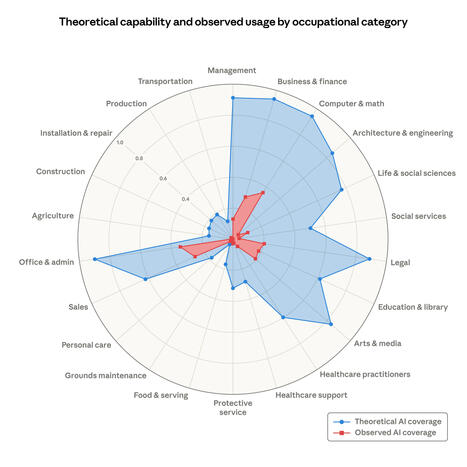
Key Findings - We introduce a new measure of AI displacement risk, observed exposure, that combines theoretical LLM capability and real-world usage data, weighting automated (rather than augmentative) and work-related uses more heavily
- AI is far from reaching its theoretical capability: actual coverage remains a fraction of what's feasible
- Occupations with higher observed exposure are projected by the BLS to grow less through 2034
- Workers in the most exposed professions are more likely to be older, female, more educated, and higher-paid
- We find no systematic increase in unemployment for highly exposed workers since late 2022, though we find suggestive evidence that hiring of younger workers has slowed in exposed occupations
Introduction The rapid diffusion of AI is generating a wave of research measuring and forecasting its impacts on labor markets. But the track record of past approaches gives reason for humility.
The Internet in the U.S. relies on long-haul and middle-mile fiber routes that are used to connect every part of the country to the core internet hubs located in Virginia, Dallas, Chicago, Atlanta, Los Angeles. New York, and Denver. In more recent times, the growth of data centers has created additional major Internet hubs in places like Phoenix, Silicon Valley, Portland, and Seattle.
Vermont’s Communications Union Districts (CUDs), which were the subject of a 2024 ILSR report, continue to make steady inroads in delivering high-quality broadband access to long-neglected rural Vermont residents. That includes the Chittenden County Communication Union District (CCCUD), which recently announced the completion of a planned fiber extension into the heavily rural communities of Essex Town, Essex Junction, Jericho, Shelburne, Westford, and Williston. The deployment was completed in partnership with Fidium Fiber, which says the expansion brought fiber optic connectivity to more than 1,900 homes and businesses across the six towns for the first time ever.
|
I stuck Amazon’s Echo Show 15 and its Alexa+ AI assistant in my kitchen for a month. Things have not gone well. When I first mounted Amazon's new Echo Show 15 on my kitchen wall, I was enthusiastic about its potential as a hands-free entertainment device. I enjoy listening to music or playing YouTube videos in the background as I’m cooking dinner. So moving that from my phone and onto the wall, with Amazon’s upgraded Alexa+ AI voice assistant that I can prompt hands-free, sounded like a winning combo. But now, after more than a month with Alexa+ on this 15-inch screen, I’ve concluded that Alexa+ simply doesn’t work well and lacks the basic reliability I need from a smart home device. Yes, it’s still in early access, but it maneuvers like an unpredictable toddler smashing around and half-completing tasks. The company reworked its well-known voice assistant in 2025, putting generative AI at the core of this new experience. As of earlier this year, Alexa+ is available to all Amazon Prime subscribers in the US. Echo owners are automatically switched over to the new version but can go back by asking to “exit Alexa+.” It’s not clear how long this will remain an option.
I’ve spent the past few days asking AI companies to convince me that the prospects for AI safety have not dimmed. Just a few years ago, it seemed that there was universal agreement among companies, legislators, and the general public that serious regulation and oversight of AI was not just necessary, but inevitable. People speculated about international bodies setting rules to insure that AI would be treated more seriously than other emerging technologies, and that could at least provide obstacles to its most dangerous implementations. Corporations vowed to prioritize safety over competition and profits. While doomers still spun dystopic scenarios, a global consensus was forming to limit AI risks while reaping its benefits. Events over the last week have delivered a body blow to those hopes, starting with the bitter feud between the Pentagon and Anthropic. All parties agree that the existing contract between the two used to specify—at Anthropic's insistence—that the Department of Defense (which now tellingly refers to itself as the Department of War) won’t use Anthropic’s Claude AI models for autonomous weapons or mass surveillance of Americans. Now, the Pentagon wants to erase those red lines, and Anthropic’s refusal has not only resulted in the end of its contract, but also prompted Secretary of Defense Pete Hegseth to declare the company a supply-chain risk, a designation that prevents government agencies from doing business with Anthropic. Without getting into the weeds on contract provisions and the personal dynamics between Hegseth and Anthropic CEO Dario Amodei, the bottom line seems to be that the military is determined to resist any limitations on how it uses AI, at least within the bounds of legality—by its own definition. The bigger question seems to be how we got to the point where releasing killer robot drones and bombs that identify and eliminate human targets wound up in the conversation as something that the US military would even consider. Did I miss the international debate about the merits of creating swarms of lethal autonomous drones scanning warzones, patrolling borders, or watching out for drug smugglers?
T-Mobile is currently beta testing a real-time translation service for T-Mobile cellular customers. The service will offer translations between fifty languages. The company is touting this as the first real-time agentic AI platform used on a wireless network. There are already a lot of translator services available today like Google Translate, JotMe, Wordly.ai, Maestro AI, and others. The advantage of the T-Mobile offering is that it would be a built-in feature that comes embedded with cellular service – a device that billions of people carry around all day.
The Pew Charitable Trusts submitted comments Feb. 18 to the National Telecommunications and Information Administration (NTIA) urging the agency to issue timely and clear guidance that will allow states to spend Broadband Equity, Access, and Deployment (BEAD) funds that are not used for broadband network construction—also known as nondeployment funds. Read the comments: Dear Assistant Secretary Roth: I am the project director for the Pew Charitable Trusts’ broadband access initiative (BAI). Pew is a nonpartisan, non-profit organization that applies a rigorous analytical approach to solving public policy problems. BAI works with state and federal policymakers, researchers, and other partners to accelerate the nation’s progress toward universal, affordable high-speed internet service. Since 2021, Pew has delivered research and facilitated peer-to-peer engagement for state broadband offices (SBOs) throughout the country. This work affords us a clear view of the challenges and opportunities related to implementation and informs our recommendations.
Talks on landmark crypto legislation have reached a new stalemate after banks said they could not support a compromise proposed by the White House, raising doubts about whether the bill will pass this year and drawing criticism from Donald Trump, who accused lenders of trying to derail it, according to a report by Reuters News. Trump, who courted crypto cash on the campaign trail and whose family has profited from its own token, on Tuesday evening took to his Truth Social platform to call out the banking industry. "We are not going to allow them to undermine our powerful Crypto Agenda," he posted.
There are several signs that suggest 2026 could be a tipping point for Florida when it comes to large-scale data centers, the warehouse facilities that house thousands of servers for artificial intelligence and other tech programs. As hotspot states like Virginia become more saturated – with about a quarter of that state’s power demand coming from data centers already – the industry is looking to spread out. Tech companies have already launched projects in other Southeast states – including multiple Amazon data centers in Mississippi and one that will be the largest data center in the Western Hemisphere in Louisiana. So why hasn’t Florida, a state with a business-friendly tax climate and plenty of open land, not been heavily targeted by the data center industry? And what signs are there that some projects could already be in the works? Here are three things to know about how the industry views the state:
Construction on a 100-percent fiber-optic internet network has begun in Federal Way, in Washington, according to Ripple Fiber. Following the recent groundbreaking in Ocean Shores, Washington, the provider is making progress on the $250 million project that includes more than 200,000 homes and businesses across King County and Grays Harbor County. Ripple Fiber expects to launch service to customers in Federal Way by summer 2026.
After hours of testimony, the county’s Planning and Development Commission (PDC) voted 4-3 Thursday to postpone a decision on a rezoning request that could allow a controversial data center at Holder Industrial Park. The continuance came after a packed meeting where dozens of residents urged commissioners to protect the surrounding environment and reject the proposal from Deltona Corporation. The board was split on whether to delay the decision or reject the application outright, with the continuance ultimately prevailing. All board members were united in opposing this type of heavy industrial rezoning for Citrus County. Attorney Clark Stillwell, representing the applicant, said Deltona plans to submit a revised application to the PDC after the state Legislature meets later this month to review data center legislation.
AI data center construction, quantum technology leaps, and long-awaited BEAD funding is making 2026 a momentous year for fiber. Every year, fiber plays an increasingly important role in our society, but 2026 is shaping up to be particularly momentous for three key reasons: AI data center construction is driving both fiber densification and advanced tech adoption, quantum technology is making steady progress towards deployment in real-world settings, and long-awaited BEAD funding is moving out of proposals and into actual spending. In the top-level policy discussions about applications and services, little has been said about the need for reliable, easily scalable broadband with fiber at the core of the telecommunications infrastructure.
On this week’s “More To The Story,” tech journalist Karen Hao sounds the alarm about the rising risks to the country—and planet—from the growth of artificial intelligence. OpenAI became the world’s most valuable private company last week after a stock deal pushed the value of the artificial intelligence developer to $500 billion. The company and its remarkable chatbot ChatGPT have single-handedly accelerated AI’s boom and threatened to upend much of how we work, create, learn, and communicate in the process. But when OpenAI was founded a decade ago, the company’s approach to artificial intelligence wasn’t taken seriously in Silicon Valley. Tech journalist Karen Hao has been covering OpenAI’s astounding rise for years and recently wrote a book about the company, Empire of AI: Dreams and Nightmares in Sam Altman’s OpenAI. She says that while many in Silicon Valley warn of AI’s sci fi–like threats, the real risks are already here.
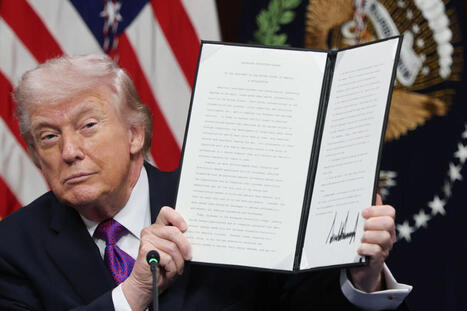
The pledge is nonbinding and unlikely to bring immediate relief on electricity bills. Making it real will fall to utilities and regulators. In an effort to quell blowback on data centers, President Donald Trump announced at a White House roundtable on Wednesday the “Ratepayer Protection Pledge,” a set of nonbinding promises that Big Tech companies signed to keep household utility bills from skyrocketing. “They need some P.R. help,” Trump said of the data centers, “because people think that if a data center goes in, their electricity prices are going to go up, and that’s not happening. It’s not going to happen.” The pledge was signed by top officials from Google, Meta, Microsoft, OpenAI, Amazon Web Services, Oracle and Elon Musk’s xAI. While Trump has previously described it as “mandatory,” the pledge is voluntary, unlike a statute or enforceable federal regulation.
lllinois State Sen. Rachel Ventura, D-Joliet, has introduced legislation directing regulators to set broadband price protections for low-income residents, though the bill text leaves key details to be determined later. The measure joins those in other states, including Connecticut, Maryland, and Minnesota, that have introduced measures aimed at capping broadband prices for qualifying households.
|