Your new post is loading...

|
Scooped by
Kim Flintoff
May 12, 2016 3:29 AM
|
MIT has been responsible for some impressive projects and advancements within the field of 3D printing. Their latest project, a shape changing interface made of 3D printed blocks called Materiable, does not disappoint as it can mimic such physical reactions as flexibility, elasticity, and viscosity.
|
|
Scooped by
Kim Flintoff
May 11, 2016 8:19 AM
|
University of Denver, Silicon STEM Academy launch ‘STEM for Grown-Ups’
The University of Denver’s Center for Professional Development and Silicon STEM Academy (SSA) have partnered to provide “STEM for Grown-Ups”, a new curriculum of interactive STEM-Intensive CEU courses and pathways for teachers and other professionals.
The Continuing Education programs cover a range of tech curriculum including computer programming, mobile application development, robotics, Arduino electronics and digital media.
“STEM for Grown-Ups offers everyone the opportunity to come back to school and learn the latest in the STEM sciences. The program will equip professionals with the tools to thrive in an ever more STEM-focused world,” said Dr. Kim Gorgens, Associate Professor, Graduate School of Professional Psychology, and Executive Director of the Center for Professional Development of the University of Denver.
Professionals interested in sampling STEM for Grown-Ups can choose from a selection of six courses in computer programming, robotics, app development and more during an introductory 5-hour immersive course on June 18.
|
|
Scooped by
Kim Flintoff
May 9, 2016 6:36 PM
|
Reworking lessons and the classroom environment can help girls excel at STEM courses
Despite recent advances, women remain underrepresented in the workforce in many science, technology, engineering and mathematics (STEM) fields. K-12 schools have been working to cultivate and encourage girls’ interest in STEM, and narrow the gap in girls’ participation in science courses. Yet, many girls enter my science classes lacking confidence in their abilities or expressing that they’re just “not good at science.”
I, too, used to have that mindset. I enjoyed science in elementary and middle school. However, in high school, my science classes were primarily comprised of lectures and worksheets. I made straight As, but I never understood the concepts. I merely memorized facts in order to do well on tests. At the time, I thought that meant I wasn’t good at science. It wasn’t until I got to college and started doing lab work that I started to enjoy science again and where I realized I could excel at it.
Here are a few strategies I use in my classes to engage girls and encourage them to pursue STEM in high school and beyond.
|
|
Scooped by
Kim Flintoff
May 9, 2016 2:46 AM
|
Next step: Robots that walk themselves off the printer.
|
|
Scooped by
Kim Flintoff
May 6, 2016 2:13 AM
|
STEM Education is an ill-defined term meaning different things to different people. As such, schools have adopted a variety of approaches to STEM education. The session will explore the different approaches, and offer advice to schools considering embracing a STEM perspective.
REGISTER
STEM Education can refer to the separate subjects or as a single integrated subject. It has been variously described as broadly as enquiry-based learning, problem-based learning, or project-based learning. Some schools offer 'one off' experiences under the STEM Education umbrella while others have embraced whole school initiatives so that all students experience some connected learning across STEM.
In this session, I will encourage schools to either evaluate their current STEM approaches using the following questions, or, if they are considering beginning a STEM education initiative to use these questions to begin their planning.
1. Why do we want to add STEM to our curriculum?
2. What problem are we aiming to solve?
3. Given the problem, which STEM strategy might address this?
4. Which teachers should be involved?
5. What school structures need to change to implement the strategy?
AITSL Australian Professional Standards for Teachers addressed in this webinar:
1.2 Understand how students learn
3.1 Establish challenging learning goals
3.6 Evaluate and improve teaching programs
|
|
Scooped by
Kim Flintoff
May 3, 2016 8:54 PM
|
POTENTIAL citizen scientists in the Avon Valley recently attended a workshop in Northam, run by BirdLife Australia and hosted by Wheatbelt NRM.
The workshop prepared residents to participate in the Great Cocky Count, covering identification, breeding and habitat range of black-cockatoos.
The Great Cocky Count is an annual survey of black-cockatoo numbers across Western Australia and is now one of Australia’s largest citizen science projects.
The focus is on the endangered Carnaby's Black-Cockatoo (Calyptorhynchus latirostris), but the vulnerable Baudin's Black-Cockatoo (Calyptorhynchus baudinii) and Forest Red-Tailed Black-Cockatoo (Calyptorhynchus banksii naso) are also counted.
|
|
Scooped by
Kim Flintoff
May 3, 2016 1:47 AM
|
Design Thinking for Educators is…
A creative process that helps you design meaningful solutions in the classroom, at your school, and in your community. The toolkit provides you with instructions to explore Design Thinking.
|
|
Scooped by
Kim Flintoff
May 2, 2016 3:10 AM
|
Elene first lit up the path toward coding for her sisters Mari and Ani. We learn how the sisters have achieved so much at such a young age.
|
|
Scooped by
Kim Flintoff
April 26, 2016 8:53 PM
|
Seeing patterns and creating beauty -- data visualization has become an art form. Meet pioneering artists who use spreadsheets, archives and digital data as their paints and canvas.
|
|
Scooped by
Kim Flintoff
April 25, 2016 6:24 AM
|
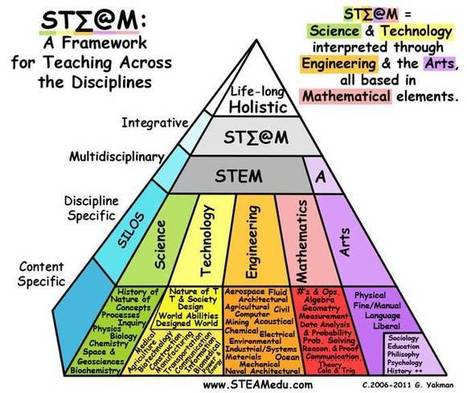
MakerSpaces are quite simply creative spaces. They are certainly STEM spaces but also STEAM as they can include artistic elements and particularly design elements. Every Makerspace is different and so they should be as they need to meet the needs of the users and the community in which they are. They are essentially open-ended exploration spaces and spaces in which students can take control of what they are learning. The voice of the learner is key to the design and everyday workings of MakerSpaces. I think it’s probably quite common to get over-whelmed by the idea of Makerspaces and to think that what you are doing is never going to live up to what you have seen happening in other places…..but I think that is misguided. Any space where kids are making, creating, collaborating and directing what they are doing can be called a Makerspace and Libraries have always fostered this kind of thinking and working.
|
|
Scooped by
Kim Flintoff
April 23, 2016 10:36 PM
|
As we go about our daily lives, we tend to assume that our perceptions — sights, sounds, textures, tastes — are an accurate portrayal of the real world. Sure, when we stop and think about it — or when we find ourselves fooled by a perceptual illusion — we realize with a jolt that what we perceive is never the world directly, but rather our brain’s best guess at what that world is like, a kind of internal simulation of an external reality. Still, we bank on the fact that our simulation is a reasonably decent one. If it wasn’t, wouldn’t evolution have weeded us out by now? The true reality might be forever beyond our reach, but surely our senses give us at least an inkling of what it’s really like.
Not so, says Donald D. Hoffman, a professor of cognitive science at the University of California, Irvine. Hoffman has spent the past three decades studying perception, artificial intelligence, evolutionary game theory and the brain, and his conclusion is a dramatic one: The world presented to us by our perceptions is nothing like reality. What’s more, he says, we have evolution itself to thank for this magnificent illusion, as it maximizes evolutionary fitness by driving truth to extinction.
|
|
Scooped by
Kim Flintoff
April 20, 2016 7:08 PM
|
Said it all before
Chief Scientist Alan “Frank” Finkel was at his engaging best giving evidence on Tuesday to the umpteenth inquiry on whether the Australian economy needs people who can count. This one is by the House of Representatives Standing Committee on Education and Employment, which is looking at how Australia can have an innovative and creative workforce. “My predecessor, Ian Chubb, led the Office of the Chief Scientist through a large number of studies to gather an evidence base on our capability in STEM education and workforce preparation, and I think that has informed everything that is in our submission and a lot of the discussion that has taken place across the community,” Dr Finkel said.
He added addressing STEM shortages takes lots of time, both to change things and to discover whether changes, notably in higher education, worked. “It takes two years to design and approve a new course. Then it is going to be four years before the first graduates from that course go through and get their bachelor degree with honours. In many disciplines there is an expectation of a masters, so there is a six- to seven-year lag from when there is a recognition through interaction with industry and academia. In order to cope with that we need to make sure industry is talking to the academic leadership about the horizon scanning, to anticipate where the new needs are. That is difficult and you can get it wrong.”
But degree changes aren’t the only thing that takes time. As Professor Chubb obviously understood, when policy advocates are so sick of an idea that they can barely mention it, that is when most people are just beginning to get it.
|
|
Scooped by
Kim Flintoff
April 18, 2016 9:21 PM
|
I’ve been teaching boys and girls to program computers professionally since 1982 when I created one of the world’s first summer camp computing programs. I led professional development at Methodist Ladies’ College in Melbourne, Australia for a few years beginning in 1990. Girls at MLC used their personal laptops to program in LogoWriter across the curriculum. (read about the history of 1:1 computing and programming here). That work led to perhaps as many as 100,000 Australian boys and girls learning to program computers in the early 1990s.
|
|
|
Scooped by
Kim Flintoff
May 11, 2016 9:19 PM
|
Introduction
Children begin using an informal version of the scientific method as infants, as they take in information from their senses, form ideas about how the world works, and test and revise their hypotheses based on new information.[i] Science education builds on this natural tendency to explore and understand the physical world by teaching students both scientific content and the principles of scientific reasoning: how to gather and evaluate evidence to form hypotheses, assess the validity of claims, develop predictions, and establish reasoned arguments.
More broadly, it is important for students to learn how science operates as an approach for understanding the world.[ii] Key concepts students should understand about the nature of science include knowledge of the scientific method; concepts such as hypotheses and theories; what forms of evidence are considered legitimate; the role of creativity and experimentation in science; the idea that scientific knowledge is constantly changing and advancing; and the history of science and its role in culture.[iii]
The section below highlights key findings from the research on teaching science.
|
|
Scooped by
Kim Flintoff
May 11, 2016 6:52 AM
|
Schools face relentless pressure to up their offerings in the STEM fields—science, technology, engineering, and math. Few are making the case for philosophy.
Maybe they should.
Nine- and 10-year-old children in England who participated in a philosophy class once a week over the course of a year significantly boosted their math and literacy skills, with disadvantaged students showing the most significant gains, according to a large and well-designed study (pdf).
|
|
Scooped by
Kim Flintoff
May 9, 2016 10:53 AM
|
If you're looking for excellent coding or pre-coding classes, games, toys, and apps, for your kids to learn to code, you'll find everything you need here.
|
|
Scooped by
Kim Flintoff
May 8, 2016 7:10 PM
|
*Update: Since this post I have added more challenges and badges to include Sphero, MaKeyMaKey, Scratch and more. There are now over 60 challenges and badges for your students! Please share any challenges and badges you make. I would love to add them. Check back again, I am adding more challenges and badges all the time. Check out the crowdsourced Gamification padlet at the end of this post too!
|
|
Scooped by
Kim Flintoff
May 4, 2016 4:16 AM
|
You can install the Scratch 2.0 editor to work on projects without an internet connection. This version will work on Mac, Windows, and some versions of Linux (32 bit).
|
|
Scooped by
Kim Flintoff
May 3, 2016 8:52 PM
|
Geological timeline came from decaying potassium
When it returned they measured the decay of potassium into argon in the mass spectrometer at Curtin University’s Argon Laboratory.
Potassium decays into argon, Prof Jourdan says, allowing researchers to date given geological events by measuring the proportions of Argon 39 and Argon 40 in a sample.
He said this “Argon-Argon” method works by heating the sample with a LASER, releasing the argon which is then measured on the mass spectrometer.
|
|
Scooped by
Kim Flintoff
May 3, 2016 1:45 AM
|
Creative problem-solving used to take place on the playground during recess, when worksheets temporarily disappeared and teachers stood at a distance. There, learning happened through exploration and play. But for today's students, creative problem-solving has migrated into the classroom as well, and been rebranded as design thinking.
Once the purview of business school seminars and executive education workshops, design thinking has started appearing in the classrooms of younger and younger students. The approach, which emerged out of Stanford University's d.school, emphasizes empathy and iterative prototyping. For teachers, it provides a way to structure the otherwise murky concept of problem-solving. And for students, it provides opportunities to tackle real-world challenges in hands-on ways. Thanks in part to free tools like consultancy Ideo's "Design Thinking For Educators," schools around the world are embracing the technique.
|
|
Scooped by
Kim Flintoff
April 27, 2016 8:49 PM
|
The Girls in ICT initiative of the International Telecommunication Union (ITU) is a global effort to raise awareness on empowering and encouraging girls and young women to consider studies and careers in Information and Communication Technologies (ICTs). The initiative is committed to celebrate and commemorate the International Girls in ICT Day on the fourth Thursday of every April as established by the ITU membership.
The Girls in ICT Portal is a tool for girls and young women to get an insight into the ICT sector as well as for partners to understand the importance of the International Girls in ICT Day, developed by the Digital Inclusion programme of ITU Telecommunication Development Bureau.
|
|
Scooped by
Kim Flintoff
April 25, 2016 9:40 PM
|
Three recommendations:
1) Kids need real computers capable of programming, video editing, music composition and controlling external peripherals, such as probes or robotics. Since the lifespan of school computers is long, they need to do all of the things adults expect today and support ingenuity for years to come.
2) Look for ways to use computers to provide experiences not addressed by the curriculum. Writing, communicating and looking stuff up are obvious uses that require little instruction and few resources.
3) Every student deserves computer science experiences during their K-12 education. Educators would be wise to consider programming environments designed to support learning and progressive education such as MicroWorlds EX and Scratch.
|
|
Scooped by
Kim Flintoff
April 23, 2016 11:07 PM
|
Check out the students and their robots who competed at VEX Worlds 2016, the world's largest robotics competition.
|
|
Scooped by
Kim Flintoff
April 23, 2016 6:23 AM
|
To mark the 450th anniversary of the bard's birth, Jennifer Rampling probes how mathematics and technology shaped his era.
We know how important it is to get kids exposed to computer programming, but how? Here are 10 easy ways to get started with coding in the classroom.
Via John Evans
|