The debates around STEM v STEAM are plentiful - many STEM advocates disconnect STEM content from meaningful and engaging contexts; seemingly forgetting about active and inquiry focussed pedagogies that can only operate well in a rich integrated ecosystem. We advocate for STEM+ and the "+" is essential.
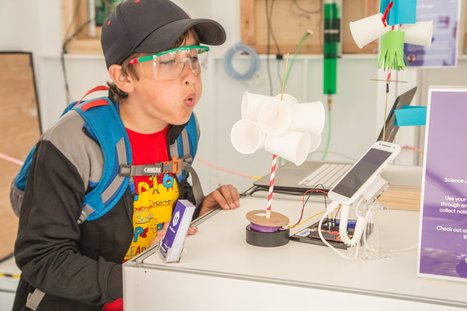
This morning, Google released Science Journal, its latest free app for Android phones. Science Journal is a digital science notebook that allows kids (and amateur scientists of all ages) to use the sensors on their Android phones for experiments. With a just a phone you can measure sound, light, and motion for some easy-access science!
The app itself is open-ended, providing the tools in a simple format that’s intuitive, but to really kick off the launch of this app Google has partnered with the experts at Exploratorium to create a number of hands-on projects. These projects are detailed on their companion site Making & Science, and kits are available to create projects around external sensors (including a kit from Make:!).
Combining physical experiences with digital experience is really the future of STEM education. Science Journal makes it easy for science educators to introduce the idea that science doesn’t need to be difficult or confined to the lab. With Science Journal on your phone, you have the basic tools you need to follow your curiosity and get started with experiments of your own.
STEM literacy is for everyone! STEM literate individuals are able to use concepts from science, technology, engineering and mathematics to understand complex problems and to innovate with others to solve them. A STEM literate person considers how STEM can improve the social, cultural, economic, and environmental conditions of their local and global communities. Building STEM literacy ensures we have both the scientists and global citizens we need to thoughtfully build equitable and sustainable futures.
Below, you'll find resources to help you stay informed about the latest news and research, get connected to other educators working in OER Commons, and start building your own teaching and learning materials.
We need to invest in arts education, along with science and tech education, because it produces well-rounded students; because it produces more humane people; because it protects our cultural heritage and enables students to understand some of the great creations that have shaped the growth of civilization; because the arts play a big role in our economies.
But we also need to do it because we are at an unprecedented technological and cultural watershed, when not only the arts will change, but the potential that each individual artist has for changing the world will become even greater. It does not take a great creative mind to see the world needs such change. But it will take great and well-trained creative minds to drive that change and to ensure that it takes us to the better future we all seek.
It's the acronym for science, technology, engineering, and mathematics, the disciplines that are vital for a thriving economy and a safe and healthy society.
In kindergarten through 12th grade in the United States, most STEM teaching and learning focuses on science or mathematics. Comparatively little attention has been paid to the "T" and "E."And, for the most part, the four subjects have been taught in isolation.
But new reform efforts - like the Next Generation Science Standards - are placing more emphasis on the connections between and among the STEM disciplines.
To understand how this trend might affect teaching and learning in the future, we need to take a closer look at integrated STEM education, not just the individual subjects that make up the acronym.
After all, in the real world, science relies on technology, mathematics, and engineering -- and engineering depends on findings from science, the application of mathematics, and the use of technological tools.
Imagine if K-12 students were taught in ways that highlighted these connections. Would they learn more and more deeply? Might they see STEM disciplines as more relevant to their lives? Could it lead more of them to pursue STEM courses and careers?
The answers to these questions depend in part on how integrated STEM education is implemented in schools and in out-of-school settings.
Research suggests that implementation has to balance learning in the individual STEM subjects with more connected ways of learning.
In addition, because it can be hard for students to make these connections themselves, teachers will need to make the connections explicit.
Inside the classroom, some teachers may use instructional approaches like problem-based learning or engineering design, which are special kinds of problem solving, to introduce integrated STEM education to their students.
Outside the classroom, students are being exposed to STEM connections in museums and science centers, through after-school experiences, like some TV shows and STEM-focused robotics competitions, and in internships.
However, we need more research to better understand the potential benefits and limitations of integrated STEM education for students, teachers, and schools.
What, for example, are the implications of integrated STEM education for how schools are organized?
How can teachers be better prepared to teach in integrated ways?
How can we test kids to determine what they are really learning and able to apply as a result of integrated STEM experiences?
The list of questions is long, but getting answers is important for students, teachers, and the nation.
David Rothkopf argues the internet alone is not bringing the world closer together. Bigger cultural exchanges play an important role, and these are fed by an education system that incorporates the arts.
Some of the greatest examples of creativity in human history have come from scientists, mathematicians, engineers, and others who have reimagined, reinterpreted, and remade our world.
We need to focus on arts education for different, profoundly fundamental, reasons: we need the arts in order to be human. Artists help us explore the mysteries of life and venture to places that we seldom take ourselves in our daily workaday existence.
Teachers! Do you have questions about STEM in school? We want to hear them! In our live-streamed edu-chat series, you ask the questions. We invite STEM education experts to join us for regular live chats and your questions and comments lead the conversation.
There's no need to register or log in. The curated chats are streamed through YouTube (video will appear where image is above) and you can use the Ask Questions tab to send through your questions (you can start right now!).
Our second chat is at 4pm on Monday 23 May with STEM in education expert Simon Crook. Find out more about Simon here
View the 156 videos that showcase innovative work taking place across the country and read the discussions that complement each video. This event runs from Tuesday, May 17 through Monday, May 23. Videos recognized as “facilitators’ choice”, “public choice” and “presenters’ choice” will be announced on this site on Tuesday, May 24.
Some Iowa schools will incorporate engineering lessons into classrooms to boost creativity, problem-solving skills Starting this fall, elementary schools in Ames, Iowa will begin integrating engineering into classrooms to challenge students to think creatively and problem solve, with hopes of encouraging more students, especially those of underrepresented groups, to envision themselves as the engineers of the future.
“This is about talking with kids that anyone can be an engineer, and an engineer is like an inventor that has a problem to solve,” said Kari Smith, an Ames math and science teacher on special assignment.
For the start of the 2016-17 school year, 11 elementary classroom teachers and two teacher technology librarians across the district’s five elementary schools have volunteered to participate in this pilot year of using the program Engineering is Elementary (EiE). The funding for the pilot was awarded to Ames with a grant from the Governor’s STEM Advisory Council. If the pilot year is a success, the district hopes to expand the program to all of its elementary classrooms.
Computational thinking is the thought processes involved in formulating a problem and expressing its solution(s) in such a way that a computer – human or machine – can effectively carry out.
Informally, computational thinking describes the mental activity in formulating a problem to admit a computational solution. The solution can be carried out by a human or machine. This latter point is important. First, humans compute. Second, people can learn computational thinking without a machine. Also, computational thinking is not just about problem solving, but also about problem formulation.1
The Digital Careers organisation says that students need experience and skills in computational thinking and computer programming (coding) to be successful in their future careers.2 The NSW syllabuses provide a range of opportunities to develop students’ understanding of computational thinking and coding.
This guide draws out the areas where computational thinking can be applied within the existing NSW K–8 syllabuses. Like the syllabuses, it is organised into stages of learning and subdivided into learning areas, with suggested activities and links to online resources.
Not all resources and activities listed in this guide refer to coding explicitly, but they do aim to develop algorithmic and computational thinking skills to better enable students and teachers to reach a coding goal.
If interdisciplinary project-based learning is a goal for you and your students this school year, you might want to start with questions that put a premium on place. For example: Where are bicycle accidents most likely to happen in your community? Where's the best spot to watch for migrating Monarch butterflies? What's the safest evacuation route in the event of a natural disaster? How have the neighborhoods of New Orleans changed after Hurricane Katrina?
To investigate such questions, students would need to gather and analyze data, look for patterns, think critically, and communicate their understanding with maps and other visual aids. In the process, they would also make connections across content areas and deepen their geo-literacy skills.
It's a scene to make you squirm. On the table is a 3D model of a part of a man's body, while overhead an arrangement of James Bond-like lasers dance with venomous glee. But this isn't a 21st Century torture scene; it's the home of a high-tech medical practice that is promising to change the way prostate cancer is treated in the UK.
We know that kids love computer games and will spend hours engrossed in them. But “educational games” are often neither educational nor much fun. Use Minecraft to organize, implement, manage, assess, guide and provide ample learning opportunities and still keep games fun.
Brent Bushnell and Eric Gradman, co-founders of LA-based Two Bit Circus, energize their audience with the STEAM Carnival, a way to make entertainment more enriching and education more fun. Armed with the knowledge that the U.S. may be short as many as three million high-skills workers by 2018, Science, Technology, Engineering, and Math need to get more interesting in order to attract students to those fields of study. Bushnell and Gradman share their stories about how the need for art and creativity drove them from their "real jobs" to a job they can't get enough of.
Students from elementary school through community college will take part in the sixth annual C-STEM Day held by the University of California, Davis on May 21. The C-STEM Day events will take place at the UC Davis campus and at University High School in Irvine, CA.
Participating students have spent the last year working with computing, robotics and math curricula developed by the UC Davis Center for Integrated Computing and STEM Education (C-STEM Center). C-STEM Day is the culminating event, where students can demonstrate the math and programming skills they have learned throughout the year. As part of C-STEM Day, students compete in the RoboPlay Challenge Competition and RoboPlay Video Competition. The event concludes with the C-STEM Day Awards Ceremony, with the presentation of awards for achievement, excellence, girl's leadership and the C-STEM scholarship.
he Human Engineering Research Laboratories at the University of Pittsburgh has been designing products to help injured veterans and others with disabilities for more than two decades. But it took a young staff member with a background in education policy to prod it to help disabled vets begin STEM careers of their own.
The lab has 80 research projects underway, including programs to develop wheelchairs that can climb stairs and robotic arms that can prepare breakfast. Founded in 1994, the lab has long maintained a focus on helping military veterans; its director, Rory A. Cooper, began using a wheelchair after suffering a spinal-cord injury in 1980 while stationed in Germany with the U.S. Army.
Data Exploration Technology Comes to Classrooms via the Common Online Data Analysis Platform (CODAP) DRL-1435470
Data are everywhere. Except in the classroom.
The Concord Consortium’s Common Online Data Analysis Platform (CODAP) provides an easy-to-use web-based data analysis tool, geared toward middle and high school students, and aimed at teachers and curriculum developers. We demonstrate CODAP, presenting some of the many ways data flows into CODAP; dynamically linked tables, graphs, and maps; and user interaction with hierarchical data structures that help make the data intuitive.
The Concord Consortium is currently collaborating with several NSF-funded curriculum development projects to bring more rich experiences with data to more teachers and students. We highlight CODAP’s use in InquirySpace (physics), OceanTracks (marine biology), and Terra Populus (social science).
CODAP is free and open source with a commercial-friendly license. As the CODAP community grows, we expect this platform to become more powerful, flexible, and adaptable to a variety of online contexts. We invite you to join the CODAP community.
Planetary Resources, a company hoping to make asteroid mining into a trillion dollar industry, earlier this year unveiled the world’s first 3D printed object made from bits of an asteroid.
3D printing, and additive manufacturing processes more generally, have made many advances in recent years. Just a few years ago, most 3D printing was only used for building prototypes, which would then go on to be manufactured via conventional processes. But it’s now increasingly being used for manufacturing in its own right.
Nearly two years ago, NASA even sent a 3D printer to the International Space Station with the goal of testing how the technology works in micro-gravity. While the printer resembles a Star Trek replicator, it’s not quite that sophisticated yet; the objects it can print are small prototypes for testing.
In Term 3 2015, Thomas visited St Peter's Girls' School and spent time in the ELC, Foundation and Year 3 classes. The teachers reported learning new insights about their students as learners and about the pedagogy that most enabled computational thinking and deep learning.
After 10+ years as a classroom teacher, Annabel has spent the last 10 years in varied education management settings spanning professional development, publishing, not for profit and broadcasting industries. Now, as Head of Digital Education for the ABC, Annabel is driving the development of the hugely popular ABC Splash as well as a number of other digital resource initiatives. Guests Chris Betcher
Chris is an Australian K-12 educator with over 25 years experience in helping students and teachers make the most of digital technologies for learning. Chris has been nominated for the edublog awards on several occasions for his educational blog betchablog
A few weeks ago we published a study showing that computing occupations drive 16% of all new wages in the U.S. We just re-did the analysis to get a more accurate picture.
The result: Computing occupations are the largest category of new wages in the United States – ahead of management, healthcare, finance, engineering, sales, or any other category.
To get content containing either thought or leadership enter:
To get content containing both thought and leadership enter:
To get content containing the expression thought leadership enter:
You can enter several keywords and you can refine them whenever you want. Our suggestion engine uses more signals but entering a few keywords here will rapidly give you great content to curate.


 Your new post is loading...