


You could sense the young Boris Nemtsov's apprehension and ambivalence two decades ago as Russia hurtled into a full-blown constitutional crisis.
After months of bitter conflict, Presiden...
Via Matt Beiriger

 Your new post is loading...
 Scoop.it! You could sense the young Boris Nemtsov's apprehension and ambivalence two decades ago as Russia hurtled into a full-blown constitutional crisis. Via Matt Beiriger 
No comment yet.
Sign up to comment
Scoop.it!

American citizenship bestows the right to vote, improves the likelihood of family members living in other countries to come and live in the US, gives eligibility for federal jobs, and can be a way to demonstrate loyalty to the US.
Scoop.it!
The American South has given us words like "y'all" and "rednecks" as well as dozens of colorful phrases like "fly off the handle," "having an axe to grind," ...
Scoop.it!

“To find out, you’d have to compare the emotions of one generation to
Scoop.it!

Singapore's unbelievably low birthrates have inspired National Night, a campaign to encourage Singaporean couples to let their patriotism explode on August 9.
Scoop.it!

Join me and National Geographic's Great Nature Project in exploring the great nature all around us!

Kenny Dominguez's curator insight,
September 27, 2013 10:37 PM
i agree with mary we should all get together and invite everyone we know 
Tracy Klug's curator insight,
September 30, 2013 3:07 PM
Join me in submitting pictures to National Geographic's Great Nature Project! You could submit them to me personally so that I can show the images to my Human Geography students! 
Molly Diallo's curator insight,
September 30, 2013 5:52 PM
I am requesting you do this and send me a copy of your pictures as well!
Scoop.it!
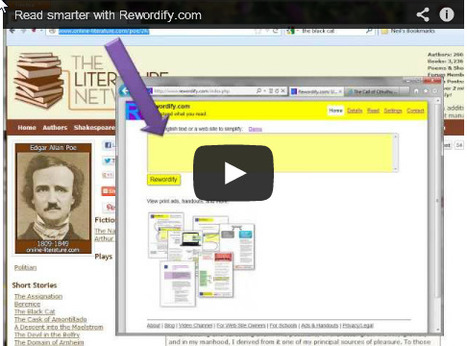
"Rewordify is a free site that was developed by a special education teacher and former computer programmer for the purpose of helping students read complex passages. At its most basic level Rewordify takes a complex passage and rephrases it in simpler terms." Via Beth Dichter

Beth Dichter's curator insight,
August 25, 2013 9:15 PM
Here is a tool you might want to try with students whom have difficulty reading complex passages. Rewordify rephrases passages (simply cut and paste text into a "yellow box" or type directly into it). Users may select setting so they only see the "easier version" (although they may see the more difficult words as they mouse over the word) or have this option in reverse. You may also enter in a website and have them rewordify the site. There is much additional information on the site including a teacher and student demo. The site is free, and also works on tablet and smartphones. As we move to more informational text and more complex (think Common Core) this site may be quite valuable for many students.
Scoop.it!
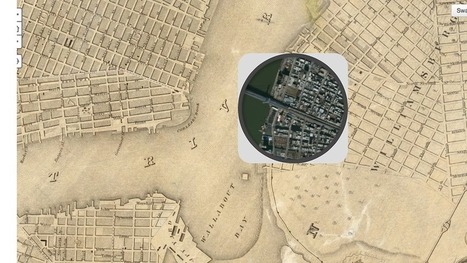
" The Smithsonian Magazine recently dipped into David Rumsey's collection of over 150,000 maps to find some of the best representations of American cities over the past couple hundred years. With some simple programming, they were able to overlay images of vintage maps of some major cities onto satellite images from today. The results are fascinating."
Scoop.it!

"FOUND is a curated collection of photography from the National Geographic archives. In honor of our 125th anniversary, we are showcasing photographs that reveal cultures and moments of the past. Many of these photos have never been published and are rarely seen by the public. We hope to bring new life to these images by sharing them with audiences far and wide. Their beauty has been lost to the outside world for years and many of the images are missing their original date or location."

Jacqueline Landry's curator insight,
September 10, 2013 10:31 AM
These pictures are awesome. It would be nice to know the locations of some of the pictures to compare them to images now.
Scoop.it!

We all know that vocabulary acquisition is an essential part of effective pedagogy. Click here to watch an interesting and colorful way to help students deeply understand and use academic vocabular... Via Darren Burris
Scoop.it!
|

|
Rescooped by
Clairelouise
from Amazing Science
September 1, 2013 11:06 AM
|
Scoop.it!


Fast-accumulating data seem to indicate that our close cousins, the Neanderthals, were much more similar to us than imagined even a decade ago. But did they have anything like modern speech and language? And if so, what are the implications for understanding present-day linguistic diversity? The MPI for Psycholinguistics researchers Dan Dediu and Stephen C. Levinson argue in their paper in Frontiers in Language Sciences that modern language and speech can be traced back to the last common ancestor we shared with the Neandertals roughly half a million years ago.
The Neanderthals have fascinated both the academic world and the general public ever since their discovery almost 200 years ago. Initially thought to be subhuman brutes incapable of anything but the most primitive of grunts, they were a successful form of humanity inhabiting vast swathes of western Eurasia for several hundreds of thousands of years, during harsh ages and milder interglacial periods. We knew that they were our closest cousins, sharing a common ancestor with us around half a million years ago (probably Homo heidelbergensis), but it was unclear what their cognitive capacities were like, or why modern humans succeeded in replacing them after thousands of years of cohabitation. Recently, due to new palaeoanthropological and archaeological discoveries and the reassessment of older data, but especially to the availability of ancient DNA, we have started to realise that their fate was much more intertwined with ours and that, far from being slow brutes, their cognitive capacities and culture were comparable to ours.
Dediu and Levinson review all these strands of literature and argue that essentially modern language and speech are an ancient feature of our lineage dating back at least to the most recent ancestor we shared with the Neanderthals and the Denisovans (another form of humanity known mostly from their genome). Their interpretation of the intrinsically ambiguous and scant evidence goes against the scenario usually assumed by most language scientists, namely that of a sudden and recent emergence of modernity, presumably due to a single – or very few – genetic mutations. This pushes back the origins of modern language by a factor of 10 from the often-cited 50 or so thousand years, to around a million years ago – somewhere between the origins of our genus, Homo, some 1.8 million years ago, and the emergence of Homo heidelbergensis. This reassessment of the evidence goes against a saltationist scenario where a single catastrophic mutation in a single individual would suddenly give rise to language, and suggests that a gradual accumulation of biological and cultural innovations is much more plausible.
Interestingly, given that we know from the archaeological record and recent genetic data that the modern humans spreading out of Africa interacted both genetically and culturally with the Neanderthals and Denisovans, then just as our bodies carry around some of their genes, maybe our languages preserve traces of their languages too. This would mean that at least some of the observed linguistic diversity is due to these ancient encounters, an idea testable by comparing the structural properties of the African and non-African languages, and by detailed computer simulations of language spread.
|
|
Scooped by
Clairelouise
August 25, 2013 4:43 PM
|
Scoop.it!

Researchers from the University of Michigan find that while Facebook provides an invaluable resource for social connection, it actually undermines well-being.
|
|
Scooped by
Clairelouise
October 5, 2013 4:36 PM
|
Scoop.it!

The Express Tribune Petition challenges confiscation of LGS textbooks The Express Tribune LAHORE: A Public Interest Litigation was filed at the Lahore High Court on Friday that challenged the provincial government's decision to confiscate and ban...
|
|
Scooped by
Clairelouise
October 5, 2013 12:08 PM
|
Scoop.it!
Ever wonder why American cowboys say "'git along little doggies" when they're talking about herding cattle? Or why a losing wrestler "cries uncle?" And why d...
|
|
Scooped by
Clairelouise
October 1, 2013 7:55 PM
|
Scoop.it!
Attention deficit hyperactivity disorder (ADHD) is one of the most feared and misunderstood of all medical conditions. Despite over 200 scientific papers bei...
|
|
Scooped by
Clairelouise
October 1, 2013 7:47 PM
|
Scoop.it!
“To find out, you’d have to compare the emotions of one generation to
another. British anthropologists think they may have found the answer —
embedded in literature.
|
|
Scooped by
Clairelouise
September 30, 2013 8:31 AM
|
Scoop.it!
The World's Constitutions to Read, Search and Compare
"A very neat new Web site — Constitute — allows you to search the constitutions of almost all the independent states in the world, with more constitutions on the way. You can search by country and by topic. Interested in which constitutions have provisions for the right to bear arms? Or gender equality? Or free speech? You can look for it."
|
|
Scooped by
Clairelouise
September 23, 2013 10:44 AM
|
Scoop.it!
Maps-of-War is a multimedia site dedicated to producing diverse, creative visuals that enhance our understanding of war and its history.
|
|
Scooped by
Clairelouise
September 16, 2013 12:16 PM
|
Scoop.it!

"Historian Susan Schulten writes in her book Mapping the Nation: History and Cartography in Nineteenth-Century America that during the 1850s many abolitionists used maps to show slavery's historical development and to illustrate political divisions within the South. (You can see many of those maps on the book’s companion website.) Schulten writes that President Lincoln referred to this particular map often, using it to understand how the progress of emancipation might affect Union troops on the ground. The map (hi-res) even appears in the familiar Francis Bicknell Carpenter portrait First Reading of the Emancipation Proclamation of President Lincoln, visible leaning against a wall in the lower right-hand corner of the room."
Tags: mapping, historical, cartography.

I chose this scoop because it relates to slavery, and slavery has something to do with economics. It also has to do with social. This map was used by Lincoln to see the reach of slavery. TOPIC: social

Great historical map of the population density of enslaved people during the 1850s. I would like to see this map with a side by side of the poulation density of modern day african americans. I think they would be very similar due to many people not wanting to leave their culture and tradtion behind. Another little thing i found interesting on this map is where the slaves were the most populated such as along the mississippi and coastal carolinas. This is from the farms having to use massive amounts of water to run and whats better than being right on the water.

This made, created in 1861, shows the relevant amounts of slavery occurring throughout that year. The map shades counties based on the percentage of total inhabitants who were enslaved. Though this map was simple, it showed the relationship between states commitments to slavery and their enthusiasm about secession, making a visual argument about Confederate motivations. President Lincoln referred to this particular map often, using it to understand how the progress of emancipation might affect Union troops on the ground. The map is a great representation of slavery that amounted during the 1860's.
|
|
Scooped by
Clairelouise
September 9, 2013 7:45 PM
|
Scoop.it!

Provides a chronological history of Ancient Rome with extensive links to internet resources.

The descriptions of what is accurate and what is false in the movie Gladiator is especially helpful.
|
|
Scooped by
Clairelouise
September 4, 2013 6:49 PM
|
Scoop.it!

Dr Sarah Parcak uses satellite technology to unearth Egypt's ancient settlements, pyramids and palaces lost in the sands of time.

It is interesting to find out that in this specific article there is controversy over the looting of tombs over 5,000 years ago as soon as the deceased were buried there were many more looting acts taken place. The Arab spring is an important landmark to think of when relating this to the reading.

This describes human characteristics that defined this region because it shows how ancient artifacts are being unearthed through new-age technology.

Space archaeology only makes sense. If we have the capability for satellites to take pictures of earth from above why shouldn't it be used for archaeological analysis? I am sure that this is only the tip of the iceberg as far as what we will see in the future from this specific field. This article/video just lends more credibility to the fact that Archaeology should function as an interdisciplinary field.
|
|
Scooped by
Clairelouise
September 1, 2013 5:55 PM
|
Scoop.it!

"Counties where at least 10 percent of people speak a language other than English at home."

This map does not bring many surprises. Places where there are a lot of Spanish speaking families are present in places where many Spanish people immigrate to, along the Mexican border and the southern tip of Florida, where Cuba is close by. One interesting thing about the French areas seen in Louisiana is that their version of French is a regional dialect. Not only is their a cluster of French speaking families, but they are all speaking a language native to the region. It is very surprising that there are not as many French speaking families along the Canadien border.

This map shows how linguistically diverse the United States is today. This map reminded me of one of the slides that we went over in class about how in the Northwest Region the predominant language was German and now it is mainly English, with some German and Native American languages still spoken in certain parts.

This data is very interesting because you can see that most of these statements speak Spanish. I noticed that most people who speak another language at home (in this case Spanish) besides English are located in the south western of United States. I wonder if this has something to do with people who immigrated to U.S from south America.
|
|
Scooped by
Clairelouise
September 1, 2013 5:51 PM
|
Scoop.it!

Hijab is an Islamic concept of modesty and privacy, most notably expressed in women’s clothing that covers most of the body.

Learning and teaching about the Hijab and its culture.

|
|
Scooped by
Clairelouise
August 28, 2013 7:08 PM
|
Scoop.it!

Once again Mighty Optical Illusions website proudly brings new optical illusion that hopefully will become as famous as the Spinning Girl did in the past.






