
SoRo class
5.2K views |
+0 today


 Your new post is loading...
 Scoop.it!
|


|
Scooped by
Clairelouise
March 18, 2014 12:09 PM
|
Scoop.it!

Understanding mistakes of the past can help guide U.S. transportation policy in the future.
In 2010, Americans drove for 85 percent of their daily trips, compared to car trip shares of 50 to 65 percent in Europe. Longer trip distances only partially explain the difference. Roughly 30 percent of daily trips are shorter than a mile on either side of the Atlantic. But of those under one-mile trips, Americans drove almost 70 percent of the time, while Europeans made 70 percent of their short trips by bicycle, foot, or public transportation. The statistics don't reveal the sources of this disparity, but there are nine main reasons American metro areas have ended up so much more car-dependent than cities in Western Europe.


Jared Medeiros's curator insight,
February 4, 2015 6:41 PM
A big reason why people are more car dependant in America is because we are a lazy nation. Americans are always looking for the easy way to accomplish things, so if you can drive a mile to work in 2 minutes or walk in 15, its almost guarenteed that the American is walking! This is obviously a general term and does not apply to all Americans but a vast majority would opt for the vehicle. As someone who has taken several trips to Europe, people there are in far better shape than in America and i'm sure that fitness along with better eating habits attribute to that.
Another reason I believe America is more dependant than Europe on cars is because it is far easier and cheaper to travel via train or subway in Europe. Train stations and public transport in America are expensive and only take you to highly populated areas while the trains in Europe will take you all over the continent.

Gene Gagne's curator insight,
November 18, 2015 2:40 PM
This has major impact on health issues, because nobody wants to walk or bike anymore which most of us did until 16 years old, it is a good form of exercise and can keep a persons body weight down. Which would lead to less health issues. Also the pollution from the vehicles and illegal dumping of tires and batteries and oil which leads to environmental problems. Socially we would meet more people and even see more of our surroundings if we drove less. Economically we as individuals would save money by not driving or would we? We would save on gas, licenses, maintenance, but on the other hand our renewal of licenses, registration, and even taxes on the vehicle help support our schools, busing and other community projects. This funding would be cut and therefore taxes will rise on something else we would end up paying for. I personally just think as Americans we drive everywhere and spend less time taking bikes, walks even skateboards all over the city which we loved to do as teenagers. I don't expect to be rollerblading or skateboarding at an older age but why do we stop at 16. It is because we are allowed to under the law to drive and everyone can't wait until high school to get their license. Once we give up our bikes and rollerblades, skateboards, walks it is hard to go back to it.

Olivia Campanella's curator insight,
September 10, 2018 10:42 AM
In 2010, Americans drove 85% of their daily trips, but in Europe they only had shares up to 50 - 65%. Americans drove 70% of the time while Europeans made 70% of their trips by bike, foot, or public transportation. American metro, compared to Western European ended up so much more car dependent.The American cities were the first to adapt to the car at a large scale. By the 1930's there was 1 registered car for every two homes in the it United States, but car ownership in Europe was for the wealthy.
|
|
Scooped by
Clairelouise
March 18, 2014 12:06 PM
|
Scoop.it!
"When you combine a street and a road, you get a STROAD, one of the most dangerous and unproductive human environments. To get more for our transportation dollar, America needs an active policy of converting STROADs to productive streets or high capacity roadways."


François Lanthier's curator insight,
January 31, 2014 2:19 PM
The Stroad - an unfortunate phenomenon... NYC is taking action to minimize its' STROADS... more cities should do the same.
|
|
Scooped by
Clairelouise
March 17, 2014 1:59 PM
|
Scoop.it!
Clairelouise's insight:
Oral recitation, written in English and Arabic

|
|
Scooped by
Clairelouise
March 14, 2014 8:37 AM
|
Scoop.it!


K_Lynam's curator insight,
March 20, 2014 4:43 PM
The Ides of March definitely BLEW into our area! Perfect timing to find @Seth Dixon's Scoop of this interactive Wind Map!

|
|
Scooped by
Clairelouise
March 10, 2014 7:50 PM
|
Scoop.it!

Reuters photographer Carlos Barria recently spent time in Shanghai, China, the fastest-growing city in the world. A week ago, he took this amazing shot, recreating the same framing and perspective as a photograph taken in 1987, showing what a difference 26 years can make. The setting is Shanghai's financial district of Pudong, dominated by the Oriental Pearl Tower at left, and the new 125-story Shanghai Tower, China's tallest building and the world's second tallest skyscraper, at 632 meters (2,073 ft) high, scheduled to finish by the end of 2014. Shanghai, the largest city by population in the world, has been growing at a rate of about 10 percent a year the past 20 years, and now is home to 23.5 million people -- nearly double what it was back in 1987. This entry is focused on this single photo pairing, with several ways to compare the two.

Joseph Thacker 's curator insight,
April 15, 2014 12:38 PM
It is amazing how quick a city can change in only 26 years. Since this picture was taken in 1987, the city's population has doubled, and is continuing to grow rapidly. Today, this city is one of the largest in the world and has magnificent skyscrapers, one of which is the second tallest in the world. It is obvious globalization hit this mega city very quickly, making it one of the most impressive cities in the world.

Jess Deady's curator insight,
May 4, 2014 9:37 PM
Buildings, skyscrapers and urbanization. Why not? This is how the world is and this is what attacks tourists. For Shanghai, they need to be up to par with all the other business and tech savvy countries and cities. This is how they are going to keep their technological business, by building what needs to be built.

|
|
Scooped by
Clairelouise
March 10, 2014 7:18 PM
|
Scoop.it!

"Ben Schmidt, assistant professor of history at Northeastern University, has visualized the routes of 19th Century ships using publicly available data set from NOAA (National Oceanic and Atmospheric Administration). The resulting image is a hauntingly beautiful image that outlines the continents and highlights the trade winds. It shows major ports, and even makes a strong visual case for the need for the Panama and Suez Canals."

Tracey M Benson's curator insight,
March 10, 2014 4:29 PM
Beautiful data visualisation of 19th century ships using publicly available data set from NOAA (National Oceanic and Atmospheric Administration).

Brian Altonen's curator insight,
March 10, 2014 6:21 PM
Lessons in GIS and Medical GIS - Examples of applications. Various Resources at hand.
|
|
Scooped by
Clairelouise
March 10, 2014 5:11 PM
|
Scoop.it!
Cultural historian and author of 'Wonderbox: Curious Histories of How to Live' Roman Krznaric reveals how the art of empathy can not only enrich one's own li...
|
|
Scooped by
Clairelouise
March 9, 2014 2:45 PM
|
Scoop.it!

Looking at models can change your brain pretty quickly. Why that's not necessarily a bad thing.
|
|
Scooped by
Clairelouise
March 7, 2014 11:58 AM
|
Scoop.it!
From
vimeo
Directed by @tiffanyshlain Please share this film far and wide! Suggested ways below. Check out the #TEDBook that accompanies this film. Info at: http://www.letitripple.org Special…
|
|
Scooped by
Clairelouise
March 18, 2014 12:09 PM
|
Scoop.it!

"A floating vessel that is longer than the Empire State Building is high has taken to the water for the first time. Despite appearances, Prelude cannot strictly be described as a ship as it needs to be towed to its destination rather than travelling under its own power."

Cam E's curator insight,
February 4, 2014 12:34 PM
I've got a weak spot for massive ships, plain and simple. I think there's even a future in ship-based cities which move around the world's oceans. Eventually ships can become so large and so advanced that the normal threats associated with the open ocean will do little to scratch them. For a comparison, the ship pictured is the Prelude FLNG, and it's almost twice the length of the Titanic.


BrianCaldwell7's curator insight,
April 5, 2016 8:19 AM
This is a floating testament that economies of scale will continue to push the limits. Today, the largest of the massive cargo ships are simply too big to get through the Panama Canal and have to travel down around the tip of South America. This is one reason why Nicaragua is planning to construct a canal to rival Panama's (Maps 101 readers can read more about the geographic implications of Nicaragua's plans in this article co-authored by myself and Julie Dixon or you can sign up for a free trial subscription to see what Maps 101 has to offer).
Tags: transportation, Nicaragua, globalization, diffusion, industry, economic.
|
|
Scooped by
Clairelouise
March 18, 2014 12:06 PM
|
Scoop.it!

The unsung hero of the global economy: the shipping container.

Jacob Crowell's curator insight,
October 5, 2014 11:50 PM
We discussed how the container has transformed the global economy. These videos show how a simple tee shirt is made from cotton in the US, labor in Columbia, Indonesia, and Bangladesh. In the 1950s Malcolm McLean developed the first shipping container industry and transformed the global economy. Due to the fact that these containers can hold some many items, shipping goods from place to place makes manufacturing a global process. Economic geographies were completely revamped by the innovation of McLean, now a making a tee shirt connects the economies of many nations. A piece of clothing being sold in the United States now is connected to labor across the globe.

Vicki Bedingfield's curator insight,
November 5, 2015 4:54 PM
Tracking the commodity of the T-shirt from cotton to retail.
BrianCaldwell7's curator insight,
April 5, 2016 8:18 AM
NPR's Planet Money has produced an 8-part series following the commodity chain of the T-Shirt. This series explores cotton production, textile mills, sweatshops, outsourcing and in this podcast, the transportation infrastructure that moves goods globally. This podcast touches on the same topic as one of my favorite TED talks, how containerization enabled globalization.
Tags: transportation, industry, economic, globalization, technology, podcast.
|
|
Scooped by
Clairelouise
March 18, 2014 12:06 PM
|
Scoop.it!
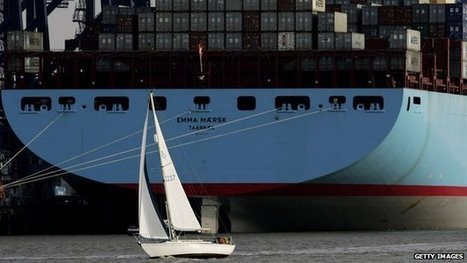
What is blue, a quarter of a mile long, and taller than London's Olympic stadium? The answer - this year's new class of container ship, the Triple E. When it goes into service this June, it will be the largest vessel ploughing the sea. Each will contain as much steel as eight Eiffel Towers and have a capacity equivalent to 18,000 20-foot containers (TEU).

Kevin Nguyen's curator insight,
October 7, 2015 1:17 PM
These vessels are specifically made to increase more profit and is a symbol of economic power for trades between Europe and Asia. They aim to increase containment of cargo so it is more efficient and time consuming of going back to fourth. However, they forced ports to become bigger to compete and keep up with these new inventions. These ships are getting too big and are only able to transit through the Suez canal and cannot go through the Panama. This lead to the Chinese expanding their reach to Nicaragua and building a larger canal to be able to pass through Central America.

Alex Smiga's curator insight,
March 14, 2016 7:42 PM
These containers are symbols of global commerce that enable economies of scale to be profitable and the outsourcing of so many manufacturing jobs to developing countries. The invention of these containers have changed the geography of global shipping and the vast majority of the world's largest ports are now in East Asia. Today though, the biggest container ships are too big to go through the Panama Canal, encouraging China to build a larger canal through Nicaragua.
BrianCaldwell7's curator insight,
April 5, 2016 8:18 AM
These containers are symbols of global commerce that enable economies of scale to be profitable and the outsourcing of so many manufacturing jobs to developing countries. The invention of these containers have changed the geography of global shipping and the vast majority of the world's largest ports are now in East Asia. Today though, the biggest container ships are too big to go through the Panama Canal, encouraging China to build a larger canal through Nicaragua.
Tags: transportation, globalization, diffusion, industry, economic.
|
|
Scooped by
Clairelouise
March 16, 2014 7:44 PM
|
Scoop.it!
A modern translation of the 95 Theses by Martin Luther.
|
|
Rescooped by
Clairelouise
from The 21st Century
March 14, 2014 6:54 PM
|
Scoop.it!
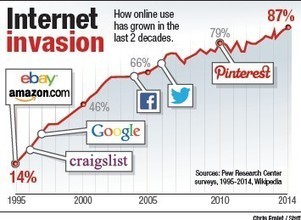
Rebecca Gajecki remembers when she researched her school papers by going to the library and looking stuff up in books.
Via Dr. Susan Bainbridge

Stephen Dale's curator insight,
March 14, 2014 5:23 AM
Do you remember the days before you carried around the world in your pocket?
That would have been before Tim Berners-Lee, a British computer scientist, submitted his proposal for what became the Web back in March of 1989. The Web turned 25 years old this week and it's hard to imagine an invention or process that has changed our lives as much in recent history, impacting everything from political movements to our love lives.
|
|
Scooped by
Clairelouise
March 12, 2014 8:14 PM
|
Scoop.it!

Who has the oil? http://pic.twitter.com/7Njc7OD8rw

Adam Deneault's curator insight,
December 14, 2015 5:40 PM
This use of oil world wide is highly uneven. Maybe there are a lot of wars because of this. We are consuming twenty million barrels of oil a year, that is a lot. The middle east hosts over sixty percent of what oil is left remaining and with countries setting the prices of oil, of course some countries will definitely have more or less. those countries with money will have the oil, those without will not. Developed countries will be able to afford and undeveloped countries will not get what they want or need.

Adrian Bahan (MNPS)'s curator insight,
March 31, 2016 11:58 AM
Natural resources are not evenly distributed...this distribution pattern impacts global economics, industrialization, development and politics tremendously.
Tags: industry, economic, energy, resources.
BrianCaldwell7's curator insight,
April 5, 2016 8:17 AM
Natural resources are not evenly distributed...this distribution pattern impacts global economics, industrialization, development and politics tremendously.
Tags: industry, economic, energy, resources.
|
|
Scooped by
Clairelouise
March 11, 2014 8:19 AM
|
Scoop.it!
The Hundred Years War - Episode 1: Trouble In The Family (History Documentary) Dr. Janina Ramirez explores the fall-out of the longest and bloodiest divorce ...
|
|
Scooped by
Clairelouise
March 10, 2014 7:49 PM
|
Scoop.it!

From
www
Once thought to be symbols of prosperity, innercity highways are now just eyesores — and sources of civic dysfunction — to some new urbanists.

Built 4 Betterness Ed van den Berg's curator insight,
March 11, 2014 9:44 AM
How's that for Rotterdam
|
|
Scooped by
Clairelouise
March 10, 2014 5:31 PM
|
Scoop.it!

For over 250 years the Royal Society for the encouragement of Arts, Manufactures and Commerce (RSA) has been a cradle of enlightenment thinking and a force for social progress. Our approach is multi-disciplinary, politically independent and combines cutting edge research and policy development with practical action.
Clairelouise's insight:
Home of the RSA animates.
|
|
Scooped by
Clairelouise
March 9, 2014 2:47 PM
|
Scoop.it!

Clairelouise's insight:
Plethora of excellent Social Studies resources.
|
|
Scooped by
Clairelouise
March 9, 2014 10:44 AM
|
Scoop.it!
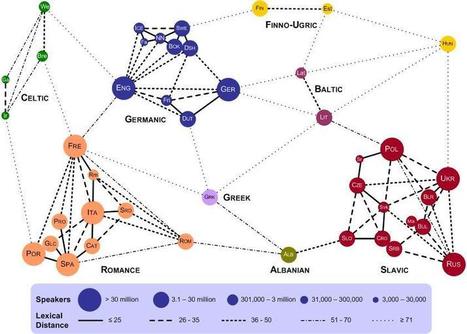
This chart shows the lexical distance — that is, the degree of overall vocabulary divergence — among the major languages of Europe. The size of each circle represents the number of speakers ...
And yes, English has its deepest roots in German...the French aspects were tacked on after the Norman Conquest.

ethanrobert's curator insight,
March 19, 2014 10:20 AM
This is a wonderful map that truly shows language families and their roots. In Europe, I was rather surprised when I seen that the Romance branch was much larger than that of the Germanic. All of the ancient Germanic groups such as the Jutes, Angols, and the Saxons were well versed in combat. Considering they conquered much of Western Europe, how is it that the Romance group is bigger than the Germanic? Also, in Eastern Europe, the Albanian language has no reason to exist. In a region dominated by the Slavic group with no environmental barriers, the Albanian language should not exist.~Ethan.


Ness Crouch's curator insight,
March 28, 2014 8:43 PM
This isn't my normal area of interest but I found this fascinating!




