
Social Impact Bonds, "Pay For Success," Results-Based Contracting, and Blockchain Digital Identity Systems
2.9K views |
+1 today


Social Impact Bonds (SIBs) are a private financing mechanism used to fund social programs. Also termed 'Pay For Success,' and 'Outcomes Based' or 'Performance Based' financing, these partnerships involve private entities funding projects aimed at improving social outcomes. If by the end of the project period, 'success' metrics are met (according to third-party evaluators), investors then profit by being paid interest on top of the reimbursed government funds for the cost of the project. This page includes a collection of updates and critical perspectives on these profit structures and on Blockchain Identity systems, de-centralized online ledger programs, poised to be the data backbone that would provide 'proof' of 'program impact' for investors. For files related to Blockchain, see: http://bit.ly/Blockchain_Files. [Note: Views presented on this page are re-shared from external websites and may not necessarily represent the views nor official position of the curator nor employer of the curator.]
Curated by
Roxana Marachi, PhD
 Your new post is loading...
 Scoop.it! 
By Carolyn Leith "Back in the early 2000's Sun Microsystems' Scott McNealy described the pending merger between Hewlett-Packard and Compaq as "the sound of two garbage trucks colliding". Whenever I read through the 449 page abomination that is the 2016 re-write of the 1965 ESEA - later rebranded as the ESSA - I can't help thinking of that phrase."...
For full post, see here: 
Scoop.it!
From
www2

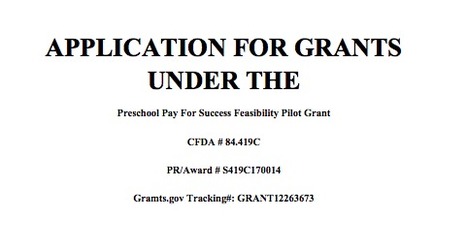
"The following members from Strong Start have come together collaboratively to form the Preschool PFS Partnership for S2P4S: SCCOE (lead applicant and service provider), Santa Clara Unified School District (outcomes “payor” and advisor), Third Sector Capital Partners (intermediary), Urban Institute (technical advisor), SRI International (evaluator), Silicon Valley Community Foundation (advisor), and First 5 Santa Clara County (advisor)." (p. 2)...
For link to download of full grant proposal, see: https://www2.ed.gov/programs/pfs/applications/cascpfsapp2016.pdf
_______
For information about SRI's 22 million dollar contract with the Department of Defense, see: https://www.businesswire.com/news/home/20030716005586/en/SRI-International-Awarded-DARPA-Contract-Develop-Cognitive
See also the following links related to Third Sector Capital here: https://www.scoop.it/t/social-impact-bonds-by-edurox?q=third
|
Scoop.it!
By James Garrett Baldwin "The Big Short is a 2015 Oscar-nominated film adaptation of author Michael Lewis’ best-selling book of the same name. The movie, directed by Adam McKay, focuses on the lives of several American financial professionals who predicted and profited from the build-up and subsequent collapse of the housing and credit bubble in 2007 and 2008.
Published in 2010, The Big Short: Inside the Doomsday Machine was a loose sequel to Lewis' best-selling book Liar's Poker, a chronicle of his work experiences at Solomon Brothers in the 1980s. Both non-fiction works offer a deep dive into the lives, workplaces and psychology of several Wall Street professionals and the financial world.
This article explores the movie The Big Short, its main characters, and the stylistic tools used by McKay to explain complex financial instruments engineered by the banks during the run-up to the subprime mortgage meltdown. The Big Short The Big Short was not the first film adaptation of a successful non-fiction book covering the financial crisis. In 2011, HBO adapted Andrew Ross Sorkin’s crisis tell-all Too Big To Fail, which also had a star-studded cast. That story centered more the few weeks leading up to the collapse of Lehman Brothers and the Congressional response to bailout the nation’s largest banks (For more, read Top 6 U.S. Government Financial Bailouts.)
The Big Short, however, is more a character-driven piece that focuses not just on the events leading up to the financial crisis but also the conflicted morality of several men who foresaw the crisis well in advance. The film adaptation stars Christian Bale, Steve Carell, Ryan Gosling, and Brad Pitt.
The story chronicles the work of hedge fund manager Michael Burry (portrayed by Christian Bale), who recognizes that the U.S. housing market of the early 21st century is virtually an asset bubble inflated by high-risk loans. In 2005, Burry – the manager of Scion Capital — creates a credit default swap that would allow him to short the housing market. However, his clients grow angry When banks and creditors argue that housing is stable, and the market in fact does keep on surging, his clients grow angry and fearful as Burry continues his short plays. When they demand their money back, he places a moratorium on withdrawals.
Meanwhile, Jared Vennett (Ryan Gosling) inadvertently discovers Burry’s goal to establish the credit default swap. Hedge fund manager Mark Baum (Steve Carrell) joins Burry in investing in the credit default swap market and recognizes that poorly structured loan packages known as collateralized debt obligations (CDOs) have received AAA ratings and are exacerbating the mortgage crisis. After discovering that questionable innovation in the CDO market has fueled massive risk in the markets, Baum concludes that the housing bubble will ultimately lead to the collapse of the U.S. economy and bets big – shorting the financial sector. (Baum was based on real-life hedge fund manager Steve Eisman. Vennett was based on Greg Lippmann, a former bond salesman at Deutsche Bank.)
Finally, two investors — Charlie Geller (John Magaro) and Jamie Shipley (Finn Wittrock) – seek the investment advice of retired banker Ben Rickert (Brad Pitt) after they discover a paper written by Vennett. After Shipley and Geller make a series of successful bets against the housing market, Rickert grows angry that they have profited off the downfall of the U.S. economy and Middle America’s financial doom. Geller was based on Cornwell Capital founder Charlie Ledley, while Jamie Shipley was based on Cornwell partner Jamie Mai. Rickert was based on Ben Hockett, a former trader at Deutsche Bank.
Though they make a fortune on their trades, the duo is left highly dejected about the amount of risk taken and the moral hazard that ultimately would fuel the bailouts of several banks. Shipley and Geller would later try – and fail – to sue the ratings agencies for their misleading rankings of mortgage-backed securities and mortgages.
Burry, meanwhile, ends up producing nearly 500% returns for investors who stay with him through the duration of the housing market's collapse.
For example, the film explains the origination and complexity of a synthetic CDO in a scene where actress Selena Gomez plays blackjack. Joined by economist Richard Thaler, they explain how increasingly larger side bets on Gomez’s hand of blackjack are great when she is winning – a metaphor for a rising housing market. However when Gomez loses the hand – or the housing market falls – those increasingly larger side bets set off a domino effect that create larger losses at the table and the economy, respectively.
Next, audiences receive a visual aid when learning the definition of a tranche. In one scene, Ryan Gosling pulls blocks from a Jenga tower to display how tranches work in mortgage-backed securities (MBS) such as collateralized mortgage obligations (CMO). By pulling out blocks in the lower part of the tower, Gosling explains that the top-rated securities at the top end of the tower can not stand when the lower-rated securities fail and are removed from its base.
Other examples of visual cuts and props explain the complexity of financial innovation. One cutaway features actress Margot Robbie in a bubble bath drinking champagne and explaining the frailty of mortgage-backed securities. Meanwhile, TV food personality Anthony Bourdain explains how tossing a two-day-old fish into a stew is similar to the subprime mortgages tossed into CDOs to hide their risky nature from unsuspecting customers. The Bottom Line The Big Short received several Academy Award nominations – including Best Picture – and won for Best Adapted Screenplay. Some critics, including Nobel Memorial Prize in Economics Laureate Paul Krugman, have said that the film fails to acknowledge that several people, outside of the characters profiled in the movie, also flagged the issues with subprime mortgages. Others noted the film failed to fully acknowledge the role that the Federal Reserve played in allowing the crisis to flourish. That said, The Big Short offers a highly engaging exploration into the years preceding the collapse of Lehman Brothers and the housing market, which led to the Great Recession. In the end, it concludes, Wall Street greed sank the global economy for years.
Scoop.it!
Abstract "This article considers proponents’ arguments for Pay for Success also known as Social Impact Bonds. Pay for Success allows banks to finance public services with potential profits tied to metrics. Pay for Success has received federal support through the Every Student Succeeds Act of 2016 and is predicted by 2020 to expand in the US to a trillion dollars. As school districts, cities, and states face debt and budget crises, Pay for Success has been advocated by philanthropists, corporate consulting firms, politicians, and investment banks on the grounds of improving accountability, cost savings, risk transfer, and market discipline. With its trailblazing history in neoliberal education, Chicago did an early experiment in Pay for Success. This article provides a conceptual analysis of the key underlying assumptions and ideologies of Pay for Success. It examines the claims of proponents and critics and sheds light on the financial and ideological motivations animating Pay for Success. The article contends that Pay for Success primarily financially benefits banks without providing the benefits that proponents promise. It concludes by considering Pay for Success in relation to broader structural economic considerations and the recent uses of public schooling to produce short-term profit for capitalists." Keywords Pay for Success; Social Impact Bonds; Chicago School Reform; Neoliberal Education; Corporate School Reform; Venture Philanthropy For full text, click title above or here: PDFSaltman, K. (2007) Capitalizing on Disaster: Taking and Breaking Public Schools. New York: Routledge.
Saltman, K. (2012) The Failure of Corporate School Reform. New York: Routledge 2012.
Saltman, K. (2010) The Gift of Education: Public Education and Venture Philanthropy. New York: Palgrave Macmillan.
http://epaa.asu.edu/ojs/article/view/2640/1918 Via Roxana Marachi, PhD
|





