



In the past decade venture investors have overlooked hardware partly because of the perception that hardware is hard and expensive, but also because fewer active VCs nowadays have a hardware-savvy background.

 Your new post is loading...
 Scoop.it! In the past decade venture investors have overlooked hardware partly because of the perception that hardware is hard and expensive, but also because fewer active VCs nowadays have a hardware-savvy background. 
Scoop.it!

The voice of the Wine Industry: Wine Industry News, Wine Industry Data, Winery Directory Online, and Wine Industry Buyers Guide (RT @MoniqueSoltani: #wine #news Conserving Water with Vineyard Sensors - Experts at Napa workshop discuss reducing...
Scoop.it!

A talk with CEO and co-founder of Libelium Alicia Asin Perez (RT @aliciaasin: Talking with Trevor Harwood @postscapes about the importance of modularity in the Internet of Things http://t.co/daU46EpvW2...
Scoop.it!

From
www

La empresa Libelium acumula premios gracias al desarrollo y creación de sensores que transmiten información
Judy Curtis / SIPR's insight:
Smart Cities, Smart Parking and Smart Agriculture products and solutions garnered the most interest from delegates to Mobile World Congress 2013 last week in Barcelona, according to Alberto Bielsa of Libelium.
Scoop.it!
Success stories of Smart Cities and IoT projects using Waspmote and Meshlium products, by Libelium
Judy Curtis / SIPR's insight:
Libelium has launched a new version of the Waspmote sensor network development platform, together with a new Waspmote Development Community website to support a network of over 2,000 developers.
Some new case studies show the incredible versatility of the IoT projects in deployment: Smart Parking, air quality monitoring, radiation detection, Smart Water, etc.
Scoop.it!

Qualcomm doesn’t believe that everything in the internet of things should have to connect to the internet, and is building out a peer-to-peer networking platform called AllJoyn to test its theory.
Judy Curtis / SIPR's insight:
Qualcomm is setting its cap for the consumer side of the Internet of Things -- with a software platform and SDK.
Scoop.it!

While they may be selling the “picks and shovels” associated with the internet of things gold rush, the world of connected devices is a rich opportunity for semiconductor companies.
Judy Curtis / SIPR's insight:
Stacey Higginbotham in GigaOm outlines the opportunity for chip makers, in the realms of connectivity, control, and of course, sensors. The gold rush is on.
Scoop.it!
"When a technology emerges, it starts first in verticals that use positive ROI to justify the expensive 'early adopter" investment. When prices drop and technology matures, it hits the inflexion point, produces scale economies and mass market solutions are born...new winners emerge to provide baseline solutions that work horizontally across verticals."
Judy Curtis / SIPR's insight:
Liz Kerton argues that the M2M sector has reached the inflexion point, and is poised to go mass market capitalizing on technology trends such as: - Mobile data networks, as provides by cellular carriers - Wi-Fi's advances over the past decade - The emergence of reliable standards-based connectivity protocols for M2M (Z-Wave, Bluetooth, ZigBee, MoCa, etc.) - Cloud computing -- always on to interact, highly scaleable to store data - Smartphones as bridge interface devices - Moore's Law -- the power of processors doubling every two years.
Scoop.it!

How will health care be transformed by smart devices, continuous patient monitoring, and tele-medicine?
Scoop.it!

ZDNet's EMEA directory of M2M vendors has market, product and contact information on companies that provide machine-to-machine (M2M) communication products and services.
Scoop.it!

A £24m prize to create a city of the future has been won by Glasgow, which will now become a test bed for smart technologies.
Judy Curtis / SIPR's insight:
This will mean improved services for Glaswegians, with real-time information about traffic and apps to check buses and trains schedules.
With the funds, the Glasgow council plans to develop an app for reporting issues such as potholes and missing bin collections, and other services that include linking up the CCTV cameras across the city with its traffic management unit in order to identify traffic incidents faster.
It will use analytical software and security cameras to help identify and prevent crime in the city and monitor energy levels to find new ways of providing gas and electricity to poorer areas where fuel poverty is a big issue.
Scoop.it!

The connected vehicle is leading the automotive industry to its most significant innovation phase since the creation of the automobile itself.
Judy Curtis / SIPR's insight:
Good points from Thilo Koslowski (Gartner) -- As our connections to networks and devices evolve, new uses for sensor networks naturally become possible. The car as a mobile device -- driven by people who consume, create and share digital information.
"As these vehicles become increasingly connected, they become self-aware, contextual, and eventually, autonomous." Mobility will run on the technology of sensors, on-board/off-board computing, in-vehicle OS, wireless, machine learning, analytics, speech recognition (et j'en passe...). Koslowski also shows us the user's point of view, interested in safety, maps, car diagnostics, traffic conditions. Smart Cars, Smart Cities, Smart Roads.
Please read on.

Ivan Begtin's curator insight,
January 10, 2013 11:36 AM
Open Government? Not smart cars government first
Scoop.it!
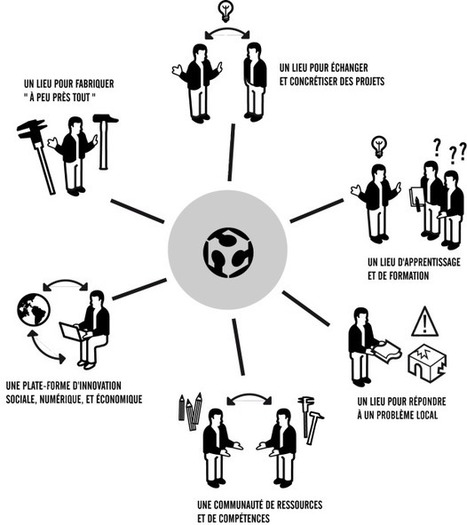
Au milieu des années 1990, Neil Gershenfeld, chercheur au sein du MIT (Massachusetts Institute of Technology) a décidé de créer un cours pour ses étudiants appelé: "comment créer n'importe quoi? Via JP Fourcade

luiy's curator insight,
March 11, 2013 7:42 PM
Au milieu des années 1990, Neil Gershenfeld, chercheur au sein du MIT (Massachusetts Institute of Technology) a décidé de créer un cours pour ses étudiants appelé: « comment créer n’importe quoi? ». C’est ainsi que le Fab Lab est né. Littéralement « Fabrication Laboratory« , ils ont été créés pour sensibiliser les jeunes à la fabrication numérique. Objectif : piloter des machines-outils pour fabriquer des objets réels conçus à partir d’un ordinateur. Une révolution dans le monde de l’artisanal. L’idée initiale visait à mettre à disposition, dans un même espace, tout le nécessaire pour mener à bien un projet personnel, depuis le principe technique, jusqu’au prototype. À disposition: du matériel électronique, informatique et des machines-outils allant de la coupeuse à bois à la découpe laser. |
Scoop.it!
Libelium Smart World Infographic: Sensors for Smart Cities, Internet of Things and beyond | Libelium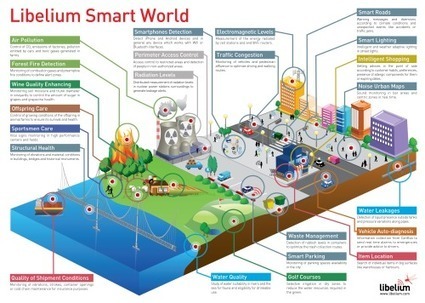
Libelium's market research document "50 Sensor Applications for a Smarter World," is captured here in an infographic comprising Smart Cities, Internet of Things (IoT) and other sensing applications.
Judy Curtis / SIPR's insight:
This is a great cross-section of the different technologies and applications that make up Smart Cities, and other applications of the Internet of Things. Easy to read and understand. A picture is worth a thousand words...
Scoop.it!

Ovum cites smart cities as key to recovery, as Libelium launches ‘smart lighting’ sensor solution in M2M magazine.
Judy Curtis / SIPR's insight:
Joe Dignan of Ovum states that after being led by IT industry stalwarts such as IBM and Cisco for the past five years, the Smart City market is at a tipping point and needs fresh ideas to take it to the next level.
He believes, as does Libelium, that it is the developer community that will provide the required impetus.
Scoop.it!

The city of Santander in Spain is the site of a large-scale Smart City test bed. As part of this project, Libelium's wireless sensor networks are used to collect data on a range of parameters important for the health of the city and its inhabitants.
Judy Curtis / SIPR's insight:
In Sensors Magazine, Alberto Bielsa of Libelium gives a comprehensive view on the SmartSantander project, explaining the rationale behind it and, in practical terms, describing how the networks were conceived and implemented.

Joshua McRae's curator insight,
March 20, 2013 5:53 AM
This article explores a real-life IoT implementation that is being used to cut the amount of carbon dioxide emissions of a city in Spain while simultaneously improving quality of life and cutting costs. Shows how the IoT can be used by citizens and the government to improve aspects of city life and drops some useful facts along the way; 75% of Europeans live in urban areas, so developments in IoT are neccessary and worthwhile.
It would be of interest to know how long it took to implement the system and what the results were; has it improved quality of life and helped to cut emissions?
Scoop.it!

Sustainable urban transportation -- sidewalks, bike lanes, and public transit like subways, buses, and street cars -- are all central to successful urban development, but no one size fits all...

Nat Sones's curator insight,
February 27, 2013 4:11 AM
As cities grow and the need to keep the lights on wars with the need to innovate, city governments must achieve a quantum leap in efficiency across every type of service. Above all (perhaps) they must keep moving despite the crowds. Cities like Copenhagen achieve this through simplicity - but can the same lessons apply to far larger urban communities?
Scoop.it!

An initiative at New York University is joining a global drive to apply modern sensor, computing and data-sifting technologies to urban environments.
Scoop.it!

Drivers tracked (anonymously) in bid to analyze citywide traffic patterns.
Judy Curtis / SIPR's insight:
That smartphone in your hand (well, hands-free when you're at the wheel) is one of the key disrupters of the Internet of Things.
Scoop.it!

GigaOM’s Stacey Higginbothom provides an excellent primer on the internet of things (IoT) and how sensors, connectivity chipsets, and semiconductors will figure in the trend. We’re look...
Scoop.it!

Smart Grid - Japan put an URGENT! stamp on its smart cities/smart grid efforts following 2011's disastrous combination of earthquake, tsunami and nuclear meltdown.
Scoop.it!
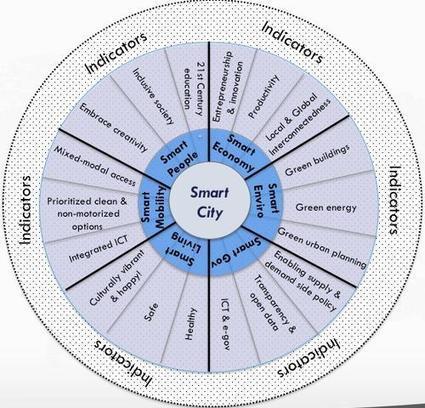
A comprehensive look at the top 10 cities in Asia/Pacific -- comparison according to Smart Cities criteria laid out by Boyd Cohen.
luiy's curator insight,
March 11, 2013 7:40 PM
The phrase "smart cities" has only emerged in the past few years, yet conferences, companies, citizens, and cities around the globe have become enamored with the concept. After all, who wants to live in a dumb city? Still, the field has yet to reach consensus on a definition for "smart cities," let alone on how to compare one city to another in the same country, or around the globe.
As a researcher and consultant, I have been working on two primary initiatives to resolve these issues. The first, as reported here in December, was the development of the Smart Cities Wheel, a holistic tool for developing and implementing smart cities strategies: .......
Scoop.it!

The Internet of Things will consist primarily of machines talking to one another, with computer-connected humans observing, analysing and acting upon the resulting 'big data' explosion. Here's how the next internet revolution is shaping up.
Scoop.it!

The Internet of Things means everything will be connnected
Judy Curtis / SIPR's insight:
IEEE takes up the IoT mantle and talks about the importance of interoperability -- essential for building an ecosystem -- and cites a movement of global collaboration underway among companies, universities and industry. And of course, IEEE is in the business of standards, bringing forward the process of creating partnerships and consensus.
“The pervasive connectivity and distributed intelligence of the IoT will play increasingly important roles in our daily lives,” says Logvinov, IEEE Senior Member. “And standards are key to the IoT’s success.” “Standardizing on a common architecture will help ensure interoperability, compatibility, and reliability, enabling the IoT to truly become a change agent for continued technology advancement,” says Mary Lynne Nielsen, director of corporate programs for IEEE-SA.
Scoop.it!
Judy Curtis / SIPR's insight:
Bridges, roads, safety, traffic, noise, air pollution -- wireless sensor devices are adapted to smart roads applications and smart cities deployments. Libelium talks about the billion dollar opportunity that Smart Roads presents in the era of IoT.
|







Sensors are the nerve endings of our world. Smart, responsive, connected. They will drive the development of urban environments (and all others).