 Your new post is loading...

|
Rescooped by
Gust MEES
from 21st Century Learning and Teaching
January 29, 2014 11:11 AM
|
Multi-platform threat exploits old Java flaw, gains persistence. Researchers have uncovered a piece of botnet malware that is capable of infecting computers running Windows, Mac OS X, and Linux that have Oracle's Java software framework installed. The cross-platform HEUR:Backdoor.Java.Agent.a, as reported in a blog post published Tuesday by Kaspersky Lab, takes hold of computers by exploiting CVE-2013-2465, a critical Java vulnerability that Oracle patched in June. The security bug is present on Java 7 u21 and earlier. Once the bot has infected a computer, it copies itself to the autostart directory of its respective platform to ensure it runs whenever the machine is turned on. Compromised computers then report to an Internet relay chat channel that acts as a command and control server.
|
|
Scooped by
Gust MEES
April 23, 2013 10:39 AM
|
Just last week you were congratulating yourself for patching your computer against a Java security hole.
Now another zero-day unpatched vulnerability has been found in Oracle's widely used softw... Here's the best piece of advice we can give you at the moment: If you don't need Java enabled in your browser, here's how to turn it off now! Many people who have Java enabled in their browser simply do not need it (By the way, don't mix up Java with JavaScript - they're different things), so the best solution for many folks is to rip Java out of their browser entirely. If you don't need Java, why put yourself at risk?
|
|
Scooped by
Gust MEES
February 26, 2013 3:54 AM
|
Oracles Mitarbeiter dürften unter Dauerstress stehen. Auch die neueste Version soll eine Sicherheitslücke enthalten, gleichzeitig kursieren Exploits für die ältere Version 7u11. Nutzer sollten schleunigst updaten oder deinstallieren.
|
|
Rescooped by
Gust MEES
from 21st Century Learning and Teaching
January 20, 2013 9:04 AM
|
Can you really justify having Java installed on your main web browser any more? Even if you have installed the latest security patch?
It's time to rip Java out of your browser for better securi...
|
|
Scooped by
Gust MEES
January 3, 2013 3:38 AM
|
Security researchers from antivirus vendor Trend Micro have uncovered a piece of backdoor-type malware that infects Java-based HTTP servers and allows attackers to execute malicious commands on the underlying systems.
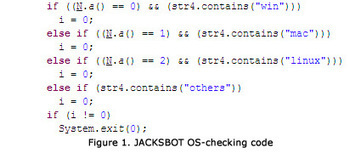
Two weeks ago, Mac security software company Intego discovered malware which it classified as "a new Java backdoor trojan called Java/Jacksbot.A.” New threats are discovered all the time, but Intego later concluded that even though Jacksbot is a variant of the Java remote access tool (RAT) created by the jailbreaking group Redpois0n, it can target multiple platforms. The malware writers behind JACKSBOT may just be testing the waters for a successful multiplatform malware; however for now they appear to be unwilling to invest the time and resources to develop the code more completely. ===> It’s likely that the authors will continue to improve the code to fully support infection for OS X and Linux. <=== Read more, a MUST: http://thenextweb.com/2012/10/31/jacksbot-java-malware-can-take-control-of-windows-mac-and-linux-systems/?utm_source=dlvr.it&amp;utm_medium=twitter
|
|
Scooped by
Gust MEES
September 28, 2012 9:30 AM
|
|
|
Scooped by
Gust MEES
September 26, 2012 12:56 PM
|
|
|
Scooped by
Gust MEES
September 1, 2012 9:43 AM
|
|
|
Scooped by
Gust MEES
August 30, 2012 5:20 PM
|
|
|
Scooped by
Gust MEES
August 30, 2012 1:34 AM
|
|
|
Scooped by
Gust MEES
August 29, 2012 8:37 AM
|
Disable Java not Bob’s Java Jive (or JavaScript) A vulnerability in the most recent version of Java means that attackers can fool you into visiting a malicious or compromised web site and, without any interaction use the vulnerability to install malicious code onto your computer. It has already been used to install a well known backdoor, giving criminals remote control over the infected machine and been incorporated into several attack tool-kits, both professional and criminal. The fact that Java is a cross-platform environment means that it is relatively simple to create attack code for most major operating systems. In the absence of a patch for this widespread and already abused vulnerability, the best advice is simply to disable Java in your web browser and this is where the distinction between Java and JavaScript becomes key, otherwise you may very well end up disabling the wrong thing and remaining at risk. To disable Java in Internet Explorer: In the Tools menu of Internet Explorer, select Manage Add-Ons and disable Java™ Plug-in SSV Helper and Java 2™ Plug-in 2 SSV Helper To disable Java in Firefox (MacOS & Windows): In the Tools menu select Add-ons and disable the Java Deployment Toolkit, Java™ Platform and/or Java Applet Plug-in To disable Java in Google Chrome: Select the Wrench icon in the top right of the Chrome browser window, choose Settings and right at the bottom choose Show advanced settings. Find the Privacy section and click the Content Settings button. Find the Plug-ins section and click the Disable individual plug-ins, look for Java and hit the Disable link. That one is well-buried! To disable Java in Safari for MacOS: In the Safari menu, open the Preferences dialogue box and select Security. untick the box Enable Java To disable Java in Safari for Windows: Click the Gear wheel in the top right of the browser window and choose Preferences, select Security and untick the box Enable Java. JavaScript is a whole different security conversation, but for the purposes of this current vulnerability it is irrelevant. Image credit: Homini:)’s Flickr Photostream under creative commons. Read more: http://countermeasures.trendmicro.eu/disable-java-not-bobs-java-jive-or-javascript/#.UD4CfQccznw.twitter
|
|
Scooped by
Gust MEES
August 28, 2012 6:08 PM
|
|
Die meisten Schadprogramme nutzen bekannte Lücken in populärer Software aus. Dabei handelt es sich sogar nur um ganz wenige Tools, die einen Großteil der insgesamt bekannten Sicherheitslücken auf sich versammeln. Hält man diese wenigen Programme immer auf dem aktuellen Stand, dann ist der eigene Windows-Rechner bereits relativ sicher. Mit wenig Aufwand erreicht man also viel Sicherheit.
|
|
Scooped by
Gust MEES
February 26, 2013 7:54 AM
|
Security Explorations indique avoir mis au jour deux vulnérabilités 0-day dans Java. Un code preuve de concept a été envoyé à Oracle. Dans le même temps, Firefox passe le plugin Java en mode click-to-play.
|
|
Scooped by
Gust MEES
January 20, 2013 8:56 AM
|
Serial Java fault-finder Adam Gowdiak has embarrassed Oracle yet again.
The Polish researcher is publicly bragging about two brand-new vulnerabilities he's found even since Oracle's most recent ...
|
|
Rescooped by
Gust MEES
from 21st Century Learning and Teaching
January 12, 2013 5:08 AM
|
After the recent discovery of a zero-day vulnerability in Oracle's Java Web Start plugin Apple and Mozilla are now disabling Java by default until fixes are made available.
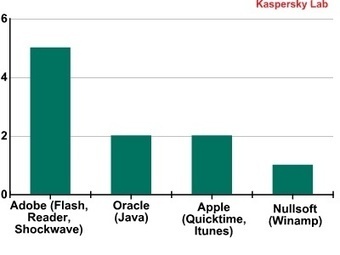
L'éditeur de logiciel de sécurité Kaspersky a publié quelques statistiques sur les failles de sécurité découvertes dans le monde au troisième trimestre. Pour délivrer ces chiffres, Kaspersky s'appuie sur la base d'utilisateurs de ses produits. On trouve ensuite des logiciels d'Adobe (Flash, Adobe Reader et Shockwave) qui est le plus représenté dans ce top 10 avec cinq mentions. Apple est également présent avec des failles concernant QuickTime (14 % des utilisateurs concernés) et iTunes (12 %). Nullsoft avec Winamp ferme la marche. En savoir plus : http://www.macg.co/news/voir/257709/vulnerabilites-kaspersky-pointe-adobe-oracle-et-apple
|
|
Scooped by
Gust MEES
October 23, 2012 8:05 PM
|
Polish firm Security Explorations and its CEO Adam Gowdiak continue to be the a thorn in Oracle's side by repeatedly questioning the giant's decision not to issue an out-of-band patch for a critical Java flaw in Java SE (Standard Edition) 5, 6 and 7. According to their research, the vulnerability could allow attackers to bypass the security sandbox in those three versions of Java, which are currently installed on nearly a billion of machines around the world. Read more, a MUST: http://www.net-security.org/secworld.php?id=13821
|
|
Scooped by
Gust MEES
September 27, 2012 10:20 AM
|
|
|
Scooped by
Gust MEES
September 25, 2012 8:15 AM
|
One Billion Users Affected by Java Security Sandbox Bypass Vulnerability, Experts Say...
|
|
Scooped by
Gust MEES
August 31, 2012 4:45 PM
|
Hundreds of domains serving up attack, tens of thousands of new victim machines since Java exploit was added to BlackHole toolkit... Widespread attacks are under way using a weaponized reliable Java exploit that relies on not one, but two zero-day exploits.
The Java exploit was originally used for targeted attacks to push remote access Trojans onto a victim's machine when it first went public, but this week was hurriedly added to the popular BlackHole crimeware kit, making it easily available to all types of cybercriminals. "When it got merged into BlackHole, it started to push malware of a more traditional type, like banking Trojans [and] Zeus variants," says Patrik Runald, director of security research for Websense. At least 100 domains are now serving up the exploit, according to estimates by Websense and other researchers, 83 percent of which are located in the U.S., according to Websense. And so far, the number of infected hosts is in the tens of thousands range, according to Seculert's latest data. Read more: http://www.darkreading.com/vulnerability-management/167901026/security/attacks-breaches/240006469/new-reliable-java-attack-spreading-fast-uses-two-zero-day-bugs.html
|
|
Scooped by
Gust MEES
August 30, 2012 12:46 PM
|
One of the attack crews using the new Java CVE-2012-4681 vulnerability is the Nitro group that was traced to China and attacked chemical companies and defense contractors. Researchers say that one of the attack groups using the two new Java zero-day vulnerabilities is the same group that was behind an earlier targeted attack campaign from 2011. That group was traced back to China and was essentially running a spear-phishing campaign, but now the crew, known as Nitro, is using the Java vulnerabilities in Web-based attacks that install the Poison Ivy remote-access tool. The attacks have been going on for more than a week, researchers say, and the Nitro group apparently is reusing both their command-and-control servers and some of the file names for the malicious executables. There are two separate domains serving the Java exploit right now, and the two main executable files the attacks are using are named "Flash_update.exe" and "hi.exe". Read more: http://threatpost.com/en_us/blogs/use-java-zero-day-flaws-tied-nitro-attack-crew-083012
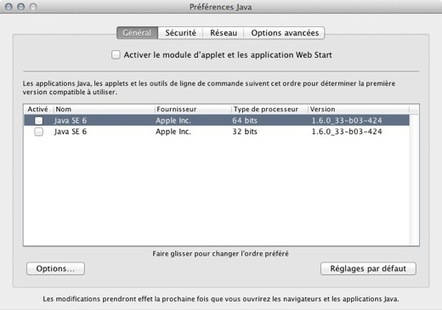
Actualité Apple : OS X : désactiver JAVA en attente d'un correctif de sécurité... JAVA ne se traine pas une formidable réputation en matière de sécurité, surtout sur nos Mac où Apple a souvent fait preuve d'une formidable lenteur pour mettre à jour la machine virtuelle JAVA. Désormais c'est Oracle qui préside aux destinées de la brique logicielle sur nos machines pommées. En attendant, si vous n'en avez pas un besoin immédiat et absolu, vous pouvez simplement désactiver JAVA pour régler la question. Pour cela, direction le dossier Utilitaires de votre dossier Applications. Lancez Préférences JAVA et, dans l'onglet gGénéral, désactivez Java SE 7 (oui, l'image montre un système avec JAVA 6). Et voilà. Pour réactiver, procédure inverse.
|
|
Scooped by
Gust MEES
August 29, 2012 6:12 AM
|
|
























Learn more:
- http://www.scoop.it/t/apple-mac-ios4-ipad-iphone-and-in-security
- http://www.scoop.it/t/securite-pc-et-internet/?tag=Linux
Learn more:
- http://www.scoop.it/t/apple-mac-ios4-ipad-iphone-and-in-security
- http://www.scoop.it/t/securite-pc-et-internet/?tag=Linux