ICT Security-Sécurité PC et Internet
114.2K views | +0 today
ICT Security-Sécurité PC et Internet
ICT Security + Privacy + Piracy + Data Protection - Censorship - Des cours et infos gratuites sur la"Sécurité PC et Internet" pour usage non-commercial... (FR, EN+DE)...
Curated by Gust MEES
Your new post is loading...
Scooped by Gust MEES
April 16, 2014 12:19 PM
Scoop.it!

Got Adobe Reader on your Android device? You Had Best Update it ASAP

Got Adobe Reader on your Android device? You Had Best Update it ASAP | ICT Security-Sécurité PC et Internet | Scoop.it
A critical security vulnerability has been found in Adobe Reader Mobile, the version of the popular PDF Reader developed for the Android operating system, which [...]


A critical security vulnerability has been found in Adobe Reader Mobile, the version of the popular PDF Reader developed for the Android operating system, which could lead to remote hackers compromising documents stored on your Android device and its SD memory card.

If you were feeling smug that you had managed to avoid the Heartbleed flaw affecting  up to 50 million Android users because you’re not running Android 4.1.1 of Jellybean, then perhaps you should wipe that smile off your face.

Gust MEES's insight:


A critical security vulnerability has been found in Adobe Reader Mobile, the version of the popular PDF Reader developed for the Android operating system, which could lead to remote hackers compromising documents stored on your Android device and its SD memory card.

If you were feeling smug that you had managed to avoid the Heartbleed flaw affecting  up to 50 million Android users because you’re not running Android 4.1.1 of Jellybean, then perhaps you should wipe that smile off your face.

.

No comment yet.
Scooped by Gust MEES
April 16, 2014 10:20 AM
Scoop.it!

The U.S. Government Wants 6,000 New 'Cyber Warriors' by 2016

The U.S. Government Wants 6,000 New 'Cyber Warriors' by 2016 | ICT Security-Sécurité PC et Internet | Scoop.it
Salaries for that kind of talent are much higher in the private sector


The Pentagon plans to triple its cybersecurity staff by 2016, U.S. Secretary of Defense Chuck Hagel announced recently.

A few days later, FBI Supervisory Special Agent Charles Gilgen said at a conference on cybercrime that his agency’s cyber division plans to hire 1,000 agents and 1,000 analysts in the coming year.

Just those two agencies are looking for 6,000 people with cybersecurity skills in the next two years. That’s a very tall order. A look at one way the government has tried to build and recruit such talent—offering university scholarships—shows why.

Gust MEES's insight:


The Pentagon plans to triple its cybersecurity staff by 2016, U.S. Secretary of Defense Chuck Hagel announced recently.

A few days later, FBI Supervisory Special Agent Charles Gilgen said at a conference on cybercrime that his agency’s cyber division plans to hire 1,000 agents and 1,000 analysts in the coming year.

Just those two agencies are looking for 6,000 people with cybersecurity skills in the next two years. That’s a very tall order. A look at one way the government has tried to build and recruit such talent—offering university scholarships—shows why.

No comment yet.
Scooped by Gust MEES
April 15, 2014 10:55 AM
Scoop.it!

Up to 50 million Android devices could be vulnerable to Heartbleed attack. Here's how to check yours

Up to 50 million Android devices could be vulnerable to Heartbleed attack. Here's how to check yours | ICT Security-Sécurité PC et Internet | Scoop.it
Millions of Android smartphones and tablets are at risk of being attacked via the Heartbleed bug, more than a week after the security vulnerability was first made public.


So, the obvious question you should be considering is, are you running Jellybean 4.1.1 on your Android devices?


Here’s how you can check:

  • Enter System settings
  • Scroll the screen down to About
  • Look for your Android version number


read more in the article...


Learn more:


Gust MEES's insight:

So, the obvious question you should be considering is, are you running Jellybean 4.1.1 on your Android devices?


Here’s how you can check:

  • Enter System settings
  • Scroll the screen down to About
  • Look for your Android version number


read more in the article...


No comment yet.
Scooped by Gust MEES
April 14, 2014 11:10 AM
Scoop.it!

Heartbleed Bug Claims First Confirmed Victims in Canada

Heartbleed Bug Claims First Confirmed Victims in Canada | ICT Security-Sécurité PC et Internet | Scoop.it
Canadian authorities reveal that social insurance numbers for 900 taxpayers were stolen before Heartbleed Bug was fixed.


Learn more:


Gust MEES's insight:


Canadian authorities reveal that social insurance numbers for 900 taxpayers were stolen before Heartbleed Bug was fixed.


Learn more:


No comment yet.
Scooped by Gust MEES
April 13, 2014 10:54 AM
Scoop.it!

German Space Research Center Under Espionage Attack: Report

German Space Research Center Under Espionage Attack: Report | ICT Security-Sécurité PC et Internet | Scoop.it
Germany's aeronautics and space research center has for months been the target of a suspected cyber attack by a foreign intelligence service.


"The government classes the attack as extremely serious because it, among other things, is aimed at armament and rocket technologies," Spiegel said.


Gust MEES's insight:


"The government classes the attack as extremely serious because it, among other things, is aimed at armament and rocket technologies," Spiegel said.


No comment yet.
Scooped by Gust MEES
April 11, 2014 4:24 PM
Scoop.it!

Internet-Sicherheitslücke: NSA soll "Heartbleed"-Fehler systematisch genutzt haben

Internet-Sicherheitslücke: NSA soll "Heartbleed"-Fehler systematisch genutzt haben | ICT Security-Sécurité PC et Internet | Scoop.it

"Heartbleed" ist eine der größten Sicherheitslücken in der Geschichte des Internets - und der US-Geheimdienst NSA hat diese offenbar ausgenutzt. Laut Nachrichtenagentur Bloomberg soll der US-Geheimdienst schon lange davon gewusst haben.


Learn more:


Gust MEES's insight:


Learn more:


No comment yet.
Rescooped by Gust MEES from 21st Century Learning and Teaching
April 11, 2014 1:42 PM
Scoop.it!

The Heartbleed Hit List: The Passwords You Need to Change Right Now

The Heartbleed Hit List: The Passwords You Need to Change Right Now | ICT Security-Sécurité PC et Internet | Scoop.it
Heartbleed: A look at which companies have issued a security patch to fix the Heartbleed bug.


Some Internet companies that were vulnerable to the bug have already updated their servers with a security patch to fix the issue. This means you'll need to go in and change your passwords immediately for these sites.

.

Even that is no guarantee that your information wasn't already compromised, but there's also no indication that hackers knew about the exploit before this week. The companies that are advising customers to change their passwords are doing so as a precautionary measure.

Learn more:


Gust MEES's insight:


Learn more:


Gust MEES's curator insight, April 11, 2014 10:05 AM


Some Internet companies that were vulnerable to the bug have already updated their servers with a security patch to fix the issue. This means you'll need to go in and change your passwords immediately for these sites.

.

Even that is no guarantee that your information wasn't already compromised, but there's also no indication that hackers knew about the exploit before this week. The companies that are advising customers to change their passwords are doing so as a precautionary measure.

Rescooped by Gust MEES from 21st Century Learning and Teaching
April 11, 2014 1:40 PM
Scoop.it!

Heartbleed Bug—Mobile Apps are Affected Too

Heartbleed Bug—Mobile Apps are Affected Too | ICT Security-Sécurité PC et Internet | Scoop.it
All the extended coverage of the Heartbleed flaw begs the question, “Are mobile devices affected by this?” The short answer: yes.


The severity of the Heartbleed bug has led countless websites and servers scrambling to address the issue. And with good reason—a test conducted on Github showed that more than 600 of the top 10,000 sites (based on Alexa rankings) were vulnerable. At the time of the scanning, some of the affected sites included Yahoo, Flickr, OKCupid, Rolling Stone, and Ars Technica.

.

All the extended coverage of the flaw begs the question, “Are mobile devices affected by this?” The short answer: yes.

.

Mobile apps, like it or not, are just as vulnerable to the Heartbleed Bug as websites are because apps often connect to servers and web services to complete various functions. As our previous blog entry has shown, a sizable number of domains are affected by this vulnerability.

Learn more:


.

Gust MEES's insight:


All the extended coverage of the Heartbleed flaw begs the question, “Are mobile devices affected by this?” The short answer: yes.

.

The severity of the Heartbleed bug has led countless websites and servers scrambling to address the issue. And with good reason—a test conducted on Github showed that more than 600 of the top 10,000 sites (based on Alexa rankings) were vulnerable. At the time of the scanning, some of the affected sites included Yahoo, Flickr, OKCupid, Rolling Stone, and Ars Technica.

.

All the extended coverage of the flaw begs the question, “Are mobile devices affected by this?” The short answer: yes.

.

Mobile apps, like it or not, are just as vulnerable to the Heartbleed Bug as websites are because apps often connect to servers and web services to complete various functions. As our previous blog entry has shown, a sizable number of domains are affected by this vulnerability.


Learn more:


Gust MEES's curator insight, April 11, 2014 11:47 AM
All the extended coverage of the Heartbleed flaw begs the question, “Are mobile devices affected by this?” The short answer: yes.

.

The severity of the Heartbleed bug has led countless websites and servers scrambling to address the issue. And with good reason—a test conducted on Github showed that more than 600 of the top 10,000 sites (based on Alexa rankings) were vulnerable. At the time of the scanning, some of the affected sites included Yahoo, Flickr, OKCupid, Rolling Stone, and Ars Technica.

.

All the extended coverage of the flaw begs the question, “Are mobile devices affected by this?” The short answer: yes.

.

Mobile apps, like it or not, are just as vulnerable to the Heartbleed Bug as websites are because apps often connect to servers and web services to complete various functions. As our previous blog entry has shown, a sizable number of domains are affected by this vulnerability.

.

Scooped by Gust MEES
April 10, 2014 7:41 AM
Scoop.it!

Heartbleed bug advice about changing your passwords

Heartbleed bug advice about changing your passwords | ICT Security-Sécurité PC et Internet | Scoop.it
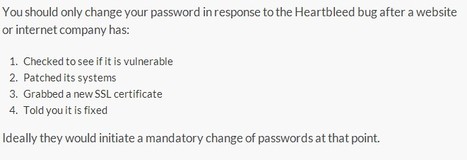
A lot of folks are going around at the moment telling the public to change all of their passwords in response to the serious Heartbleed internet security bug.

But it's not necessarily the wisest advice.


Learn more:


No comment yet.
Scooped by Gust MEES
April 9, 2014 11:58 AM
Scoop.it!

Heartbleed, OpenSSL et la question de la sécurité expliqués simplement

Heartbleed, OpenSSL et la question de la sécurité expliqués simplement | ICT Security-Sécurité PC et Internet | Scoop.it
Lundi soir, une faille importante était annoncée au sein d'OpenSSL. Comme nous l'avions évoqué hier, celle-ci pourrait avoir des conséquences assez graves, mais...


Learn more:


Gust MEES's insight:


Learn more:


No comment yet.
Scooped by Gust MEES
April 9, 2014 11:37 AM
Scoop.it!

What the Heartbleed bug is, and how you can protect yourself (and your servers)

What the Heartbleed bug is, and how you can protect yourself (and your servers) | ICT Security-Sécurité PC et Internet | Scoop.it

Over the last couple of days, you may have heard about the rather ominous sounding Heartbleed bug -- a bug that affected hundreds of millions of websites, exposing usernames, passwords, encryption keys, and other sensitive data. This bug went undiscovered for two years, meaning it's highly likely that some of your data was exposed, and may have been scooped up by enterprising hackers -- and unfortunately, given the nature of this bug, there's almost nothing you can do about.


Learn more:


Gust MEES's insight:


Learn more:


No comment yet.
Scooped by Gust MEES
April 8, 2014 5:47 PM
Scoop.it!

Heartbleed security patches coming fast and furious

Heartbleed security patches coming fast and furious | ICT Security-Sécurité PC et Internet | Scoop.it


Fixes for the highly dangerous OpenSSL Heartbleed security hole are arriving now. Update your servers ASAP.


Learn more:


Gust MEES's insight:


Learn more:


No comment yet.
Scooped by Gust MEES
April 4, 2014 11:48 AM
Scoop.it!

Researchers Uncover Interesting Browser-Based Botnet

Researchers Uncover Interesting Browser-Based Botnet | ICT Security-Sécurité PC et Internet | Scoop.it
Security researchers at Incapsula discovered a DDoS attack on a video site that used a persistent XSS vulnerability and malicious Javascript.
Gust MEES's insight:


Security researchers discovered an odd DDoS attack against several sites recently that relied on a persistent cross-site scripting vulnerability in a major video Web site and hijacked users’ browsers in order to flood the site with traffic.


No comment yet.
Scooped by Gust MEES
April 16, 2014 10:35 AM
Scoop.it!

Massive FBI facial recognition database raises privacy fears

Massive FBI facial recognition database raises privacy fears | ICT Security-Sécurité PC et Internet | Scoop.it

The FBI is building a massive facial recognition database that could contain as many as 52 million images by 2015, including 4.3 million non-criminal images, according to information obtained by th...


Learn more:


Gust MEES's insight:


The FBI is building a massive facial recognition database that could contain as many as 52 million images by 2015, including 4.3 million non-criminal images, according to information obtained by th...


Learn more:


No comment yet.
Scooped by Gust MEES
April 16, 2014 9:29 AM
Scoop.it!

Heartbleed claims British mums and Canadian tax payers as victims

Heartbleed claims British mums and Canadian tax payers as victims | ICT Security-Sécurité PC et Internet | Scoop.it
The critical security vulnerability in OpenSSL known commonly as Heartbleed continues to raise alarms, with websites now warning that hackers have breached their systems by exploiting the bug, and stolen personal information about users.


Learn more:


Gust MEES's insight:


Learn more:


No comment yet.
Scooped by Gust MEES
April 14, 2014 1:22 PM
Scoop.it!

Heartbleed-Bug: Über 1.000 Android-Apps betroffen

Heartbleed-Bug: Über 1.000 Android-Apps betroffen | ICT Security-Sécurité PC et Internet | Scoop.it
Längst hat die Heartbleed-Lücke auch mobile Geräte erreicht: Sicherheitsexperten von Trend Micro zufolge, verbinden sich rund 1.300 Android-Apps mit angreifbaren Servern - darunter auch 15 Banking-Apps.


Learn more:


Gust MEES's insight:


Learn more:


No comment yet.
Scooped by Gust MEES
April 13, 2014 11:40 AM
Scoop.it!

Obama lets NSA use zero-day flaws given “clear national security” need

Obama lets NSA use zero-day flaws given “clear national security” need | ICT Security-Sécurité PC et Internet | Scoop.it
White House officials: policy dates back to January 2014, during review process.


President Barack Obama has explicitly decided that when any federal agency discovers a vulnerability in online security, the agency should come forward, rather than exploit it for intelligence purposes, according to The New York Times, citing unnamed “senior administration officials.”


Learn more:


Gust MEES's insight:


President Barack Obama has explicitly decided that when any federal agency discovers a vulnerability in online security, the agency should come forward, rather than exploit it for intelligence purposes, according to The New York Times, citing unnamed “senior administration officials.”

Learn more:


No comment yet.
Scooped by Gust MEES
April 12, 2014 9:16 AM
Scoop.it!

NSA Denies Exploiting 'Heartbleed' Vulnerability

The NSA denied a report claiming it was aware of and even exploited the "Heartbleed" online security flaw to gather critical intelligence.


Learn more:


Gust MEES's insight:


Learn more:


No comment yet.
Scooped by Gust MEES
April 11, 2014 3:52 PM
Scoop.it!

NSA Said to Have Used Heartbleed Bug, Exposing Consumers

NSA Said to Have Used Heartbleed Bug, Exposing Consumers | ICT Security-Sécurité PC et Internet | Scoop.it
The U.S. National Security Agency knew for at least two years about a flaw in the way that many websites send sensitive information, now dubbed the Heartbleed bug, and regularly used it to gather critical intelligence, two people familiar with the matter said.


The NSA’s decision to keep the bug secret in pursuit of national security interests threatens to renew the rancorous debate over the role of the government’s top computer experts.


Learn more:


Gust MEES's insight:


The NSA’s decision to keep the bug secret in pursuit of national security interests threatens to renew the rancorous debate over the role of the government’s top computer experts.


Learn more:


No comment yet.
Rescooped by Gust MEES from 21st Century Learning and Teaching
April 11, 2014 1:41 PM
Scoop.it!

How to protect yourself in Heartbleed's aftershocks

How to protect yourself in Heartbleed's aftershocks | ICT Security-Sécurité PC et Internet | Scoop.it
The companies know what to do about Heartbleed now. Here's what you, as an individual, need to do now.

.

You should also clear out all your Web browsers' cache, cookies, and history. That's never a bad idea anyway. You don't want old memorized passwords walking into trouble at an untrustworthy site. To do this with the most popular browsers...


Learn more:


Gust MEES's insight:


Learn more:


Gust MEES's curator insight, April 11, 2014 10:16 AM


You should also clear out all your Web browsers' cache, cookies, and history. That's never a bad idea anyway. You don't want old memorized passwords walking into trouble at an untrustworthy site. To do this with the most popular browsers...


Rescooped by Gust MEES from 21st Century Learning and Teaching
April 10, 2014 11:03 AM
Scoop.it!

Has the NSA Been Using the Heartbleed Bug as an Internet Peephole?

Has the NSA Been Using the Heartbleed Bug as an Internet Peephole? | ICT Security-Sécurité PC et Internet | Scoop.it
The Heartbleed bug is unusually worrisome because it could possibly be used by the NSA or other spy agencies to steal your usernames and passwords — for sensitive services like banking, ecommerce, and web-based email — as well as the private keys that vulnerable web sites use to encrypt your traffic to them.


Either way, there are now signatures available to detect exploits against Heartbleed, as Dutch security firm Fox-IT points out on its website, and depending on how much logging companies do with their intrusion-detection systems, it may be possible to review activity retroactively to uncover any attacks going back over the last two years.


Learn more:


Gust MEES's insight:


Either way, there are now signatures available to detect exploits against Heartbleed, as Dutch security firm Fox-IT points out on its website, and depending on how much logging companies do with their intrusion-detection systems, it may be possible to review activity retroactively to uncover any attacks going back over the last two years.


So might hear in a couple of months more then, probably!


Learn more:


Gust MEES's curator insight, April 10, 2014 11:00 AM


Either way, there are now signatures available to detect exploits against Heartbleed, as Dutch security firm Fox-IT points out on its website, and depending on how much logging companies do with their intrusion-detection systems, it may be possible to review activity retroactively to uncover any attacks going back over the last two years.


So might hear in a couple of months more then, probably!


Scooped by Gust MEES
April 9, 2014 12:01 PM
Scoop.it!

Heartbleed Bug Breaks Internet Encryption, Steals Yahoo Passwords

Heartbleed Bug Breaks Internet Encryption, Steals Yahoo Passwords | ICT Security-Sécurité PC et Internet | Scoop.it
Are you ready for the next massive vulnerability? It’s called Heartbleed and it could give hackers access to user passwords and even trick people into using fake versions of popular Web sites.


Learn more:


Gust MEES's insight:


Learn more:


No comment yet.
Scooped by Gust MEES
April 9, 2014 11:42 AM
Scoop.it!

The Feds Cut a Deal With In-Flight Wi-Fi Providers, and Privacy Groups Are Worried

The Feds Cut a Deal With In-Flight Wi-Fi Providers, and Privacy Groups Are Worried | ICT Security-Sécurité PC et Internet | Scoop.it
Gogo, the inflight Wi-Fi provider, is used by millions of airline passengers each year to stay connected while flying the friendly skies. But if you think the long arm of government surveillance doesn't have a vertical reach, think again.


According to a letter Gogo submitted to the Federal Communications Commission, the company voluntarily exceeded the requirements of the Communications Assistance for Law Enforcement Act, or CALEA, by adding capabilities to its service at the request of law enforcement. The revelation alarms civil liberties groups, which say companies should not be cutting deals with the government that may enhance the ability to monitor or track users.


“CALEA itself is a massive infringement on user’s rights,” says Peter Eckersley of the Electronic Frontier Foundation. “Having ISP’s [now] that say that CALEA isn’t enough, we’re going to be even more intrusive in what we collect on people is, honestly, scandalous.”

Gogo provides inflight Wi-Fi and digital entertainment to Delta, American Airlines, Alaska Airlines, Virgin America, US Airways and others using a dedicated air-to-ground network that GoGo says it designed in consultation with law enforcement.


Gust MEES's insight:


“CALEA itself is a massive infringement on user’s rights,” says Peter Eckersley of the Electronic Frontier Foundation. “Having ISP’s [now] that say that CALEA isn’t enough, we’re going to be even more intrusive in what we collect on people is, honestly, scandalous.”


No comment yet.
Scooped by Gust MEES
April 9, 2014 11:34 AM
Scoop.it!

OpenSSL-Sicherheitslücke: Warum "Heartbleed" Millionen Web-Nutzer gefährdet

OpenSSL-Sicherheitslücke: Warum "Heartbleed" Millionen Web-Nutzer gefährdet | ICT Security-Sécurité PC et Internet | Scoop.it
IT-Experten schlagen Alarm: Eine schwere Sicherheitslücke macht viele eigentlich besonders gesicherte Webseiten anfällig für Angriffe. Login-Daten und sensible Informationen sind in Gefahr, Nutzer sollten vorsichtshalber ihre Passwörter ändern.


Learn more:


Gust MEES's insight:
No comment yet.
Scooped by Gust MEES
April 8, 2014 2:38 PM
Scoop.it!

Anatomy of a data leakage bug - the OpenSSL "heartbleed" buffer overflow

Anatomy of a data leakage bug - the OpenSSL "heartbleed" buffer overflow | ICT Security-Sécurité PC et Internet | Scoop.it
An information disclosure vulnerability has been found, and promptly patched, in OpenSSL.

Paul Ducklin takes a look at what went wrong in the code...


Learn more:


Gust MEES's insight:


Learn more:


No comment yet.