 Your new post is loading...

|
Rescooped by
Gust MEES
from 21st Century Learning and Teaching
September 12, 2012 12:53 PM
|
|
|
Scooped by
Gust MEES
September 4, 2012 11:26 AM
|
|
|
Scooped by
Gust MEES
September 1, 2012 9:47 AM
|
Google engineer finds British spyware on PCs and smartphones FinSpy turning up in dictatorships across the world... Two security researchers have found new evidence that legitimate spyware sold by British firm Gamma International appears to be being used by some of the most repressive regimes in the world. Google security engineer Morgan Marquis-Boire and Berkeley student Bill Marczak were investigating spyware found in email attachments to several Bahraini activists. In their analysis they identified the spyware infecting not only PCs but a broad range of smartphones, including iOS, Android, RIM, Symbian, and Windows Phone 7 handsets. The spying software has the capability to monitor and report back on calls and GPS positions from mobile phones, as well as recording Skype sessions on a PC, logging keystrokes, and controlling any cameras and microphones that are installed. Read more: http://www.theregister.co.uk/2012/08/31/finspy_gamma_polcie_spying/
|
|
Scooped by
Gust MEES
August 30, 2012 10:20 AM
|
Privacy for dummies.... 10 Incredibly Simple Things You Should Be Doing To Protect Your Privacy Please tell me you have a password protecting this. Over the weekend, I wound up at Washington, D.C.’s Trapeze School with a group of friends. Before one of them headed up a ladder to attempt a somersault landing from the trapeze bar, she handed me her phone and asked me to take photos. “What’s the password?” I asked. “I don’t use one,” she replied. My jaw dropped as it often does when someone I know tells me they’re choosing not to take one of the very simplest steps for privacy protection, allowing anyone to snoop through their phone with the greatest of ease, to see whichever messages, photos, and sensitive apps they please. Read more: http://www.forbes.com/sites/kashmirhill/2012/08/23/10-incredibly-simple-things-you-should-be-doing-to-protect-your-privacy/
|
|
Scooped by
Gust MEES
August 20, 2012 11:17 AM
|
Dunkin’ Donuts launched its mobile payment app today as retailers race to take control of the ways we pay with our smartphones. Dunkin’ Donuts’ new mobile payment app released today lets you set up an account and pay by scanning an on-screen barcode at the checkout counter. As with Starbucks’ popular mobile app, the system works like a glorified gift card. You can add money to your account by feeding the app your credit card information, and in the case of the Dunkin’ Donuts app you can send gift cards to friends. The Starbucks app tracks your purchases and rewards frequent buyers with free drinks. In both cases, the user experience doesn’t exactly qualify as revolutionary. The convenience factor is about equal to using a physical gift card or a credit card. Such apps are most convenient for retailers themselves, who for the first time can advertise to customers via the same technology those customers are using to pay. Stores can tighten this retail feedback loop even further by creating a record of a single customer’s purchases in perfect detail, and even by tracking a customer’s physical location to send them an ad or a deal when they get close to the front door. Read more: http://www.wired.com/business/2012/08/your-digital-life-for-a-donut-the-price-of-paying-with-your-phone/?utm_source=feedburner&utm_medium=feed&utm_campaign=Feed:+wiredbusinessblog+(Wired:+Blog+-+Wired+Business)&utm_content=Google+Reader
|
|
Scooped by
Gust MEES
August 9, 2012 11:56 AM
|
|
|
Scooped by
Gust MEES
July 24, 2012 9:12 AM
|
|
|
Scooped by
Gust MEES
July 17, 2012 4:18 PM
|
|
|
Scooped by
Gust MEES
July 10, 2012 6:47 AM
|
|
|
Scooped by
Gust MEES
July 5, 2012 5:23 AM
|
ACTA has received a knockout blow from the European Parliament as the majority of MEPs voted in favor of rejecting the controversial trade agreement, which critics say would protect copyright at the expense of freedom of speech on the Internet. Read more: http://www.rt.com/news/acta-eu-parliament-vote-400/
|
|
Scooped by
Gust MEES
June 30, 2012 8:47 AM
|
|
|
|
Scooped by
Gust MEES
September 8, 2012 1:53 PM
|
|
|
Scooped by
Gust MEES
September 4, 2012 9:56 AM
|
|
|
Scooped by
Gust MEES
August 31, 2012 4:29 PM
|
|
|
Scooped by
Gust MEES
August 28, 2012 2:47 PM
|
URI took a publicly available server offline after a breach compromised the information of faculty and students. University of Rhode Island (URI) officials disabled the school's College of Business Administration computer server, after the personal information of more than 1,000 faculty and students, as well as students from another school, was publicly available. How many victims? About 1,000 current and former URI faculty members, in addition to 22 former students of the university and 80 students from an unnamed out-of-state school. What type of personal information? The names, birth dates, Social Security numbers and some compensation information of faculty members. Former URI students had their Social Security numbers and names exposed, while students from the out-of-state school had their grades, names and Social Security numbers posted to the server. Read more: http://www.scmagazine.com/university-of-rhode-island-server-breach-exposes-staff-and-student-data/article/256398/
|
|
Rescooped by
Gust MEES
from 21st Century Learning and Teaching
August 20, 2012 11:42 AM
|
|
|
Scooped by
Gust MEES
August 11, 2012 9:00 AM
|
A computer containing medical and personal information for approximately 2,500 patients was stolen from a Stanford faculty member's locked office sometime between July 15 and 16, according to Stanford University Medical Center. The computer, which may also have held some patient social security numbers, was outfitted with software that would detect when and where the computer connected to the Internet. No detection has occurred yet. No one's complete medical records or health history were stored in the computer. Read more: http://cyberwarzone.com/cyberwarfare/computer-patient-info-stolen-stanford?utm_source=dlvr.it&utm_medium=twitter
|
|
Scooped by
Gust MEES
July 19, 2012 11:20 AM
|
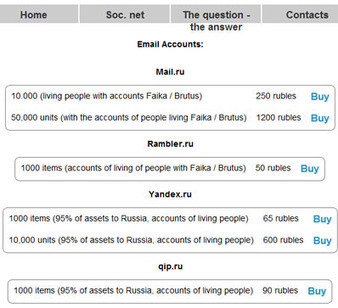
The recently unearthed website of a service specializing in selling access to compromised email and social networking accounts of Russian and Ukrainian users offers a fascinating glimpse into just how much one such account is worth to spammers. Wannabe spammers and social engineers can choose to buy accounts by the service, and should be ready to pay 190 rubles ($5.9) for 100 compromised Vkontakte accounts belonging mostly to Russian users, or 180 rubles ($5.6) for the same number belonging to mostly Ukrainian users. Facebook accounts are somewhat cheaper - 500 for 200 rubles ($6.2), and the same number of compromised Twitter account can be had for 250 rubles ($7.7). Read more to find out how others are earning money with your stolen data, you should: http://www.net-security.org/secworld.php?id=13275
|
|
Scooped by
Gust MEES
July 17, 2012 8:07 AM
|
Anonymous hacks oil giants, leaks employees' passwords In support of Greenpeace's efforts to stop companies drilling for oil in the Arctic, Anonymous has leaked around 1,000 email addresses belonging to five of the biggest multinational oil companies and its corresponding passwords (both in clear text and hashed). This leak is a continuation of a previous one from June, when the group dumped email login credentials of Exxon employees. This time Shell, BP Global, Gazprom and Rosneft were hit. Read more: http://www.net-security.org/secworld.php?id=13256&utm_source=dlvr.it&utm_medium=twitter
|
|
Scooped by
Gust MEES
July 10, 2012 6:33 AM
|
|
|
Scooped by
Gust MEES
July 7, 2012 2:45 PM
|
Summary: It's not your imagination. A new report from researchers at UC Berkeley says web trackers have stepped up their efforts to follow you, and they show no signs of slowing down. There's also some evidence to suggest that the advertisers and analytics companies behind this major increase in web tracking are shifting their focus away from cookies, which can be easily detected and blocked, and are using HTML5 local storage instead. ===> Privacy at danger! <=== Read more: http://www.zdnet.com/researchers-find-web-tracking-up-privacy-down-7000000358/
|
|
Scooped by
Gust MEES
July 4, 2012 10:42 AM
|
Les eurodéputés viennent de se prononcer par 478 voix contre 39 en faveur du rejet du très controversé texte de loi anti-contrefaçon. C'est fini, ou presque (car comme nous vous l'indiquions il y a quelques jours, le commissaire européen Karel de Gucht compte ignorer purement et simplement le rejet du texte). Le traité ACTA est, après plusieurs mois de débats intensifs, bel et bien mort et enterré. Ce matin, les députés européens étaient réunis dans le cadre d'une séance plénière au cours de laquelle ils avaient à voter pour ou contre l'accord anti contrefaçon. En savoir plus : http://www.linformaticien.com/actualites/id/25507/le-parlement-europeen-rejette-le-traite-acta.aspx
|

























Even if we know we are going to be traced with social media and all types of search engine, and if we have the choice not to use social media, it is difficult to unfollow this new way of communication and search.