Your new post is loading...

|
Rescooped by
Gust MEES
from 21st Century Learning and Teaching
November 25, 2012 12:36 AM
|
|
|
Scooped by
Gust MEES
November 24, 2012 4:33 PM
|
Infographic of the week: Why ignoring information security is lethal
Via Frederic GOUTH
|
|
Scooped by
Gust MEES
November 23, 2012 1:45 PM
|
|
|
Scooped by
Gust MEES
November 23, 2012 12:36 PM
|
The European Cloud Partnership (ECP) brings together industry and the public sector to establish a Digital Single Market for cloud computing in Europe. It has been established as part of the European Cloud Strategy. The ECP operates at two levels: a Steering Board and an implementation level.
The Steering Board provides advice to the Commission on strategic options to turn cloud computing into an engine for sustainable economic growth, innovation and cost-efficient public services.
The ECP's Steering Board is chaired by Toomas Hendrik Ilves, President of Estonia and is composed of high-level representatives of the IT and telecom industry and decision makers from governmental IT policy making (see here for info).
Read more: https://ec.europa.eu/digital-agenda/en/european-cloud-partnership
|
|
Scooped by
Gust MEES
November 23, 2012 11:23 AM
|
|
|
Scooped by
Gust MEES
November 23, 2012 8:54 AM
|
|
|
Scooped by
Gust MEES
November 22, 2012 12:27 PM
|
An increasing number of complex attacks demand improved early warning detection capabilities for CERTs. By having threat intelligence collected without any impact on production infrastructure, CERTs can better defend their constituencies assets. Honeypots are powerful tools that can be used to achieve this goal. This document is the final report of the ‘Proactive Detection of Security Incidents: Honeypots’ study. Publication date: Nov 22, 2012
|
|
Rescooped by
Gust MEES
from Social Media and its influence
November 21, 2012 2:29 PM
|
|
|
Rescooped by
Gust MEES
from 21st Century Learning and Teaching
November 21, 2012 8:14 AM
|
|
|
Scooped by
Gust MEES
November 20, 2012 5:58 PM
|
|
|
Rescooped by
Gust MEES
from 21st Century Learning and Teaching
November 20, 2012 9:43 AM
|
A team of researchers have created a proof-of-concept piece of malware that can give attackers control of USB smart card readers attached to an infected Windows computer over the Internet. In the case of USB smart card readers, the attacker can use the middleware software provided by the smart card manufacturer to perform operations with the victim's card as if it was attached to his own computer, said Paul Rascagneres, an IT security consultant at Luxembourg-based security auditing and consulting firm Itrust Consulting, last week. Rascagneres is also the founder and leader of a malware analysis and engineering project called malware.lu, whose team designed this USB sharing malware. There are already documented cases of malware that hijacks smart card devices on the local computer and uses them through the API (application programming interface) provided by the manufacturer. Read more, a MUST: http://www.pcworld.com/article/2014713/security-team-finds-malware-that-hijacks-usb-smart-cards.html
|
|
Scooped by
Gust MEES
November 20, 2012 8:32 AM
|
The Linux root kit targets 64-bit Linux platforms and uses advanced techniques to hide itself, and infects the websites hosted on attacked HTTP server working to launch drive-by download attacks. “It's an outstanding sample, not only because it targets 64-bit Linux platforms and uses advanced techniques to hide itself, but primarily because of the unusual functionality of infecting the websites hosted on attacked HTTP server - and therefore working as a part of drive-by download scenario,” commented Marta Janus, a Kaspersky Lab Expert who examined the rootkit sample. ===> “This rootkit, though it's still in the development stage, shows a new approach to the drive-by download schema and we can certainly expect more such malware in the future.” <=== Read more: http://www.securityweek.com/linux-rootkit-found-launching-iframe-injection-attacks
|
|
|
Scooped by
Gust MEES
November 24, 2012 5:02 PM
|
Irans Regierung führt einen biometrischen Ausweis ein, der gleichzeitig als Zugangskarte zum Web fungieren soll. "Wie ein Schlüssel", so die staatliche Nachrichtenagentur IRNA, soll der neue "Smart-Card"-Ausweis den iranischen Bürgern den Eintritt in die digitale Welt ermöglichen, und zwar "fälschungssicher und mit eindeutigen Identifikationsmöglichkeiten". Doch genau wie ein Schlüssel kann die neue Karte Türen nicht nur öffnen, sondern auch verschließen. Immer wieder kündigt das iranische Regime an, ein geschlossenes nationales "Halal-Intranet" einzuführen, das nur noch den Zugriff auf nach iranisch-islamischem Recht einwandfreie Seiten erlaubt. Erst Ende September hatte der britische "Guardian" berichtet, dass Forscher der Universität Pennsylvania auf eine funktionierende Testversion des "Halal"-Netzes gestoßen waren. Sollte Teheran seine Vision verwirklichen, könnte es von den Bürgern verlangen, sich bei jeder Online-Nutzung mit der neuen Karte zu identifizieren. Mehr erfahren: http://www.spiegel.de/politik/ausland/iran-ueberwachung-der-buerger-mit-biometrischem-ausweis-a-868076.html
|
|
Rescooped by
Gust MEES
from 21st Century Learning and Teaching
November 24, 2012 9:51 AM
|
|
|
Scooped by
Gust MEES
November 23, 2012 1:55 PM
|
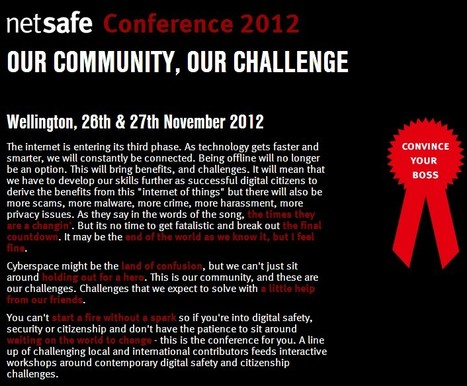
NetSafe, New Zealand's dedicated internet safety organisation, is determined to reduce the harm people are suffering online. Experts gather to reduce internet harm NetSafe, New Zealand's dedicated internet safety organisation, is determined to reduce the harm people are suffering online. “The truly international nature of the internet will always remain as a jurisdictional challenge, but there are definitely areas where New Zealand can make improvements” says NetSafe Executive Director, Martin Cocker. “We can improve regulation, strengthen enforcement capability, and develop better education programmes.” To do this, NetSafe is holding a conference in Wellington next week entitled ===> 'Our community: Our challenge'. <===
|
|
Scooped by
Gust MEES
November 23, 2012 1:00 PM
|
Sophomore is suing, claiming badges violate her religious freedom. A Texas high school sophomore has filed suit against San Antonio's Northside Independent School District, seeking to block her expulsion for refusing to wear a radio frequency identification badge in school. The girl and her parents are claiming the policy is a violation of her First Amendment rights, citing religious beliefs as the reason she has refused to wear the badge. Northside began issuing RFID badges to students at two schools in September as part of an effort to track students within the school and their attendance of classes. Back then, Northside spokesman Pascual Gonzalez told Wired's David Kravets that the RFID cards were an essential part of making sure they could get state aid tied to attendance. "What we have found, they are there, they're in the building and not in their chairs," Gonzalez said. "If they are on campus, we can legally count them present." Read more: http://arstechnica.com/tech-policy/2012/11/texas-school-districts-rfid-tracking-of-students-goes-to-court/
|
|
Scooped by
Gust MEES
November 23, 2012 12:29 PM
|
A Georgian security researcher is due to present details of an unpatched vulnerability in Google's Chrome browser at the Malcon security conference in India over the weekend. Years ago the circumstances of Ucha Gobejishvili's presentation would hardly have raised an eyebrow but that was before Google began offering up to $60,000 in bug bounties for the low-down on most serious, remotely exploitable bugs in its Chrome web browser software. Gobejishvili has apparently forgone potential financial rewards by leaving Google in the dark before unwrapping a remotely exploitable hole in the Chrome web browser, which reportedly involves a critical vulnerability in a Chrome DLL. More details are due to emerge at a presentation by Gobejishvili at the International Malware Conference (MalCon) in New Delhi on Saturday (24 November). Read more: http://www.theregister.co.uk/2012/11/23/mystery_chrome_0_day/
|
|
Scooped by
Gust MEES
November 23, 2012 10:33 AM
|
|
|
Scooped by
Gust MEES
November 23, 2012 8:02 AM
|
|
|
Scooped by
Gust MEES
November 22, 2012 9:38 AM
|
|
|
Scooped by
Gust MEES
November 21, 2012 9:59 AM
|
|
|
Scooped by
Gust MEES
November 21, 2012 6:31 AM
|
|
|
Rescooped by
Gust MEES
from 21st Century Learning and Teaching
November 20, 2012 9:54 AM
|
European Commission - Press Release - European Commission MEMO Brussels, 20 November 2012 European Commission Vice President for the Digital Agenda Neelie Kroes and the U.S. Digital Agenda: EU and US sign joint declaration to make the internet safer for kids European Commission Vice President for the Digital Agenda Neelie Kroes and the U.S. Secretary of Homeland Security Janet Napolitano have today signed a Joint Declaration in London, committing to make the Internet a safer and better place for children. In the Declaration, Vice President Kroes and Secretary Napolitano:
- agree to implement joint campaigns on the occasion of an annual Safer Internet Day. As a first step, the U.S. Department of Homeland Security intends to participate in the EU’s Safer Internet Day for young people on February 5, 2013.
- commit to contribute to international cooperation in fighting child sexual abuse online in the immediate future. This will build on existing work by the Virtual Global Taskforce and Interpol on law enforcement collaboration to combat child sexual abuse worldwide. International cooperation is essential if we are to be effective in fighting child sexual abuse online. - acknowledge that parents and guardians need to trust the content and services their children access and commit to continue working with industry and other stakeholders so that parents and children can make informed choices online.
This declaration complements other European Commission initiatives to keep children save and confident in the digital world. These include the EU Strategy for a safer internet and better internet content for children and teenagers presented earlier this year (see IP/12/445) and a Commission-brokered coalition of top tech & media companies to make the internet a better place for our kids. see IP/11/1485) Read more, a MUST: http://europa.eu/rapid/press-release_MEMO-12-881_en.htm
|
|
Scooped by
Gust MEES
November 20, 2012 8:37 AM
|
|