



Public-key encryption relies on a pair of cryptographic keys, one public and the other private. You'd think that programmers would be able to tell which one to keep private and which one to make pu...

 Your new post is loading...
 Scoop.it! Public-key encryption relies on a pair of cryptographic keys, one public and the other private. You'd think that programmers would be able to tell which one to keep private and which one to make pu... No comment yet.
Sign up to comment
Scoop.it!

The three alleged leaders of the Gozi cybercrime gang were indicted in federal court. The Gozi trojan was highly successful, but it may be too hard to operate with the alleged masterminds in jail.
Gust MEES's insight:
A MUST read!
Scoop.it!

This summer, citizens in cities across the Nation will join together to improve their communities and governments as part of the National Day of Civic Hacking.
Civic Hacking Day is an opportunity for software developers, technologists, and entrepreneurs to unleash their can-do American spirit by collaboratively harnessing publicly-released data and code to create innovative solutions for problems that affect Americans.
While civic hacking communities have long worked to improve our country and the world, this summer will mark the first time local developers from across the Nation unite around the shared mission of addressing and solving challenges relevant to OUR blocks, OUR neighborhoods, OUR cities, OUR states, and OUR country.
National Day of Civic Hacking will provide citizens an opportunity to do what is most quintessentially American: roll up our sleeves, get involved and work together to improve our society.

Gust MEES's curator insight,
January 24, 2013 2:30 AM
Ready to get involved in YOUR community? You can learn more about the National Day of Civic Hacking at: http://www.hackforchange.org/.
Scoop.it!

"The number of cyber incidents has increased by 42 per cent over the past two years. The strategy emphasizes the necessity of partnerships – with the Australian community, business and international governments – to better protect the country against potentially devastating cyber-attacks and to meet other national security challenges. It will also encourage the innovation Australia will need to help manage the security risks of the future," she pointed out.
Gust MEES's insight:
By checking my Curation here you will get always the freshest News about Cyber-Security in English, French and German:
- http://www.scoop.it/t/securite-pc-et-internet
Scoop.it!

The security vulnerabilities in Java make it difficult for users to continue using the browser plugin. Security researchers say it's time to get rid of Java altogether and only use it when it's absolutely required.
===> In the face of that kind of threat, the most rational course of action is to simply eliminate the target, and that means it's time to abandon Java for good. <===
Gust MEES's insight:
===> In the face of that kind of threat, the most rational course of action is to simply eliminate the target, and that means it's time to abandon Java for good. <===
Scoop.it!

What is the consequence of cyber warfare slowly becoming increasingly common?
The “happy hacker” of the 80s and 90s, he said, is long gone. Instead, we now have to deal with criminals who try to make money from their malware and botnets, hacktivists who try to protest and governments attacking their own citizens and other governments for espionage and full-scale cyber warfare. As for cyber warfare in general, one thing Hypponen especially stressed is the difference between cyber espionage and cyber warfare. Spying, said Hypponen, is not warfare. “Warfare is something different,” he said. “It’s when you start using malware, viruses and backdoors to target our critical infrastructure.” Today, he argued we are seeing the very first stages of a global cyber arms race. We are now seeing many other governments besides U.S. and Israel jump on the same bandwagon and now that other countries see that these attacks are successful, they want to jump on the bandwagon, too.
Gust MEES's insight:
Read more, a MUST!
Scoop.it!

Can you really justify having Java installed on your main web browser any more? Even if you have installed the latest security patch?
Gust MEES's insight:
===> A MUST follow instructions!!! <===
Use one browser where Java is disabled for normal surfing! Use a second one where Java is enabled for making eBanking + other sites which require Java...
Make sure YOU have the last update and delete ALL previous versions of JAVA on your hard disk!
Learn more:
- http://www.scoop.it/t/securite-pc-et-internet?tag=Java-vulnerabilities
- https://gustmees.wordpress.com/2013/01/15/safer-internet-day-2013-sid2013-participation/
Scoop.it!

Everything we do in the Internet leaves digital fingerprints. Therefore, it is only logical that many web users are worried about the issue of privacy. Their worry is not without reason. Because privacy laws differ from country to country, a company is not legally obligated to ensure that the processing of personal data will comply with the laws of all countries where the persons whose data have been collected reside. For example, if a company is incorporated in an offshore country, the company may not be obliged to observe any data protection laws. However, because of the global nature of the Internet, such a company may still offer online services to persons residing in countries with strict data protection laws. Even large countries and organizations, such as the EU and the US, have different approaches in their attempts to regulate the use of personal information in the information society. The purpose of the present article is to briefly describe the data protection laws of the EU (Section 2) and the US (Section 3). Finally, a conclusion is drawn (Section 4). Via Frederic GOUTH, Gust MEES
Gust MEES's insight:
A MUST read, very interesting... Should get included in any courses about ICT...
Gust MEES's curator insight,
January 17, 2013 8:03 AM
A MUST read, very interesting... Should get included in any courses about ICT...
Scoop.it!

Want an easier way to log into your Gmail account? How about a quick tap on your computer with the ring on your finger?
Gust MEES's insight:
Looks interesting, wait and see...
Scoop.it!

Patrick Lambert describes the intelligence-based security model — a response to new attack surfaces that don’t fit into the standard perim
There needs to be a much higher degree of cooperation in the industry, between security professionals, management, and IT. In an era of openness and connectivity, more focus needs to be put on quick detection and response, instead of relying on aging technologies.
At the end of the day, it won’t be the organization with the most hardened firewall that will succeed in keeping online threats out, but those with the highest degree of awareness and understanding.
An ecosystem of governments, vendors and corporations needs to cooperate and grow in order to counter organized crime. Only then will network security start on the path it needs to go in order to fight ever changing threat models.
Gust MEES's insight:
A MUST read...
Scoop.it!
A new report showcases increased security risks with mobile device usage within Federal government as adoption of smartphones and other mobile devices becomes more widespread.
Gust MEES's insight:
Isn't that Naivety!?
Check also:
- https://gustmees.wordpress.com/2012/11/05/naivety-in-the-digital-age/
Scoop.it!
Investigations Forensics
Gust MEES's insight:
Toujours un MUST et un plaisir à lire...
Scoop.it!
Le Luxembourg a été mentionné comme une des victimes d’une cyberattaque connue sous le nom de code "Red October"...
Les investigations menées par le Computer Emergency Response Team (CERT) gouvernemental permettent de constater que l’attaque a été limitée à une machine du réseau informatique de l’État. L’analyse en détail de l’incident informatique par le CERT gouvernemental a permis de conclure que cette attaque peut être considérée comme n’étant pas exceptionnellement grave.
Des mesures de protection adéquates ont été mises en place, qui ont permis un arrêt immédiat de transferts illicites de données. Le gouvernement rappelle dans ce contexte que les mesures tant proactives que réactives mises en œuvre par les services compétents du gouvernement, notamment le Centre des technologies de l’information de l’État, ont permis de maîtriser l’attaque en question.
Gust MEES's curator insight,
January 17, 2013 12:26 PM
De bonnes infrastructures et des mesures proactives aident à contrer des attaques...
===> Proactive Thinking! <===
|
Scoop.it!

From
phys

A new voluntary system aimed at rooting out online copyright piracy using a controversial 'six strikes' system is set to be implemented by US Internet providers soon, with the impact unclear.
Bambauer said the effort appears to be "backdoor policymaking" by the US administration after it failed to implement any new policy. But the US system is not a government program and entities are participating voluntarily, Lesser said, adding that the effort sought to learn from other countries' programs . In France, she said, merely announcing the program discouraged illegal file-sharing by "people who thought they were doing this anonymously," and drove an increase in legal services. "We hope there will be a similar psychological impact here," Lesser added.
Gust MEES's insight:
A MUST read!

Rose Lee's comment,
January 26, 2013 9:54 AM
Good post.sharing some useful information about <a href="http://www.myeasymba.blogspot.com/2012/05/online-mba-degree-in-canada.html">; Online Degree in Canada</a>
Scoop.it!

A third individual received a suspended prison sentence in connection with the same attacks
Gust MEES's insight:
Read more about prison, jail and teach your children and learners, students the consequences of illegal actions on Internet:
- http://www.scoop.it/t/securite-pc-et-internet?tag=Jail...
- http://www.scoop.it/t/securite-pc-et-internet?tag=Prison
Gust MEES's curator insight,
January 25, 2013 11:04 AM
Read more about prison, jail and teach your children and learners, students the consequences of illegal actions on Internet:
Scoop.it!
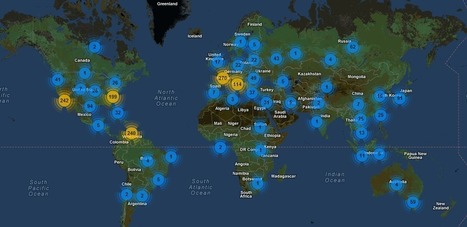
McAfee Labs has long monitored botnet activities and their control servers as they plague the Internet. With millions of McAfee endpoints and network security appliances sending information to McAfee Global Threat Intelligence (GTI) in the cloud, coupled with a vast collection of malicious binary and proactive research, McAfee Labs has a clear view of botnet threats around the world.
Gust MEES's curator insight,
January 23, 2013 8:06 PM
One sees every time the same countries on TOP of the BAD lists of Cyber-Security!!!
===> These countries SHOULD start to Teach the basics of Cyber-Security in Education to make sure that people from other countries will not get touched by malware as Internet doesn't have any borders!!! <===
Check ALSO:
TOP 20 countries with Malware Resources:
- http://www.scoop.it/t/21st-century-learning-and-teaching?tag=TOP+20+countries+whit+malware+resources
- https://gustmees.wordpress.com/2012/05/28/not-only-rights-but-also-responsibility/
- https://gustmees.wordpress.com/2013/01/15/safer-internet-day-2013-sid2013-participation/
- https://gustmees.wordpress.com/category/get-smart-with-5-minutes-tutorials/
- https://gustmeesen.wordpress.com/2012/02/13/why-ict-security-why-the-need-to-secure-a-computer/
- https://gustmeesen.wordpress.com/2012/03/16/beginners-it-security-guide/
- https://gustmeesfr.wordpress.com/
Scoop.it!
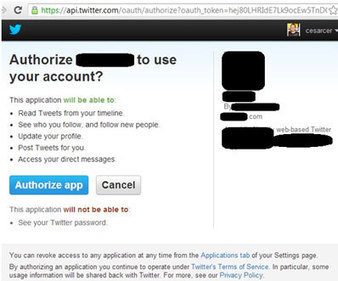
"There should be millions of Twitter users that have signed in with Twitter into third-party applications. Some of these applications might have gained access to and might still have access to Twitter users private direct messages," he points out, and advises users to check third-party applications permissions and revoke the apps to which they never gave permission to access their DMs. Via Gust MEES
Gust MEES's insight:
===> check third-party applications permissions and revoke the apps to which they never gave permission to access YOUR DMs. <===
Gust MEES's curator insight,
January 22, 2013 11:42 AM
===> check third-party applications permissions and revoke the apps to which they never gave permission to access YOUR DMs. <===
Check ALSO:
- https://twitter.com/settings/applications
- http://blog.ioactive.com/2013/01/you-can-not-trust-social-media-twitter-vulnerable.html
- https://gustmees.wordpress.com/2012/11/05/naivety-in-the-digital-age/
Gust MEES's curator insight,
January 22, 2013 11:52 AM
===> check third-party applications permissions and revoke the apps to which they never gave permission to access YOUR DMs. <===
Gust MEES's curator insight,
January 22, 2013 11:59 AM
===> check third-party applications permissions and revoke the apps to which they never gave permission to access YOUR DMs. <===
Scoop.it!

German internet users should be on their guard today, after malware was widely spammed out posing as a flight confirmation from Lufthansa.
Gust MEES's insight:
===> BEWARE of the MALWARE!!! <===
Scoop.it!

Four leading UK universities for Computer Science are taking part in a code-breaking competition as part of Cyber Security Challenge UK 2013
Gust MEES's insight:
Very good idea and initiative... Looks like EUROPE is leading in Cyber-Security Education ;)
Gust MEES's curator insight,
January 21, 2013 12:11 PM
Very good idea and initiative... Looks like EUROPE is leading in Cyber-Security Education ;)
A Challenge for other countries to catch up ;)
Scoop.it!

Cabinet Office says all generations require better understanding of online safety if the public and businesses are to stay secure.
Gust MEES's insight:
Learning the basics of Cyber-Security is a MUST in 21st Century! Check also:
Gust MEES's curator insight,
January 17, 2013 9:27 AM
Learning the basics of Cyber-Security is a MUST in 21st Century! Check also:
- https://gustmees.wordpress.com/2013/01/15/safer-internet-day-2013-sid2013-participation/
Scoop.it!

Serial Java fault-finder Adam Gowdiak has embarrassed Oracle yet again.
Gust MEES's insight:
Use one browser where Java is disabled for normal surfing! Use a second one where Java is enabled for making eBanking + other sites which require Java... Make sure YOU have the last update and delete ALL previous versions of JAVA on your hard disk! Learn more: - http://www.scoop.it/t/securite-pc-et-internet?tag=Java-vulnerabilities - https://gustmees.wordpress.com/2013/01/15/safer-internet-day-2013-sid2013-participation/
Scoop.it!

So here we are with the first Cyber Attacks Timeline for 2013 covering the first half of January. Apparently the new year has begun with an intense activity by Cyber Crooks. Hacktivists and Cyber C...
Gust MEES's insight:
A LOT from Education in there, about time to learn the basics of Cyber-Security ;)
Check ALSO:
- https://gustmees.wordpress.com/2012/10/11/learning-basics-of-cyber-security-by-easy-to-follow-steps/
Scoop.it!

More than 90% of user-generated passwords can be made vulnerable to hacking in a matter of seconds, according to new research from Deloitte.
The problem, researchers said, is that everything that we thought to be true must be reconsidered given advances in technology.
"Passwords containing at least eight characters, one number, mixed-case letters and non-alphanumeric symbols were once believed to be robust,” said Duncan Stewart, a director of research for the report. “But these can be easily cracked with the emergence of advance hardware and software.”
For instance, a machine running readily available virtualization software and high-powered graphics processing units can crack any eight-character password in about five hours, he noted.
Gust MEES's insight:
Learning the basics of Cyber-Security is a MUST in 21st Century:
- https://gustmees.wordpress.com/2012/10/11/learning-basics-of-cyber-security-by-easy-to-follow-steps/
- https://gustmees.wordpress.com/2013/01/15/safer-internet-day-2013-sid2013-participation/
Scoop.it!

"The Pobelka botnet is just one of the many examples of how a single individual was able to attack Internet users for over a year without much resistance," the analysts noted. "The ease at which cybercrime services are available to criminals, makes it trivial for anyone to start in this business. The potential gains for the criminals are large, with little to no chance of successful prosecution."
Gust MEES's insight:
A MUST read...
Scoop.it!

Overview Red October is a malware family, also named Sputnik, which was detected in October 2012 by Kaspersky. It was active since 2007, installations have been spotted around the globe and targets were diplomatic and governmental agencies. The malware usually was sent by email to selected people in the respective organizations.
As a cover, different office file formats have been used to transport the loader of the malware, using different exploits to drop the malicious content. After several stages of unpacking, the malware is running persistently on the computer and only when it successfully probes internet connectivity, it decrypts a separate file and starts to behave maliciously: it connects to a Command and Control server, awaiting new commands or downloading and executing specific malware modules.
Detection
Currently, the domains in this document are known to be used for Command and Control activity.
Any hit in your organisation's Proxy or DNS log files or firewall logs during the last 6 years indicate a compromised host in your organization.
Proactive measures
- Block access to below mentioned domains and IP addresses.
- Reactive measures
- Review log files, also those from backups regarding hits on the domains / IP addresses. In case of a hit, identify and isolate the machine by unplugging it from the network. CIRCL can assist with the analysis of memory and file system dumps.
Read more...
Gust MEES's insight:
Stay informed...

Philip Verghese 'Ariel's curator insight,
January 18, 2013 1:31 AM
Overview Red October is a malware family, also named Sputnik, which was detected in October 2012 by Kaspersky. It was active since 2007, installations have been spotted around the globe and targets were diplomatic and governmental agencies. The malware usually was sent by email to selected people in the respective organizations. |






Not too tricky, is it?
For all the software you're likely to use, such as OpenSSH, OpenSSL and GPG, private keys are labelled with the text PRIVATE KEY.
And that's the one you're supposed to keep private!