Your new post is loading...

|
Scooped by
Gilbert C FAURE
October 7, 2023 10:58 AM
|
Autonomous medical robots may be conducting full medical operations sooner rather than later.
|
|
Scooped by
Gilbert C FAURE
September 26, 2023 5:17 AM
|
Need to polish your skills in Urology, Robotic Surgery?Onsite medical training course with experts in the field : Ruben De Groote, Alberto Breda...
|
|
Scooped by
Gilbert C FAURE
September 23, 2023 10:46 AM
|
This open access book on robotic colorectal surgery describes the possible surgical approaches to the different colorectal segments...
|
|
Scooped by
Gilbert C FAURE
September 19, 2023 6:29 AM
|
Issues occurring after surgeries for certain stomach cancers have reduced by 18%
|
|
Scooped by
Gilbert C FAURE
September 15, 2023 4:42 AM
|
UCL Discovery is UCL's open access repository, showcasing and providing access to UCL research outputs from all UCL disciplines.
|
|
Scooped by
Gilbert C FAURE
August 31, 2023 7:43 AM
|
Total hip arthroplasty (THA) is a successful surgical method for hip replacement but still poses challenges and risks. Robotic-assisted THA (rTHA) using new generation robotic systems has emerged to improve surgical precision and outcomes.
|
|
Scooped by
Gilbert C FAURE
August 30, 2023 10:49 AM
|
Background and objective Renewed interest in robot-assisted cardiac procedures has been demonstrated by several studies. However, concerns have been raised about the need for a long and complex learning curve.
|
|
Scooped by
Gilbert C FAURE
August 21, 2023 2:56 AM
|
نشر cyril perrenot صورًا على LinkedIn
|
|
Scooped by
Gilbert C FAURE
August 4, 2023 4:27 AM
|
Background Broad implementation of the American Board of Surgery’s entrustable professional activities initiative will require assessment instruments that are reliable and easy to use. Existing assessment instruments of general laparoscopic surgical skills have limited reliability, efficiency, and validity across the spectrum of formative (low-stakes) and summative (high-stakes) assessments. A novel six-item global assessment of surgical skills (GASS) instrument was developed and evaluated with a focus upon safe versus unsafe surgical practice scoring rubric. Methods The GASS was developed by iterative engagement with expert laparoscopic surgeons and includes six items (economy of motion, tissue handling, appreciating operative anatomy, bimanual dexterity, achievement of hemostasis, overall performance) with a uniform three-point scoring rubric (“poor–unsafe”, “adequate–safe”, “good–safe”). To test inter-rater reliability, a cross-sectional study of four bariatric surgeons with experience ranging from 4 to 28 years applied the GASS and the global operative assessment of laparoscopic skills (GOALS) to 30 consecutive Roux-en-Y gastric bypass procedure operative videos. Inter-rater reliability was assessed for a simplified dichotomous “safe” versus “unsafe” scoring rubric using Gwet’s AC2. Results The GASS inter-rater reliability was very high across all six domains (0.88–1.00). The GASS performed comparably to the GOALS inter-rater reliability scores (0.96–1.00). The economy of motion and bimanual dexterity items had the highest percentage of unsafe ratings (9.2% and 5.8%, respectively). Conclusion The GASS, a novel six-item instrument of general laparoscopic surgical skills, was designed with a simple scoring rubric (poor-safe, adequate-safe, good-safe) to minimize rater burden and focus feedback to trainees and promotion evaluations on safe surgical performance. Initial evaluation of the GASS is promising, demonstrating high inter-rater reliability. Future research will seek to assess the GASS against a broader spectrum of laparoscopic procedures.
|
|
Scooped by
Gilbert C FAURE
July 24, 2023 2:50 AM
|
The Society of Robotic Surgery is dedicated to robotic, minimally invasive, NOTES, and single-port access surgery. Our meetings and events serve as a forum to improve research and clinical outcomes.
|
|
Scooped by
Gilbert C FAURE
July 19, 2023 4:05 AM
|
Background and Objectives: Robotic surgery has been widely adopted in general surgery worldwide but access to this technology is still limited to a few hospitals. With the recent introduction of new robotic platforms, several studies reported the feasibility of different surgical procedures. The aim of this systematic review is to highlight the current clinical practice with the new robotic platforms in general surgery. Materials and Methods: A grey literature search was performed on the Internet to identify the available robotic systems. A PRISMA compliant systematic review was conducted for all English articles up to 10 February 2023 searching the following databases: MEDLINE, EMBASE, and Cochrane Library. Clinical outcomes, training process, operating surgeon background, cost-analysis, and specific registries were evaluated. Results: A total of 103 studies were included for qualitative synthesis after the full-text screening. Of the fifteen robotic platforms identified, only seven were adopted in a clinical environment. Out of 4053 patients, 2819 were operated on with a new robotic device. Hepatopancreatobiliary surgery specialty performed the majority of procedures, and the most performed procedure was cholecystectomy. Globally, 109 emergency surgeries were reported. Concerning the training process, only 45 papers reported the background of the operating surgeon, and only 28 papers described the training process on the surgical platform. Only one cost-analysis compared a new robot to the existing reference. Two manufacturers promoted a specific registry to collect clinical outcomes. Conclusions: This systematic review highlights the feasibility of most surgical procedures in general surgery using the new robotic platforms. Adoption of these new devices in general surgery is constantly growing with the extension of regulatory approvals. Standardization of the training process and the assessment of skills’ transferability is still lacking. Further studies are required to better understand the real clinical and economical benefit.
|
|
Scooped by
Gilbert C FAURE
July 18, 2023 10:41 AM
|
|
|
Scooped by
Gilbert C FAURE
July 18, 2023 10:39 AM
|
|
|
|
Scooped by
Gilbert C FAURE
October 6, 2023 4:17 AM
|
Docking time with the Hugo™ RAS system in gyn surgery
|
|
Scooped by
Gilbert C FAURE
September 24, 2023 2:42 AM
|
Learn more about services at Mayo Clinic.
|
|
Scooped by
Gilbert C FAURE
September 23, 2023 10:45 AM
|
Technologies are not meant to replace what physicians do but to contribute to their work and support what they already do so they can do it better. New technologies will allow healthcare workers to focus on treating patients and innovating, while automation does the repetitive part of the work.
|
|
Scooped by
Gilbert C FAURE
September 18, 2023 6:16 AM
|
Novel EM tracking developments mitigate distortion and enable surgical navigation in a wider range of use cases.
|
|
Scooped by
Gilbert C FAURE
September 15, 2023 4:41 AM
|
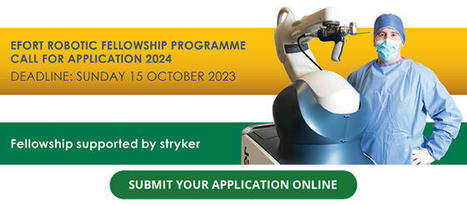
THE FELLOWSHIPPARTICIPATING HOST SITESAPPLICATION CRITERIAPROGRAMME 2020-2023 EFORT has launched the Robotic Fellowship Programme in September 2019, it is kindly supported by Stryker. For this upcoming EFORT Robotic Travelling Fellowship Programme, accepted fellows will be trained in a wide range of robotic assisted hip and knee arthroplasty surgery under the supervision of distinguished surgeons with extensive clinical and academic experience in the joint replacement robotic field. The programme is an excellent preparation for clinical practice outside of an academic environment and is designed to provide the best and widest practical experience of Mako robotic orthopaedic procedures. The fellows will learn how to effectively integrate the technology into the day-to-day practice by “scrubbing-in” where possible in compliance with the host centre’s standard protocol. For fellows with an existing experience in robotics, this is an excellent opportunity to gather further knowledge and experience in this field. Whilst experience in robotics is preferred, however, it is not essential if the applicant demonstrates appropriate experience and enthusiasm for the use of robotic surgery in their future career. Fellowship programme outline: This Travelling Fellowship Programme will offer four dedicated traveling timeslots (two in spring 2024 and two in autumn 2024) to visit six leading Mako Robotic University Teaching Hospitals in Europe: Spring 2024 Slot 1 from 03 to 23 March 2024 Slot 2 from 07 to 27 April 2024 Autumn 2024 Slot 1 from 06 to 24 October 2024 Slot 2 from 10 to 30 November 2024 During this 3-week travelling fellowship, accepted fellows will be spending two consecutive days at each host site: either Monday and Tuesday or Thursday and Friday. While Sundays and Wednesdays will be allocated as travel days, Fridays will be designated as free days, allowing the fellows to explore and unwind. To ensure a personalized and immersive experience, we will accept a maximum of 2 fellows per slot, totalling eight fellows for the entire programme. The selection of host sites per slot is done by EFORT. To provide our fellows with a seamless and enjoyable experience, all fellowship logistics will be handled by EFORT. All expenses related to accommodation and travel will be covered through the fellowship grant. Austria Graz/Kalwang | AUVA UKH Styria (Steiermark) | Dr. Antonio Klasan Linz | Kepler University Clinic Linz | Dr. Philipp Proier Belgium Roeselare | AZ Delta Roeselare | Prof. Dr. Thomas Luyckx Eeklo | AZ Alma Hospital Belgium | Dr. Hans Van den Wyngaert France Nîmes | University Hospital Center of Nîmes | Prof. Pascal Kouyoumdjian (TBC) Lyon | Hôpital de la Croix-Rousse | Prof. Sébastien Lustig Germany Hannover | Orthopaedic Clinic of Medical School Hannover, DIAKOVERE Annastift | Prof. Henning Windhagen & Dr. Sufian S. Ahmad Brandenburg | University Clinic Brandenburg an der Havel | Prof. Roland Becker & Dr. Michael Salzmann Italy Parma | Casa di Cura Città di Parma | Prof. Guiseppe Adravanti Modena | Policlinico of Modena University, Hospital of Modena | Prof. Fabio Catani Verona | Clinica San Francesco | Dr. Piergiuseppe Perazzini Rozzano | Istituto Clinico Humanitas | Prof. Guido Grappiolo & Dr. Mattia Loppini Luxembourg Kirchberg | Hôpitaux Robert Schuman | Dr. Pit Putzeys The Netherlands Zoetermeer | Reinier Haga Orthopedic Centre | Dr. Ruud de Ridder Utrecht | St Antonius Utrecht | Dr. Auw Yang United Kingdom Glasgow | Golden Jubilee University National Hospital | Mr. Nick Ohly London | ROH/UCL | Prof. Fares Haddad Interested candidates are invited to submit their applications until 15 October 2023, midnight CET. All submitted applications will be reviewed after that date and the review outcome shall be available by the end of November 2023. Only fellowship applications from fellows practicing in one the following countries will be considered: Austria Denmark Finland France Germany Ireland Italy Luxembourg Netherlands Portugal Spain Switzerland United Kingdom The successful applicant should have one year pre- to three years post-national surgical qualifications. Fluent English language is mandatory for this fellowship. Fellows must be available during one of the proposed timeslots in 2024. Applicants are asked to submit the following documents in English together with the completed online application form: CV*. Copy of applicant’s medical doctor license. Copy of your license as a European specialist OR residency registration certificate. Motivational letter (max. 500 words) outlining the current level of surgery skills and expertise in robotics (if any), dedication to hip and knee replacement surgery, reasoning on how this robotic fellowship will improve your surgery skills and patient outcomes. Min. 2 reference letters. Publication history to date. List of participation in any EFORT activities (congresses, abstract submissions, webinars, courses, etc). *The CV should include at least the following information:– Country where currently practicing.– Your interaction with robotics to date and/or non-robotic relevant consideration.– Age and experience.– Surgery examination grades.– Teaching center of origin. Only complete applications made through our online application system will be considered. To apply please go to www.manuscriptmanager.net/efort, login or create an account and select the EFORT Robotic Travelling Fellowship Programme from the list. For any questions, please contact: fellowships@efort.org In spring 2020, two fellows participated in our European travelling fellowship programme. Find out more about this programme through the following fellowship report: Dr. Veenesh Selvaratnam and Dr. David George | Robotic Travelling Fellowship March 2020PDF document | 7 pages | 400kb Unfortunately, the fellowship programme came to a halt in 2020 due to the global Covid pandemic. It resumed in 2022 with an updated national/regional programme, a new round of fellows and additional centres of excellence to cover the training demand for robot-assisted surgeries. The programme successfully took place in 2022/2023 and is now completed. We would like to thank all our host surgeons for opening their doors to our fellows but most of all for sharing their knowledge and their immense support and hospitality to make this programme such a rewarding experience: 11 accepted fellows. 17 different centers of excellence spread across 8 European countries. 8 series of travelling fellowships varying from 2 to 5 weeks of duration. The Benelux fellowship programme took place in the following host centres: Kirchberg (L) | Hôpitaux Robert Schuman, Dr. Pit Putzeys. Roeselare (BE) | AZ Delta Roeselare, Prof. Dr. Thomas Luyckx. Eeklo (BE) | AZ Alma Hospital Belgium, Dr. Hans Van den Wyngaert. Zoetermeer (NL) | Reinier Haga Orthopedic Centre, Dr. Verburg & Dr. Rutgers. Utrecht (NL) | St Antonius Utrecht, Dr. Auw Yang. Report: Dr. Andreas Fontalis | Robotic Travelling Fellowship November/December 2022 PDF document | 8 pages | 1Mb The United Kingdom fellowship programme took place in the following host centres: Glasgow | Golden Jubilee University National Hospital, Mr. Nick Ohly. London | ROH/UCL, Prof. Fares Haddad. Reports: Dr. Baseem Choudhry | Robotic Travelling Fellowship January 2023PDF document | 6 pages | 350kb Dr. Talal Al Jabri | Robotic Travelling Fellowship January 2023PDF document | 3 pages | 340kb Dr. Haroon Rehman | Robotic Travelling Fellowship April 2023PDF document | 3 pages | 100kb The Italian fellowship programme took place in the following host centres: Parma | Casa di Cura Città di Parma, Prof. Adravanti. Modena | Policlinico of Modena University, Hospital of Modena, Prof. Fabio Catani. Verona | Clinica San Francesco, Dr Perazzini. Rozzano | Istituto Clinico Humanitas, Prof. Guido Grappiolo & Dr. Mattia Loppini. Reports: Dr. Anna Maria Alifano | Robotic Travelling Fellowship February/March 2023PDF document | 9 pages | 1.5Mb Dr. Vincenzo de Matteo | Robotic Travelling Fellowship February/March 2023PDF document | 6 pages | 780kb The German/Austrian fellowship programme took place in the following host centres: Hannover (DE) | Orthopaedic Clinic of Medical School Hannover, DIAKOVERE Annastift, Prof Henning Windhagen & Dr. Sufian S. Ahmad. Brandenburg (DE) | University Clinic Brandenburg an der Havel, Prof. Roland Becker & Dr.. Michael Salzmann. Graz/Kalwang (AT) | AUVA UKH Styria (Steiermark), Dr. Antonio Klasan. Linz (AT) | Kepler University Clinic Linz, Dr. Philipp Proier. Reports: Dr. Matthias Luger | Robotic Travelling Fellowship February/March 2023PDF document | 4 pages | 1.2Mb Dr. Max Thieme | Robotic Travelling Fellowship February/March 2023PDF document | 9 pages | 580kb Dr. Ayman Gabr | Robotic Travelling Fellowship April/May 2023PDF document | 6 pages | 820kb The French fellowship programme took place in the following host centres: Nîmes | University Hospital Center of Nîmes, Prof. Pascal Kouyoumdjian Lyon | Hôpital de la Croix-Rousse, Prof. Sébastien Lustig Report: Dr. Angelo Vasiliadis | Robotic Travelling Fellowship April/May 2023PDF document | 5 pages | 620kb
|
|
Scooped by
Gilbert C FAURE
August 31, 2023 7:42 AM
|
The proceeds will be used for the research and development, clinical trials, and commercialisation of its modular surgical robot, the Carina™ RAS Platform.
|
|
Scooped by
Gilbert C FAURE
August 30, 2023 10:47 AM
|
The IMRA curriculum is designed for all surgeons commencing robotic surgery. View the course range and learn more.
|
|
Scooped by
Gilbert C FAURE
August 14, 2023 5:31 AM
|
Robotic assistance can help a surgeon understand and control exactly where their implements lie in relation to each part of the patient's body - including bones, nerves and blood vessels.
|
|
Scooped by
Gilbert C FAURE
July 29, 2023 2:34 AM
|
La chirurgie robotique est économiquement rentable. L’exemple du cancer de la prostate.
Halte aux redevances du robot.
|
|
Scooped by
Gilbert C FAURE
July 23, 2023 3:50 AM
|
This is minimally invasive surgery the way you’ve always imagined. Because this is surgical robotics — reimagined.
#medtech #surgical #robotics | 11 commentaires sur LinkedIn
|
|
Scooped by
Gilbert C FAURE
July 18, 2023 10:41 AM
|
Robotic-assisted surgery (RAS) is here to stay and comes with the potential to completely transform the way aspects of surgical care are delivered.
|
|
Scooped by
Gilbert C FAURE
July 18, 2023 10:39 AM
|
CAIR researchers have developed MicroNeuro, the world's first flexible robotic system for minimally invasive neurosurgery.
|


 Scoop.it!